



Contents
Case Study

A water drop on a wine bottle is easy to place and hard to measure. We built a Dropometer around the bottle.

Last Updated
October 18, 2026
Industry
Glass research and testing
Location
Europe
Customer since
2021
Configuration
Fully custom Dropometer
Image
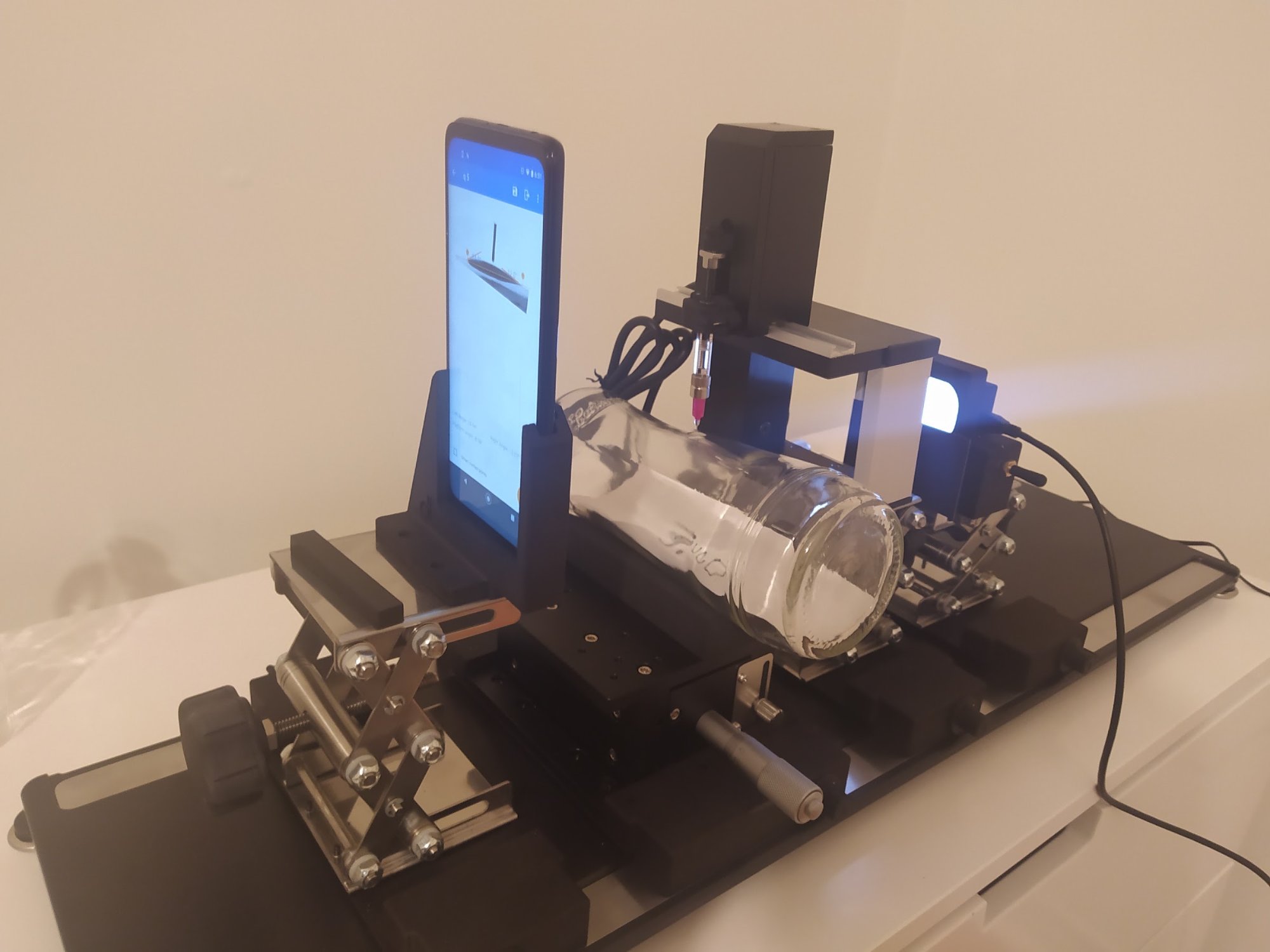
Droplet Lab build photo, February 2022
Drop shape method validated against a KRÜSS DSA100E in peer review Published contact angle accuracy of 0.35° 2 peer reviewed validation papers

A European glass research and testing institute needed reproducible contact angles on the outside of whole glass containers, from small vials to wine bottles. Its existing goniometer did not work on the inside of small containers, and the lab had no proper way to line up a curved bottle surface with the camera. Droplet Lab designed and built a completely custom Dropometer with adjustable stages, an automatic dispenser and a backlight, sized for three families of bottles up to 9 cm in diameter and 34 cm tall.

Custom Dropometer built by Droplet Lab: a glass bottle lying on its side on adjustable stages under the automatic dispenser, with the phone camera showing the water drop on the bottle surface
Abhimanyu Photo
Written by
Abhimanyu Bhandankar
Holds an MBA from Schulich School of Business and a BE in IT. He joined Droplet Lab in July 2019 and now leads sales and marketing.
CEO at Droplet Lab
Read More
Gurdeep-Saini-Photo
Technical Review by
Gurdeep Singh Saini
Holds a BASc in Mechanical Engineering from Ryerson University (now Toronto Metropolitan University) and an MASc from York University. He develops the automatic edge and baseline detection behind the Dropometer's analysis.
COO at Droplet Lab
Read More
Abhimanyu Photo
Written By

Abhimanyu Bhandankar

CEO at Droplet Lab

Holds an MBA from Schulich School of Business and a BE in IT. He joined Droplet Lab in July 2019 and now leads sales and marketing.

Gurdeep-Saini-Photo
Reviewed By

Gurdeep Singh Saini

COO at Droplet Lab

Holds a BASc in Mechanical Engineering from Ryerson University (now Toronto Metropolitan University) and an MASc from York University. He develops the automatic edge and baseline detection behind the Dropometer's analysis.

Primary outcome: one instrument for every bottle size the lab tests

Container families the custom Dropometer was designed to hold

Approximate diameter and height of each family, as specified by the institute in October 2020

Small vials 1 to 2 cm diameter, 6 to 8 cm tall
Medium bottles 4 to 6.5 cm diameter, 13 to 18 cm tall
Wine bottles 7 to 9 cm diameter, 18 to 34 cm tall

The institute specified three families of containers, from vials of 1 to 2 cm diameter to bottles of 7 to 9 cm diameter and up to 34 cm tall. The custom unit holds each bottle on its side, so the drop sits on the top line of the outside surface, where the camera can see it in profile. The institute has not disclosed what the measurement is used for, and has not shared measurement results with Droplet Lab.

3 families

Container families the unit was designed to hold.

1 to 9 cm

Range of container diameters, from vials to wine bottles.

34 cm

Height of the tallest bottles in the specification.

3 apps

Contact angle, surface tension and surface energy apps activated for the unit.

Executive Summary

Who

A European glass research and testing institute that carries out laboratory testing on glass and glass containers for industry.

Problem

The lab measured water contact angle on glass bottles by placing a 10 µl drop by hand on a horizontal bottle and photographing it from the side. With no proper way to align the curved bottle surface with the camera, results were hard to reproduce across container sizes. Its existing goniometer did not work on the inside of small containers, even when they were cut open.

Solution

A completely custom Dropometer designed and built by Droplet Lab: a long baseplate with lab jacks and linear and vertical translation stages to position the bottle, an automatic dispenser on a counterweighted stage, an LED backlight, and a phone running the contact angle, surface tension and surface energy apps.

Time to Value

8 October 2019: first enquiry. 10 September 2020: the need set out, from small vials to wine bottles. 29 September 2020: demo. 2 October 2020: three container families specified. 16 October 2020: feasibility tests successful. 30 April 2021: custom build quoted. 21 December 2021: unit ready to ship. 7 March 2022: unit delivered with its own manual. 30 September 2022: final tests at the institute.

Results

The unit holds three families of containers, from 1 cm vials to 9 cm wine bottles, and shipped with a manual written for it. In its final tests in September 2022 the institute said the equipment seemed ok. In January 2023 it reported that the test worked and that it was waiting for real samples.

Highlights

1 to 9 cm

Container diameters

3

Container families

Automatic

Drop placement

2021

Customer since

The institute, at a glance

Organisation

A European glass research and testing institute serving the glass industry.

Products / applications

Glass containers, from small vials to wine bottles. Purpose of the measurement not disclosed by the client.

Measurement stage

Laboratory testing on whole containers.

Users

Laboratory researchers at the institute.

Materials and surfaces tested

Outside surface of glass bottles and vials, with ultrapure water.

Key constraints

Curved, transparent surfaces; containers up to 34 cm long; a wide range of diameters on one instrument.

The challenge: a reproducible drop profile on a curved, transparent surface

Contact angle instruments are built for flat samples. A bottle is round, clear and up to 34 cm long.

Why bottles are hard to measure

Contact angle measurement reads the angle from the profile of a drop where it meets the surface, and it is a standard way to describe wettability. On a flat sample that line is easy to find. On a bottle the surface curves away in every direction, so the camera must look exactly along the top line of the bottle, or the angle it reads is wrong. For a classroom view of how a surface treatment changes wetting on glass, see our experiment on superhydrophobic surfaces on glass.

Why the existing goniometer was not enough

The lab already owned a commercial goniometer, but it did not work on the inside surface of small containers, even when they were cut open. For drops on the outside of whole bottles, the lab had no proper system to line up the bottle with a camera.

Why size range matters

The lab tests many container designs, from vials about 1 cm across to wine bottles about 9 cm across and up to 34 cm tall. A fixture for one size would not fit the others. The same problem appears on any part too large or awkward for a standard sample stage; see surface energy and wetting checks on large parts. Teams testing glass for buildings can start with our construction industry guide.

The insight: move the bottle, not the camera

What Was Deployed

Delivered configuration: a completely custom unit built around the Dropometer contact angle and surface tension kit and its standard automatic stage, on a long baseplate made for this order. The bottle lies on its side on adjustable supports. Lab jacks set its height, and manual linear and vertical translation stages bring the top line of the bottle into line with the camera. The automatic dispenser sits on a counterweighted stage above the bottle, and an LED backlight sits behind the drop. The phone runs the contact angle, surface tension and surface energy apps, and Droplet Lab wrote a manual for this unit. The standard Dropometer is a 1 kg portable kit that sets up in about 2 minutes. Our guide to contact angle goniometers for field and on site testing compares portable options.
The Origin

From a question about vials to the first fully custom Dropometer

On 8 October 2019 the institute's lab director asked whether the Dropometer could measure the inside of a small glass container about 2 cm across. The lab already owned a commercial goniometer, but it did not work properly on the inside surface of small containers, even when they were cut open. The project then waited on the next year's budget.

On 10 September 2020 a researcher at the institute set out the wider need: reproducible water drops on bottles of many sizes, from small vials to wine bottles. After a demo on 29 September, the institute sent the dimensions of its three container families on 2 October. Droplet Lab's engineers ran feasibility tests and reported success on 16 October 2020.

Droplet Lab then designed a new instrument rather than adapting a standard one, and quoted the custom build on 30 April 2021. The institute shipped glass samples to Droplet Lab for testing, and the finished unit was ready to ship on 21 December 2021. It was Droplet Lab's first completely custom version of the instrument.

Before vs After

Metric Before After
Drop placement 10 µl drop placed by hand with a pipette Automatic dispenser on a counterweighted stage
Lining up the bottle surface with the camera No fixture to align the curved surface bearing the drop Translation stages and lab jacks bring the top line of the bottle level with the camera
Holding the bottle Bottle laid horizontal with no dedicated fixture Adjustable supports for containers from about 1 to 9 cm diameter and up to 34 cm tall
Inside surface of small containers Not measurable with the existing goniometer Out of scope; the custom unit measures the outside surface

Rollout timeline

Timeline (high level)

8 October 2019: First enquiry

Lab director asks whether the Dropometer can measure inside small glass containers

September to October 2020: Requirements

  • Researcher sets out the need for vials to wine bottles (10 September)
  • Demo (29 September) and three container families specified (2 October)
  • Feasibility tests by Droplet Lab successful (16 October)

2021: Design and build

  • Custom build quoted on 30 April 2021
  • Glass samples sent to Droplet Lab for testing
  • Finished unit ready to ship on 21 December 2021

7 March 2022: Delivered

Custom unit delivered with its own manual

March to September 2022: Parts and final tests

  • Replacement baseplate feet and screws shipped after transit damage (March 2022)
  • Damaged stage part returned for repair; pending parts delivered by September 2022
  • Institute's final tests: the equipment seemed ok (30 September 2022)

January 2023: Waiting for real samples

  • Institute reports that the test worked
  • Measurements on real samples to follow

Proof and validation: what this case shows, and what it does not

Test method

The institute's own method: a 10 µl drop of ultrapure water on the outside surface of a horizontal glass bottle, imaged from the side. The custom unit automates drop placement and positions the bottle so the surface bearing the drop lines up with the camera. Purpose of the measurement not disclosed by the client.

Sample size and operators

Designed for three container families specified by the institute. Feasibility tests and design checks were run by Droplet Lab engineers on glass supplied by the institute. Operated at the institute by its laboratory researchers.

Repeatability / reproducibility

No repeatability data has been shared by the institute. The drop shape method used by the apps is validated against a KRÜSS DSA100E in peer review.

Notes / assumptions

This page describes the engineering of a custom instrument. The institute has not published or shared results from it, and has not disclosed what the measurement is used for. The unit measures the outside surface of bottles; the inside surface of small containers, the institute's first question in 2019, is out of scope.

Outcomes to date

Measured Outcomes

1 to 9 cm

Container diameters on one unit

From vials to wine bottles, as specified by the institute.

34 cm

Tallest bottle

Bottles lie on their side on adjustable supports along a long baseplate.

10 µl

Drop volume in the institute's method

Now placed by an automatic dispenser instead of by hand.

Operational Outcomes

Repeatable alignment

Translation stages and lab jacks give a set way to line up each bottle with the camera.

Whole containers

Bottles and vials measured whole, lying on their side.

First custom build

Droplet Lab's first completely custom version of the instrument.

Financial Context

Custom engineering, quoted as one project

This page does not show the price. The institute bought the custom unit directly from Droplet Lab, with design, build, testing on its own glass and a custom manual quoted together.

Purchase · custom

Design, build, testing and manual quoted as one project.

Channel · Droplet Lab

Bought directly from Droplet Lab.

Scope · 3 families

Vials to wine bottles on one instrument.

Custom setups are quoted after a short feasibility discussion and, where useful, tests on your samples.

In the client's words

We need to improve the reproducibility of this test, for a large variety of container diameters, from small vials to wine bottles, as we don't have a proper system to align correctly the edge of the bottle's surface bearing the drop with the camera.
Laboratory researcher - European glass research and testing institute

What's next

Delivered

Custom Dropometer for whole glass containers (delivered 2022)
Custom manual for bottle alignment and drop placement

Planned

Measurements on the institute's real samples, which it was waiting for in January 2023

Frequently asked questions

Can you measure contact angle on the outside of a glass bottle?

Yes, with a custom setup. For this institute Droplet Lab built a completely custom Dropometer with adjustable stages, lab jacks, an automatic dispenser and a backlight. It holds containers from about 1 cm to 9 cm in diameter and up to 34 cm tall, and lines up the top of the bottle with the camera.

Why is a curved bottle hard to measure?

Contact angle is read from the drop profile where it meets the surface. On a bottle the surface curves away in every direction, so the camera must look exactly along the top line of the bottle, or the angle it reads is wrong.

Does a custom build use the standard analysis?

Yes. The custom unit uses the automatic dispenser and apps from the standard Dropometer, so the drop shape analysis is the one validated against a KRÜSS DSA100E in peer review. Droplet Lab ran feasibility tests before the order and wrote a manual for the unit.

Next Step

Need to measure a sample that will not fit a standard goniometer?

Droplet Lab designs custom stages and fixtures around the Dropometer for samples that are curved, large or awkward to hold. Book a 15 minute demo, describe your sample, and we will tell you whether a standard unit, an adapted one or a custom build fits.