Contents

Client Citation Analysis

Fluorophilic boronic acid copolymer surfactant for stabilization of complex emulsion droplets with fluorinated oil

This communication introduces a fluorophilic boronic acid (FBA) copolymer surfactant and uses pendant-drop surface tension measurements to quantify how FBA and poly(vinyl) alcohol (PVA) alter fluorinated oil–water interfacial tension in support of emulsion-stabilization conclusions.

At-a-Glance Summary

Primary surface measurement reported

Pendant-drop interfacial tension measurements of the perfluorohexane–water interface, reported as values and distributions across four additive conditions.

How the paper credits the instrument

Materials and methods, verbatim: "The surface tensions of the interfaces are characterized using pendant drop method on the droplet lab tensiometer and analyzed with the OpenDrop package available at https://github.com/jdber1/opendrop."

How the interfacial tension data were used in the study

The tension values compare PFH–water interfaces with and without FBA (in PFH) and PVA (in water). All conditions gave broadly similar tension, including ones that failed to stabilise: the paper states that lasting stabilisation is "only obtained for the combined FBA–PVA system, not when only the individual components are used." Tension therefore did not distinguish the working system from the failing ones.

Paper Details

Title
Fluorophilic boronic acid copolymer surfactant for stabilization of complex emulsion droplets with fluorinated oil
Authors
Zhang Wu; Brendan T. Deveney; Jörg G. Werner; Stefano Aime; David A. Weitz
Journal
Lab on a Chip
Year
2025
Volume
25
Pages / Article
2315–2319
Article type
Communication (RSC short format), peer-reviewed. Received 30 March 2025, accepted 14 April 2025, published 15 April 2025.
Funding & interests
Funded by NSF through the Harvard MRSEC (DMR-2011754) and the Center for Nanoscale Systems (NNCI, NSF 1541959). Authors at Harvard SEAS and Physics, Boston University, and ESPCI Paris. The paper states "there are no conflicts to declare." Droplet Lab appears in no funding, acknowledgement, affiliation or conflict statement.
10.8
Scopus metrics (Elsevier / Scopus rating 2024)
CiteScore 2024
Scopus metrics (Elsevier / Scopus rating 2024)
CiteScore subject ranks (CiteScore 2024)
  • Q1 - Biochemistry, Genetics and Molecular Biology - Biochemistry (47/441)
  • Q1 - Chemistry - Chemistry (all) (51/404)
1.163
Scopus metrics (Elsevier / Scopus rating 2024)
SNIP 2024
1.201
Scopus metrics (Elsevier / Scopus rating 2024)
SJR 2024
5.4
Journal Impact Factor (Clarivate JCR)
Journal Impact Factor (JCR 2024)

What Was Measured

Primary surface / interfacial measurement

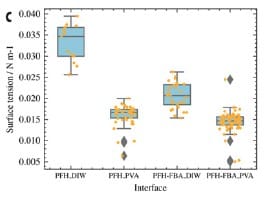
Interfacial tension at the perfluorohexane–water interface, measured by pendant drop and fitted with OpenDrop, across four conditions: PFH with deionised water; PFH with PVA-in-water; PFH containing FBA with deionised water; PFH containing FBA with PVA-in-water. This was the only interface measured. Reported as boxplots (median, IQR, min/max, individual points, outliers) in Fig. 2b–c; the paper states no replicate count, measurement temperature or phase densities.

Supporting measurements

Interfacial rheology was used to assess the rheological properties of the FBA–PVA interfacial film using oscillatory amplitude and frequency sweeps with a double wall ring configuration. Imaging (bright-field and fluorescent confocal micrographs) was used to characterize droplet and microcapsule morphologies at room temperature and approximately 0 °C.

Instruments Mentioned

Surface tension (pendant drop)

“droplet lab tensiometer” (pendant drop method; analyzed with the OpenDrop package)

Interfacial rheology

HR 20 discovery hybrid rheometer (TA Instruments), equipped with a double wall ring

Imaging

confocal microscopy (bright-field and fluorescent confocal micrographs) with a temperature control stage

Glass capillary microfluidic device

Two tapered cylindrical capillaries in a square capillary; inlet silanised with trichloro(1H,1H,2H,2H-perfluorooctyl)silane, outlet with a PEG-silane. Generated the double emulsion drops (Fig. 4a–b).

Optical microscopy

Drop-maker imaging (Fig. 4b).

Synthesis apparatus

Vacuum oven ~70 °C, centrifuge, 100 °C reflux, 1–2 µm filtration. Used for the FBA copolymer synthesis (Fig. 1b).

Role of the Droplet Lab instrument

Using the pendant drop method on the "droplet lab tensiometer," the authors measured interfacial tension at the perfluorohexane–water interface, analysing droplet shapes with the OpenDrop package; third-party open-source software to obtain values in mN m⁻¹ across four additive conditions: PFH with deionised water, PFH with PVA-in-water, PFH containing FBA with deionised water, and PFH containing FBA with PVA-in-water.

The measurements quantify how FBA in the fluorinated oil phase and PVA in the aqueous phase each change PFH–water interfacial tension. The result was a negative one: FBA alone, PVA alone and the combination all gave broadly similar tension, while only the combination produced lasting stabilisation. The authors conclude that "the synergistic and beneficial interfacial assembly of the FBA and PVA is necessary for stabilization"; an interfacial-mechanics effect, not a tension-reduction effect.

This system contains three interfaces that jointly set droplet morphology: hexane–water, perfluorohexane–water, and hexane–perfluorohexane. Only the perfluorohexane–water interface was measured. The hexane–water interface was never measured. The hexane–perfluorohexane tension, which the paper credits with driving the reconfiguration into two-core triple emulsion drops, is described only as "low" and carries no measured value. No spreading coefficients or Neumann triangle analysis appear anywhere in the paper. Separately, the interfacial rheology in Figure 3 used HFE-7500, a different fluorinated oil from the perfluorohexane used for the tension work, so the two datasets do not describe the same interface.

Method Snapshot

Method Snapshot Table

System / interface (as shown) Fluorinated oil phase Aqueous phase Surface measurement output Analysis approach Data figure(s) Conditions / notes
PFH/DIW PFH Deionized water (DIW) Surface tension distribution (boxplot + individual points) Pendant drop method on the “droplet lab tensiometer”; OpenDrop analysis Fig. 2b–c PFH–water drop interfaces presented as grayscale pendant-drop images and boxplots
PFH + FBA/DIW PFH + FBA (in PFH phase) DIW Surface tension distribution (boxplot + individual points) Pendant drop method on the “droplet lab tensiometer”; OpenDrop analysis Fig. 2b–c Condition explicitly compared against PFH/DIW
PFH/PVA–water PFH PVA in DIW phase (“PVA–water”) Surface tension distribution (boxplot + individual points) Pendant drop method on the “droplet lab tensiometer”; OpenDrop analysis Fig. 2b–c Condition explicitly compared against PFH/DIW
PFH + FBA/PVA–water PFH + FBA (in PFH phase) PVA in DIW phase (“PVA–water”) Surface tension distribution (boxplot + individual points) Pendant drop method on the “droplet lab tensiometer”; OpenDrop analysis Fig. 2b–c Surface tension compared against single-additive cases; presented as boxplots with outliers marked

Key Findings

FBA lowers PFH–water interfacial tension

Adding FBA to PFH reduces the interfacial tension of the PFH–water interface to around 20 mN m⁻¹, compared to approximately 30 mN m⁻¹ without additives.

PVA lowers PFH–water interfacial tension

Adding PVA to water reduces the interfacial tension of the PFH–water interface to around 17 mN m⁻¹.

Combined FBA + PVA yields similar surface tension

Paper, verbatim: "A similar surface tension is obtained when using the combination of FBA-in-PFH and PVA-in-water." The trailing clause "as shown in the surface tension measurements" is not in the paper.

Interfacial tension did not distinguish the systems that work from those that fail

FBA alone, PVA alone and the combination all gave broadly similar interfacial tension, yet only the combination stabilised the emulsion. The paper states: "However, lasting stabilization against coalescence of fluorocarbon–water emulsions is only obtained for the combined FBA–PVA system, not when only the individual components are used. This indicates that the synergistic and beneficial interfacial assembly of the FBA and PVA is necessary for stabilization." The discriminating measurement was interfacial rheology, not tension.

Interfacial rheology, not tension, explains the stabilisation (TA Instruments HR 20)

The FBA–PVA interface showed a complex shear modulus two orders of magnitude higher than 008-FluoroSurfactant (RAN Biotechnologies), PVA alone, or no surfactant. Both amplitude and frequency sweeps show G′ > G″ ; a viscoelastic solid film with shear-thinning consistent with dynamic covalent bonding. The storage modulus for HFE-7500 with 10 wt% PVA was "beyond the detection limit of the interfacial rheometer."

Double emulsions reconfigured into two-core triple emulsions on cooling

Hexane and perfluorohexane have an upper critical solution temperature near 23 °C. Cooling microfluidically generated double emulsion drops to approximately 0 °C drove phase separation inside the droplet, producing lower-symmetry two-core triple emulsion drops. This is the paper's headline result and the substance of its Conclusions.

Figures & Visuals

What it shows

What it shows

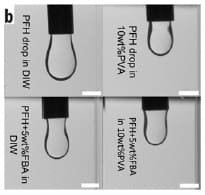
Selected grayscale pendant-drop images for PFH–water interfaces with and without FBA in the PFH phase or PVA in the DIW phase.

What it shows

What it shows

Boxplots and individual data points show the distribution of surface tension values for PFH/DIW, PFH/PVA–water, PFH + FBA/DIW, and PFH + FBA/PVA–water interfaces.

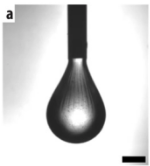
3 wt% FBA copolymer; 0.08 M HEPES; 2 wt% PVA. Scale bar 500 µm.

Figure 2a (paper) — instrument not stated in the source

3 wt% FBA copolymer; 0.08 M HEPES; 2 wt% PVA. Scale bar 500 µm.

Transient wrinkle formation during retraction of an HFE-7500 drop containing FBA from a water bath containing HEPES and PVA is shown as a visual indicator of interfacial film behavior in the combined-component system.

Why It Matters

The pendant-drop measurements enable direct comparison of PFH–water interfacial tension across four additive conditions, presented in Fig. 2b–c. They are one of four measurement modes in the paper: interfacial shear rheology (Fig. 3a–d), glass capillary microfluidic drop generation (Fig. 4a–b) and confocal microscopy (Fig. 4c) carry the paper's conclusions.

The paper's conclusion is that interfacial tension and stabilisation are decoupled: similar tension values occur across additive conditions that behave very differently, and stabilisation is "only obtained for the combined FBA–PVA system, not when only the individual components are used." The authors attribute it to interfacial assembly rather than tension reduction, evidenced by a complex shear modulus two orders of magnitude above the controls. For a formulator, the practical reading is that tension screens candidates and interfacial rheology discriminates them.

Practical Takeaways

Condition-to-condition interfacial comparison

Pendant-drop tensiometry compares PFH–water interfaces across baseline, FBA-only, PVA-only, and combined FBA–PVA conditions in a single figure set (Fig. 2b–c).

Distribution-first reporting

Interfacial tension is presented as boxplots with individual data points and outliers marked, showing spread rather than a single mean. Note that the paper does not report replicate count, measurement temperature, or phase densities for these measurements — the distributions show scatter, but the underlying n is not stated.

Tie surface tension to formulation outcomes

The study uses the measured PFH–water tensions to contextualise coalescence behaviour. Because tension values were similar across conditions that stabilised and conditions that did not, tension alone did not predict the outcome — the paper states stabilisation was "only obtained for the combined FBA–PVA system, not when only the individual components are used."

Pair tensiometry with interfacial mechanics when relevant

Interfacial rheology on a TA Instruments HR 20 with a double wall ring characterised the FBA–PVA film, and is where the mechanism shows up: a complex shear modulus two orders of magnitude higher than 008-FluoroSurfactant (RAN Biotechnologies), PVA alone, or no surfactant, with G′ > G″ in both amplitude and frequency sweeps. Pair tensiometry with interfacial rheology when tension values alone do not separate your formulations.