Primary surface measurement reported
Water contact angle (wettability) of electrospun polystyrene fiber mats (and a PS film reference surface) using water droplets.

Client Citation Analysis
Water contact angle (wettability) of electrospun polystyrene fiber mats (and a PS film reference surface) using water droplets.
The authors state: “The contact angle was analyzed on Tabletop goniometer, Droplet Lab (model not specified)”
Water contact angle values and images are used to compare hydrophobicity across electrospinning conditions (chloroform:DMF ratio and applied voltage) and to support a Cassie–Baxter treatment of rough-surface wettability reported as fractional projected area (f).
Water contact angle of electrospun PS fiber mats with water, presented as contact-angle images and contact angle versus applied voltage for multiple chloroform:DMF solvent ratios.
Fiber morphology (including fiber and pore dimensions) by SEM, plus solution electrical conductivity and viscosity; surface area and porosity were obtained via gas adsorption and discussed alongside wettability results.
Electrochemistry Meter Orion VersaStarPro (Thermo Scientific)
Rheometer Anton-Paar MCR 302 (coaxial cylinder system, ISO 3219)
Scanning Electron Microscope (SEM) Zeiss SIGMA VP
ImageJ
“tabletop goniometer from Droplet Lab”
ASAP 2460 (Micromeritics)
The paper uses the Droplet Lab tabletop goniometer to analyze water contact angle on electrospun PS fiber mats, with representative droplet images (including a PS film shown as a smooth-surface reference) and quantitative contact-angle values reported across electrospinning conditions.
These contact-angle outputs are used to compare hydrophobicity trends with solvent ratio and applied voltage and to parameterize a Cassie–Baxter-based calculation of fractional projected area (f) reported for the fiber mats.
The fiber mats are described as highly hydrophobic based on water contact-angle characterization, with reported contact angles spanning from 130.1° to 143.2° across the studied conditions.
The authors report: “Generally, the contact angle increases as applied voltage increases,” based on the contact angle versus voltage comparison for multiple solvent ratios (Figure 7 and Table 5).
The highest contact angle value in Table 5 is 143.2 ± 0.6° for the chloroform:DMF ratio of 30:70 at 22.5 kV.
The paper explains the voltage-driven contact-angle increase as a combined effect of reduced fiber diameter, increased bead frequency, and pores on the fiber surface, which together increase surface roughness and promote hydrophobic behavior.
Using the Cassie–Baxter model, the authors report fractional projected area (f) values that are less than 0.3 for all samples (Table 6), and highlight sample C:D_30:70_22.5 with f = 0.143 and an "air below the droplet" contribution of 0.857. These are calculated values, not measured air fractions: the paper states that "the Cassie-Baxter model is used, therefore, it is assumed that water does not penetrate the electrospun fibers." No contact angle hysteresis, advancing or receding angle, sliding angle or roll-off measurement was made to distinguish Cassie–Baxter from the Wenzel state the paper names as the alternative.
From the Conclusion: "the solvent mixture plays an important role in the morphological formation of the fibers, with a chloroform:DMF volume ratio equal to 70:30 leading to thinner fibers in the range of 1 μm with an internal and external porosity. While the use of a chloroform:DMF volume ratio of 30:70 leads to fibers with the presence of beads and only internal porosity." Fibre diameters span 0.95 to 2.84 µm (Table 4), with internal pores of 20–50 nm, larger pores near 100–200 nm, and external porosity around 100 nm on the 70:30 blend.
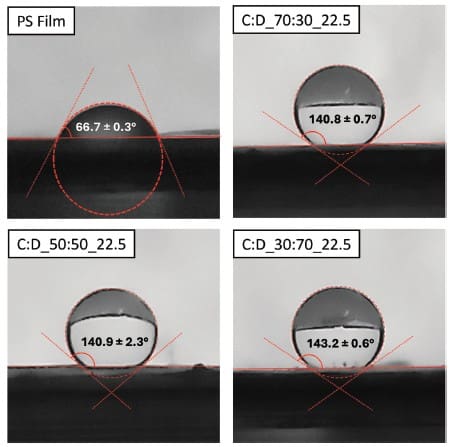
Shows contact-angle images of the PS film (smooth surface reference) and electrospun samples made with different chloroform:DMF ratios at 22.5 kV.
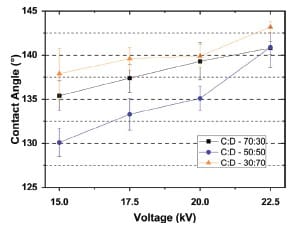
Plots contact angle versus applied voltage for fiber mats produced using the different chloroform:DMF ratios, supporting the stated trend of increasing contact angle with voltage.
Within the paper's framing, water contact angle is the study's only wettability measurement, connecting electrospinning conditions (mixed-solvent ratio and applied voltage) to the hydrophobic performance of porous PS fiber mats. Morphology — fibre diameter, bead formation and pore structure — was characterised separately by SEM on a Zeiss SIGMA VP, which produced four of the paper's seven figures.
The authors position these hydrophobic, porous fiber mats as candidates for applications including textiles, filtration, and biomedical fields, with contact-angle results serving as the study’s primary wettability evidence alongside morphology and porosity characterization.
Two figures conflict within the paper. The abstract reports surface area as "≈35 m² g⁻¹" while Section 3.3 gives 135.78, 23.59 and 21.39 m² g⁻¹ for the 70:30, 50:50 and 30:70 ratios — irreconcilable with ≈35 by any averaging. And the Section 3.1 conductivity values (0.61, 0.42 and 0.40 μS cm⁻¹ for 70:30, 50:50 and 30:70) are assigned to solvent ratios in the reverse order of Table 3. Neither affects the contact angle data, but both are worth knowing before citing figures from this paper.
The study uses water contact angle (measured on a Droplet Lab tabletop goniometer) to compare hydrophobicity across mats produced with different chloroform:DMF ratios and voltages.
Contact angle generally increased with applied voltage (Figure 7 and Table 5) — the paper's own wording is "Generally, the contact angle increases as applied voltage increases" — though not monotonically in every series. The 30:70 series runs 137.9 → 139.6 → 139.9 → 143.2°, and the 0.3° step at 20.0 kV is smaller than that sample's own standard deviation of ±1.3°.
The highest reported contact angle is 143.2 ± 0.6° for the 30:70 chloroform:DMF condition electrospun at 22.5 kV (Table 5).
The paper reports Cassie–Baxter fractional projected area (f) values (Table 6) and highlights C:D_30:70_22.5 with f = 0.143 and an air contribution under the droplet of 0.857. These estimate the air fraction beneath the droplet conditional on the wetting-state assumption — the paper assumes rather than demonstrates that water does not penetrate the fibre mat, and reports no hysteresis, sliding angle or advancing/receding measurement that would test it.
The authors attribute contact-angle differences to changes in fiber diameter, bead formation, and pore presence, describing these as contributors to increased roughness and hydrophobic behavior.