DWR and Textile Water Repellency Testing: Measure Each Durable Water Repellent Finish on Fabric With Contact Angle and Roll Off Alongside the AATCC Repellency Test Method
A spray rating tells you a fabric passed; it does not tell you by how much, or why it failed after washing. Measure water contact angle and roll off on the fabric surface, fresh and after laundering and abrasion, to rank DWR finishes and catch weak batches before the spray test.
Who this is for: Textile finishers, DWR chemists, outdoor apparel and technical textile teams, and labs qualifying water repellent fabrics, including protective and military textiles.
Where it fits: Finish development, durability testing after washing and abrasion, and batch checks between AATCC or ISO spray tests.
What it does not do: It does not give an official spray rating, hydrostatic head, breathability or oil grade.
Droplet Lab Team
Droplet Lab builds precision instruments and software for surface science measurement, specialising in contact angle analysis and surface tension characterisation. Used by researchers across materials science, pharmaceuticals, coatings, and advanced manufacturing, Droplet Lab's Dropometer has contributed to studies published in peer-reviewed journals including Advanced Functional Materials (Impact Factor 19). The team combines instrument engineering with deep domain knowledge in wettability science with a focus on practical accuracy.
Why DWR testing needs more than a pass or fail
Above 95
spray rating given to every fabric in one study by the standard AATCC TM22 spray test, so the test could not tell similarly graded fabrics apart.
Hill et al., AATCC Journal of Research 7(6), 2020
10 October 2026
date from which the EU PFHxA restriction applies to clothing textiles for the general public, at 25 ppb for PFHxA and its salts.
Commission Regulation (EU) 2024/2462
Sources: Kowalski M. et al., Quality and quantity assessment of the water repellent properties of functional clothing materials after washing, Materials, 2022; Hill P.J. et al., Quantifying water repellency by modifying spray test method AATCC TM22, AATCC Journal of Research, 2020; Commission Regulation (EU) 2024/2462 of 19 September 2024. Figures come from these sources, not from Droplet Lab measurements.
What this fabric repellency check does and what it does not
A quick reference for textile and DWR teams checking fit before reading further.
Evidence Box
DWR finishes that pass the spray test fresh but lose water repellency after washing, abrasion or a switch to fluorine free chemistry.
Complements AATCC TM22 spray testing and AATCC TM193 aqueous liquid repellency; supports AATCC TM79 drop absorbency timing; partially compliant with ISO 19403-7 roll off, up to 60° tilt.
The Dropometer drop shape method was validated against a KRUSS DSA100E in two peer reviewed papers, in Review of Scientific Instruments and Colloids and Surfaces A.
An Iowa State University coatings group added a Dropometer with an automatic dropper, tilt stage and fabric holder to measure contact angle and roll off on coated fabrics with water and oils.
A University of Calgary polymer group measured electrospun polystyrene fibre mats as highly hydrophobic and explained them with the Cassie Baxter model (Macromolecular Rapid Communications, 2024).
Contact angle on fabric depends on weave and roughness. Use it to compare like fabrics, not to replace the spray rating.
What water repellency question are you trying to answer?
Pick the card closest to your role. Each one points to the part of this page that answers it.
DWR chemist
You are moving from C8 and C6 fluorocarbon finishes to fluorine free DWR. Contact angle and roll off on treated fabric rank each repellent finish in minutes, and show which ones keep their water repellency after washing.
Textile finishing QA
You run a water repellent finish on a stenter line and release fabric by spray rating. A contact angle check on each roll catches weak add on or cure before the full spray test.
Protective and military textile buyer
You qualify coated fabrics where repellency must survive abrasion and laundering. Contact angle and roll off before and after Martindale abrasion give numbers to compare suppliers.
Is this the right test for your DWR program?
It measures how water droplets meet the fabric surface. It does not replace standard spray or hydrostatic tests.
Good fit if
Less relevant if
How to test DWR water repellency on fabric
The answer in under a minute.
To evaluate the water repellency of a finish, condition the fabric, place water drops on the fabric surface with a holder that keeps it flat, and measure contact angle and roll off angle. Repeat after set washing and abrasion cycles. Rank DWR finishes on both numbers and their decline, then confirm the best with the AATCC spray test your customers specify.
The Dropometer contact angle kit with its tilt stage runs both checks; our contact angle measurement guide and sliding angle measurement guide explain the methods. It complements AATCC TM22 spray testing. A Canadian federal research team used it on water repellent polyester fabric, and a University of Calgary group published electrospun polystyrene fibre results measured with it. Our fabrics guide covers the wider context.
Expert perspective on repellency and roll off
Repellency and mobility are not the same thing: a high contact angle says a drop is repelled, but whether it rolls off is a separate question; the two can even be mutually exclusive.
Why DWR finishes fail and why spray ratings miss it
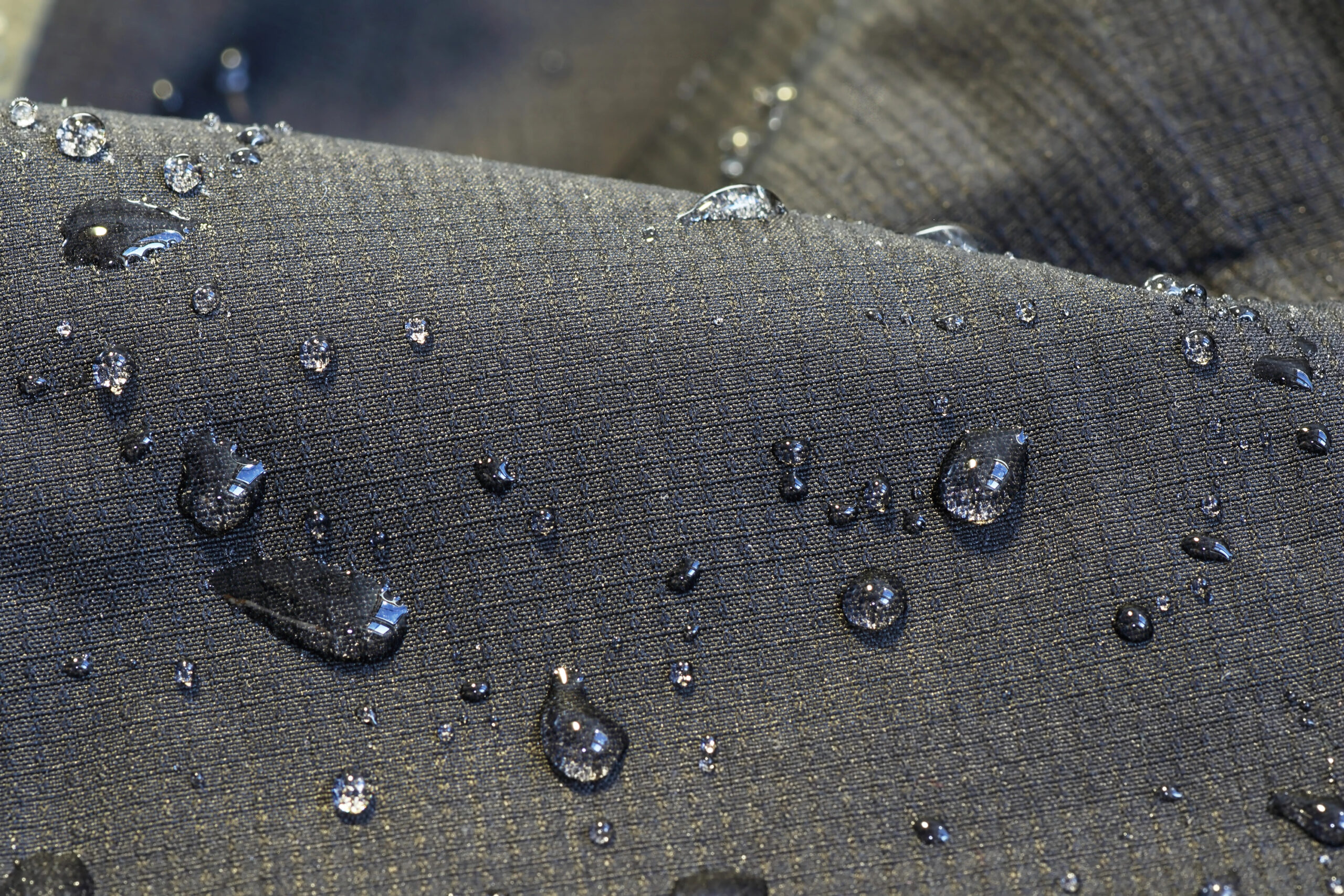
A durable water repellent (DWR) finish makes water droplets bead up and roll off the fabric surface instead of soaking into the fibre and yarn. It is what keeps outdoor apparel, workwear, protective textiles and technical fabrics from wetting out, and it protects the breathability of a waterproof membrane underneath. For decades the best DWR finishes were long chain C8 fluorocarbons, linked to PFOA and PFOS, and then C6 fluorocarbon chemistry. Regulation is ending that: the EU PFHxA restriction applies to clothing textiles for the general public from 10 October 2026, and New York and California restrict intentionally added PFAS in apparel. Fluorine free finishes have higher surface energy, so they can match fluorocarbons on water but are weaker against oils and low surface tension liquids. Most teams still judge water repellency with the AATCC TM22 or ISO 4920 spray test, a visual rating against a chart. It is the right acceptance test, but it gives a pass or fail band, it can rate very different fabrics the same, and it does not show why repellency drops after washing or abrasion. Contact angle alone is not the answer either: one study found angles above 120° on fabrics that had already failed the spray test. Teams need contact angle and roll off measured together, fresh and after durability steps, next to the spray test.
Why water repellency drops and what to check
Why:
- Too little repellent finish, or a cure below the recommended temperature, leaves parts of the fibre uncovered.
How to detect:
- Lower contact angle and higher sliding angle than the reference roll.
Corrective action:
- Check pad pick up, bath concentration, stenter temperature and dwell time, then retest.
Why:
- Detergent left after washing lowers the surface tension of water on the fabric and wets it.
How to detect:
- Readings fall after washing and partly recover after thorough rinsing or heat.
Corrective action:
- Rinse well, tumble dry or heat activate as the finish requires, and retest.
Why:
- Rubbing removes or flattens the finish on the yarn surface.
How to detect:
- Readings fall after Martindale or other abrasion cycles, most at high wear areas.
Corrective action:
- Review binder or crosslinker and finish durability; compare decline curves.
Why:
Non fluorinated finishes often match water repellency but give little oil repellency. Our page on PFAS free reformulation covers the switch.How to detect:
- Good water contact angle, but oils or water and alcohol mixtures wet the fabric.
Corrective action:
- Decide which liquids the end use must repel, and test those liquids.
Why:
Weave, yarn and fibre texture change the apparent contact angle through Cassie Baxter wetting. Our lotus effect glossary entry and experiment on superhydrophobic glass explain why.How to detect:
- The same finish reads differently on woven fabrics and knits, or on polyester and cotton fabric.
Corrective action:
- Compare finishes on the same fabric, and keep a reference roll for each construction.
Why:
Drop volume, fabric tension and lighting change readings on soft, low contrast fabric. Our guide to reproducible contact angle measurement covers fair comparisons.How to detect:
- The reference fabric reads differently between days or operators.
Corrective action:
- Use a fabric holder, fixed drop volume and lighting, and measure the reference every session.
Not sure why your DWR finish is failing?
Send a fresh and a washed fabric sample, and we will compare them on a call.
What a fabric repellency record contains
Each check produces a record you can file with the roll or finish trial. These records can sit beside your spray rating, hydrostatic and washing results in your existing quality records.
Fabric identity
Fibre, construction, dye, water-repellent finish, add on, cure and roll number.
History
Fresh, or the number of washes, detergent and drying, or abrasion cycles.
Method settings
Liquids, drop volume, tilt rate, holder and drops per sample.
Readings
Contact angle and sliding angle, median and spread.
Decision
Release, retest or hold, linked to the spray rating.
Drop images
Automatic edge and baseline detection gives the same reading from the same image, so a reviewer can recheck any result.
What to measure for repellent finish performance and durability
Water contact angle on the fabric
Why it matters: It shows how strongly the finish repels water droplets.
How to interpret: Compare with a reference roll of the same fabric; thresholds are set per fabric from your own correlation with spray ratings.
When it is not enough: Roughness inflates angles on textured fabric.
Sliding angle on a tilt stage
Why it matters: It shows whether water beads up and rolls off, which is what keeps fabric dry.
How to interpret: Lower is better; drops that do not slide by 60° are recorded as 60° or more.
When it is not enough: Fabric must be held flat and tensioned.
Contact angle with oils or water and alcohol mixtures
Why it matters: It shows wettability by oils and stains, where fluorine free finishes differ most.
How to interpret: Use the liquids your end use or AATCC TM118 and TM193 grading relate to.
When it is not enough: It does not give the official grade.
All of the above after washing and abrasion
Why it matters: Durability of water repellency is where finishes separate.
How to interpret: Compare decline curves, not single points.
When it is not enough: Lab cycles do not match field wear exactly.
Validated measurement approach for fabric repellency
How the Dropometer itself has been validated, and where textile researchers have used it.
Peer reviewed method
The Dropometer drop shape method is published in Review of Scientific Instruments and Colloids and Surfaces A. Contact angle was validated against a KRUSS DSA100E, with a published accuracy of 0.35°.
See the validation papersCustomer evidence on coated fabric
Dr. Shan Jiang's group in Materials Science and Engineering at Iowa State University added a Dropometer with an automatic dropper, a tilting stage and a fabric holder in 2025, to measure contact angle and roll off on coated fabric samples with water and oils. The group published its rechargeable antimicrobial coatings work in ACS Applied Materials and Interfaces in 2026.
Read the case studyHow to test DWR fabric with contact angle and roll off
Six steps for one fabric and one finish. Repeat for each new construction or chemistry.
Condition the fabric
Condition samples at standard temperature and humidity, and mark the face side.
Lock the method
Fix liquids, drop volume, fabric holder and tension that keep the surface of the fabric flat, tilt rate and drops per sample.
Measure the reference roll
Measure an approved roll with a known spray rating, and check readings against our client collected wetting measurements dataset.
Set gates from spray ratings
Correlate contact angle and sliding angle with spray ratings on the same rolls, fresh and after washing.
Check each roll or trial
Measure the same way, then repeat after your set washing and abrasion cycles.
Release, retest or spray test
Release inside the gates and send borderline rolls to the full spray test. Our guide to the best contact angle goniometer for industrial QA covers production use.
We completed our gage R&R study on the unit and it performed very well.
Brandon Barbee
Corporate Quality Engineer, Zeus Industries, Polymer Manufacturing
Download the textile DWR repellency SOP
A two page SOP you can adapt for your fabrics, with the method lock, conditioning, wash and abrasion steps, gates against a reference roll, a troubleshooting table and a record sheet.
Sliding angle measurement with the Dropometer
Example DWR finish screen through washing
Example data only. Your values and gates will differ and must come from your own reference rolls and spray ratings.
Example gates against the reference: contact angle within 5° and sliding angle no more than 10° higher. The fluorine free finish matches fresh but loses more after 20 washes. The low add on trial fails before washing, so it never needs a spray test. The unfinished fabric shows the baseline.
Example DWR finish screen
| Finish | Wash cycles | Water contact angle (°) | Water sliding angle (°) | Result |
|---|---|---|---|---|
| Reference C6 fluorocarbon finish | 0 | 142 | 12 | Reference |
| Reference C6 fluorocarbon finish | 20 | 136 | 20 | Reference |
| Fluorine free DWR | 0 | 141 | 14 | Pass |
| Fluorine free DWR | 20 | 128 | 34 | Reformulate for durability |
| Fluorine free DWR, low add on | 0 | 124 | 40 | Hold |
| Unfinished fabric | 0 | Wets | Wets | Information |
Example data, not customer data. Polyester woven fabric, conditioned 24 h at 65 %RH and 20 °C; 10 µL water drops on a fabric holder; washes at 40 °C with tumble drying.
The order to check signals when repellency drops
Check these in order. Each one rules out a cause before you look at the next.
Conditioning and rinse
Rules out humidity and detergent residue.
Contact angle
Shows whether the finish is there and repels water.
Sliding angle
Shows whether water rolls off; our sliding angle guide explains the test.
Readings after washing and abrasion
Shows durability of water repellency.
Spray rating
Confirms performance with the AATCC or ISO test your customer specifies.
Common questions about DWR and textile water repellency
Questions DWR chemists and textile QA teams ask about repellency testing.
They measure different things. AATCC TM22 rates the wetted pattern after spraying against a chart. Contact angle measures single water droplets. Kowalski and colleagues found angles above 120° on washed fabrics that scored grade 0 in the spray test, so use contact angle with roll off, and keep the spray test for acceptance.
Water repellency on a garment depends on water rolling off, not just beading. A drop can sit at a high angle and still pin to the fibres. Schellenberger and colleagues combined standard methods with a roll off angle setup to compare fluorinated and fluorine free finishes. Sliding angle shows that difference with a number.
On water, often yes. Hill and colleagues found non fluorinated finishes gave water repellency similar to C8 and C6 finishes but were clearly inferior for oil repellency. Schellenberger and colleagues found the best non fluorinated alternatives equal to short chain fluorinated polymers on water, but weaker against low surface tension liquids.
Measure the initial water repellency, then durability after washing and abrasion resistance, for example after Martindale cycles. Kowalski and colleagues found water repellency fell below an acceptable spray grade after the fifth wash for all materials tested, and the PFC free finish was the least resistant to washing. Compare the decrease in water repellency as curves, not single points.
AATCC TM22 applies to any textile fabric, finished or not, and ISO 4920 is its ISO counterpart for spray testing; ISO 4920 notes it does not predict rain penetration. AATCC TM118 covers oil repellency, AATCC TM193 water and alcohol repellency, AATCC TM127 hydrostatic pressure and AATCC TM35 rain penetration. The Dropometer complements TM22 and TM193 and does not replace them.
The EU PFHxA restriction applies to clothing textiles for the general public from 10 October 2026, with other consumer textiles following in 2027. New York bans intentionally added PFAS in apparel from 2025, with severe wet conditions outdoor apparel from 2028, and California has a similar law. Check current rules for your market; we do not give regulatory advice.
No. Water repellency is about each water droplet beading and rolling off the surface. Waterproof fabrics have high water resistance under pressure, measured by hydrostatic head (AATCC TM127) or a rain test (AATCC TM35), usually thanks to a membrane or coating. A DWR finish keeps the outer face dry so a breathable membrane can keep working.
A contact angle instrument with a fabric holder to keep samples flat, a tilt stage for roll off, and image analysis that copes with low contrast fabric. The Dropometer has a fabric stage and a snap in tilt stage up to 60°. Our page on ski wax hydrophobicity covers roll off on another sports surface.
What changes when you measure fabric repellency with numbers
Typical changes in how teams work. Benchmarks are given only where a published source exists.
Before and with fabric contact angle checks
| Metric | Before Dropometer | With Dropometer | Indicative Benchmark |
|---|---|---|---|
| Finish ranking | Spray rating bands | Contact angle and sliding angle as numbers | Standard spray test rated every fabric above 95 (Hill et al., 2020) |
| Durability tracking | Spray rating after washing | Decline curves after washing and abrasion | All materials fell below grade 3 after 5 washes (Kowalski et al., 2022) |
| Batch checks | Full spray test on every roll | Quick check on each roll, spray test on borderline rolls | No published benchmark; track on your own rolls |
| Fluorine free transition | Fluorocarbon reference | Candidates ranked on water and oil | EU PFHxA limits for clothing from 10 October 2026 |
See the test on your own fabric
Send a fresh and a washed sample of your fabric. We will show the comparison on a call.
Estimate saved finish development work
Enter your own numbers. The result is an estimate, not a Droplet Lab claim.
DWR finish development estimate
Estimate saved finish development and spray test work.
Result
Monthly savings = materials saved + technician time saved from reduced iterations.
What contact angle cannot tell you about fabric
Honest limits, so you know when to reach for another test.
Contact angle and sliding angle show how water droplets meet the fabric surface. Spray rating, hydrostatic head, rain tests, breathability, oil grades and PFAS content need their own tests.
Standards, evidence and related repellency workflows
These pages cover the AATCC standards, the customer evidence and related water repellency tests.
Standard
AATCC TM22
Spray test for water repellency, and how contact angle complements it.
Standard
AATCC TM193
Aqueous liquid repellency with water and alcohol solutions.
Standard
AATCC TM79
Water drop absorbency of textiles.
Standard
AATCC TM118
Oil repellency by hydrocarbon resistance.
Case study
Iowa State University
Contact angle and roll off on coated fabrics with water and oils.
Case study
Canadian federal research team
Water repellent coatings on white polyester fabric.
Case study
University of Calgary
Electrospun fibre mats measured on a shared Dropometer.
Published paper
Electrospun polystyrene porous fibers
Solvent and voltage effects on fibre hydrophobicity.
Instrument
Dropometer
Contact angle and sliding angle in one kit.
Related use case
Functional hydrophobicity and self cleaning
All hydrophobicity use cases in one place.
Related use case
Ski wax hydrophobicity testing
Contact angle and roll off on waxed ski bases.
Related use case
Windshield rain repellent performance
Water repellency and roll off on glass.
How this page was created
Editorial and technical transparency notes for this page.
Drafting assistance
Drafted with Claude Opus 5.5 (Anthropic) using web search for sources, then edited by the Droplet Lab team.
Technical review
Reviewed and edited for technical accuracy by the Droplet Lab Team.
Verification steps
Standard identifiers, units, thresholds and key procedural claims are checked against cited sources before publication.
Updates
Reviewed every 12 months or when the underlying method changes.
Report a correction
Spotted an issue in this summary? Send a correction request and our team will review it.
Correction Request
We work hard to keep this page accurate and up to date. If you spot an error (wrong revision/year, missing requirement, incorrect interpretation, or broken link), tell us and we'll review it.
Contact us to report a correction