Contents
Functional Hydrophobicity

PFAS-Free Coatings: Prove PFAS Chemicals and Forever Chemicals Can Be Replaced Without Losing Water and Oil Repellency

Most PFAS alternatives match fluorinated finishes on water but lose oil repellency. Measure water and oil contact angles, surface free energy and roll off before and after wear, so you know which PFAS-free formulation keeps the performance your customers need.


Who this is for: Coating, textile, packaging and consumer product teams developing PFAS-free replacements for fluorinated finishes.

Where it fits: Candidate screening, durability testing and batch release of PFAS-free coatings.

What it does not do: It does not show whether a product contains PFAS. That needs chemical analysis.

Method
Sessile drop contact angle with water and oils, surface free energy and tilt stage roll off
Standard
Fully compliant with ISO 19403-2; partially compliant with ISO 19403-7, up to 60° tilt
Setup
About 2 minutes
Gurdeep-Saini-Photo
Written by
Gurdeep Singh Saini
Holds a BASc in Mechanical Engineering from Ryerson University (now Toronto Metropolitan University) and an MASc from York University. He develops the automatic edge and baseline detection behind the Dropometer's analysis.
COO at Droplet Lab
Read More

Droplet-Lab logo
Technical Review by
Droplet Lab Team
Droplet Lab builds precision instruments and software for surface science measurement, specialising in contact angle analysis and surface tension characterisation. Used by researchers across materials science, pharmaceuticals, coatings, and advanced manufacturing, Droplet Lab's Dropometer has contributed to studies published in peer-reviewed journals including Advanced Functional Materials (Impact Factor 19). The team combines instrument engineering with deep domain knowledge in wettability science with a focus on practical accuracy.

Read More
Gurdeep-Saini-Photo
Written By

Gurdeep Singh Saini

COO at Droplet Lab

Holds a BASc in Mechanical Engineering from Ryerson University (now Toronto Metropolitan University) and an MASc from York University. He develops the automatic edge and baseline detection behind the Dropometer's analysis.

Droplet-Lab logo
Reviewed By

Droplet Lab Team

Droplet Lab builds precision instruments and software for surface science measurement, specialising in contact angle analysis and surface tension characterisation. Used by researchers across materials science, pharmaceuticals, coatings, and advanced manufacturing, Droplet Lab's Dropometer has contributed to studies published in peer-reviewed journals including Advanced Functional Materials (Impact Factor 19). The team combines instrument engineering with deep domain knowledge in wettability science with a focus on practical accuracy.


Why it matters

Why PFAS-free coatings are now a priority

4.0 ppt

EPA's enforceable drinking water limits for PFOA and PFOS, set in April 2024. Compliance deadlines are under proposed revision as of 2026.

US EPA, PFAS National Primary Drinking Water Regulation

About 10,000

PFAS covered by the universal restriction proposal ECHA published in February 2023, which estimated 4.4 million tonnes would reach the environment over 30 years without action.

European Chemicals Agency, February 2023

End of 2025

when 3M completed its exit of PFAS manufacturing, after announcing it would stop making fluoropolymers and PFAS based additives.

3M, Form 10-K for fiscal 2025

Sources: US Environmental Protection Agency, PFAS National Primary Drinking Water Regulation (final rule April 2024; proposed revisions May 2026); European Chemicals Agency, ECHA publishes PFAS restriction proposal, 7 February 2023; 3M Company, annual report on Form 10-K for fiscal 2025. Figures come from these sources, not from Droplet Lab measurements.

Quick reference

What this repellency check does and what it does not

A quick reference for teams replacing fluorinated chemistry, before reading further.

Evidence Box

Problem this solves

PFAS-free candidates that pass a water test but fail on oil, stains or durability once they reach the customer.

Standards

Fully compliant with ISO 19403-2 for surface free energy; partially compliant with ISO 19403-7 roll off, up to 60° tilt.

Peer reviewed method

The Dropometer drop shape method was validated against a KRUSS DSA100E in two peer reviewed papers, in Review of Scientific Instruments and Colloids and Surfaces A.

Customer case study

A University of Utah polymers lab measured four commercial low fluorinated ski waxes at 2 °C and room temperature after fluorinated waxes were banned in ski racing.

Published research

Researchers rented a portable Dropometer to compare bio based ski wax prototypes with water and ethylene glycol at 23 °C, and with ethylene glycol at −5 °C.

Honest limit

Contact angle measures performance, not chemistry. It cannot confirm a product is free of PFAS.

Who this is for

What PFAS-free question are you trying to answer?

Pick the card closest to your role. Each one points to the part of this page that answers it.

R&D formulator

You are developing PFAS-free replacements and need to rank candidates against your fluorinated reference. Water and oil contact angles, surface free energy and roll off show where each candidate falls short, before costly field trials.

A water test alone will pass most PFAS-free finishes; test oil too.

Quality manager

Your plant has switched to a PFAS-free coating and needs a release test that catches weak batches. Contact angle gates set from the approved reference give each batch a recorded pass or hold.

Set gates from your approved PFAS-free reference, not from the old fluorinated data sheet.

Process engineer

A new chemistry has changed how the finish cures and how much you apply. Measuring after each process change shows whether add on, cure or substrate is the cause when repellency drops.

Retest after washing or abrasion; fresh readings can hide poor durability.
Fit check

Is this the right test for your PFAS-free program?

It measures how well a coating repels water and oil. It does not measure what the coating contains.

Good fit if

You compare PFAS-free candidates with a fluorinated reference.
You need oil repellency as well as water repellency.
You test durability after washing, abrasion or weathering.
You release PFAS-free coating batches against an approved reference.
You need surface free energy from two or more liquids.

Less relevant if

You need to prove a product does not contain PFAS.
You need total fluorine or targeted PFAS analysis.
You need a customer's textile spray rating or oil grade test run as written.
You need toxicity or environmental fate data.
Summary

How to evaluate PFAS-free coatings

The answer in under a minute.

Test PFAS-free coatings with water and an oil, not water alone. Studies found non fluorinated finishes can match fluorinated ones on water repellency but give little or no oil repellency. Measure water and oil contact angles, surface free energy and roll off, fresh and after wear, then keep the candidate that meets your real performance need.

The Dropometer contact angle and surface energy kit runs all three checks; our contact angle measurement guide explains the method, and surface free energy follows ISO 19403-2. A University of Utah polymers lab used it on low fluorinated ski waxes, and researchers used it to compare bio based ski wax prototypes. Our cosmetics guide covers personal care uses.

Expert Quote

Expert perspective on repellency

“

A surface can pin a drop at a high angle yet never let it roll. High repellency and easy roll-off are different properties, and a single contact angle won't tell you which one you have.

Dr. Alidad Amirfazli

Professor, Department of Mechanical Engineering, York University; Co-founder, Scientific Advisor, Droplet Lab

The problem

Why PFAS alternatives often fall short

PFAS, per- and polyfluoroalkyl substances, are called forever chemicals because they persist in the environment. Their low surface energy made them the default for coatings that repel water, oil and stains. PFAS uses range from non-stick cookware and carpet to outdoor textiles, food packaging and some cosmetic products. PFAS pollution of drinking water has driven new limits: EPA set enforceable 4.0 ppt limits for PFOA and PFOS in 2024, ECHA proposed restricting about 10,000 PFAS in 2023, and 3M completed its exit of PFAS manufacturing at the end of 2025. Teams are now developing PFAS-free replacements for fluoropolymer and other fluorinated finishes, built on silicones, waxes, hydrocarbons and other non fluorinated chemistry. The difficulty is that these alternatives to PFAS usually repel water well but oil poorly. Peer reviewed textile studies found non fluorinated finishes gave water repellency similar to fluorinated ones but no oil repellency. A water drop test alone will pass them, and the gap shows up later as oil stains, soiling or failed customer tests.

A PFAS-free coating beads water but oil or grease soaks in.
Repellency falls faster after washing or abrasion than the fluorinated version.
Drops sit at a high angle but do not roll off.
Results change between batches of the new formulation.
Customer stain or soil tests fail after a switch that passed in house.
Troubleshooting

Why PFAS-free coatings lose repellency and what to check

Why:

Silicone, wax and hydrocarbon surfaces have higher surface energy than fluorinated ones, so oils with low surface tension still wet them. Our surface energy guide explains why.

How to detect:

  • Water contact angle is close to the reference, but the oil contact angle is much lower or the oil spreads.

Corrective action:

  • Decide whether the product really needs oil repellency. If it does, screen other chemistries or accept a lower oil target with the customer.

Why:

  • A new formulation may need a different add on, cure time or temperature than the fluorinated one it replaces.

How to detect:

  • Contact angle rises with add on or cure time and has not levelled off.

Corrective action:

  • Run a small add on and cure series and set the process where the readings plateau.

Why:

Roughness amplifies wetting, so a textured surface can read high on water while the chemistry is weak. Our Wenzel model glossary entry and experiment on Wenzel and Cassie Baxter wetting explain the effect.

How to detect:

  • High water contact angle with a high sliding angle, or results that change with texture.

Corrective action:

  • Measure the chemistry on a smooth reference panel as well as on the real substrate.

Why:

  • Some PFAS alternatives wear or rearrange faster than fluorinated finishes.

How to detect:

  • Readings fall after each wash or abrasion cycle faster than the reference.

Corrective action:

  • Add a binder or crosslinker, retest after the same wear, and compare curves, not single points.

Why:

  • Surfactants used to apply the formulation can stay on the surface and lower repellency.

How to detect:

  • Contact angle improves after a rinse or a heat step.

Corrective action:

  • Review surfactant level, rinse and cure, then retest the rinsed and unrinsed surface.

Why:

Drop volume, read time and probe liquid purity change readings, so candidates look different when they are not. Our guide to reproducible contact angle measurement covers fair comparisons.

How to detect:

  • The reference panel reads differently from day to day.

Corrective action:

  • Lock the method, measure the reference with every set, and use fresh probe liquids.

Not sure where your PFAS-free candidate falls short?

Bring your fluorinated reference and a candidate to a call, and we will compare them on screen.

Quality records

What a PFAS-free coating test record contains

Each check produces a record you can file with the candidate or batch. These records can feed into your existing quality records and customer data packs.

Sample identity

Formulation, batch, substrate, add on, cure and the fluorinated or approved reference.

Wear history

Fresh, or the number of washes, abrasion cycles or weathering hours.

Method settings

Probe liquids, drop volume, read time, tilt rate and number of drops.

Readings

Water and oil contact angles, surface free energy and sliding angle, with median and spread.

Decision

Keep, reformulate or reject, against the gates set from the reference.

Drop images

Automatic edge and baseline detection gives the same reading from the same image, so a reviewer can recheck any result.

Measurements

What to measure to evaluate PFAS alternatives

Water

Water contact angle

Why it matters: It shows water repellency, which most PFAS alternatives can match.

How to interpret: Compare with your fluorinated reference on the same substrate. Thresholds are set per substrate from your own correlation with field or customer tests.

When it is not enough: It will pass coatings that fail on oil.

Oil

Oil contact angle, for example hexadecane or diiodomethane

Why it matters: It shows the oil repellency gap between fluorinated and PFAS-free chemistry.

How to interpret: A low angle or spreading drop means oils and greasy soils will wet the surface.

When it is not enough: It does not replace a customer's oil grade test where one is specified.

Surface energy

Surface free energy from two or more liquids

Why it matters: It gives one number to rank chemistries, with polar and dispersive parts.

How to interpret: Lower is more repellent. Use the same liquids and model, such as OWRK, for every sample.

When it is not enough: Different models give different values, so compare within one model.

Roll off

Sliding angle on a tilt stage

Why it matters: It shows whether drops roll off, which keeps a surface clean.

How to interpret: A high contact angle with a high sliding angle means drops pin.

When it is not enough: The tilt stage reaches 60°; drops that do not slide are recorded as 60° or more.

Durability

All of the above after washing, abrasion or weathering

Why it matters: PFAS-free finishes often differ most in how long they last.

How to interpret: Compare the decline curve with the reference.

When it is not enough: Lab wear does not fully match field life.

Validation

Validated measurement approach for repellency testing

How the Dropometer itself has been validated, and where customers have used it on fluorine free products.

Peer reviewed method

The Dropometer drop shape method is published in Review of Scientific Instruments and Colloids and Surfaces A. Contact angle was validated against a KRUSS DSA100E, with a published accuracy of 0.35°.

See the validation papers

Customer evidence on fluorine free waxes

After fluorinated waxes were banned in ski racing, a University of Utah polymers lab measured four commercial low fluorinated glide waxes at 2 °C and room temperature. The two waxes rated for the coldest snow were less water repellent in the cold.

Read the case study
QC Protocol

How to evaluate a PFAS-free formulation against your reference

Six steps for one substrate and one reference. Repeat for each new substrate or chemistry.

1

Lock the method

Fix probe liquids (water and an oil), drop volume, read time, tilt rate and drops per sample.

2

Measure the reference

Measure your fluorinated or approved coating on the same substrate, fresh and after wear.

3

Set gates from the need

Decide which properties the product really needs, water, oil or roll off, and set gates from the reference and customer tests.

5

Test durability

Repeat after washing, abrasion or weathering, and compare decline curves.

We completed our gage R&R study on the unit and it performed very well.

Brandon Barbee

Corporate Quality Engineer, Zeus Industries, Polymer Manufacturing

Download the PFAS-free repellency testing SOP

A two page SOP you can adapt for your coatings, with the method lock, gates against a reference, a troubleshooting table and a record sheet.

Contact angle measurement with the Dropometer

Example output

Example PFAS-free candidate screen against a fluorinated reference

Example data only. Your values and gates will differ and must come from your own references.

How to read this screen
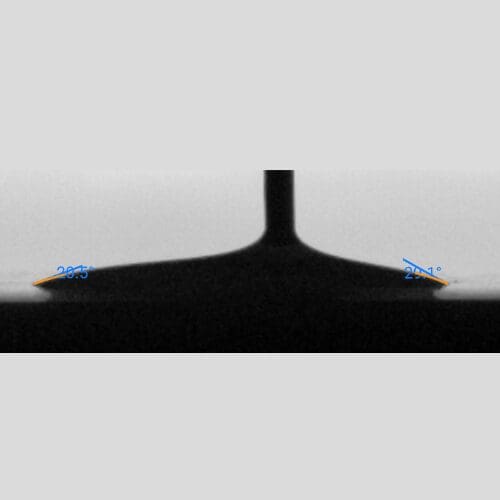
Example gates: water contact angle within 5° of the reference and sliding angle at or below 20°; oil gate only where the product needs it. Both PFAS-free candidates match the reference on water. Only the silicone keeps some oil repellency, and the wax loses most of its water repellency after abrasion. Our client collected wetting measurements dataset adds real world context.

Low contact angle measurement of a spread droplet, showing left angle of approximately 28.5° and right angle of approximately 20.4°, indicating a hydrophilic surface

Example PFAS-free candidate screen

Coating Wear Water contact angle (°) Hexadecane contact angle (°) Surface free energy (mJ/m²) Sliding angle (°) Result
Fluorinated reference Fresh 118 72 12 12 Reference
PFAS-free silicone Fresh 110 36 21 15 Pass if oil not needed
PFAS-free wax Fresh 112 Spreads 25 18 Pass if oil not needed
PFAS-free silicone After abrasion 106 30 23 19 Pass if oil not needed
PFAS-free wax After abrasion 92 Spreads 33 60 or more Reformulate

Example data, not customer data. Flat coated panels at 23 °C; water and hexadecane contact angles; surface free energy by OWRK from water and diiodomethane; sliding angle with 20 µL water drops.

Signal order

The order to check signals when a PFAS-free coating underperforms

Check these in order. Each one rules out a cause before you look at the next.

1

Reference panel

Confirms the method and liquids read as they did last time.

2

Water contact angle

Shows whether basic water repellency is there.

3

Oil contact angle

Shows the oil repellency gap that water hides.

5

Readings after wear

Shows whether the coating lasts as long as the reference.

FAQ

Common questions about PFAS-free coatings

Questions formulation and quality teams ask when replacing fluorinated chemistry.

What are PFAS and why are they called forever chemicals?

PFAS are per and polyfluoroalkyl substances, a large family of synthetic chemicals with strong carbon fluorine bonds. Those bonds make them very persistent, so they build up in water, soil and people, which is why they are called forever chemicals. The same chemistry gives the very low surface energy that made them so useful in repellent coatings.

Can PFAS-free coatings match fluorinated performance?

On water, often yes. Hill and colleagues (Chemosphere, 2017) found several non fluorinated durable water repellent finishes gave water repellency similar to long chain PFAS, but none gave oil repellency. Schellenberger and colleagues (Chemosphere, 2018) found the same oil gap. Whether that matters depends on the product.

Why test with oil as well as water?

Fluorinated surfaces repel both because their surface energy is very low: aligned CF3 groups have been measured near 6.7 mJ/m² (Nishino, Langmuir, 1999). Silicone and hydrocarbon surfaces are higher, so they still repel water but oils wet them. Only an oil contact angle or surface free energy shows that gap.

Does this test show whether a product contains PFAS?

No. Contact angle measures how a surface performs, not what it is made of. To show a product does not contain PFAS, use chemical analysis such as targeted PFAS testing or total fluorine, through an accredited lab. Use contact angle to prove the PFAS-free version still performs.

What are the main applications of PFAS that need alternatives?

Common PFAS uses include non-stick cookware, stain resistant carpet and upholstery, outdoor textiles, food packaging, firefighting foams and some cosmetic products. Each needs different properties, so set your test from the product's real need. Our cosmetics guide covers personal care surfaces.

What is the current regulation?

EPA's enforceable 4.0 ppt limits for PFOA and PFOS in drinking water remain in place, with compliance deadlines under proposed revision as of 2026. ECHA's universal restriction proposal for about 10,000 PFAS was published in 2023 and is still in progress. Check current rules for your market; we do not give regulatory advice.

Which standards apply?

ISO 19403-2 covers surface free energy from contact angles, and ISO 19403-7 covers roll off on a tilt stage, where the Dropometer is partially compliant up to 60°. Textile buyers may also specify spray rating or oil grade tests, which use their own equipment.

Which instrument do we need?

A contact angle instrument that takes water and oils, calculates surface free energy and has a tilt stage. The Dropometer does all three, with the tilt stage as a snap in option. Our pages on hydrophobic performance verification and ski wax hydrophobicity testing cover related tests.

Business impact

What changes when you measure PFAS-free repellency

Typical changes in how teams work. Benchmarks are given only where a published source exists.

Before and with repellency measurement

Metric Before Dropometer With Dropometer Indicative Benchmark
Candidate screening Water drop or spray test only Water and oil contact angle, surface free energy and roll off Non fluorinated finishes matched water but not oil repellency (Hill et al., 2017)
Durability check Visual after wear Readings after each wear step No published benchmark; track on your own candidates
Batch release Data sheet or visual Contact angle gates from the approved reference No published benchmark; track on your own batches
Regulatory pressure Fluorinated chemistry PFAS-free formulation with performance data EPA 4.0 ppt PFOA and PFOS limits (2024)

See the test on your own candidates

Bring your reference and a PFAS-free candidate. We will show the comparison on a call.

Estimate saved reformulation work

Enter your own numbers. The result is an estimate, not a Droplet Lab claim.

PFAS-free reformulation estimate

Estimate saved reformulation work.

Each Dropometer unit is US$5,000; the default models one unit.
Chemistry, substrate and wear testing cost for one candidate.
Coating, curing, water and oil contact angles and analysis.
No published benchmark. Use your own estimate and start low if unsure.

Result

~0
Candidates saved per month
~0
Monthly savings
~0
Payback period
~0
First year net benefit

Monthly savings = materials saved + technician time saved from reduced iterations.

Limits

What contact angle cannot tell you about PFAS-free coatings

Honest limits, so you know when to reach for another test.

It does not detect PFAS or prove a product is free of them.
It does not replace textile spray rating or oil grade tests a customer specifies.
Surface free energy values depend on the liquids and model used.
Rough or porous surfaces can give high readings that hide weak chemistry.
The tilt stage reaches 60°; drops that do not slide are recorded as 60° or more.
Lab wear tests do not fully predict field durability.

Contact angle, surface free energy and sliding angle measure water and oil repellency. PFAS content, toxicity, stain release, breathability and field life need their own tests.

How this page was created

Editorial and technical transparency notes for this page.

Transparency Details 4 checklist items
01

Drafting assistance

Drafted with Claude Opus 5.5 (Anthropic) using web search for sources, then edited by the Droplet Lab team.

02

Technical review

Reviewed and edited for technical accuracy by the Droplet Lab Team.

03

Verification steps

Standard identifiers, units, thresholds and key procedural claims are checked against cited sources before publication.

04

Updates

Reviewed every 12 months or when the underlying method changes.

Report a correction

Spotted an issue in this summary? Send a correction request and our team will review it.

Correction Request

We work hard to keep this page accurate and up to date. If you spot an error (wrong revision/year, missing requirement, incorrect interpretation, or broken link), tell us and we'll review it.

Contact us to report a correction
Sources

References

1.
US Environmental Protection Agency. Per and polyfluoroalkyl substances (PFAS): PFAS National Primary Drinking Water Regulation. Final rule April 2024; page updated May 2026. https://www.epa.gov/sdwa/and-polyfluoroalkyl-substances-pfas
2.
US Environmental Protection Agency. Proposed PFAS rescission rule. 2026. https://www.epa.gov/sdwa/proposed-pfas-rescission-rule
3.
European Chemicals Agency. ECHA publishes PFAS restriction proposal. Helsinki, 7 February 2023. https://echa.europa.eu/-/echa-publishes-pfas-restriction-proposal
4.
3M Company. Annual report on Form 10-K for the fiscal year ended 31 December 2025. https://www.sec.gov/Archives/edgar/data/66740/000006674026000014/mmm-20251231.htm
5.
3M. 3M to exit PFAS manufacturing by the end of 2025. News release, 20 December 2022. https://news.3m.com/2022-12-20-3M-to-Exit-PFAS-Manufacturing-by-the-End-of-2025
6.
Hill, P.J., Taylor, M., Goswami, P., Blackburn, R.S. Substitution of PFAS chemistry in outdoor apparel and the impact on repellency performance. Chemosphere 181:500 to 507, 2017. https://doi.org/10.1016/j.chemosphere.2017.04.122
7.
Schellenberger, S. et al. Facing the rain after the phase out: performance evaluation of alternative fluorinated and non fluorinated durable water repellents for outdoor fabrics. Chemosphere 193:675 to 684, 2018. https://doi.org/10.1016/j.chemosphere.2017.11.027
8.
Nishino, T. et al. The lowest surface free energy based on CF3 alignment. Langmuir 15(13):4321 to 4323, 1999. https://doi.org/10.1021/la981727s
9.
ISO 19403-2. Paints and varnishes, wettability, part 2: determination of the surface free energy of solid surfaces by measuring the contact angle. See our ISO 19403-2 page. https://dropletlab.com/industry-standards/iso-19403-2/
10.
Chen, X. et al. Contact angle measurement with a smartphone. Review of Scientific Instruments 89(3):035117, 2018. https://pubs.aip.org/aip/rsi/article-abstract/89/3/035117/368179/Contact-angle-measurement-with-a-smartphone
11.
Surface tension measurement with a smartphone using a pendant drop. Colloids and Surfaces A: Physicochemical and Engineering Aspects. https://www.sciencedirect.com/science/article/abs/pii/S0927775717307744