“
Repellency and mobility are not the same thing: a high contact angle says a drop is repelled, but whether it rolls off is a separate question: the two can even be mutually exclusive.

ISO 19403-7 measures the tilt at which a drop rolls off a paint or varnish film, and the advancing and receding angles at that moment. The Dropometer runs this on its tilt stage from 0 to 60°, reading each angle with ±0.35° accuracy (Dropometer product specification). A fixed tilt rate needs the automatic sliding stage add-on, and drops that still hold at 60° need a stage that tilts further.
What brings you here?
Quality manager
You need to show that drops roll off an easy to clean coating, not just bead on it. The roll off angle gives you a number per panel that you can trend by batch.
R&D chemist
You need to know whether an additive or cure change makes drops move more easily. Compare roll off angles and the front and back angles between formulations, and use the decision tree to pick the method.
Product engineer
You need roll off limits that match how glass, panels or facades shed water and soil in use. Measure surfaces that cleaned well and ones that did not, then set limits from your own data.
Free one page checklist for ISO 19403-7: what to prepare, the settings to lock, when a drop counts as rolled off and what to record. Made for coating QC benches.
Talk to an expert
Tell us your coating, substrate and current roll off check. We will tilt drops on your panels live and tell you plainly which part of ISO 19403-7 the Dropometer covers and which it does not.


Droplet Lab builds precision instruments and software for surface science measurement, specialising in contact angle analysis and surface tension characterisation. Used by researchers across materials science, pharmaceuticals, coatings, and advanced manufacturing, Droplet Lab's Dropometer has contributed to studies published in peer-reviewed journals including Advanced Functional Materials (Impact Factor 19). The team combines instrument engineering with deep domain knowledge in wettability science with a focus on practical accuracy.
ISO 19403-7:2024, Paints and varnishes, Wettability, Part 7: Measurement of the dynamic contact angles and the roll off angle on a tilt stage, from ISO/TC 35/SC 9. Adopted as EN ISO 19403-7:2024. It replaces ISO 19403-7:2017.
Partially compliant. The Dropometer places a drop, tilts the panel and reads the roll off angle and the front and back contact angles optically. Its tilt stage stops at 60°, and the manual stage does not hold a fixed tilt rate. Use the automatic sliding stage add-on for a fixed rate, and a stage that tilts further for drops that hold past 60°.
Contact angle range 10° to 175° on sessile and tilted drops, accuracy ±0.35°, tilt stage 0 to 60°, manual or automatic, camera 10 frames per second. All from the Dropometer product specification.
The drop shape method is validated against a KRUSS DSA100E in two peer reviewed papers. See our validation publications.
Researchers at RISE Research Institutes of Sweden rented a portable Droplet Lab instrument for static contact angles and approximate roll off angles on bio based ski waxes, tilting by hand. Read our analysis of the report.
A low roll off angle shows that drops move easily on the clean film. It does not prove the coating stays clean outdoors or survives abrasion. Pair it with your soiling, cleaning or weathering test.
What this standard measures, who uses it and how the Dropometer fits
ISO 19403-7 measures the roll off angle: the tilt at which a liquid drop starts to roll off a paint or varnish film on a tilt stage. It also reads the advancing and receding contact angles of the drop at that moment. Makers of easy to clean, anti adherent and self cleaning coatings use it to show that drops leave the surface, not just bead on it. The Dropometer is partially compliant: it runs the measurement on its tilt stage from 0 to 60° and reads each angle with ±0.35° accuracy, but a fixed tilt rate needs the automatic sliding stage add-on and drops that hold past 60° need a stage that tilts further.
The current edition is ISO 19403-7:2024, adopted in Europe as EN ISO 19403-7:2024. It replaces the 2017 edition, and its title now names both results: the dynamic contact angles and the roll off angle on a tilt stage. For the terms, see the roll off and sliding angle glossary entry and our sliding angle measurement guide.
The Dropometer contact angle and sliding angle kit snaps in a tilt stage, so you can tilt coated panels at the line or in the lab. Coating teams use roll off angles for self cleaning and anti soiling validation, including solar glass. Researchers at RISE used a portable Droplet Lab instrument for approximate roll off angles in a bio based ski wax study. For background, read the paint guide and why contact angle matters for coatings and adhesives QC.
Further reading: reproducible sliding angle measurement, Experiment 8: sliding and roll off angle on hydrophobic surfaces, the measurement method selector and our buying guide for ISO and GLP regulated high throughput QC.
The ISO 19403-7 measurement, step by step, in our own words
These steps outline the procedure and show where the Dropometer differs from the method's apparatus. They do not replace the standard. Buy the current edition and follow its drop volume, tilt rate, roll off criterion and specimen rules.
Manual stage, or the automatic sliding stage add-on for a programmed tilt.
From the Dropometer product specification, for sessile and tilted drops.
Base plate, phone holder, LED, syringe and tilt stage. No PC needed.
Coat, cure and condition the test panels as the standard specifies. Handle them by the edges and keep the test area free of dust and skin oils. Mark the spots you will test.
Place the base plate on a level, vibration free bench and snap in the tilt stage at 0°. Mount the phone and LED, and fill the syringe with the test liquid. Fix the panel flat on the stage so it cannot slip as it tilts.
Dispense the drop volume the standard specifies and set it down gently, centred in the image. Keep the volume the same for every drop, because the roll off angle depends strongly on drop size. The automatic dropper add-on doses from 0.05 µL; the manual dropper moves 5.29 µL per rotation.
Tilt the stage at the rate the standard specifies, the same for every drop. The automatic sliding stage add-on runs a programmed tilt. On the manual stage the rate depends on the operator, so record that as a deviation. See tilting plate for the method behind it.
The roll off angle is the tilt at which both the front and back contact points have moved by the distance the standard sets. Read the front (advancing) and back (receding) angles at that moment. Automatic edge and baseline detection gives the same reading from the same image. If the drop still holds at 60°, report the result as above 60°.
Repeat on spots that were not wetted before. Record the mean and spread of the roll off angle and both contact angles, the liquid, drop volume, tilt program and room conditions. See reproducible sliding angle measurement for good bench practice.
This video shows a complete Dropometer sliding angle measurement, from setup to result. It covers the steps above in one run.
Independent benchmarking and publication-based validation references.
Peer reviewed method
The Dropometer drop shape method is validated against a KRUSS DSA100E in two peer reviewed papers, one in Review of Scientific Instruments and one in Colloids and Surfaces A. Published contact angle accuracy is ±0.35°.
Customer evidence
We have no published customer case study on roll off angles of paint yet. RISE Research Institutes of Sweden used a portable Droplet Lab instrument for static contact angles and approximate roll off angles on bio based ski waxes, tilting by hand.
ISO 19403-7 · roll off angle · coating QC
The public listing of ISO 19403-7:2024 publishes no pass or fail roll off angle (source: ISO 19403-7:2024 listing). Biolin Scientific's summary of the method says the roll off angle is reached once both contact points have moved at least 1 mm, and that at least three drops are measured on areas not wetted before (source: Biolin Scientific, standards for tensiometers).
So set your limits from your own correlation or capability study. Measure panels that cleaned easily or shed soil in your trial, and panels that did not, with the same liquid, drop volume and tilt program. Then set an accept limit and a review band from that data. A reference panel run with every batch shows when the setup has drifted.
Drop volume and tilt rate both change the result, so a limit only holds for the settings it was set with. Repeat the study when you change resin, additive, cure, substrate, liquid, drop volume or tilt program.
Example data for illustration only. These are not measured results. Your own coating, test liquid, drop volume, tilt program and limits decide the numbers.
| Panel | Drops (n) | Roll off angle (°) | Advancing at roll off (°) | Receding at roll off (°) | Decision |
|---|---|---|---|---|---|
| Reference panel | 5 | 18.4 | 112.6 | 98.9 | Reference, in range |
| Batch A | 5 | 21.7 | 111.8 | 96.2 | Accept |
| Batch B | 5 | 31.0 | 109.5 | 88.1 | Review: check cure and additive level |
| Batch C | 5 | Above 60 | n/a | n/a | No roll off by 60°: hold, check for contamination |
Each row is the mean of five drops on fresh spots of one panel, with the same drop volume and the same automatic tilt program. The decision column uses an example accept limit of 25° or less and a review band of 25 to 45°, set from a correlation study, not from the standard. Batch C did not roll off by 60°, the top of the Dropometer tilt stage, so it is reported as above 60°.
The same example data as the table: roll off angle per panel against an example accept limit, an example hold limit and the 60° top of the Dropometer tilt stage.
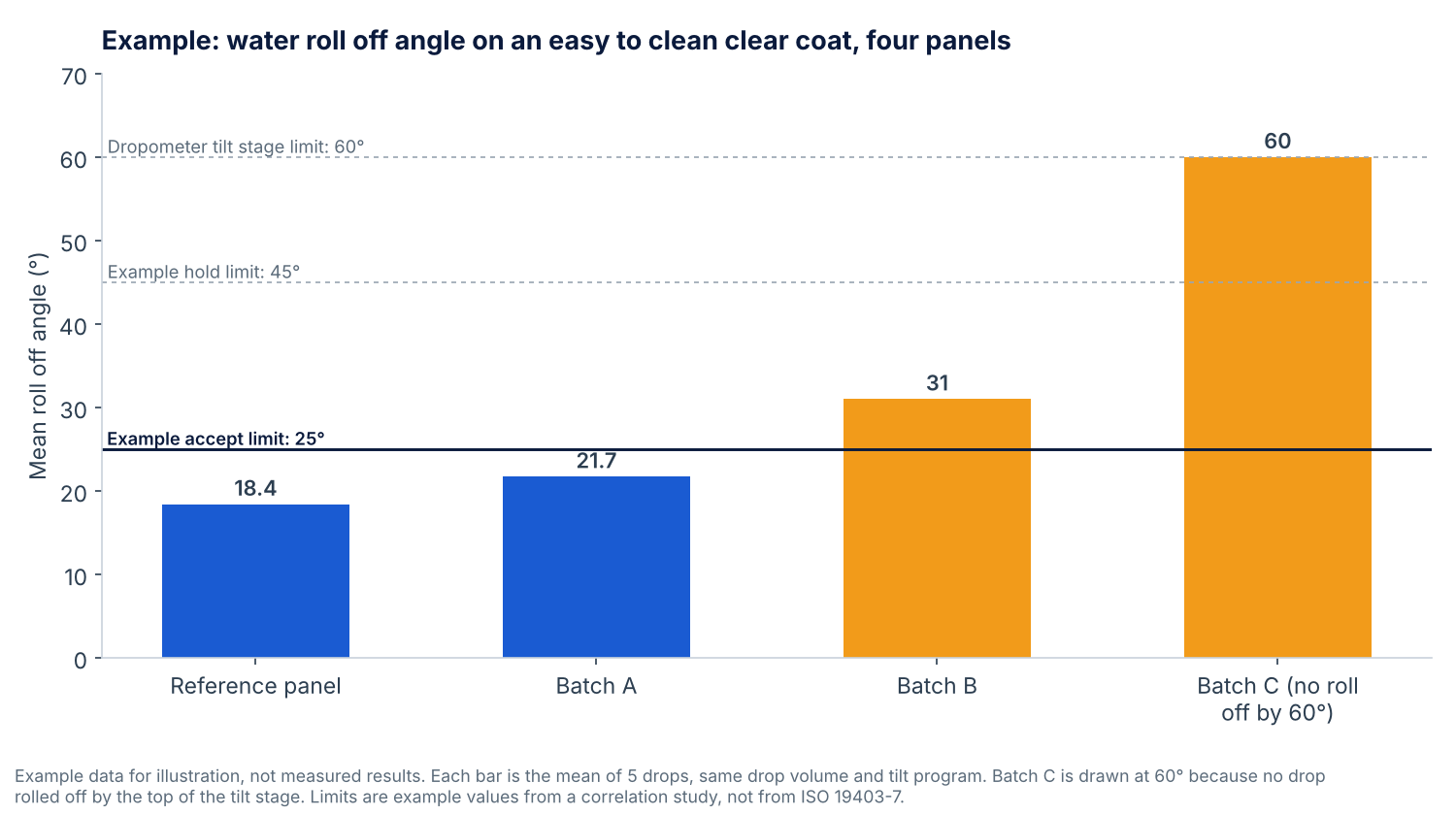
Example data, not measured results.
What changes when the check is a measured roll off angle
| Metric | Before Dropometer | With Dropometer | Results |
|---|---|---|---|
| How repellency is checked | Static contact angle, or drops watched by eye on a tilted panel | Roll off angle read on a tilt stage, with front and back angles | No published benchmark |
| Result format | Beads or does not bead | A tilt angle per drop plus two contact angles, ±0.35° accuracy | Dropometer product specification |
| Record | Operator note | Drop images and angles saved per measurement | No published benchmark |
| Drops that hold past 60° | Lab instrument with a tilt stage that reaches further | Reported as above 60°; still needs that instrument for a value | Dropometer product specification |
Bring two panels: one that cleans easily and one that holds drops. We will tilt drops on both live.
Enter your own numbers. The defaults are examples, not Droplet Lab results.
Quality cost snapshot
Result
Annual exposure combines audit/CAPA cost, customer rejections, and recall probability; avoided exposure applies the risk reduction percentage.
Lock these before you compare results between shifts, labs or sites
| Parameter | Recommended Setting | Technical Rationale |
|---|---|---|
| Test liquid | As the standard specifies, the same for every run | Each liquid gives its own roll off angle. Do not compare across liquids. |
| Drop volume | As the standard specifies, fixed for every drop | Gravity drives roll off, so a bigger drop rolls at a lower tilt. |
| Tilt rate | As the standard specifies; automatic sliding stage add-on | Faster tilting reads higher roll off angles. The manual stage rate depends on the operator. |
| Tilt range | 0 to 60° on the Dropometer | Report drops that hold at 60° as above 60°, or use a stage that tilts further. |
| Roll off criterion | Both contact points moved by the distance the standard sets | A drop that only stretches has not rolled off yet. |
| Fit model | Polynomial, the same for every run | The Dropometer software uses the polynomial model for tilted drops, which are not symmetric. |
| Replicates | Several drops per panel, each on a spot not wetted before | A wetted spot can hold residue or water and change the next reading. |
| Environment | Record room temperature and humidity | The Dropometer runs at 10 to 45 °C and has no temperature or humidity control. |
Pick the method by the question you need answered
Start: What do you need to know about how drops leave your coating?
You test easy to clean or anti adherent coatings and need the tilt at which a drop rolls off, with the front and back angles.
Use ISO 19403-7, this page. The Dropometer is partially compliant: it runs the measurement on its 0 to 60° tilt stage, with the automatic sliding stage add-on for a fixed tilt rate.
Your coating pins drops at steep tilts, and you need a roll off value rather than a result of above 60°.
Use ISO 19403-7 on a lab instrument with a tilt stage that reaches 90°. The Dropometer can still screen batches as below or above 60°.
You want hysteresis from a growing and shrinking drop without tilting the panel.
Use EN ISO 19403-6. The Dropometer adds and withdraws liquid through the needle.
Your coating becomes more wettable under UV light, and you need the water contact angle over the exposure.
Use ISO 27448. The Dropometer reads the water contact angle; the UV exposure needs your own light source.
Start from the question you need answered. Blue boxes are measurements the Dropometer runs.
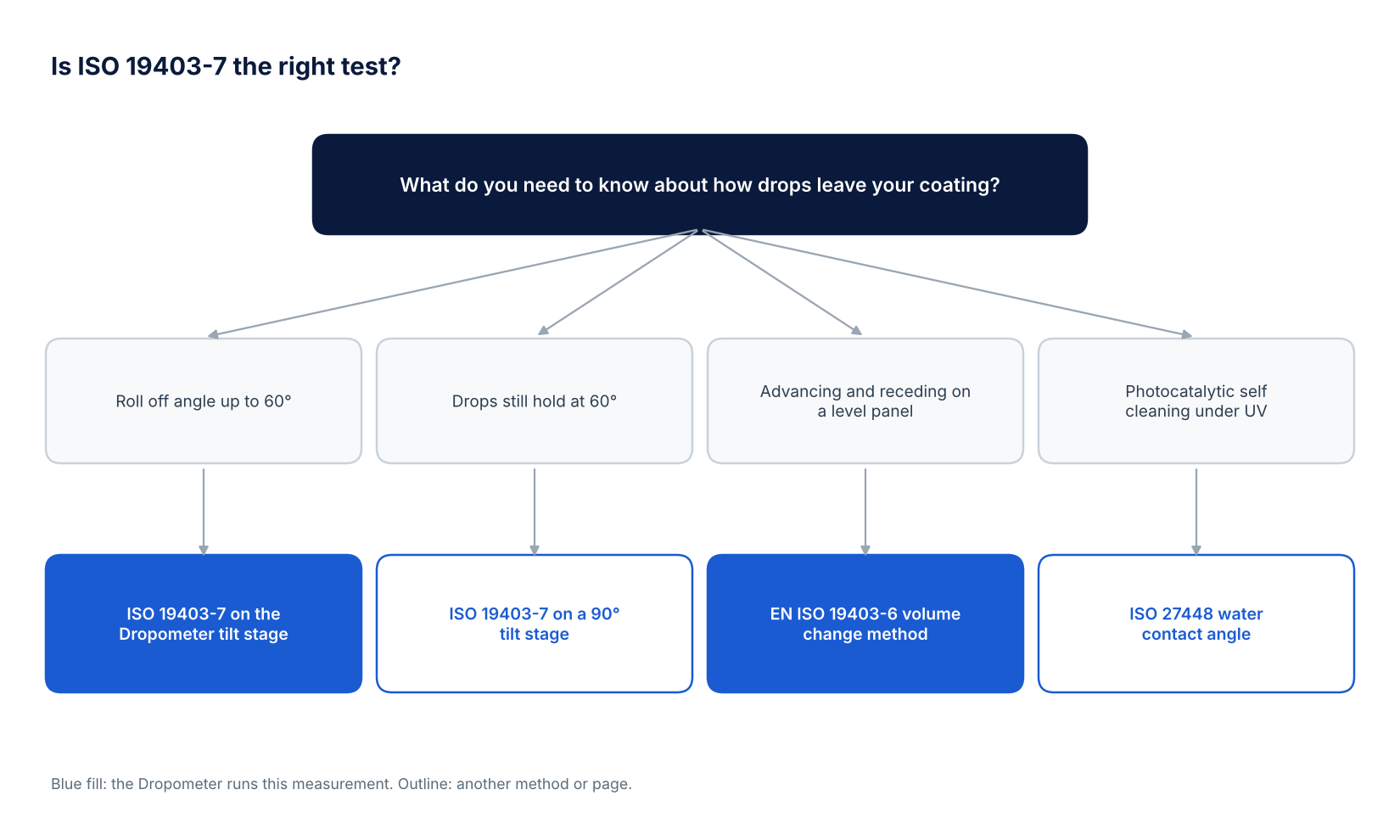
Is ISO 19403-7 the right test?
What the roll off angle tells you, and what it does not
Honest limits of the method and of the Dropometer
It specifies a method for the dynamic measurement of the roll off angle of a liquid drop on a solid surface: the tilt at which the drop starts to roll off a paint or varnish film on a tilt stage. It also reads the angles of the drop rolling off at that moment, advancing at the front and receding at the back. The result helps you evaluate easy to clean and anti adherent surfaces.
In part. The Dropometer places the drop, tilts the panel from 0 to 60° and reads the roll off angle and the front and back angles with ±0.35° accuracy. For a fixed tilt rate, use the automatic sliding stage add-on. Drops that still hold at 60° need a lab instrument with a stage that tilts further.
The 2024 edition replaces ISO 19403-7:2017, which Europe adopted as EN ISO 19403-7:2020. The new title names both results: the dynamic contact angles and the roll off angle on a tilt stage. Check the full text for detailed changes, and quote the edition your customer names in your report.
No. A high static angle shows that a drop is repelled, but not that it rolls off. Some rough or patchy surfaces bead water yet pin the drop. The roll off angle and the gap between the front and back angles show whether drops actually move. See sliding angle measurement.
Report the result as above 60° and note the tilt stage limit. For many QC checks that is enough to hold a batch. If you need the actual value, run those panels on an instrument with a tilt stage that reaches 90°.
Gravity pulls the drop down the slope, so a bigger drop rolls off at a lower tilt. Tilting faster reads a higher roll off angle, because the drop lags behind the stage. Fix both in your procedure and use the automatic sliding stage add-on for a steady rate.
This page summarises ISO 19403-7 in our own words and does not reproduce the standard. Buy the current edition from ISO or your national standards body before you write a procedure. The Dropometer is partially compliant with this method. Droplet Lab does not certify compliance. Your own method validation does.
Sources, review and tools
ISO 19403-7:2024 listing; ISO 19403-7:2017 listing (withdrawn); EVS-EN ISO 19403-7:2024 listing; DIN EN ISO 19403-7:2025-01 listing (DIN Media), the Dropometer product specification and Droplet Lab validation papers.
Drafted with Claude (Anthropic) from the sources listed, then reviewed by Droplet Lab.
We did not copy text from the standard. Buy the current edition for the full procedure.
October 2026
Spotted an issue in this summary? Send a correction request and our team will review it.
Correction Request
We work hard to keep this page accurate and up to date. If you spot an error (wrong revision/year, missing requirement, incorrect interpretation, or broken link), tell us and we'll review it.
Contact us to report a correction