
Wettability is set by the top five to ten ångström of a surface: what the liquid actually sees. It doesn't matter what lies beneath; that outermost layer is what you are really measuring.

ISO 27448 rates photocatalytic self cleaning by tracking the water contact angle while UV light breaks down an oleic acid film. The Dropometer reads that angle from 10° to 175° with ±0.35° accuracy, on a drop shape method validated in two peer reviewed papers. You supply the UV lamp and radiometer, and final angles below 10° need a goniometer that reads down to 0°.
What brings you here?
Quality manager
You need a number for each batch of self cleaning glass, tile or panel. The Dropometer reads the water contact angle between UV exposures, from 10° up, on battery at your UV bench.
R&D
You need to know whether ISO 27448 fits your coating, or whether you need a sliding angle or a methylene blue test. Use the decision tree to pick the method and the instrument.
Test lab
You need to know what the Dropometer covers before you quote ISO 27448 work. It reads angles from 10° up; your UV lamp, radiometer and a goniometer that reads to 0° cover the rest.
Free one page checklist for ISO 27448: what to prepare, the settings to lock, which part the Dropometer covers and what to record. Made for coating and glass labs.
Talk to an expert
Tell us your coating, substrate and UV setup. We will show the measurement live and tell you plainly which part of ISO 27448 the Dropometer covers and which part it does not.


Droplet Lab builds precision instruments and software for surface science measurement, specialising in contact angle analysis and surface tension characterisation. Used by researchers across materials science, pharmaceuticals, coatings, and advanced manufacturing, Droplet Lab's Dropometer has contributed to studies published in peer-reviewed journals including Advanced Functional Materials (Impact Factor 19). The team combines instrument engineering with deep domain knowledge in wettability science with a focus on practical accuracy.
ISO 27448:2009, Fine ceramics (advanced ceramics, advanced technical ceramics): test method for self-cleaning performance of semiconducting photocatalytic materials, measurement of water contact angle. It is one of the ISO testing methods for photocatalytic materials from ISO/TC 206, alongside ISO 10678 for the photocatalytic activity of surfaces in an aqueous medium by degradation of methylene blue. ISO lists it as confirmed in 2020, with a later systematic review closed in March 2026.
Partially compliant. The Dropometer reads the water contact angle from 10° to 175°. The method also needs UVA lamps at a set irradiance, a radiometer, an oleic acid coating step and a contact angle meter that reads down to 0°. The Dropometer provides none of the UV parts and does not read below 10°.
Contact angle range 10° to 175°, accuracy ±0.35°, display resolution 0.01°, camera 10 frames per second, from the Dropometer product specification.
The drop shape method is validated against a KRUSS DSA100E in two peer reviewed papers. See our validation publications.
We have no published client paper or case study on photocatalytic coatings to this method yet. For a related workflow, see self cleaning and anti soiling validation.
ISO describes the water contact angle as one factor in self cleaning performance. The final angle does not measure how fast the coating breaks down other soils. A methylene blue test to ISO 10678 measures photocatalytic activity in water, and other international standards cover air purification and antibacterial activity.
What this standard measures, who uses it and how the Dropometer fits
ISO 27448 rates the self cleaning performance of photocatalytic surfaces, such as titanium dioxide coated glass and tiles, by tracking the water contact angle while UV light breaks down an oleic acid film. Makers of self cleaning glass, facade panels, tiles and other building materials use it to compare the performance of photocatalytic materials across products and batches. The Dropometer is partially compliant: it reads the water contact angle from 10° to 175° with ±0.35° accuracy, but it has no UV source or radiometer, and it cannot read the near 0° angles that very active, superhydrophilic coatings reach.
The method cleans each specimen under UV, then coats it with oleic acid so the surface turns water repellent. It then irradiates the specimen with ultraviolet light (UVA) from a black light lamp, the UV light source, at a fixed irradiance and reads the water contact angle at five points at set intervals. The results are the final contact angle and the irradiation time taken to reach it.
The Dropometer contact angle and surface energy kit acts as the contact angle meter between UV exposures. Your own black light lamp and radiometer set the irradiance, and a goniometer that reads down to 0° covers final angles below 10°. For self cleaning products in the field, see self cleaning and anti soiling validation, including solar panels. For background, read the consumer products guide, or use the measurement method selector to pick a method.
Some self cleaning coatings work the other way: they are hydrophobic or superhydrophobic, so drops roll off and carry dirt away. That calls for a sliding angle, not this standard. See sliding angle measurement, the roll off and sliding angle glossary entry, reproducible sliding angle measurement and the roll off angle experiment on hydrophobic surfaces.
Further reading: water contact angle reference values for common surfaces, choosing a contact angle goniometer for ISO and GLP regulated, high throughput QC, and contact angle work on ski wax by a university lab, in the ski wax case study and our analysis of the ski wax and friction thesis. Those are water repellent surfaces, not photocatalytic coatings.
The ISO 27448 measurement, step by step, in our own words
These steps outline the procedure and show where the Dropometer fits and where other equipment takes over. They do not replace the standard. Buy the current edition and follow its specimen, irradiance, interval and reporting rules.
From the Dropometer product specification. Display resolution is 0.01°.
Covers the angle before UV and the fall to 10°. Final angles below 10° need a goniometer that reads to 0°.
Base plate, phone holder, LED and syringe. No PC needed. The UV lamp is yours.
Cut five flat specimens to the size the standard specifies and handle them with clean gloves. Clean each one under UV for the time and irradiance the standard specifies, using your own black light lamp and radiometer. The Dropometer has no UV source.
Coat each specimen with oleic acid by one of the two routes the standard gives: dip coating from a dilute solution in n-heptane, then oven drying, or wiping on a weighed amount by hand. Record which route you used, because it sets the UV irradiance for the test.
Level the base plate, mount the phone and LED, and fill the syringe with distilled water. Set the automatic dropper to one fixed drop volume and keep it for the whole test. Read the angle at five points, at the time after placement the standard specifies. The mean must be 20° or more for a valid test.
Place the specimen under your black light lamp at the irradiance the standard sets for your oleic acid route, checked at the specimen surface with your radiometer. Keep the room inside the temperature and humidity band the standard specifies, and record both.
At each interval, move the specimen to the Dropometer, read five points and return it to the lamp. Automatic edge and baseline detection gives the same reading from the same image. Once readings approach 10°, plan to confirm on a goniometer that reads down to 0°.
Stop when three consecutive means vary by 10% or less, or when the angle reaches 5° or less. Report the final angle, UV time, lamp, irradiance, oleic acid route and room conditions. State any reading taken on a second instrument. For field checks after the lab test, see self cleaning and anti soiling validation.
This video shows a complete Dropometer contact angle measurement, from setup to result. It covers the steps above in one run.
Independent benchmarking and publication-based validation references.
Peer reviewed method
The Dropometer drop shape method is validated against a KRUSS DSA100E in two peer reviewed papers, one in Review of Scientific Instruments and one in Colloids and Surfaces A. The product specification gives a contact angle accuracy of ±0.35°.
Customer evidence
We have no published client paper or case study on photocatalytic coatings to ISO 27448 yet. The self cleaning use case shows how water contact angle checks fit coating validation for glass and solar panels.
ISO 27448 · final contact angle · photocatalytic coating QC
ISO 27448 reports the final contact angle and the UV time to reach it for each specimen. The test is valid only if the mean angle before UV is 20° or more. You stop when three consecutive readings have a coefficient of variation of 10% or less, or when the angle reaches 5° or less (source: TCVN 8556:2010, the national adoption of ISO 27448:2009).
We found no pass or fail angle in the published summaries of the method. In a 2023 benchmark of industrial and experimental materials, the most active of the titanium dioxide photocatalytic films reached a final angle of 16 ± 4° after 20 min of UV, and other products took 360 and 3000 min (source: Peeters, Lenaerts and Verbruggen, Materials, 2023). That spread shows why limits must come from your own product.
Set your accept limit from a correlation study. Test coatings that stayed clean in field exposure and coatings that did not, then pick the final angle and UV time that separate them. Repeat the study when you change the coating, the substrate or the lamp.
Example data for illustration only. These are not measured results. Your own coating, lamp and limits decide the numbers.
| Specimen | Angle before UV (°) | Angle at 24 h UV (°) | Final angle (°) | CV of last 3 (%) | Decision |
|---|---|---|---|---|---|
| Coating A, final at 72 h | 71.2 | 16.4 | 15.4 | 6.0 | Accept |
| Coating B | 69.8 | Below 10 | Below 10 | n/a | Below Dropometer range: confirm on a goniometer that reads to 0° |
| Coating C, final at 72 h | 73.5 | 58.4 | 54.0 | 7.4 | Above limit: hold the batch |
Each value is the mean of five drop positions on one specimen. The decision column uses an example accept limit of a final angle of 20° or lower within 72 h of UV, set from a field correlation study. Readings below 10° are outside the Dropometer range, so no number is shown.
The same example data as the table, plotted over 72 h of UV. Coating B has no points after 8 h because its angle fell below the Dropometer's 10° lower limit.
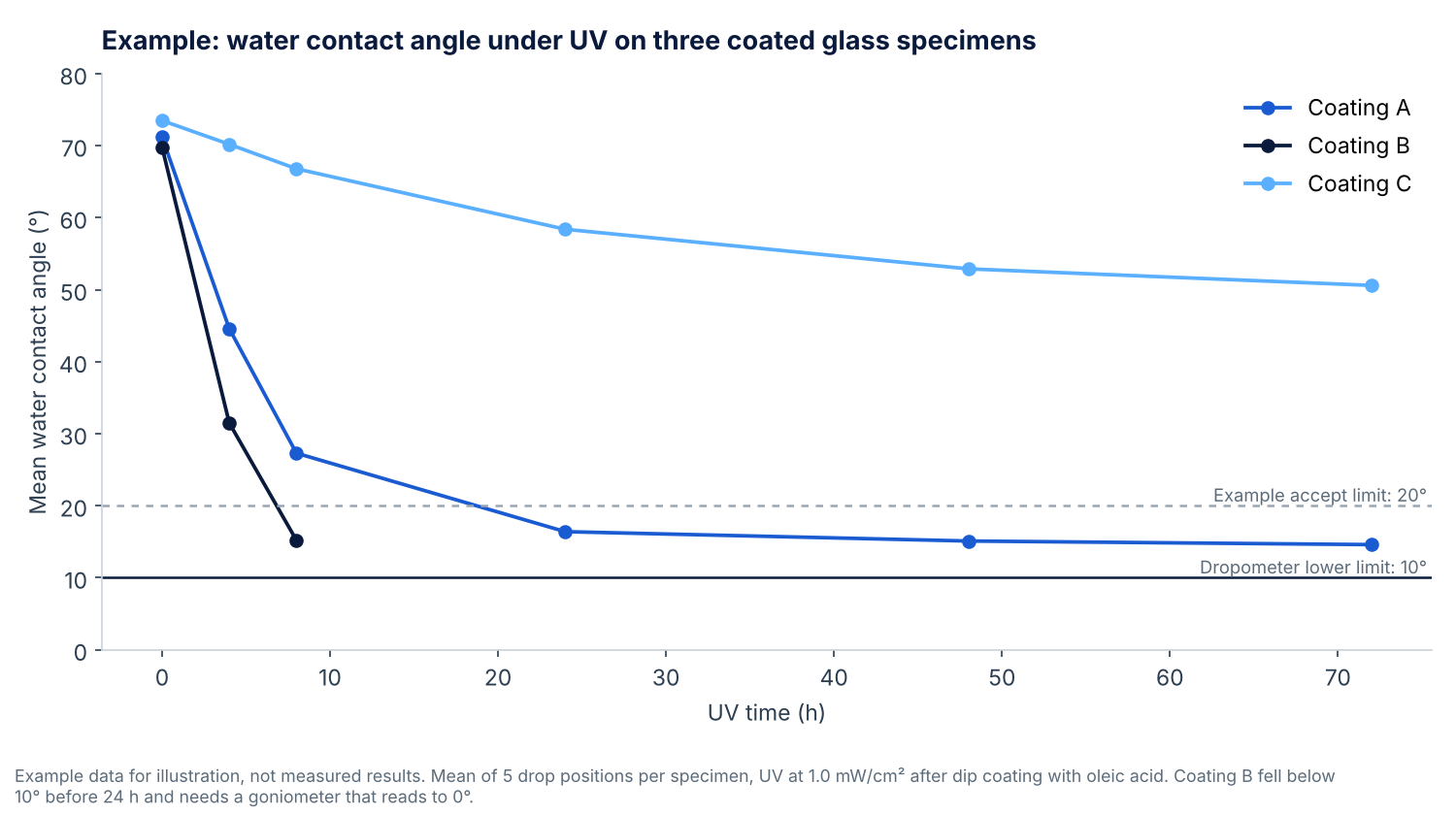
Example data, not measured results.
What changes when the contact angle meter sits next to your UV bench
| Metric | Before Dropometer | With Dropometer | Results |
|---|---|---|---|
| Where the angle is read | Shared lab goniometer, away from the UV bench | Next to the UV bench, on battery for up to 8 h | Dropometer product specification |
| Result format | Water beading judged by eye | An angle per drop from 10° to 175°, ±0.35° accuracy | Dropometer product specification |
| Record | Operator note | Drop image and angle saved per reading | No published benchmark |
| Final angles below 10° | Goniometer that reads to 0° | Still needs that goniometer | Dropometer product specification |
Bring a coated specimen that cleaned well in the field and one that did not. We will read the water contact angle on both live.
Enter your own numbers. The defaults are examples, not Droplet Lab results.
Quality cost snapshot
Result
Annual exposure combines audit/CAPA cost, customer rejections, and recall probability; avoided exposure applies the risk reduction percentage.
Lock these before you compare coatings, batches or labs
| Parameter | Recommended Setting | Technical Rationale |
|---|---|---|
| Test liquid | Distilled water | This is a water contact angle method. |
| Drop volume | One fixed volume, reported | A 2023 benchmark notes the standard does not set a drop volume; its authors used 4 µL. The automatic dropper doses down to 0.05 µL. |
| Reading time | As the standard specifies, a few seconds after placement | At 10 frames per second the Dropometer suits a fixed reading time of this length. |
| Positions and specimens | Five points per specimen, five specimens | The final angle is set per specimen from the mean of five points. |
| UV irradiance | 1.0 or 2.0 mW/cm², from your own lamp and radiometer | The UV irradiation level depends on the oleic acid route (TCVN 8556:2010). The Dropometer has no UV source. |
| Stop rule | CV of three consecutive means 10% or less, or angle 5° or less | The Dropometer cannot confirm the 5° point. Readings below 10° need a goniometer that reads to 0°. |
| Fit model | Young-Laplace or polynomial, the same for every reading | Both models are in the Dropometer software. Low angles give flat drops, so keep one model per study. |
| Environment | 23 ± 5 °C and 40 to 70% RH; record both | Conditions from TCVN 8556:2010. The Dropometer runs at 10 to 45 °C and has no temperature or humidity control. |
Pick the method by the question you need answered
Start: How does your coating keep itself clean?
Your coating is a UV active photocatalyst, such as titanium dioxide, and its final angle stays at 10° or above.
Use ISO 27448, this page. The Dropometer is partially compliant: it reads the angles and your own UV lamp and radiometer run the exposure.
Your coating turns superhydrophilic, or you must confirm the 5° stop point.
Use ISO 27448 with a goniometer that reads down to 0° for the final readings. The Dropometer covers the earlier readings from 10° up.
Your coating is water repellent and cleans by roll off, not by UV.
Use a sliding angle test such as ISO 19403-7. See sliding angle measurement.
You need to know how fast the coating breaks down a dye in water.
Use the methylene blue test to ISO 10678. The Dropometer does not run that test.
Start from how your coating cleans itself. Blue boxes are measurements the Dropometer runs; for ISO 27448 that is the angle reading from 10° up, with your own UV lamp.
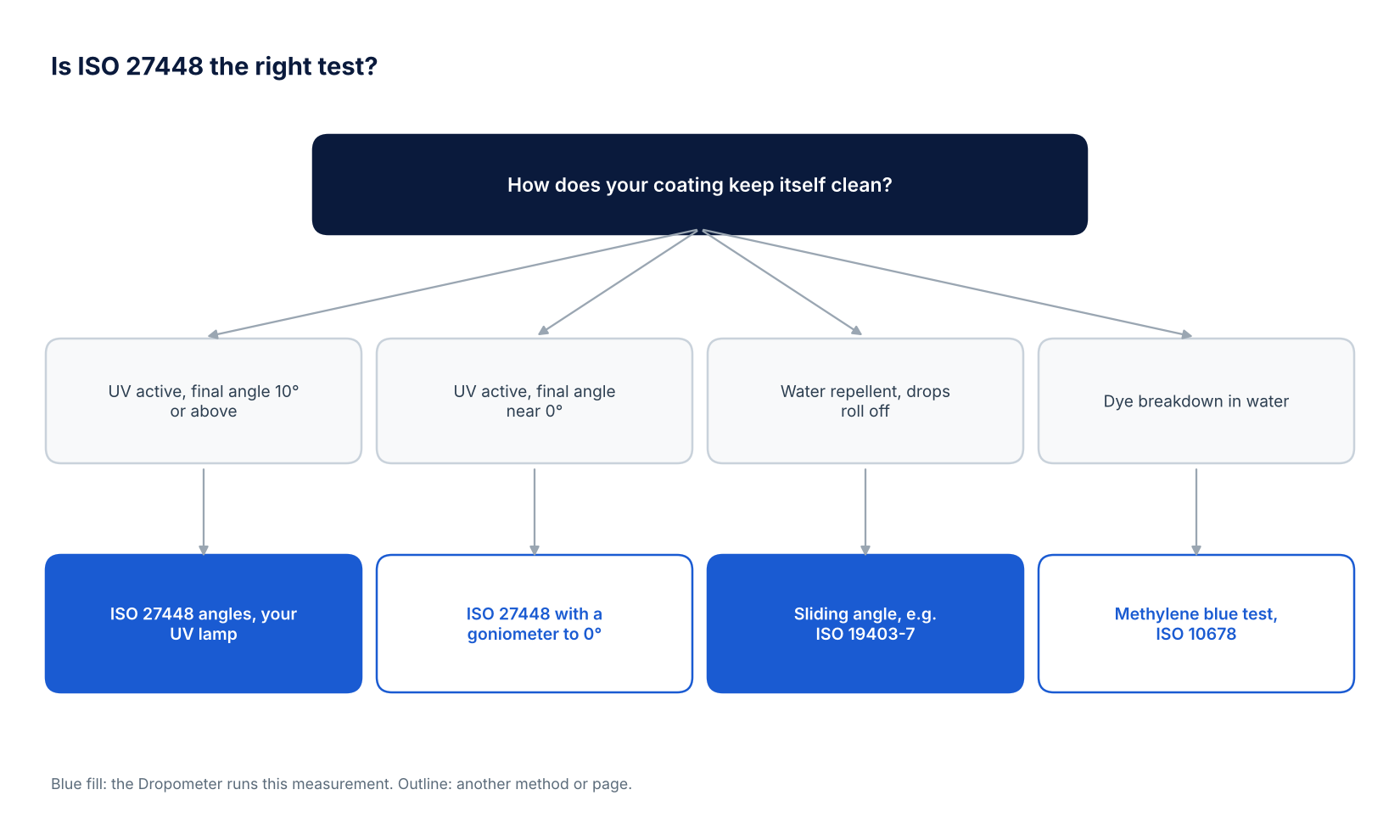
Is ISO 27448 the right test?
What the falling angle tells you, and what it does not
Honest limits of the method and of the Dropometer
It measures how the water contact angle on a photocatalytic surface falls under UV light, after the surface is coated with oleic acid. The final contact angle and the UV time to reach it rate self cleaning performance. It is aimed at semiconducting photocatalytic materials such as titanium dioxide, the semiconductor behind most self cleaning glass.
In part. The Dropometer reads the water contact angle from 10° to 175° with ±0.35° accuracy, so it covers the angle before UV and the fall to 10°. It has no UV source or radiometer, so you supply the black light lamp. Final angles below 10°, and the 5° stop point, need a goniometer that reads down to 0°.
The reading leaves the Dropometer range. Move the specimen to a goniometer that reads down to 0° for the remaining readings, and report which instrument gave the final angle. Not every coating gets there: a 2023 benchmark reported a final angle of 16 ± 4° for its most active titanium dioxide film.
A fluorescent black light lamp giving UVA between 300 and 400 nm, with a peak near 351 nm. The irradiance at the specimen is 1.0 or 2.0 mW/cm², depending on how the oleic acid was applied (source: TCVN 8556:2010, the national adoption of ISO 27448:2009). Check it with a calibrated radiometer. Other light sources, including visible light lamps, fall outside this method.
Water permeable substrates, rough surfaces that hide the drop, highly hydrophobic materials, granular materials and visible light sensitive photocatalysts. For indoor light photocatalysts, see ISO 19810. For water repellent coatings that clean by roll off, see ISO 19403-7.
No. A low angle shows the oleic acid film has broken down and water spreads. It does not show the full self cleaning properties of the coating: how it handles real soil, rain or abrasion. Use the angle to compare coatings and batches, and set limits from field exposure on your own product.
ISO 27448 is the ISO test for self cleaning by water contact angle measurements. Other ISO standards from the same committee rate photocatalysis in other ways: ISO 10678 by degradation of methylene blue in water, and separate standards cover air purification and antibacterial activity. Each rates a different property, so a coating can do well on one and poorly on another. The Dropometer runs only the contact angle part.
This page summarises ISO 27448 in our own words and does not reproduce the standard. Buy the current edition from ISO before you write a procedure. The Dropometer is partially compliant with this method. Droplet Lab does not certify compliance. Your own method validation does.
Sources, review and tools
ISO 27448:2009 listing (ISO); ISO 27448:2009 sample pages (iTeh); TCVN 8556:2010, national adoption of ISO 27448:2009; Peeters, Lenaerts and Verbruggen, Benchmarking the photocatalytic self cleaning activity of industrial and experimental materials with ISO 27448:2009, Materials 16 (2023) 1119, the Dropometer product specification and Droplet Lab validation papers.
Drafted with Claude (Anthropic) from the sources listed, then reviewed by Droplet Lab.
We did not copy text from the standard. Buy the current edition for the full procedure.
October 2026
Spotted an issue in this summary? Send a correction request and our team will review it.
Correction Request
We work hard to keep this page accurate and up to date. If you spot an error (wrong revision/year, missing requirement, incorrect interpretation, or broken link), tell us and we'll review it.
Contact us to report a correction