



Contents
Case Study

Ski wax makers sell waxes by snow temperature. A University of Utah lab measured whether the wax is most water repellent where the label says.

Last Updated
October 18, 2026
Industry
Polymer materials research
Location
Salt Lake City, Utah, USA
Customer since
January 2021
Published with the Dropometer
2022 conference paper, 2024 article, 2024 MS thesis
Image
Kramer 2024, Fig. 6, CC BY 4.0
Named in a 2024 University of Utah research article Drop shape method validated against a KRÜSS DSA100E in peer review 2 peer reviewed validation papers

Prof. Jeffrey Bates's experimental polymers lab in Materials Science and Engineering chose a manual Dropometer one week after asking for a quote in January 2021. After the FIS ban on fluorinated ski waxes, the lab measured water contact angle on four Swix low fluorinated glide waxes, cold and at room temperature. Contact angle, like hardness and friction, did not follow the use temperatures printed on the wax.

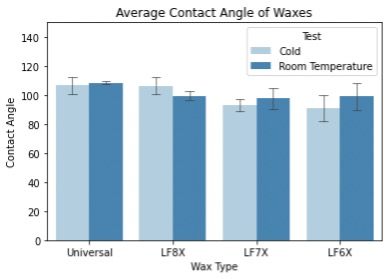
Bar chart of average water contact angle on four Swix low fluorinated ski glide waxes at cold and room temperature, measured with the Dropometer (Kramer 2024, Fig. 6, CC BY 4.0)
Abhimanyu Photo
Written by
Abhimanyu Bhandankar
Holds an MBA from Schulich School of Business and a BE in IT. He joined Droplet Lab in July 2019 and now leads sales and marketing.
CEO at Droplet Lab
Read More
Gurdeep-Saini-Photo
Technical Review by
Gurdeep Singh Saini
Holds a BASc in Mechanical Engineering from Ryerson University (now Toronto Metropolitan University) and an MASc from York University. He develops the automatic edge and baseline detection behind the Dropometer's analysis.
COO at Droplet Lab
Read More
Abhimanyu Photo
Written By

Abhimanyu Bhandankar

CEO at Droplet Lab

Holds an MBA from Schulich School of Business and a BE in IT. He joined Droplet Lab in July 2019 and now leads sales and marketing.

Gurdeep-Saini-Photo
Reviewed By

Gurdeep Singh Saini

COO at Droplet Lab

Holds a BASc in Mechanical Engineering from Ryerson University (now Toronto Metropolitan University) and an MASc from York University. He develops the automatic edge and baseline detection behind the Dropometer's analysis.

Primary outcome: water contact angle did not follow the waxes' marketed temperatures

Average water contact angle, cold vs room temperature (about 18.5 °C)

Four Swix low fluorinated glide waxes on sintered UHMWPE ski base; averages read from Kramer, RANGE: Journal of Undergraduate Research, 2024, Fig. 6, and rounded

LF6X (sold for -10 to -5 °C): cold vs room About 91° vs 99°
LF7X (sold for -8 to -2 °C): cold vs room About 93° vs 98°
LF8X (sold for -4 to 4 °C): cold vs room About 106° vs 99°
Universal (all conditions): cold vs room About 107° vs 108°

Averages read from Figure 6. LF6X, sold for -10 to -5 °C, read about 91° cold and 99° at room temperature. LF7X, sold for -8 to -2 °C, read about 93° and 98°. LF8X read about 106° and 99°, and Universal stayed near 107 to 108°. The error bars overlap for LF6X and LF7X. With hardness and friction, the author found no correlation with the advertised use temperatures.

4 waxes

Swix LF6X, LF7X, LF8X and Universal low fluorinated glide waxes on sintered UHMWPE ski base.

2 temperatures

Samples tested cold and at about 18.5 °C, with room temperature water drops.

3+ samples each

At least three samples of every wax at every temperature, averaged.

1 week to order

From the website quote request on 4 January 2021 to choosing the manual version on 11 January.

Executive Summary

Who

Prof. Jeffrey Bates's experimental polymers lab in the Department of Materials Science and Engineering at the University of Utah in Salt Lake City. Graduate and undergraduate students study polymer surfaces, including ski bases and ski waxes.

Problem

After fluorinated ski waxes were banned from competition, wax makers and skiers needed to know why waxes glide the way they do. Hydrophobicity is one of the main proposed mechanisms, but there were no standard tests linking it to the use temperatures printed on wax packaging.

Solution

A manual Dropometer for contact angle and surface tension, ordered in January 2021 after a website quote request. In the 2024 ski wax study, room temperature water drops were placed on waxed ultra high molecular weight polyethylene (UHMWPE) ski base discs, cold and at about 18.5 °C, and the angles were found with the included software.

Time to Value

4 January 2021: quote request through the website. 5 January: quotes for manual and automatic versions. 11 January: manual version chosen. 13 January: purchase order. 29 March 2021: delivered. 2022: conference paper. March 2023: free software update. 2024: ski wax article and MS thesis.

Results

In a 2024 article, the two waxes sold for the coldest snow read lower average contact angles in the cold than at room temperature, though their error bars overlap. The Universal wax stayed near 107 to 108° at both. With hardness and friction tests, the author found no correlation between the waxes' properties and their advertised use temperatures.

Highlights

~91° vs 99°

LF6X average, cold vs room

4

Waxes compared

3

Publications from the lab

2021

Customer since

Quote teaser

This is like one of the most easy, robust, straightforward contact angle setup that I've seen.

University of Utah, at a glance

Research focus

Experimental polymers: polymer surfaces and interfaces, including ski bases, ski waxes and polymers in contact with biological systems.

Products / applications

Ski glide wax performance after the fluorinated wax ban; polymer interfaces with small scale biological systems.

Measurement stage

Research characterisation alongside hardness, friction and spectroscopy.

Users

Graduate and undergraduate students and postdoctoral researchers in Materials Science and Engineering.

Materials and surfaces tested

Low fluorinated paraffin glide waxes on sintered UHMWPE ski base, with water.

Key constraints

Soft wax surfaces; testing at more than one temperature; many student operators.

The challenge: testing a performance claim the ski industry never had to prove

Fluorinated waxes were gone. Nobody could say exactly why the replacements should work.

Why ski wax suddenly needed science

Fluorinated ski waxes have been banned from FIS competition over health and environmental concerns. Makers and skiers needed to understand which properties actually drive glide, so replacements could be judged on evidence. The same question runs through ski wax hydrophobicity and glide testing and the repellency work in our consumer products wetting guide.

The claim being tested

Waxes are sold for specific snow temperatures. A common belief is that a wax is hardest, slipperiest and most water repellent at its marketed temperature. Hydrophobicity is one of the three proposed mechanisms Clara Kramer tested in her 2024 article, summarised in our analysis of the low fluorinated ski glide wax study.

Why it is hard to measure

Wax is soft and its properties change with temperature. Each wax must be applied, scraped and brushed the same way, then measured at more than one temperature on the real ski base material. A static angle is only part of the picture, because contact angle hysteresis and roll off also shape how water leaves a ski base. Our sliding angle measurement guide, the notes on reproducible sliding angle measurement and experiment 8 on roll off angle on hydrophobic surfaces cover that next step. The Utah study measured static contact angle only.

What success would require

The lab needed a contact angle instrument of its own that students could run on many samples, at two temperatures, with angles found by software rather than by hand. Teams weighing methods can start with our measurement method selector. Water contact angle on a coated surface is also the readout in ISO 27448 for photocatalytic self cleaning surfaces, where the Dropometer supports the contact angle step only.

The insight: measure hydrophobicity on the real ski base, at more than one temperature

What Was Deployed

Delivered configuration (ordered January 2021, delivered 29 March 2021): a manual Dropometer contact angle and surface tension kit with phone camera and sample stage, without the automatic dropper or tilting stage. In the 2024 ski wax study, Swix LF6X, LF7X, LF8X and Universal waxes were ironed onto 60 mm sintered UHMWPE ski base discs at each maker's recommended iron temperature, then scraped and brushed the same way. Room temperature water drops were placed on cold samples and on samples at about 18.5 °C, and the angles were found with the included software. The article does not report the drop volume.
The Origin

"We frequently need to make contact angle measurements"

On 4 January 2021, Prof. Jeffrey Bates filled in the quote form on Droplet Lab's website: "I have an experimental polymers research lab at the University of Utah, and we frequently need to make contact angle measurements." Droplet Lab sent quotes for a manual and an automatic version the next day. On 11 January he wrote, "I will proceed with purchasing the manual device," and the university issued its purchase order two days later. He added on 26 January: "We're looking forward to adding contact angle measurement abilities to our lab." The instrument arrived on 29 March 2021. Graduate and undergraduate students then used it across the lab's polymer work, including ski glide waxes after the fluorinated wax ban. Lorenz Cushman's 2024 MS thesis lists contact angle among its laboratory tests; see our analysis of the ski wax friction thesis. Labs comparing instruments can read our guide to the best contact angle goniometer for advanced research.
Decision Rationale

Manual, decided in a week

The lab compared two versions and one phone upgrade before ordering.

Option A

Manual Dropometer, standard phone

Contact angle and surface tension, manual drop placement.

Chosen
Option B

Manual Dropometer, upgraded phone

Same instrument with a newer phone model.

Not chosen: the quote was already with purchasing.
Option C

Automatic Dropometer

Automatic dropper for hands off drop placement.

Not chosen.
The lab chose the manual version over the automatic one, and kept the standard phone because the quote was already with purchasing. For a polymer lab placing single drops on flat samples, manual dispensing was enough, and the decision took one week from first contact. The trade off came later: the original phone slowed by 2023 and failed in March 2024, and the lab bought a newer model. Ski wax data like this is what our open dataset of client collected wetting measurements is gathering from customer labs.

Next Step

Testing a coating that has to repel water in the cold?

The Dropometer measures contact angle and surface tension in a portable 1 kg kit. Its drop shape method is validated against a KRÜSS DSA100E in peer review, and setup takes about 2 minutes. Book a 15 minute demo and bring a coated sample.

Before vs After

Metric Before After
Contact angle in the lab No instrument of its own Manual Dropometer from March 2021
Quote request to order None One week (4 to 11 January 2021)
Hydrophobicity of cold snow waxes vs use temperature Assumed highest at the marketed temperature Lower average in the cold for LF6X and LF7X; error bars overlap
Universal wax, cold vs room temperature Untested in the lab About 107° vs 108°, essentially unchanged
Lab publications using the Dropometer None before 2021 2022 conference paper, 2024 article, 2024 MS thesis

Rollout timeline

Timeline (high level)

January 2021: Quote to order in one week

  • Website quote request on 4 January; quotes on 5 January
  • Manual version chosen on 11 January; purchase order on 13 January

March 2021: Delivered

  • Manual Dropometer with contact angle and surface tension
  • Delivered to the lab on 29 March 2021

2021 to 2023: Lab use

  • Graduate and undergraduate students measure polymer surfaces
  • 2022 conference paper on polymer interfaces and sperm viability

March 2023 to March 2024: Software and phone

  • Free software update delivered remotely in March 2023
  • Updated app sent to a student in December 2023 after capture problems
  • Original phone failed in March 2024; the lab bought a newer phone

2024: Ski wax results

  • Undergraduate article on four low fluorinated waxes, with Dropometer contact angles
  • MS thesis on ski wax material properties and friction

Proof and validation: what the ski wax study shows, and what it does not

Test method

Static water contact angle on four Swix low fluorinated glide waxes (LF6X, LF7X, LF8X, Universal) ironed onto 60 mm sintered UHMWPE ski base discs. Room temperature water; samples tested cold and at about 18.5 °C. Figure 6 labels the cold set only as Cold, and the article gives no drop volume. Angles found with the Dropometer's included software.

Sample size and operators

At least three samples of each wax at each temperature, averaged; drops per sample not reported. One undergraduate researcher ran the study, mentored by Prof. Bates.

Repeatability / reproducibility

Figure 6 shows error bars of roughly 1 to 9 degrees; the article does not say what they represent or tabulate them. For LF6X and LF7X the cold and room temperature bars overlap. Values on this page are read from the chart and rounded.

Notes / assumptions

This is an undergraduate research article, not a peer reviewed paper. Both test temperatures sit above most of the waxes' use ranges, as the author notes. The article's text names LF7X and LF8X as higher at room temperature, while its Figure 6 shows LF7X and LF6X higher at room temperature and LF8X higher in the cold; this page follows the figure. The 2024 MS thesis is listed, not quoted.

Outcomes to date

Measured Outcomes

~91° vs 99°

LF6X, cold vs room temperature

The wax sold for the coldest snow read a lower average contact angle cold than at room temperature, with overlapping error bars (Kramer, RANGE: Journal of Undergraduate Research, 2024, Fig. 6).

~107° vs 108°

Universal wax

The all conditions wax kept almost the same contact angle at both temperatures, as its label suggests.

None found

Correlation with marketed use temperature

Across contact angle, hardness and friction, the author found no correlation between measured properties and the waxes' advertised use temperatures.

Operational Outcomes

Fast decision

One week from first contact to choosing the manual version.

Student run

Undergraduate and graduate researchers produced contact angle data used in a published article and an MS thesis.

Published output

A 2022 conference paper, a 2024 research article and a 2024 MS thesis from the lab.

What the lab said

This is like one of the most easy, robust, straightforward contact angle setup that I've seen.
Postdoctoral researcher - Materials Science and Engineering

What's next

Delivered

Ski wax hydrophobicity vs use temperature (RANGE: Journal of Undergraduate Research, 2024)
MS thesis on ski wax material properties and friction (2024)
Conference paper on polymer interfaces and sperm viability (2022)

In Pilot

A further paper from the lab using contact angle is under review

Frequently asked questions

Is ski wax most water repellent at its marketed temperature?

Not in this study. In a 2024 University of Utah article, the two waxes sold for the coldest snow read lower average contact angles in the cold than at room temperature, though their error bars overlap. With hardness and friction tests, the author found no correlation with the advertised use temperatures.

How were the waxes measured?

Four Swix low fluorinated waxes were ironed onto sintered UHMWPE ski base discs, then scraped and brushed the same way. Room temperature water drops were placed on cold samples and on samples at about 18.5 °C, and the angles were found with the included software.

Which configuration did the lab choose?

A manual Dropometer for contact angle and surface tension, without the automatic dropper or tilting stage. The lab chose it one week after asking for a quote in January 2021, and it was delivered on 29 March 2021.

Next Step

Testing a coating that has to repel water in the cold?

The Dropometer measures contact angle and surface tension in a portable 1 kg kit. Its drop shape method is validated against a KRÜSS DSA100E in peer review, and setup takes about 2 minutes. Book a 15 minute demo and bring a coated sample.