“
Not all contact-angle measurements are created equal: the right method depends on the application. A sessile drop and a tilted plate can give very different, and equally correct, numbers.

AATCC TM193 grades how well a finished fabric resists wetting by a fixed series of water and isopropanol mixtures, judged by eye. The Dropometer is partially compliant: it measures the contact angle of each test liquid on the fabric with the fabric holder, and checks each liquid's surface tension by pendant drop with ±0.03 mN/m accuracy (Dropometer datasheet). Contact angle is an alternative method, not the visual grading method the standard specifies; if a contract or customer requires an AATCC TM193 result, run a correlation study on your own samples first.
What brings you here?
Quality manager
You grade fabric to AATCC TM193 by eye. Adding the angle of each test liquid gives you a number you can trend by lot and by wash count.
R&D chemist
You need to compare finishes that reach the same grade. The angle of each test liquid shows which one holds up better, before the grade changes.
Lab technician
A grade is only as good as the liquid behind it. Check each water and isopropanol mixture by pendant drop before it touches a fabric.
Free one page checklist for AATCC TM193 with the Dropometer: how to check the test liquids, the settings to lock, how to read angles next to the visual grade and what to record. Made for textile QC and finish labs.
Talk to an expert
Tell us your fabric, finish and the grade your customer asks for. We will check a test liquid and measure angles on your fabric live, and tell you plainly where the Dropometer fits next to the visual grade and where it does not.


Assistant Research Professor, UMass Lowell
Expertise
Bio-inspired surface science and engineering; Roll-to-Roll processing for functional polymeric surface; High-rate manufacturing of polymer nanocomposites
Research Interests
Education
Ph.D.: University of Massachusetts Lowell, 2016
MS: University of Science and Technology of China, 2011
BS: Xidian University, 2007
AATCC TM193-2023, Test Method for Aqueous Liquid Repellency: Water/Alcohol Solution Resistance, from AATCC. It ranks how well a finished fabric resists wetting by a fixed series of water and isopropanol (IPA) mixtures. It does not measure a universal critical surface tension. ISO 23232:2009 covers a test of the same name for textiles.
Partially compliant. The Dropometer measures the wetting the standard is after, as the contact angle of each test liquid on the fabric, and checks each liquid's surface tension by pendant drop. Contact angle is an alternative method, not the visual grading method the standard specifies. If a contract or customer requires an AATCC TM193 result, run a correlation study on your own samples first.
Contact angle range 10° to 175°, accuracy ±0.35°, display resolution 0.01°. Pendant drop surface tension up to 75 mN/m, accuracy ±0.03 mN/m. Both from the Dropometer product specification.
The drop shape method is validated against a KRUSS DSA100E in two peer reviewed papers. See our validation publications.
Researchers used a Droplet Lab tabletop goniometer to measure water contact angle on electrospun polystyrene fibre mats, with values from 130.1° to 143.2° (Macromolecular Rapid Communications, 2024). Read our analysis of the paper. We have no published client study run to AATCC TM193 itself.
The grade and the angle show resistance to wetting by the test liquids. Neither measures resistance to rain or water under pressure, and ISO notes the grade is not an absolute measure of stain resistance. Pair them with the test your product needs.
What this standard measures, who uses it and how the Dropometer fits
AATCC TM193 is the aqueous liquid repellency test: drops of water and isopropanol mixtures, each with a lower surface tension than the last, go on the fabric, and the grade is the highest numbered liquid that does not wet it. Surface tension alone does not decide the result. On the same siloxane finish, water and IPA mixtures can hold much higher contact angles than alkanes of similar surface tension (Acha et al., 2026). Polarity, hydrogen bonding, the dispersive and polar parts of surface tension, and how fast the liquid spreads all play a part. Textile mills, finish makers and brands use it to check durable water repellent and stain resistant finishes, often after home laundering. The Dropometer is partially compliant. It checks the surface tension of each test liquid by pendant drop and measures the contact angle of each liquid on the fabric, but it does not give the visual grade. Contact angle is an alternative method, not the visual grading method the standard specifies; if a contract or customer requires an AATCC TM193 result, run a correlation study on your own samples first.
The standard lists eight test liquids, from 98:2 to 40:60 water to isopropanol by volume. Published work using the method lists 50.0, 42.0 and 33.0 mN/m at 25 °C for liquids 2, 3 and 4 (Gels, 2023). A drop that stays clear and rounded passes. A drop that darkens the fabric or wicks in fails. On a textured fabric the angle you see is an apparent angle. Air can stay trapped under the drop, as the Cassie Baxter model describes, but whether it does depends on the liquid, the weave and time. Treat the model as a guide, not a prediction.
The Dropometer contact angle and surface energy kit reads each test liquid on the fabric holder with ±0.35° accuracy, and its pendant drop mode checks the liquids before you test. For the wider fabric workflow, see textile and DWR water repellency testing. Read our coated fabric contact angle case study, and our analysis of a study where researchers measured water contact angle on electrospun polystyrene fibre mats with the Dropometer. For background, read the fabrics guide and the contact angle measurement guide.
Further reading: reproducible contact angle measurement, choosing a contact angle goniometer for industrial QA, a classroom experiment on superhydrophobic glass and an open dataset of client collected wetting measurements.
Check the AATCC TM193 test liquids, then measure each one on the fabric, step by step
These steps describe a pendant drop check and a contact angle measurement on the Dropometer. They do not replace the visual grading in AATCC TM193. Buy the current edition and follow its liquids, drop size, timing and grading rules for any result you report to the standard.
From the Dropometer product specification. Display resolution is 0.01°.
Pendant drop surface tension accuracy, from the Dropometer product specification. Range up to 75 mN/m.
Base plate, phone holder, LED, syringe and fabric holder. No PC needed.
Mix each water and isopropanol liquid by volume in clean glassware, to the ratios the standard lists. Cap the bottles and label them with liquid number and date. Note the density of each mixture, because the pendant drop fit needs it.
Hang a drop of each liquid from a clean needle and read its surface tension. Compare it with the value the standard lists, and record room temperature. Remake any liquid that sits outside the tolerance you set, because alcohol can evaporate from an open bottle.
Condition the specimens as the standard specifies. Clamp each one flat and face up in the fabric holder, without stretching it. Handle it by the edges, because skin oils change wetting.
Start with the lowest numbered liquid and work up, as in the standard. Place the drop size the standard specifies, keep it the same for every drop and do not touch the fabric with the needle. Use a fresh spot for each drop.
Capture each drop at the observation time the standard sets. Published work used 10 s. Automatic edge and baseline detection reads the angle, so two operators get the same reading from the same image. Also note what you see by eye: a clear rounded drop, darkening or wicking. The Cassie Baxter model explains why textured fabric reads high.
Record the visual grade to the standard, the mean angle and spread for each liquid, wash count, room temperature and the liquid check values. State that the angles are contact angle results, not the AATCC TM193 grade. Use your correlation study to link the two.
This video shows a complete Dropometer contact angle measurement, from setup to result. It covers the steps above in one run.
Independent benchmarking and publication-based validation references.
Peer reviewed method
The Dropometer drop shape method is validated against a KRUSS DSA100E in two peer reviewed papers, one in Review of Scientific Instruments and one in Colloids and Surfaces A. Published accuracy is ±0.35° for contact angle and ±0.03 mN/m for surface tension (Dropometer product specification).
Customer evidence
A university team used a Droplet Lab goniometer to measure water contact angle on electrospun polystyrene fibre mats, published in Macromolecular Rapid Communications in 2024. We have no published client study run to AATCC TM193 itself.
AATCC TM193 · aqueous liquid repellency · textile finish QC
Each grade depends on a test liquid of the right composition. A pendant drop surface tension check confirms the liquid was made up correctly. Published work using the method lists 50.0 mN/m for liquid 2 (95:5 water to isopropanol), 42.0 mN/m for liquid 3 (90:10) and 33.0 mN/m for liquid 4 (80:20), all at 25 °C (source: Gels 2023, Table 1). Check every liquid by pendant drop against the value the standard lists, at a recorded room temperature, before you grade fabric.
AATCC TM193 gives a grade, not a contact angle limit. Your product specification or your customer sets the minimum grade. To use angles, run a correlation study: grade a set of fabrics by eye to the standard, measure the angle of the same test liquids on the same fabrics, then set your angle limits from that data.
Repeat the study when you change fibre, weave, finish chemistry or wash procedure. See reproducible contact angle measurement for bench practice.
Example data for illustration only. These are not measured results. Your own fabric, finish and wash procedure decide the numbers.
| Sample | Liquid 3 check (mN/m) | Visual grade | Liquid 3 angle at 10 s (°) | Std dev (°) | Decision |
|---|---|---|---|---|---|
| As finished | 41.97 | 4 | 124.6 | 1.5 | Accept |
| After 5 washes | 42.02 | 3 | 116.2 | 2.0 | Accept |
| After 10 washes | 41.95 | 3 | 101.3 | 3.1 | Grade holds, angle below review limit: check the finish |
Each angle is the mean of five drops of test liquid 3 (90:10 water to isopropanol) read at 10 s on the fabric holder, at 25 °C room temperature. The liquid was checked by pendant drop first against the 42.0 mN/m reference (Gels, 2023). The example customer minimum is grade 3, and the example review limit of 110° comes from your own correlation study.
The same example data as the table: the angle of test liquid 3 falls with washing before the visual grade drops below the example minimum.
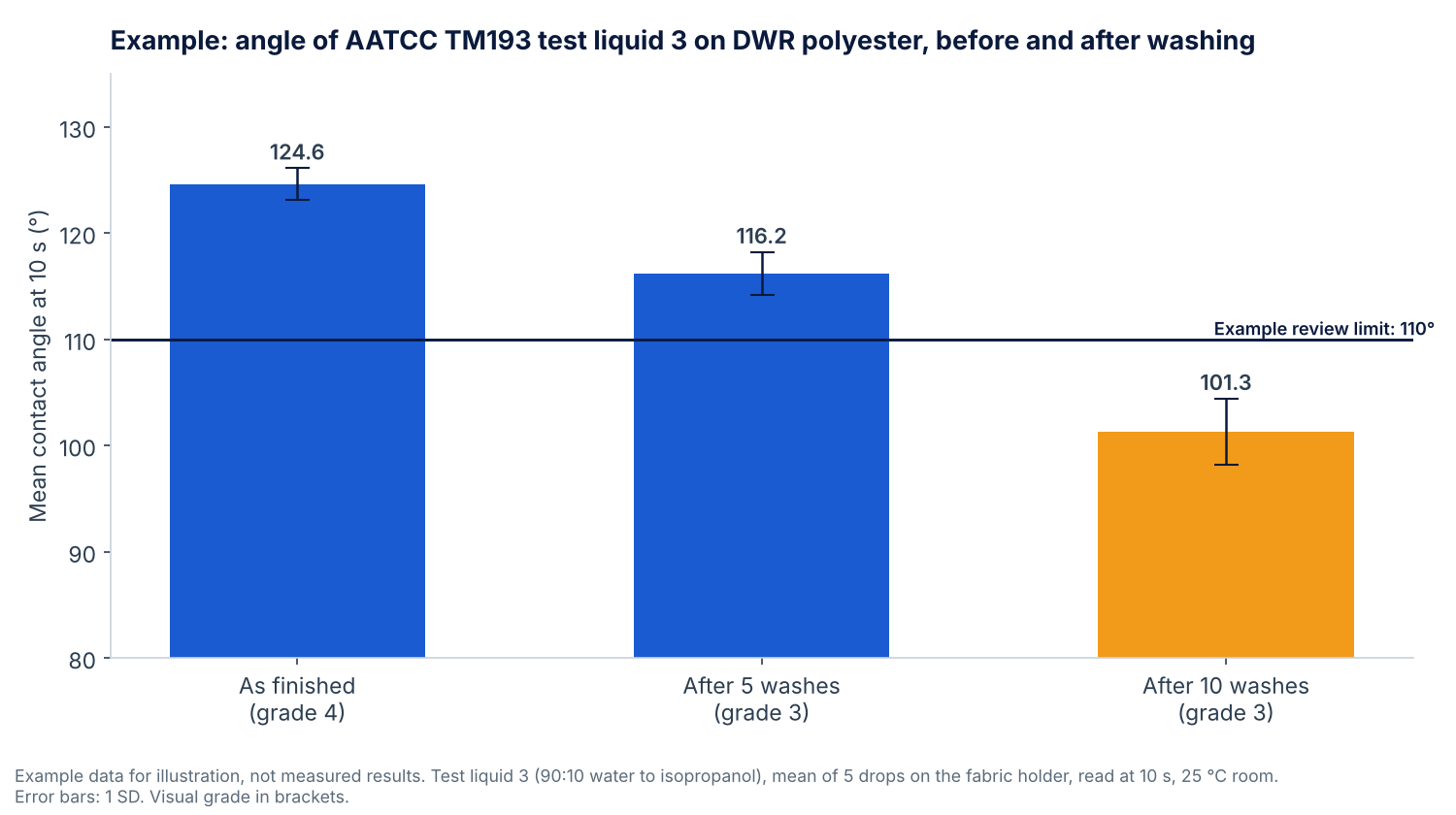
Example data, not measured results.
What changes when a measured angle sits next to the visual grade
| Metric | Before Dropometer | With Dropometer | Results |
|---|---|---|---|
| How wetting is judged | Drop shape read by eye, one grade per fabric | Angle of each test liquid read from the drop image | No published benchmark |
| Test liquid check | Mixed by volume and trusted | Surface tension of each liquid read by pendant drop, ±0.03 mN/m accuracy | Dropometer product specification |
| Change after washing | Seen only when the grade drops | A falling angle within the same grade | No published benchmark |
| Reported AATCC TM193 grade | Visual grading to the standard | Still needs visual grading to the standard | AATCC TM193 scope |
Bring a fabric as finished and the same fabric after washing. We will measure both live with your test liquids, so you can evaluate the finish yourself.
Enter your own numbers. The defaults are examples, not Droplet Lab results.
Quality cost snapshot
Result
Annual exposure combines audit/CAPA cost, customer rejections, and recall probability; avoided exposure applies the risk reduction percentage.
Lock these before you compare angles between lots, washes or sites
| Parameter | Recommended Setting | Technical Rationale |
|---|---|---|
| Method | Sessile drop contact angle of each test liquid, reported next to the visual grade | AATCC TM193 specifies a visual grade. The angle is an alternative reading. |
| Test liquids | Water and isopropanol by volume, as the standard lists | Each grade depends on the liquid's water to IPA ratio, which sets both its surface tension and its polarity. |
| Liquid check | Pendant drop, density entered for each mixture | The Young-Laplace fit needs the density of the drop. |
| Specimen mounting | Fabric holder, flat and face up, not stretched | A wavy or stretched fabric changes the baseline and the angle. |
| Drop size | As the standard specifies, fixed for every drop | A changing size adds spread that is not about the finish. |
| Observation time | As the standard specifies, fixed for every drop | Low surface tension liquids can wick in over time. Published work used 10 s. |
| Fit model | Young-Laplace or polynomial, the same for every run | Both models are in the Dropometer software. Do not mix them within one study. |
| Replicates | Several drops per liquid, each on a fresh spot | Weave and finish vary across the fabric. Report mean and spread. |
| Environment | Record room temperature; condition samples and liquids first | The Dropometer has no temperature control and runs at 10 to 45 °C. |
Pick the method by the question you need answered
Start: What do you need to know about the finished fabric?
Your customer or specification asks for a minimum water/alcohol repellency grade.
Grade the fabric by eye as the standard specifies. Contact angle on the Dropometer is an alternative method: run a correlation study on your own samples before you use angles against a TM193 grade.
You mix your own water and isopropanol liquids, or a bottle has been open for a while.
Check each liquid by pendant drop on the Dropometer and compare it with the value the standard lists, at a recorded room temperature.
You want to compare finishes with the same grade, or see repellency fade with washing before the grade drops.
Measure the contact angle of each test liquid on the fabric holder. See textile and DWR water repellency testing.
You need resistance to oily stains, or to water sprayed or driven onto the fabric.
Use AATCC TM118 for oil, AATCC TM22 for the spray test, or AATCC TM 79 for absorbency.
Start from the question you need answered. Blue boxes are measurements the Dropometer runs.
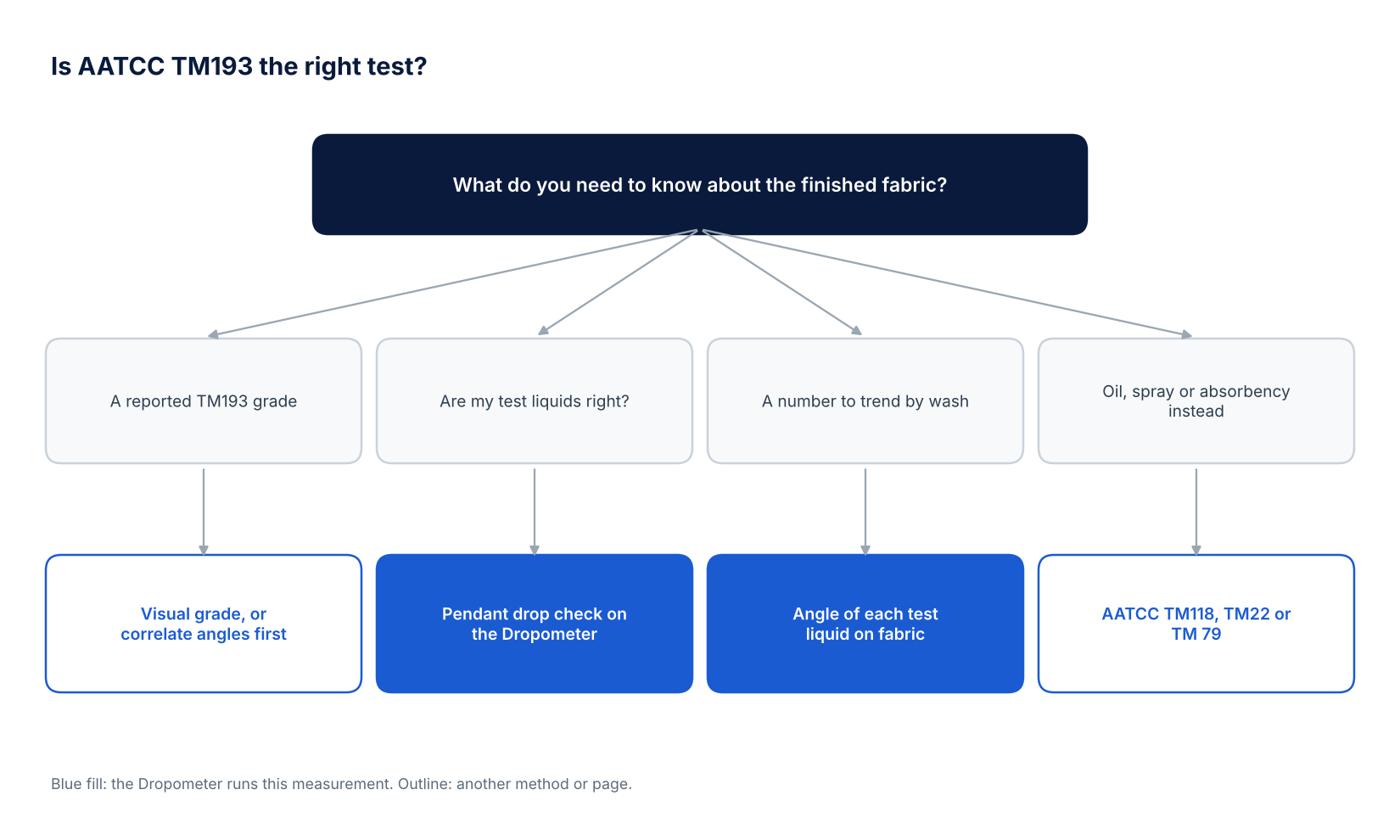
Is AATCC TM193 the right test?
What the angle tells you next to the grade, and what it does not
Honest limits of the method and of the Dropometer
It ranks how well a finished fabric resists wetting by a defined series of water and isopropanol mixtures. Each liquid has a lower surface tension than the last, but the grade is a rank within that series, not a surface tension measurement. Drops of each liquid go on the fabric in turn. The grade is the highest numbered liquid that stays as a clear, rounded drop without wetting the fabric.
In part, so it is partially compliant. It checks each test liquid's surface tension by pendant drop and measures each liquid's contact angle on the fabric with the fabric holder. It does not give the visual grade. Contact angle is an alternative method, not the visual grading method the standard specifies; if a contract or customer requires an AATCC TM193 result, run a correlation study on your own samples first.
Hang a pendant drop of each liquid and read its surface tension, then compare it with the value the standard lists. Published work lists 50.0, 42.0 and 33.0 mN/m at 25 °C for liquids 2, 3 and 4 (source: Gels 2023). The Dropometer reads surface tension with ±0.03 mN/m accuracy (Dropometer datasheet). Record room temperature.
Both rate fabric against a series of water and alcohol solutions, and they share a title. We have not confirmed that the two are technically identical. Check which one your customer names in the specification, and quote that one in your test report.
TM193 uses water and alcohol liquids, so it rates resistance to water based stains. AATCC TM118 uses hydrocarbon liquids for oil repellency. AATCC TM22 sprays water onto the fabric to rate rain repellency.
Air stays trapped between fibres under the drop, so you read an apparent angle. The Cassie Baxter model describes this. Compare angles only between fabrics of the same construction, and set limits from your own fabric.
No. The Dropometer has no temperature control and runs at 10 to 45 °C. The surface tension of each test liquid changes with temperature, so condition samples and liquids as the standard specifies and record room temperature with every result.
This page summarises AATCC TM193 in our own words and does not reproduce the standard. Buy the current edition from AATCC before you write a procedure. The Dropometer is partially compliant: it checks the test liquids by pendant drop and measures their contact angle on the fabric, an alternative to the visual grading the standard specifies. Droplet Lab does not certify compliance. Your own method validation does.
Sources, review and tools
AATCC store: TM193 Test Method for Aqueous Liquid Repellency: Water/Alcohol Solution Resistance; AATCC: summary of changes, TM193-2023 revision; GlobalSpec: AATCC 193 document history (2004 to 2023); ISO 23232:2009 listing, the Dropometer product specification and Droplet Lab validation papers.
Drafted with Claude (Anthropic) from the sources listed, then reviewed by Droplet Lab.
We did not copy text from the standard. Buy the current edition for the full procedure.
October 2026
Technical review by Dr Jinde Zhang.
Spotted an issue in this summary? Send a correction request and our team will review it.
Correction Request
We work hard to keep this page accurate and up to date. If you spot an error (wrong revision/year, missing requirement, incorrect interpretation, or broken link), tell us and we'll review it.
Contact us to report a correction