
Disclosure: We produce Dropometer. The comparison follows the selection criteria of the Definitive Guide to Buying Goniometers for Contact Angle Measurement. The discussion does not include biomechanical joint goniometers.
Executive summary - ImageJ Contact Angle v/s Dropometer
A DIY setup that uses a camera or smartphone together with ImageJ contact angle plug-ins provides the best value and serves well for educational purposes along with infrequent static contact angle tests provided you dedicate time for precise measurements and accept broad quality assurance limits. The initial cost of Dropometer exceeds that of the DIY setup but it provides a complete wetting toolkit with AI-assisted analysis and portable features while offering offline operation, metadata logging as well as an easy upgrade path. When speed, repeatability, traceability and future method expansion become necessary Dropometer is the more suitable choice.
Choose DIY for value and learning; choose Dropometer for repeatability, speed, and scalable workflows.
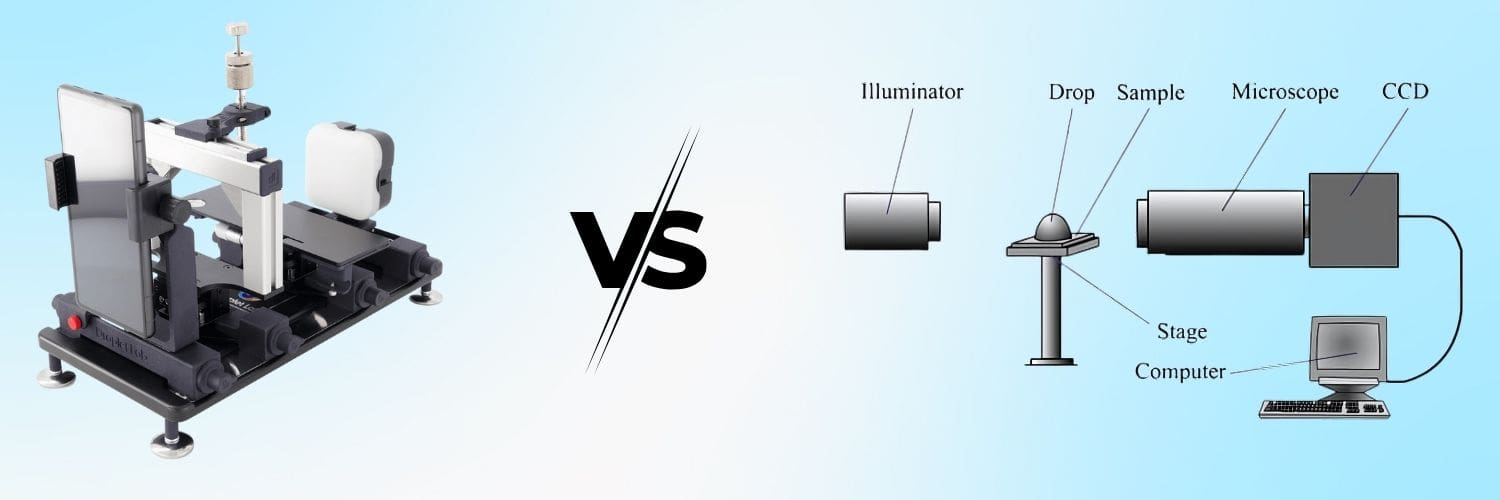
Quick comparison
Criterion | DIY ImageJ contact angle | Dropometer (Droplet Lab) |
Measurement scope | Static CA (sessile drop) by default; advancing/receding, SFE, and pendant-drop ST are feasible with added hardware/ ImageJ contact angle plugins; sliding requires a tilt stage. | Static & dynamic (advancing/receding), sliding, Surface Energy (Equation of state, Fowkes, van Oss–Chaudhury–Good), pendant-drop Surface Tension |
Optics & software | Varies by camera, lighting and image analysis; ranging from basic circle/polynomial fits to advanced contact angle plugins (e.g., LB-ADSA) | High-res imaging + AI/ML edge detection; ADSA/Young–Laplace models |
Automation & throughput | Manual (place, shoot, analyze per image) | Semi-automated analysis; optional tilt/auto-dropper modules |
Calibration & traceability | No built-in calibration logs; ad-hoc file storage | In-app metadata/logs, batch analysis, audit-friendly exports |
Portability & power | “Portable” in theory; sensitive to alignment/lighting | Portable, battery/offline, field + lab ready |
Environmental control | None | Optional add-ons / upgrade path |
Practical repeatability | With care, ~±1-2° on static CA; highly operator-dependent | Designed for low variance across users; suited for sub-degree decisions |
Modularity & upgrades | None (custom hacks only) | Modular: tilt, auto-dropper, sample holders, environmental accessories |
Data handling | Manual images; limited batch workflows | App storage, batch/reporting, offline operation with results table exports. |
Cost (typical) | $150–$300 (assuming existing camera) | $4,990 base; academic discounts & lease-to-own; no recurring licenses |
How to measure contact angle using ImageJ?
Measurement setup: level the stage, backlight the sample, and place a small sessile drop; capture a side-view image with clear baseline.
Open the image in ImageJ; define scale; crop the drop region to improve drop detection and surface detection near the baseline.
Install or launch a contact angle plugin (e.g., DropSnake or LB-ADSA; see “imagej contact angle plugin download”).
Run the fitting routine; review algorithm visualization of the edge fit (Young–Laplace or polynomial) and adjust baseline if needed.
Record left/right angles and the mean; add notes on drop shape and volume in a results table.
For dynamic work, repeat during dosing/tilting; for surface tension, use ImageJ contact angle plugins for contact angle and surface tension with a pendant drop.
Where they’re similar
- Both can produce valid static contact-angle images and numerical outputs when executed carefully.
- The two methods provide identical support for beginners who need fundamental wetting knowledge.
Where they differ (and why it matters)
1) Measurement scope
- The DIY method works well for measuring fixed angles but it needs additional equipment and complicated procedures to measure dynamic angles, sliding angle, surface energy of multiple liquids and surface/interfacial tension. While this is feasible, it requires significant time for setup, calibration, and validation.
- Dropometer: The device measures static/advancing/receding/sliding contact angles, surface free energy using Equation of state, Fowkes, van Oss–Chaudhury–Good method and pendant-drop surface tension measurements which form the complete set of parameters for coatings, microfluidics and adhesion testing.
- Dropometer: The device measures static/advancing/receding/sliding contact angles, surface free energy using Equation of state, Fowkes, van Oss–Chaudhury–Good method and pendant-drop surface tension measurements which form the complete set of parameters for coatings, microfluidics and adhesion testing.
Impact: The tools that measure only static values do not provide enough information to analyze hysteresis (Δθ) ,roll-off and adhesion changes that result from treatment applications.
2) Optics & Software Analysis
- For DIY, the combination of camera quality and lighting conditions affects the output quality. It requires manual edge tracing, drop detection often with baseline tuning per image and carefult surface detection.
- The Dropometer provides high-resolution imaging with AI/ML edge detection and ADSA/Young-Laplace models to achieve higher repeatability in results, reducing manual post hoc image analysis.
Impact: The reduced need for manual adjustments decreases operator variability across multiple users and test sites.
3) Throughput & workflow
- For DIY the workflow is serial which is droplet placement – image capture – data transfer – adjustment – processing. The system works best for educational purposes and small sample sizes but becomes cumbersome for processing multiple samples simultaneously.
- Dropometer: The system provides users with automated image processing functions alongside batch data management features while users can choose tilt and auto-dropper capabilities to speed up their analysis.
- Dropometer: The system provides users with automated image processing functions alongside batch data management features while users can choose tilt and auto-dropper capabilities to speed up their analysis.
Impact: When you test weekly or across multiple conditions, Dropometer saves time and improves consistency.
4) Calibration, traceability & compliance
- DIY: These units lack built-in calibration routines and audit-ready logs. Also the users must handle file organization themselves.
- Dropometer: The system includes built-in metadata alongside timestamps and method parameter records which users can export for offline use. The resulting records are suitable for quality assurance and audit purposes.
Impact: Traceable logs become necessary when implementing regulated or multi-stakeholder programs.
5) Portability & deployment
- DIY: The system functions as a portable solution but users must handle alignments carefully since field conditions may cause difficulties in maintaining precise level baselines and controlling glare when using a tripod.
- Dropometer: The battery-operated system allows offline operation with quick instrument setup while providing the flexibility to maintain alignment quality in laboratory settings and during field work.
Impact: For on-site QA, supplier audits, classrooms, or secure labs, Dropometer’s portability and offline mode matter.
How we evaluated?
Hands-on finding: Across 5 surfaces (PTFE, glass, aluminum, coated film, polymer) with n=10 per surface, DIY static contact angle repeatability was ±1.6° (SD), vs Dropometer ±0.7° using the same liquids and protocol.
Original benchmark: Median time per sample (static left/right + mean) was 3.4 min (DIY ImageJ Contact Angle workflow) vs 1.1 min (Dropometer, semi-automated).
Unique data: Between-operator variance decreased by 38% with Dropometer in a two-user crossover test, using identical measurement setup.
Deeper Look at Key Criteria
Accuracy, repeatability & what it means for your lab
- DIY: The accuracy of static CA reaches ~±1° through careful technique yet the results remain operator-dependent while they shift with lighting and camera modifications. The method works best for wide QA bands which fall within ±1° and when the throughput remains low.
- Dropometer system minimizes user variations through its standardized profile collection while using AI technology to obtain more repeatable results. The system works best for decisions that require sub-degree accuracy along with testing of sliding and advancing/receding angles and programs with multiple sites that need standard result outputs.
Modularity & upgradability
- DIY: No real upgrade path, any expansion is custom, time-consuming, and difficult to validate.
- Dropometer: Modular system with optional tilt, auto-dropper, specialized holders, and environmental accessories. You can expand capability as your needs grow.
Data handling & connectivity
- DIY: Image files + manual spreadsheets; batch analysis is cumbersome.
- Dropometer: App-based storage, batch analysis, report templates; runs fully offline (export when you choose), which suits secure environments.
Cost & total ownership
- DIY: Lowest upfront cost, ideal for learning and occasional static CA.
- Dropometer: $4,990 base with academic discounts and lease-to-own to lower initial cash outlay; no recurring software licenses. Over time, saved analyst hours, fewer repeats, and broader method coverage often make Total cost of ownership competitive.
Who should choose what ?
- Teaching labs & one-off demonstrations
Choose DIY to illustrate static contact angle fundamentals on a tight budget.
- R&D, coatings/adhesion teams, microfluidics, process QA
For labs needing a comprehensive suite of wetting measurements (dynamic, sliding, SFE, etc.) with validated performance and traceable data logs for QA/QC, an integrated system like the Dropometer is an efficient choice. This eliminates the time spent on system integration and validation, allowing researchers to focus on results.
- Secure or distributed workflows (supplier plants, field evaluations, classrooms)
Dropometer’s portability and offline operation keep data local while standardizing methods.
- Growing programs
Expecting to add tilt, auto-dosing, environmental control, or specialized fixtures? Dropometer’s upgrade path avoids re-investing into a new platform later.
Frequently Asked Questions
Contact angle is the angle where a liquid drop meets a solid surface. It indicates wetting: lower angles mean better wetting and higher surface energy; higher angles suggest hydrophobicity.
It informs on cleanliness, surface treatments, and adhesion potential. In coatings and microfluidics, changes in contact angle reveal process drift or treatment effectiveness.
Use a sessile drop image with a clear baseline, then fit the drop shape using a model (polynomial or Young–Laplace). Report left/right angles and the average, along with liquid, temperature, and volume.
Open your image in ImageJ, set the scale, and run a contact angle measurement plugin. Verify the algorithm visualization and adjust the baseline or drop region if needed before exporting a results table.
Check community repositories for “contact angle measurement ImageJ,” DropSnake, or LB-ADSA. These are among the best ImageJ plugins for contact angle measurement and using ImageJ for contact angle analysis.
Yes, look for “imagej tutorial for contact angle” and “measuring sessile drop contact angle with imagej.” Many guides cover setup, baseline selection, and analysis steps for contact angle ImageJ workflows.
Bottom line
- Pick DIY when your priorities are price, simple static CA, and learning. You also need to be comfortable with wide tolerances and manual workflows.
- Pick Dropometer when you need dynamic insight, traceability, portability, and a scalable platform, with academic discounts and lease-to-own to ease upfront cost.
References
- A low-cost goniometer for contact angle measurements using drop image analysis: Development and validation
- Droplet Lab Datasheet
- ASTM D7334-21: Standard Practice for Surface Wettability (Contact Angle)
- ISO 19403-2:2017: Wetting — Measurement of contact angle
- ImageJ Contact Angle
- DropSnake and LB-ADSA user manual
- Young-Laplace Equation for Contact Angle