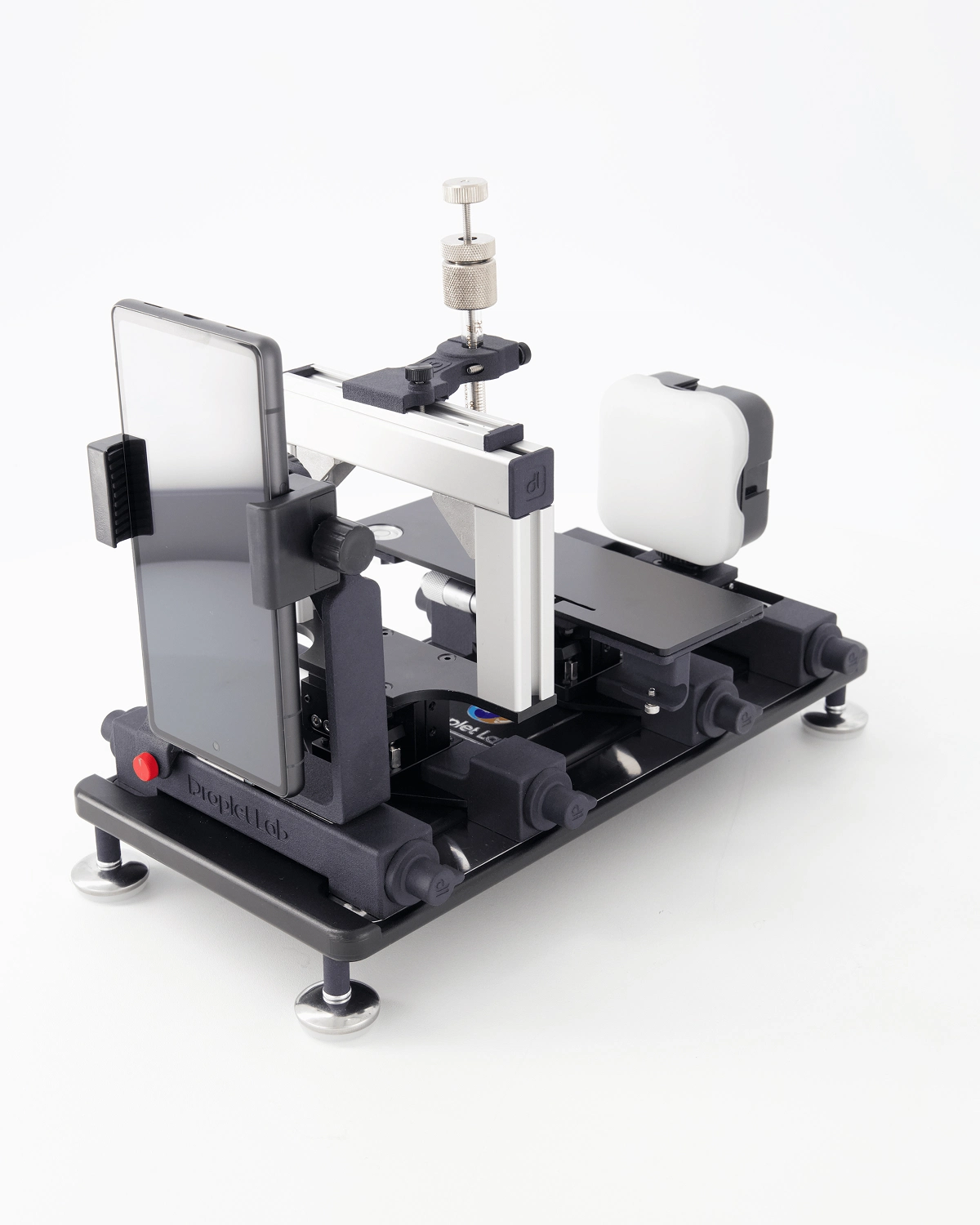
Dropometer
US$4,990 base kit, checked 25 October 2026, Droplet Lab

Surface tension tensiometer comparison
The du Noüy ring is the classic way to measure surface tension: lift a thin platinum ring out of the liquid and read the maximum force. The Dropometer measures surface tension from the shape of a pendant drop instead. This page compares the two methods on accuracy, standards, sample size, handling and cost, using KRÜSS's current ring tensiometers as the examples.
US$4,990 base kit, checked 25 October 2026, Droplet Lab
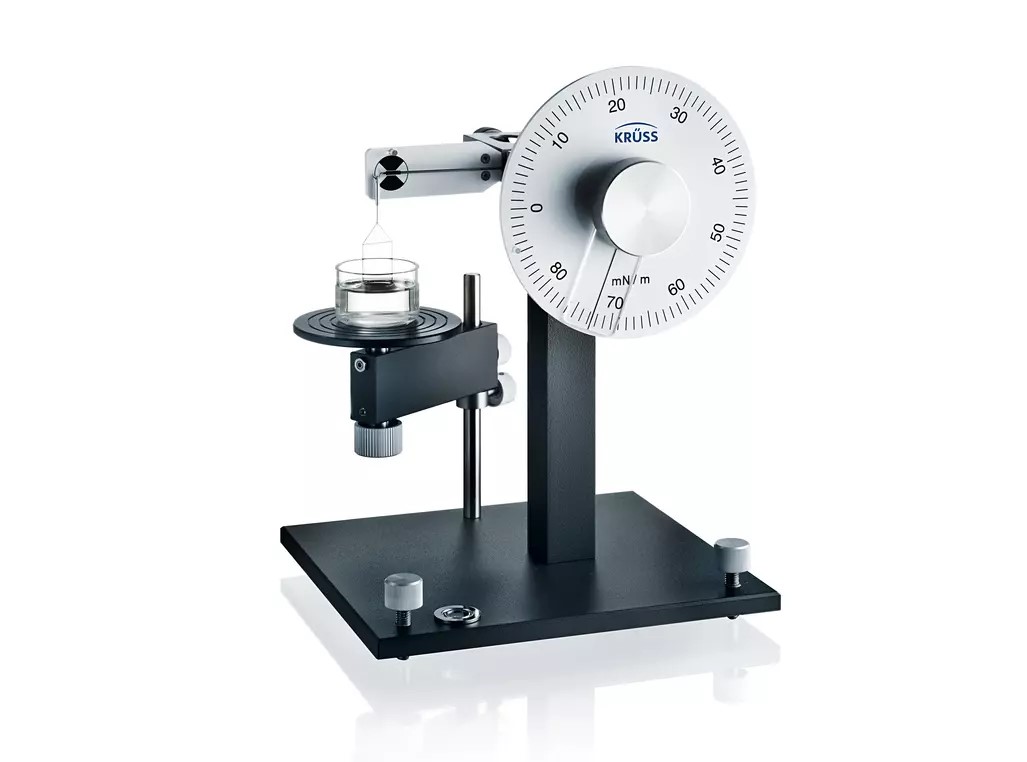
KRÜSS K6 and K20: quote only, checked 25 October 2026, KRÜSS


If your standard or customer names the ring, such as ASTM D1331 or ASTM D971, or your liquids read above 75 mN/m, use a ring tensiometer. For microlitre samples, no ring to clean or correct, interfacial tension and contact angle in one kit, and a published price, the Dropometer (US$4,990) is the better buy.
The du Noüy ring measures force. A platinum ring is pulled up through the surface, the instrument records the maximum pull before the liquid film tears, and a correction factor turns that force into surface tension. The Dropometer measures shape. A drop hangs from a needle, the camera records its outline, and the app fits the Young–Laplace equation. Our surface tension measurement guide and the guide to optical vs force tensiometers explain both, and the tensiometer glossary entry defines the terms.
Both measure the surface tension of liquids and the interfacial tension between two liquids.
Both are long established: the ring in ASTM D1331 and ASTM D971, pendant drop in the drop shape literature and in peer reviewed comparisons.
Both need careful technique: a clean, fully wetted ring, or a sharp drop outline and the right density.
The ring reads a maximum force at the moment the film tears, which then needs a correction for ring size and liquid density. The pendant drop reads the shape of a drop at rest, with no correction factor.
A ring needs a vessel of liquid and a platinum ring that is cleaned, often by flaming, and kept perfectly round. A pendant drop needs a few microlitres and a clean needle.
Ring instruments such as the KRÜSS K20 read 1 to 999 mN/m. The manual K6 reads 1 to 90 mN/m. The Dropometer reads up to 75 mN/m, which covers water and most solutions.
ASTM D1331 names the ring and the Wilhelmy plate. ASTM D971 and IEC 62961 name the ring. None names pendant drop, so a method change needs a correlation study.
The ring is lowered into the liquid, then the liquid is lowered or the ring raised until a film forms. The force rises to a maximum and the film tears. That maximum includes the weight of liquid lifted around the ring, so the instrument applies a correction such as Harkins-Jordan or Zuidema-Waters. The K20 offers both, a linear correction, or none.
A drop hangs from a needle in front of an LED backlight. The phone camera records the outline, and the app fits the Young–Laplace equation using the density difference you enter. The Dropometer datasheet states ±0.03 mN/m up to 75 mN/m, and two peer reviewed papers compared it with a KRÜSS DSA100E. Try it with our pendant drop experiment.
A ring reading is taken as the film tears, so slow surfactants can read differently with timing. A pendant drop can be watched until the value stops changing. Our reference measurements dataset and the article on measuring surface tension with a smartphone show pendant drop results.
KRÜSS lists three force tensiometers that use the ring, all quote only: the manual K6, 1 to 90 mN/m at 0.5 mN/m; the semi-automatic K20, 1 to 999 mN/m at 0.01 mN/m; and the automated Tensíío. Kibron's EZ-Pi Plus uses a miniaturised ring or plate probe. CSC Scientific's ring tensiometers show different prices on two CSC pages, so we leave them out.
Figures from each maker's own pages and data sheets, checked 25 October 2026.
| Criterion | du Noüy ring tensiometer | Dropometer |
|---|---|---|
| Method | Force on a platinum ring at film tear | Shape of a pendant drop, Young–Laplace fit |
| Price (checked 25 October 2026) | KRÜSS K6, K20 and Tensíío: quote only | US$4,990 base kit, phone and app included |
| Surface tension range | K6 1 to 90 mN/m; K20 1 to 999 mN/m | Up to 75 mN/m |
| Resolution | K6 0.5 mN/m; K20 0.01 mN/m (ring) | 0.01 mN/m |
| Stated accuracy | K20: −0.2/+0.1 mN/m (plate calibration); none stated for the ring | ±0.03 mN/m (datasheet); compared with a KRÜSS DSA100E in peer review |
| Correction factor | Needed: Harkins-Jordan, Zuidema-Waters or linear | None |
| Sample | A vessel deep enough to immerse the ring | A few µL |
| Probe care | Platinum ring cleaned and kept round | Needle rinsed between liquids |
| Interfacial tension | Yes | Yes |
| Slow surfactants | Reading taken at film tear | Dynamic pendant mode follows one drop over time |
| Other measurements | K20: density by buoyancy | Contact angle, surface free energy |
| Standards named for the method | ASTM D1331 (methods A, B); ASTM D971 and IEC 62961 | None of these names pendant drop |
| Temperature | K20: optional thermostat, −10 to 130 °C | Room temperature in the base kit; built to order upgrade, ask for range |
| Weight | K20: 11 kg | 1 kg, battery up to 8 h |
Sources: KRÜSS K20 data sheet, KRÜSS K6 page, KRÜSS Tensíío data sheet, Dropometer specification. All checked 25 October 2026. No ring tensiometer maker we checked publishes a price.
We read KRÜSS's ring tensiometer pages and data sheets, the standards that name the ring, and the Dropometer specification on 25 October 2026. We did not run a ring and a pendant drop side by side for this page, so it gives no time per sample or repeatability figures.
Disclosure: Droplet Lab makes the Dropometer, so read this page knowing that. Every ring instrument figure links to the maker's own page. The verdict changes for any lab whose standard specifies the ring: there the ring wins, whatever the sample size. Made with Claude Opus 5.5 and reviewed by Droplet Lab.
The ring and the pendant drop are both correct methods; they measure different things on the way to the same property. The quote below makes the same point about contact angle.
Not all contact-angle measurements are created equal: the right method depends on the application. A sessile drop and a tilted plate can give very different, and equally correct, numbers.
What this means here: report the method with every surface tension value, and do not mix ring and pendant drop results in one data set without a correlation check.
Pick: a ring tensiometer such as the KRÜSS K20. See our ASTM D971 and IEC 62961 page.
Pick: keep the ring, or run a correlation study before switching. See the production QC guide.
Pick: Dropometer. A few microlitres per reading, followed over time. See the dynamic surface tension guide.
Pick: Dropometer. See the under US$5,000 guide.
Pick: the KRÜSS K6 to show the ring by hand; the Dropometer education unit for drop shape. See the teaching lab guide.
Use a du Noüy ring when a standard or a customer names it, when you must stay comparable with years of ring data, or when your liquids read above 75 mN/m. Use the Dropometer when sample is scarce, when you want no ring to clean or correct, and when you also need interfacial tension, contact angle or surface free energy. If you are unsure, book a 15 minute consult and bring a liquid you already measure with a ring.
On clean liquids at equilibrium they should agree within the accuracy of each instrument. They can differ on surfactant solutions that take time to settle, because the ring reads at the moment the film tears. Report the method with each value.
The maximum pull includes the liquid lifted around the ring. Harkins-Jordan and Zuidema-Waters corrections adjust for ring size and liquid density. Pendant drop fits the drop shape directly, so it needs none.
Not for reporting to that standard. ASTM D971 and IEC 62961 specify the ring; a correlation study on your own samples is needed before pendant drop results can stand in. See our ASTM D971 and IEC 62961 page and ASTM D1331 summary.
Clean it between liquids, usually by rinsing and flaming the platinum, keep it flat and round, and make sure it is fully wetted. A bent ring changes the reading.
Yes, with good technique. The Dropometer was compared with a KRÜSS DSA100E in two peer reviewed papers. Our surface tension measurement guide covers the technique.
How the Dropometer compares with other tensiometers and surface analysis instruments.
Where the Dropometer's accuracy figure comes from.
Dropometer contact angle and pendant drop surface tension were compared with a KRÜSS DSA100E in two peer reviewed papers: Review of Scientific Instruments (2018) and Colloids and Surfaces A (2017).
Customers have cited the Dropometer in 57 peer reviewed papers, theses and conference papers, listed with links.