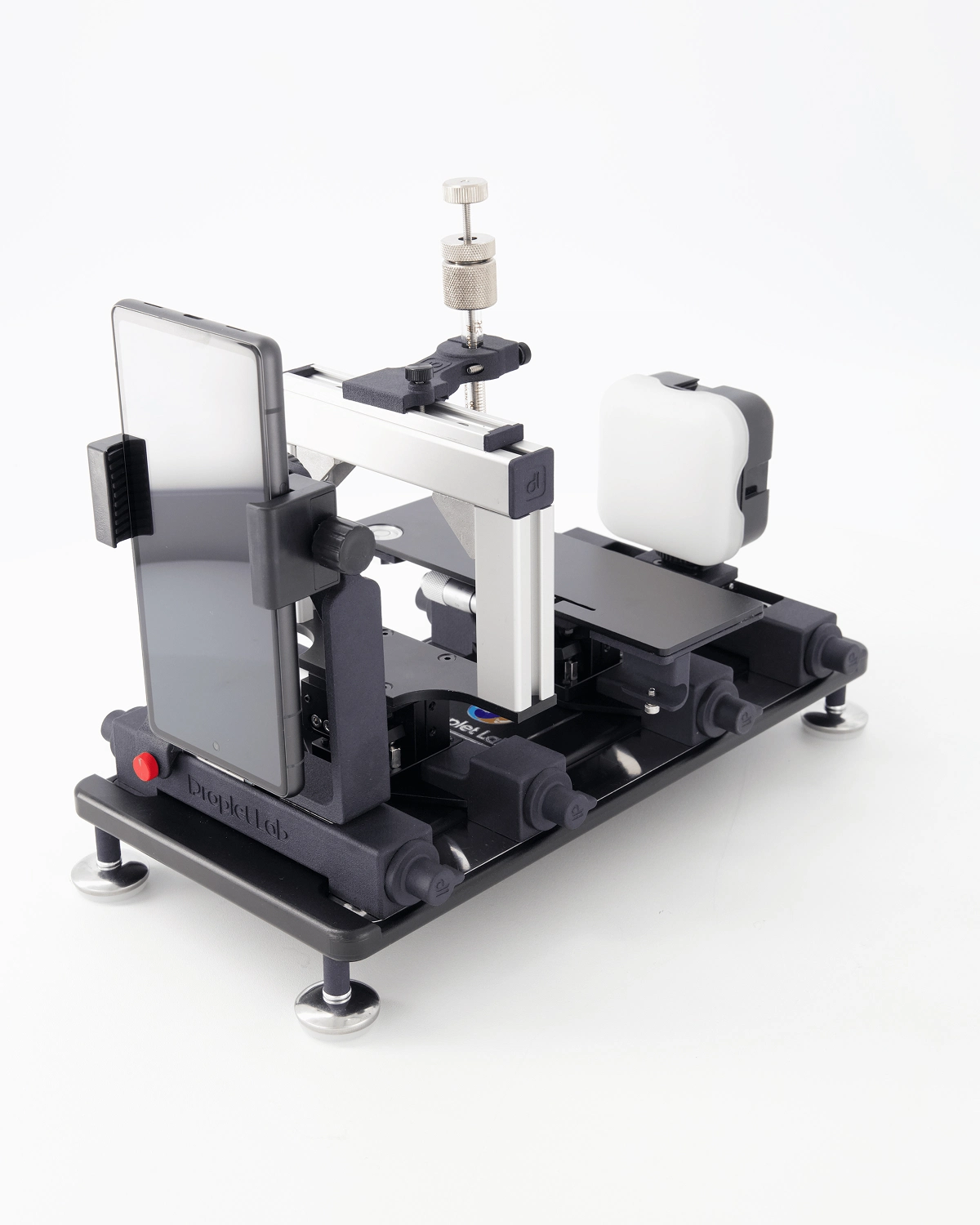
Dropometer
US$4,990 base kit, checked 25 October 2026, Droplet Lab

Surface tension tensiometer comparison
The Kibron EZ-Pi Plus is a compact force tensiometer that measures with a small diameter probe, a miniaturised du Noüy ring or Wilhelmy method. The Dropometer measures surface tension optically, from the shape of a pendant drop. Both are built for small samples. This page compares them on range, accuracy, sample size, temperature, power and cost.
US$4,990 base kit, checked 25 October 2026, Droplet Lab
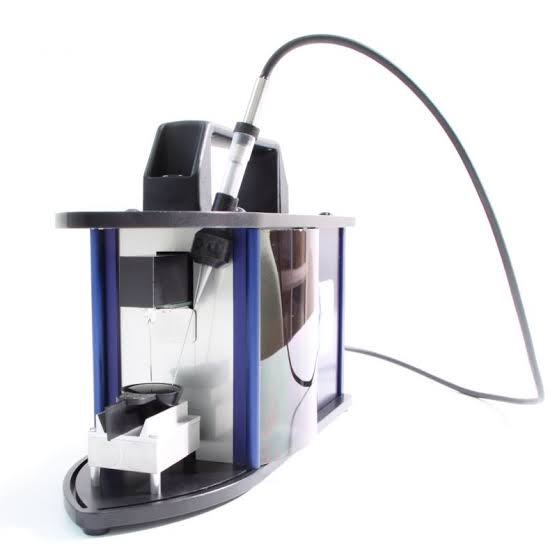
Quote only, no price on the Kibron page, checked 25 October 2026, Kibron


Buy the Kibron EZ-Pi Plus if you need readings above 75 mN/m, a force method listed with ASTM D1331, or set temperatures with a circulating bath. Buy the Dropometer (US$4,990) for microlitre drops, contact angle and surface free energy in the same kit, battery power and a published price.
Both are compact instruments for labs that measure small volumes. The EZ-Pi Plus hangs a thin probe, a DyneProbe, from a microbalance and reads the force as the liquid wets it. The Dropometer records the outline of a drop hanging from a needle and fits the Young–Laplace equation. Our surface tension measurement guide covers both methods, the guide to optical vs force tensiometers compares them, and the Young–Laplace glossary entry explains the drop shape fit.
Both measure surface tension and oil to water interfacial tension.
Both fit on a small bench: the EZ-Pi Plus is 26 × 8 × 16 cm and 1.3 kg; the Dropometer weighs 1 kg.
Both are aimed at small samples rather than large vessels.
The EZ-Pi Plus reads force on a small probe, a miniaturised du Noüy or Wilhelmy method, so the probe must be clean and wetted. The Dropometer reads the shape of a drop, so it needs a sharp outline and the density difference.
Kibron states 1 to 350 mN/m, 0.01 mN/m accuracy or sensitivity and 0.001 mN/m resolution. The Dropometer states up to 75 mN/m, ±0.03 mN/m accuracy and 0.01 mN/m resolution, compared with a KRÜSS DSA100E in peer review.
The EZ-Pi Plus takes 0.5 to 3 mL as standard, or 25 to 50 µL in a steel vial on request. A pendant drop uses a few microlitres.
Kibron lists advancing and receding contact angle by the force method, which needs the solid shaped as a probe. The Dropometer measures sessile drop contact angle on a flat sample and calculates surface free energy.
A DyneProbe, sold in sets of four, hangs from a microbalance with a 0 to 100 mg or 0 to 300 mg sensor. The liquid wets the probe and the force gives surface tension. Kibron says a measurement takes around 30 seconds. EZ-PI Plus Manager software runs on a computer connected by USB, which also powers the instrument. See Kibron EZ-Pi Plus.
A drop hangs from a needle in front of an LED backlight. The phone camera records the outline and the app fits the Young–Laplace equation, using the density difference you enter. Static mode gives one value; dynamic pendant mode follows the same drop over time. Two peer reviewed papers compared it with a KRÜSS DSA100E. Our reproducible surface tension guide covers technique.
The EZ-Pi Plus works from 0 to 100 °C when connected to a circulating bath, with a Pt-100 sensor included. The Dropometer works at room temperature in the base kit; temperature control is a built to order upgrade with no published range yet.
Kibron publishes no price, and its page gives two viscosity limits for the EZ-Pi Plus: 100,000 mPas in the description and 60,000 cP in the table. Ask Kibron which applies to your samples. For CMC work, Kibron points to the Delta-8; see our surfactant and CMC guide.
Figures from each maker's own pages and data sheets, checked 25 October 2026.
| Criterion | Kibron EZ-Pi Plus | Dropometer |
|---|---|---|
| What it is | Compact force tensiometer with small probes | Optical pendant drop tensiometer kit |
| Price (checked 25 October 2026) | Quote only | US$4,990 base kit, phone and app included |
| Method | Miniaturised du Noüy or Wilhelmy, DyneProbes | Pendant drop, Young–Laplace fit |
| Surface tension range | 1 to 350 mN/m | Up to 75 mN/m |
| Resolution | 0.001 mN/m (0 to 100 mg sensor); 0.003 mN/m (0 to 300 mg) | 0.01 mN/m |
| Stated accuracy | 0.01 mN/m (accuracy or sensitivity, per Kibron) | ±0.03 mN/m (datasheet); compared with a KRÜSS DSA100E in peer review |
| Sample | 0.5 to 3 mL; 25 to 50 µL vial on request | A few µL |
| Time per reading | Around 30 s (Kibron) | Not published |
| Interfacial tension | Oil and water | Yes, pendant drop |
| Contact angle | Advancing and receding by the force method | Sessile drop on flat samples, plus surface free energy |
| Temperature | 0 to 100 °C with a circulating bath; Pt-100 included | Room temperature in the base kit; built to order upgrade, ask for range |
| Power | Over USB from the computer | 5 V, battery up to 8 h |
| Size and weight | 26 × 8 × 16 cm, 1.3 kg | 1 kg |
| Software | EZ-PI Plus Manager on a computer | App on the included phone; CSV and TIFF export |
| Standard listed | ASTM D1331-14 | None claimed |
| Warranty | Not stated on the Kibron page | 5 years |
Sources: Kibron EZ-Pi Plus page, Dropometer specification. All checked 25 October 2026. Kibron publishes no price or warranty for the EZ-Pi Plus, and its page gives two different viscosity limits.
We read Kibron's EZ-Pi Plus page and the Dropometer specification on 25 October 2026. We did not run the two side by side, so this page gives no repeatability figures, and it quotes Kibron's own time per reading.
Disclosure: Droplet Lab makes the Dropometer, so read this page knowing that. Every EZ-Pi Plus figure links to Kibron's own page, including the two where Kibron's stated figures beat ours. The verdict changes for a lab measuring above 75 mN/m or working to a ring or plate method: the EZ-Pi Plus wins there. Made with Claude Opus 5.5 and reviewed by Droplet Lab.
Two small-sample tensiometers can both be right and still disagree, because they measure different things on the way to surface tension. The quote below makes the same point about contact angle.
Not all contact-angle measurements are created equal: the right method depends on the application. A sessile drop and a tilted plate can give very different, and equally correct, numbers.
What this means here: pick the method your procedure names, report it with each value, and check both against a liquid with a known surface tension.
Pick: Kibron EZ-Pi Plus, 1 to 350 mN/m. See the production QC guide for other force instruments.
Pick: Kibron EZ-Pi Plus. Kibron lists ASTM D1331. See our ASTM D1331 summary.
Pick: Dropometer. See the dynamic surface tension guide.
Pick: Dropometer. One kit, published price. See the under US$5,000 guide.
Pick: Dropometer education unit; it shows the drop shape students fit. See the teaching lab guide and our pendant drop experiment.
Choose the Kibron EZ-Pi Plus for liquids above 75 mN/m, a force method your procedure names, or set temperatures with a bath. Choose the Dropometer for drops of a few microlitres, sessile drop contact angle and surface free energy in the same kit, battery power and a published price. Compare both on your liquids against the values in our client wetting measurements dataset. If you are unsure, book a 15 minute consult.
On paper, the EZ-Pi Plus: Kibron lists 0.01 mN/m accuracy or sensitivity, against ±0.03 mN/m on the Dropometer datasheet. The Dropometer figure comes with two peer reviewed comparisons against a KRÜSS DSA100E. Check either on a liquid of known surface tension.
A pendant drop uses a few microlitres. The EZ-Pi Plus takes 0.5 to 3 mL as standard, and Kibron offers a 25 to 50 µL stainless steel vial on request.
Both, in different ways. Kibron lists advancing and receding contact angle by the force method, with the solid as the probe. The Dropometer measures sessile drop contact angle on a flat sample and calculates surface free energy from several liquids.
Yes. It is powered and controlled over USB by EZ-PI Plus Manager. The Dropometer runs on battery and analyses on the included phone.
Either can measure a concentration series by hand. Kibron points to its Delta-8 for CMC plates. See our surfactant and CMC guide and the article on measuring surface tension with a smartphone.
How the Dropometer compares with other tensiometers and surface analysis instruments.
Where the Dropometer's accuracy figure comes from.
Dropometer contact angle and pendant drop surface tension were compared with a KRÜSS DSA100E in two peer reviewed papers: Review of Scientific Instruments (2018) and Colloids and Surfaces A (2017).
Customers have cited the Dropometer in 57 peer reviewed papers, theses and conference papers, listed with links.