
Surface science explainer
Self-Assembled Monolayers: How One Molecular Layer Controls Wetting and Interfaces
A self-assembled monolayer (SAM) is a single ordered layer of molecules that bonds itself to a surface, such as alkanethiols on gold or organosilanes on oxidised silicon. Changing only the outer end group can move the water contact angle from below 15° to above 110° on the same substrate (Bain et al., 1989).


Droplet Lab Team
Droplet Lab builds precision instruments and software for surface science measurement, specialising in contact angle analysis and surface tension characterisation. Used by researchers across materials science, pharmaceuticals, coatings, and advanced manufacturing, Droplet Lab's Dropometer has contributed to studies published in peer-reviewed journals including Advanced Functional Materials (Impact Factor 19). The team combines instrument engineering with deep domain knowledge in wettability science with a focus on practical accuracy.
What is a self-assembled monolayer?
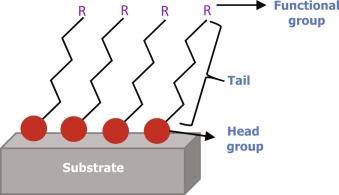
Short answer: it is a film one molecule thick that forms on its own when a clean surface meets the right molecules. Each molecule has a head group that bonds to the surface, a chain, and an end group that faces outwards.
The best known systems are alkanethiols on gold (Nuzzo and Allara, 1983) and organosilanes on silicon oxide or glass (Sagiv, 1980). The film is only a few nanometres thick, set by the chain length (Love et al., 2005).
How does molecular self-assembly build a monolayer?
A clean substrate is placed in a dilute solution or vapour of the molecules. Head groups bind to the surface quickly, then the chains slowly pack into an ordered, upright layer. Van der Waals interactions between neighbouring alkyl chains drive this packing and give a densely packed, highly ordered monolayer (Love et al., 2005).
Packing quality depends on surface cleanliness, solvent purity, time and temperature. Defects, missing molecules and contamination all show up later as changes in wetting.
Why does SAM surface chemistry control contact angle and surface energy?
Wetting is decided by the outermost few ångström of a surface. A SAM lets you choose exactly what sits in that layer, while the substrate underneath stays the same.
Bain et al. (1989) showed that methyl terminated thiols on gold give water contact angles above 110°, while hydroxyl terminated ones give angles below 15°. Mixing the two lets you dial in any value in between.
That makes SAMs useful model surfaces for testing surface energy calculations. The surface energy measurement guide explains the models, and the contact angle to surface energy calculator runs them on your own angles.
Expert Quote
Wettability is set by the top five to ten ångström of a surface — what the liquid actually sees. It doesn't matter what lies beneath; that outermost layer is what you are really measuring.

How do you check SAM quality with contact angle?
Measure both advancing and receding water contact angles, not just a static value. A well packed SAM shows a small gap between the two; a large gap points to disorder, gaps or contamination.
Measure several spots across the sample to check coverage. Add a second liquid, such as diiodomethane, if you need surface free energy rather than a single angle (Owens and Wendt, 1969).
For thin films and coatings in general, see the thin film and nanocoating characterization use case and the SEMI/ASTM D7490 summary for measuring the surface tension of solid coatings from contact angles.
Where are self-assembled monolayers used in devices and sensors?
SAMs are used to tune wetting and adhesion in biosensors, microfluidic channels and micro electromechanical devices. In organic electronics, SAMs on electrodes and gate dielectrics shift the work function and improve charge transport in organic field-effect transistors. They also serve as release layers in nanoimprint lithography and as model surfaces in protein adsorption studies (Love et al., 2005).
In each case, contact angle is the quickest check that the layer is present and intact before the next process step.
How are SAMs used for interfacial engineering in perovskite solar cells?
In inverted (p-i-n) perovskite solar cells, a SAM can replace a thicker polymer hole transport layer. Molecules with a phosphonic acid anchoring group bind to the transparent oxide electrode, and a carbazole based head group extracts holes from the perovskite absorber (Al-Ashouri et al., 2019).
Because the layer is only one molecule thick, its molecular design, packing density and orientation set the electrode work function and how much charge is lost at the interface. This kind of interfacial engineering has helped improve efficiency and stability in single junction and tandem cells (Al-Ashouri et al., 2019).
Wetting is a practical hurdle. The perovskite precursor solution has to spread evenly over the SAM to form a uniform perovskite film, and some SAMs leave the surface too hydrophobic for that. A contact angle on each coated substrate is a quick check of coverage and surface energy before deposition.
How long does a SAM stay good?
Thiol monolayers on gold slowly oxidise in air and light, and silane layers can pick up contamination from the lab environment. Both drift away from their fresh contact angle over time (Love et al., 2005).
Measure soon after preparation, store samples clean and covered, and record the time between preparation and measurement.
Where can you go deeper?
These pages cover the methods, standards and data behind this post.
- Case study: Fused silica and quartz R&D
- Buying guide: Best Surface Energy Analyzer for Research (multi-liquid models)
- Glossary: Equation of State (SFE model)
- Measurement quality: Reproducible surface energy calculation
- Classroom experiment: Exp 6: Surface free energy with multiple liquids
- Open dataset: Surface Free Energy of Common Polymers and Substrates
- Related post: Why Oil Spreads and Water Beads
- Related post: Surface Tension vs Surface Energy: What Is the Difference?
- Related post: Why Does Contact Angle Matter for Coatings and Adhesives QC?
Check your monolayers with contact angle
See how a portable instrument measures contact angle, sliding angle and surface free energy, in a short call.
Frequently Asked Questions
How thick is a self-assembled monolayer?
A few nanometres. The thickness is set by the length of the molecule's chain (Love et al., 2005).
What water contact angle does an alkanethiol SAM give?
Methyl terminated thiols on gold give water contact angles above 110°, and hydroxyl terminated ones give angles below 15° (Bain et al., 1989).
Why does my SAM show high contact angle hysteresis?
Large hysteresis usually means disorder, incomplete coverage, contamination or a rough substrate. Clean the substrate, use fresh solution and measure soon after preparation.
Which liquids should I use to get surface energy from a SAM?
Use at least two liquids, one polar such as water and one mainly dispersive such as diiodomethane, and apply a model such as Owens and Wendt (1969).