
Surface science guide
The Ultimate Guide to Surfactants: How Surfactants Work, Types and Uses in Detergents and Cosmetics
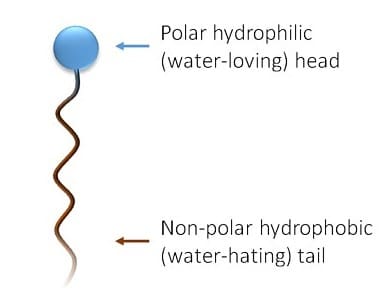
Surfactants are molecules with a hydrophilic, water-loving head and a hydrophobic tail. They gather at surfaces and interfaces, lower surface tension and let oil and water mix, wet and foam. Above the critical micelle concentration they form micelles that hold oil, which is how detergents clean.


Droplet Lab Team
Droplet Lab builds precision instruments and software for surface science measurement, specialising in contact angle analysis and surface tension characterisation. Used by researchers across materials science, pharmaceuticals, coatings, and advanced manufacturing, Droplet Lab's Dropometer has contributed to studies published in peer-reviewed journals including Advanced Functional Materials (Impact Factor 19). The team combines instrument engineering with deep domain knowledge in wettability science with a focus on practical accuracy.
What are surfactants?
Short answer: surfactants, short for surface active agents, are chemical compounds whose molecules have a hydrophilic (water-loving) head and a hydrophobic tail that points away from water. That split makes them gather at surfaces and interfaces, where they lower surface tension and let liquids that normally stay apart, such as oil and water, mix, wet and foam.
The structure of surfactants is simple. The hydrophobic tail is usually an alkyl chain of about 8 to 18 carbon atoms, and the hydrophilic head can carry a negative charge, a positive charge, both, or none (Rosen and Kunjappu, 2012).
They are the working ingredient in soaps, detergents, shampoos, cosmetics, paints, inks, pesticide sprays, food emulsions and many medicines. Small amounts matter: a fraction of a percent of surfactant can drop the surface tension of water from about 72 mN/m at 25°C to below 40 mN/m (Vargaftik et al., 1983; Rosen and Kunjappu, 2012).
How do surfactants work to lower surface tension?
Water molecules pull strongly on each other. At the surface, each molecule has neighbours only on one side, so the surface behaves like a stretched skin. That pull is surface tension.
Surfactant molecules move to the surface with their tails pointing out of the water. They replace some of the water at the surface and weaken the inward pull, so surface tension falls. The more surfactant at the surface, the lower the tension, until the surface is full.
Adsorbing to a fresh surface takes time, from milliseconds to seconds or longer, depending on the surfactant and its concentration (Eastoe and Dalton, 2000). That is why a spray, a print head or a coating line can behave differently from a static lab test, which is covered in why you need dynamic surface tension. The surface tension measurement guide explains the methods.
What is the critical micelle concentration (CMC)?
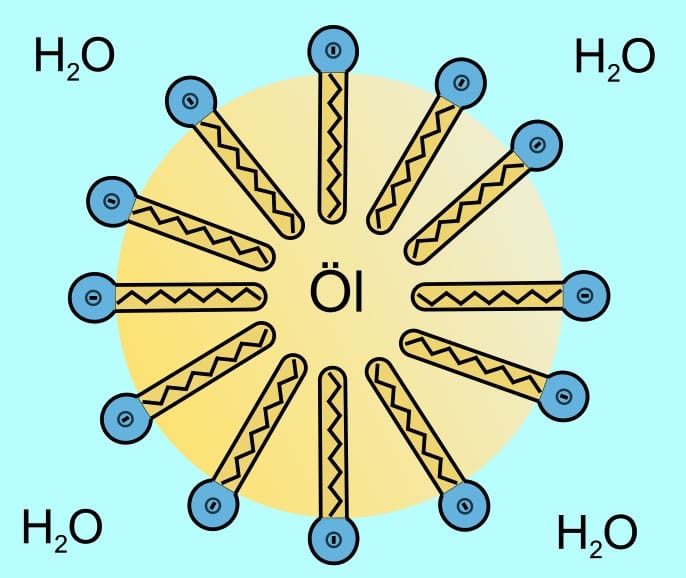
Once the surface is full, extra surfactant has nowhere to go at the interface. The molecules group together in the liquid instead and form structures called micelles: clusters with tails hidden inside and heads facing the water. The concentration where this starts is the critical micelle concentration, or CMC.
Below the CMC, surface tension drops as you add surfactant. Above it, surface tension stays almost flat, and the extra surfactant goes into micelles that can hold oil and grease in their cores. That is how detergents lift dirt.
Typical CMC values in water at 25°C are about 8 mM for sodium dodecyl sulfate (SDS) and about 1 mM for cetyltrimethylammonium bromide (CTAB), with non-ionic surfactants often much lower (Mukerjee and Mysels, 1971; Rosen and Kunjappu, 2012). The CMC of common surfactants dataset lists more values.
Expert Quote
Plot surface tension against surfactant concentration and the interface tells you when it is saturated — the curve bends at the point where the surface can hold no more.

What types of surfactants are there?
Surfactants are grouped by the charge on their hydrophilic head. That charge controls how the hydrophilic and hydrophobic groups interact with surfaces, salts and each other (Rosen and Kunjappu, 2012).
| Type | Head group charge | Common examples | Typical uses |
|---|---|---|---|
| Anionic | Negative | Sodium dodecyl sulfate (SDS, also sold as sodium lauryl sulfate), sodium laureth sulfate, linear alkylbenzene sulfonate, soaps | Detergents, shampoos, dish soap and household cleaning products; strong cleaning and foaming |
| Cationic | Positive | Quaternary ammonium compounds such as CTAB and benzalkonium chloride | Fabric softeners, hair conditioners, disinfectants; positively charged heads stick to negatively charged surfaces such as fabric and hair |
| Nonionic | None | Alcohol ethoxylates, polysorbates (Tween), Triton X-100 | Low foam cleaners, food and pharmaceutical emulsions, agrochemical adjuvants; less sensitive to hard water |
| Amphoteric (zwitterionic) | Positive and negative, depending on pH | Cocamidopropyl betaine | Mild shampoos and body washes, often paired with anionic surfactants to reduce irritation |
Applications of surfactants: how surfactants are used in products and industry
- Soaps and detergents. Soaps, detergents, dishwashing liquids and other cleaning agents wet surfaces, lift grease into micelles and keep dirt from settling back.
- Shampoo and personal care products. Anionic sulfates clean and foam, amphoteric betaines make the formula milder, and cationic surfactants in conditioners cling to hair. "Sulfate free" products usually aim for mildness on skin and hair.
- Paints, coatings and inks. Wetting agents help a liquid spread over a substrate and disperse pigments evenly.
- Agriculture. Adjuvants help spray drops spread on waxy leaves and reduce drift.
- Food, cosmetics and pharmaceuticals. An emulsifier such as a polysorbate or lecithin stabilises the emulsion of water and oil in sauces, cosmetic creams and drug formulations.
- Firefighting. Foaming surfactants help foam spread over burning fuel and cut off oxygen.
Why do surfactants make foam?
Foam is gas trapped in thin liquid films. In pure water those films drain and break almost at once. Surfactant molecules line both sides of each film, lower its tension and resist stretching, so the films last long enough to build a foam.
That is useful in shampoo and firefighting foam, and a problem in fermentation tanks, paper mills and coating lines, where defoamers are added. Foam stability tests track how quickly foam forms and collapses.
How are surfactants measured?
- Surface tension. Pendant drop, Wilhelmy plate and du Noüy ring methods measure how far a surfactant lowers surface tension. EN 14370 sets out how to measure the surface tension of surfactant solutions.
- CMC. Measure surface tension across a range of concentrations and plot it against the log of concentration. The CMC is where the falling line meets the flat one. Experiment 9 walks through it, and the CMC assessment use case compares techniques.
- Dynamic surface tension. Measured over time on a fresh surface, it shows how fast a surfactant reaches the interface.
- Interfacial tension. The tension between two liquids, such as oil and water, matters for emulsions and enhanced oil recovery.
- Contact angle. Shows whether the surfactant solution actually wets the target surface.
The Dropometer measures surface tension, interfacial tension and contact angle from drop images with automatic edge and baseline detection. A university rheology lab uses it for pendant drop surface tension, and a published study of polymer and surfactant mixtures used it to track surface activity.
What is the environmental impact of surfactants?
Surfactants end up in wastewater in large volumes. Those that break down slowly can harm aquatic life, which is why biodegradability is now a design requirement. In the European Union, surfactants in detergents must meet ultimate aerobic biodegradability criteria under Regulation (EC) No 648/2004.
Fluorinated surfactants, used for example in some firefighting foams, are a particular concern because they persist in the environment, and many users are moving to fluorine free alternatives.
What comes next for surfactants?
- Biosurfactants. Made by microbes, for example rhamnolipids, sophorolipids and surfactin. They are biodegradable and work in detergents, cosmetics and oil recovery, though cost still limits wider use (Banat et al., 2010).
- Plant based surfactants. Sugar and plant oil based surfactants such as alkyl polyglucosides are replacing some petrochemical ones.
- Tailored molecules. Designing head and tail groups for a specific job, such as stability at high temperature or salt content.
- Nanotechnology and medicine. Surfactants disperse nanoparticles and help deliver poorly soluble drugs.
Where can you go deeper?
These pages cover the methods, standards and data behind this post.
- Buying guide: Best Tensiometer for Surfactant and CMC Research
- Tool: Free Contact Angle Tool
- Related post: Why Water Forms Droplets in Oil But Oil Spreads in Water
Measure surface tension and CMC with a pendant drop
See a surfactant solution measured by pendant drop with automatic edge and baseline detection, in a short call.
Frequently Asked Questions
What does a surfactant do?
It collects at the surface of a liquid or at the boundary between two liquids and lowers the tension there. That helps liquids wet surfaces, mix with oil and form foam.
What is the difference between anionic and nonionic surfactants?
Anionic surfactants have a negatively charged head and clean and foam strongly. Nonionic surfactants have no charge, foam less and are less affected by hard water and salts.
What happens above the critical micelle concentration?
Surface tension stops falling and stays almost constant. Extra surfactant forms micelles in the liquid, which can hold oil and grease in their cores.
How is the CMC measured?
Measure surface tension at a series of concentrations and plot it against the log of concentration. The CMC is the break point where the falling line meets the flat one.
Are surfactants bad for the environment?
Some are. Slowly degrading and fluorinated surfactants can persist in water. EU rules require detergent surfactants to biodegrade, and biosurfactants and plant based surfactants are growing alternatives.