“
Not all contact-angle measurements are created equal: the right method depends on the application. A sessile drop and a tilted plate can give very different, and equally correct, numbers.

TAPPI T 441 is the Cobb test US mills and box plants use: it weighs how many grams of water one square metre of sized paper, board or corrugated board takes up in a set time. The Dropometer does not measure the Cobb value. It complements the test with a fast water contact angle check on sizing, which you correlate with your own Cobb data to flag a weak lot before the full test.
What brings you here?
Quality manager
You report Cobb values by side, but each test takes weighing, blotting and a second weighing. A water contact angle pre check flags a weak lot or side early, so you know what to test first.
Process engineer
You need to see a sizing change at the reel, not after the lab result. Correlate the angle with your Cobb data for each grade and side, then use it as a fast check.
R&D
You need to know whether a new sizing or coating keeps water out, at the surface and over 30 min. Use the decision tree to pick the test for each question.
Free one page checklist for running a water contact angle pre check next to the TAPPI T 441 Cobb test: what to prepare, the settings to lock, how to pair results by side and what to record. Made for mill and box plant QC benches.
Talk to an expert
Tell us your grade, sizing and Cobb limits. We will measure the water contact angle live and tell you plainly where a pre check fits next to your Cobb tester and where it does not.


Droplet Lab builds precision instruments and software for surface science measurement, specialising in contact angle analysis and surface tension characterisation. Used by researchers across materials science, pharmaceuticals, coatings, and advanced manufacturing, Droplet Lab's Dropometer has contributed to studies published in peer-reviewed journals including Advanced Functional Materials (Impact Factor 19). The team combines instrument engineering with deep domain knowledge in wettability science with a focus on practical accuracy.
ANSI/TAPPI T 441 om-24, Water absorptiveness of sized (non-bibulous) paper, paperboard, and corrugated fiberboard (Cobb test), a TAPPI official method. It revises om-20 and builds on studies by Cobb and Lowe (ANSI Webstore listing).
Complements workflow. The Cobb value is a mass of water per square metre, found by weighing. The Dropometer does not measure it. It measures the water contact angle on the sized surface, a pre check you correlate with your own Cobb results.
Contact angle range 10° to 175°, accuracy ±0.35°, display resolution 0.01°, from the Dropometer product specification. The camera runs at 10 frames per second, which suits a reading at a fixed time such as 5 s.
The drop shape method is validated against a KRUSS DSA100E in two peer reviewed papers. See our validation publications.
A university fibre lab used the Dropometer for static water contact angle on electrospun lignin and PLA fibre mats, read within 10 s (Fibers, 2025). The study did not run a Cobb test or use paper. Read our analysis of the paper.
A contact angle reads the surface in the first seconds. It does not weigh the water the sheet takes up over 120 s or 30 min, so it cannot replace a reported TAPPI T 441 Cobb value.
What this standard measures, who uses it and how the Dropometer fits
TAPPI T 441 measures the water absorptiveness of sized paper, paperboard and corrugated board by the Cobb test: the grams of water one square metre of the sheet takes up in a set time. US paper mills, linerboard and box makers, and packaging test labs use the Cobb value to check sizing and how a grade will stand up to water. The Dropometer complements this workflow. It does not measure the Cobb value, which needs weighing, but it adds a fast water contact angle check on sizing that you correlate with your own Cobb data.
The current edition is ANSI/TAPPI T 441 om-24, which revised om-20 (source: ANSI Webstore listing). A Cobb tester clamps a ring with a 100 cm² test area over the sheet and wets one face with water for the test period. The piece is then drained, blotted with a 10 kg roller and weighed again, as the standard specifies (source: Thwing-Albert Cobb tester brochure). You report the mass gain in g/m² with its time, for example Cobb120. US labs commonly run 120 s for paper and 30 min for combined board, and test felt and wire sides separately (source: SGS-IPS). TAPPI sends unsized and absorbent grades to TAPPI T 432 and does not recommend the Cobb test as a sizing test for writing paper (source: SGS-IPS).
The Dropometer contact angle and surface energy kit reads the water contact angle on the same face at a fixed time, such as 5 s, with ±0.35° accuracy (Dropometer product specification). A drop that stays high points to good sizing at the surface; a drop that flattens and soaks in points to a weak spot. For the basics, see the contact angle measurement guide and wettability in our glossary. To keep readings comparable between shifts and mills, follow reproducible contact angle measurement, and sense check values against our water contact angle reference values for common surfaces.
Timed water contact angle on paper also drives wicking control for paper microfluidic and lateral flow tests. A shared facility at Cornell University uses the Dropometer for contact angle work, and a fibre lab there used it to read water contact angle on lignin based fibre mats, a fibrous material rather than paper. If you are choosing an instrument for a mill or converting QC bench, see our best contact angle goniometer for industrial QA.
Further reading: the packaging and containers guide.
A water contact angle pre check next to the TAPPI T 441 Cobb test, step by step
These steps show where the Dropometer fits next to the Cobb test. They do not replace TAPPI T 441. Buy the current edition and follow its apparatus, test period, blotting and specimen rules for any Cobb value you report.
From the Dropometer product specification. Display resolution is 0.01°.
Base plate, phone holder, LED and syringe. No PC needed.
5 V battery operation, so the unit can sit at the machine or corrugator.
From the same sheet, take test pieces for the Cobb test and a strip for the contact angle, and mark the felt and wire sides. For combined board, mark the outer liner. Condition them in the atmosphere the standard specifies, and handle them by the edges, since skin oils change both results.
Lay the strip flat on the Dropometer stage, side under test up. Dispense a fixed drop of the same water you use for the Cobb test and read the angle at a fixed time, such as 5 s. Automatic edge and baseline detection gives the same reading from the same image.
Place several drops on fresh areas of each side and take the mean. Compare it with your pre check limit for that grade. A low mean flags that lot and side for the Cobb test first; it does not fail the lot on its own.
On your Cobb tester, weigh the test piece, clamp it under the ring and wet the same face for the test period, such as 120 s for paper. Drain, blot with the roller and weigh it again, as the standard specifies. The mass gain per square metre is the Cobb value.
Plot the Cobb value against the angle for each lot and side of one grade. Add lots that passed and lots that failed. Set the pre check limit with a margin from that plot, not from a published table. See TAPPI T 458 for timed angle readings on paper.
Record the angle, reading time, drop volume and room conditions next to the Cobb value, its test period and the side tested. Report the Cobb value from the Cobb tester as the TAPPI T 441 result. The angle stays a pre check.
This video shows a complete Dropometer contact angle measurement, from setup to result. It covers the steps above in one run.
Independent benchmarking and publication-based validation references.
Peer reviewed method
The Dropometer drop shape method is validated against a KRUSS DSA100E in two peer reviewed papers, one in Review of Scientific Instruments and one in Colloids and Surfaces A. Published contact angle accuracy is ±0.35° (Dropometer product specification).
Customer evidence
We have no published client study that pairs the Dropometer with TAPPI T 441. A shared facility at Cornell University uses it for contact angle work, and a fibre lab there used it for water contact angle on lignin based fibre mats (Fibers, 2025).
TAPPI T 441 · Cobb value · paper, linerboard and box QC
TAPPI T 441 is a test method and sets no pass or fail Cobb value (source: ANSI/TAPPI T 441 om-24 listing). Your grade specification or your customer sets the limit. One published US limit applies to fibreboard boxes for hazardous materials: after a 30 min Cobb test, the outer surface may gain no more than 155 g/m² (source: 49 CFR 178.516). That rule names ISO 535 as the Cobb method.
No published table converts a contact angle into a Cobb value. The two do tend to move together. In one mill study on three paper machines, mean water contact angles of 76.3°, 93.2° and 101.7° went with mean Cobb60 values of 33.4, 29.3 and 28.1 g/m², but the link was not a straight line across all samples (source: Lopes et al., Tecnicelpa 2010).
So build your own correlation for each grade and each Cobb time. Take lots that passed and lots that failed, read the water contact angle on the same face at a fixed time, then run TAPPI T 441 as the standard specifies. Set a pre check limit with a margin, so lots near the line still go to the full Cobb test. Expect a weaker link for a 30 min test than for 120 s, since a longer test depends more on water moving through the whole sheet. Repeat the study when you change furnish, sizing agent, surface size or calender settings.
Example data for illustration only. These are not measured results. Your own grades, sizing and Cobb limits decide the numbers.
| Lot and side | Drops (n) | Angle at 5 s (°) | Pre check | Cobb120 from Cobb tester (g/m²) | Decision |
|---|---|---|---|---|---|
| Lot A, felt side | 5 | 101.3 | Pass | 26.8 | Release |
| Lot A, wire side | 5 | 97.5 | Pass | 29.1 | Release |
| Lot B, felt side | 5 | 93.0 | Pass | 32.4 | Release |
| Lot B, wire side | 5 | 88.2 | Flag | 34.6 | Release on the Cobb result; close to both limits |
| Lot C, felt side | 5 | 84.6 | Flag | 39.5 | Hold the lot, check sizing |
| Lot C, wire side | 5 | 79.9 | Flag | 44.2 | Hold the lot, check sizing |
Each angle is the mean of five drops read at 5 s on the Dropometer. Each Cobb120 value is the mean of five tests on a Cobb tester, not the Dropometer. The example pre check limit is 90° or higher at 5 s, set with a margin from this correlation. The example Cobb120 limit is 35 g/m² or lower, from an example customer specification. A lot is released only when both sides pass the Cobb limit.
The same example data as the table: Cobb120 from the Cobb tester for each lot and side, against an example Cobb120 limit.
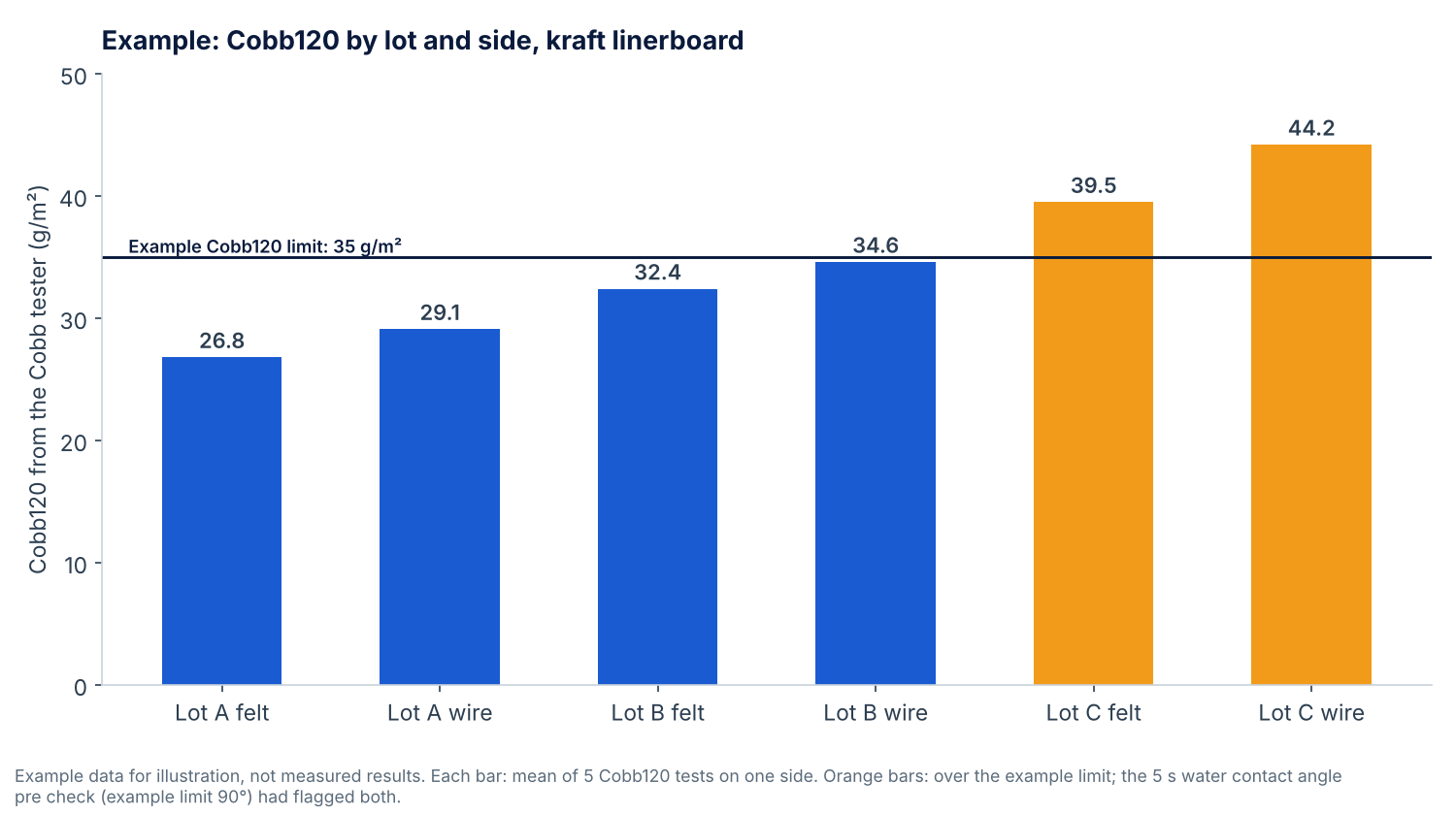
Example data, not measured results.
What changes when a contact angle pre check sits next to the Cobb test
| Metric | Before Dropometer | With Dropometer | Results |
|---|---|---|---|
| First sign of a sizing problem | After the Cobb test, blotting and the second weighing | From a water drop read at 5 s on the side under test | No published benchmark |
| Which lots and sides go to the Cobb tester first | Tested in the order they arrive | Flagged lots and sides tested first | No published benchmark |
| Where the check runs | Lab with balance, Cobb ring and roller | At the machine, corrugator or converting line, on battery for up to 8 h | Dropometer product specification |
| Reported TAPPI T 441 value | Cobb tester | Still the Cobb tester | TAPPI T 441 scope |
Bring two samples with known Cobb values: one that passed and one that failed. We will measure the water contact angle on both sides live.
Enter your own numbers. The defaults are examples, not Droplet Lab results.
Quality cost snapshot
Result
Annual exposure combines audit/CAPA cost, customer rejections, and recall probability; avoided exposure applies the risk reduction percentage.
Lock these before you pair contact angle and Cobb results
| Parameter | Recommended Setting | Technical Rationale |
|---|---|---|
| Cobb test period | As the standard specifies or as agreed, for example 120 s for paper | Name it in every result, such as Cobb120. US labs often run 30 min on combined board (SGS-IPS). Values at different times do not compare. |
| Side tested | Felt and wire side, each read for angle and Cobb | Sizing and texture often differ between the two sides, so pair and report them separately. |
| Test water | The same distilled or deionised water for both tests | Impurities change the angle and can change uptake. |
| Drop volume | Fixed for every drop | A changing volume adds spread that is not about sizing. |
| Angle reading time | Fixed for every drop, for example 5 s | On paper the angle falls as water spreads and soaks in, so time must not vary. |
| Fit model | Young-Laplace or polynomial, the same for every run | Both models are in the Dropometer software. Do not mix them within one study. |
| Pre check limit | Set per grade, side and Cobb time from your own data | No published table converts a contact angle into a Cobb value. |
| Environment | Conditioned room and water temperature as the standard specifies; record both | The Dropometer has no temperature or humidity control and runs at 10 to 45 °C. |
Pick the method by the question you need answered
Start: What do you need to know about the sheet and water?
Your specification, customer or a packaging rule asks for a Cobb value in g/m² at a set time.
Use TAPPI T 441, this page, or ISO 535 on a Cobb tester. The Dropometer does not measure the Cobb value.
You want to flag a weak lot or side at the machine and decide which lots to test first.
Read the water contact angle at a fixed time on the Dropometer and correlate it with your own Cobb data. It complements the Cobb test and does not replace it.
You need ruling and writing quality, or the angle and absorbency over seconds.
Use TAPPI T 458, where the Dropometer is fully compliant, or see TAPPI T 558 and ISO/TS 14778, where it runs part of the method.
Your grade is made to take up water, such as towel, tissue or blotting paper.
TAPPI points to TAPPI T 432 for bibulous paper (SGS-IPS). Very absorbent paper can also take the angle below 10°, the bottom of the Dropometer range.
Start from the question you need answered. Blue boxes are measurements the Dropometer runs.
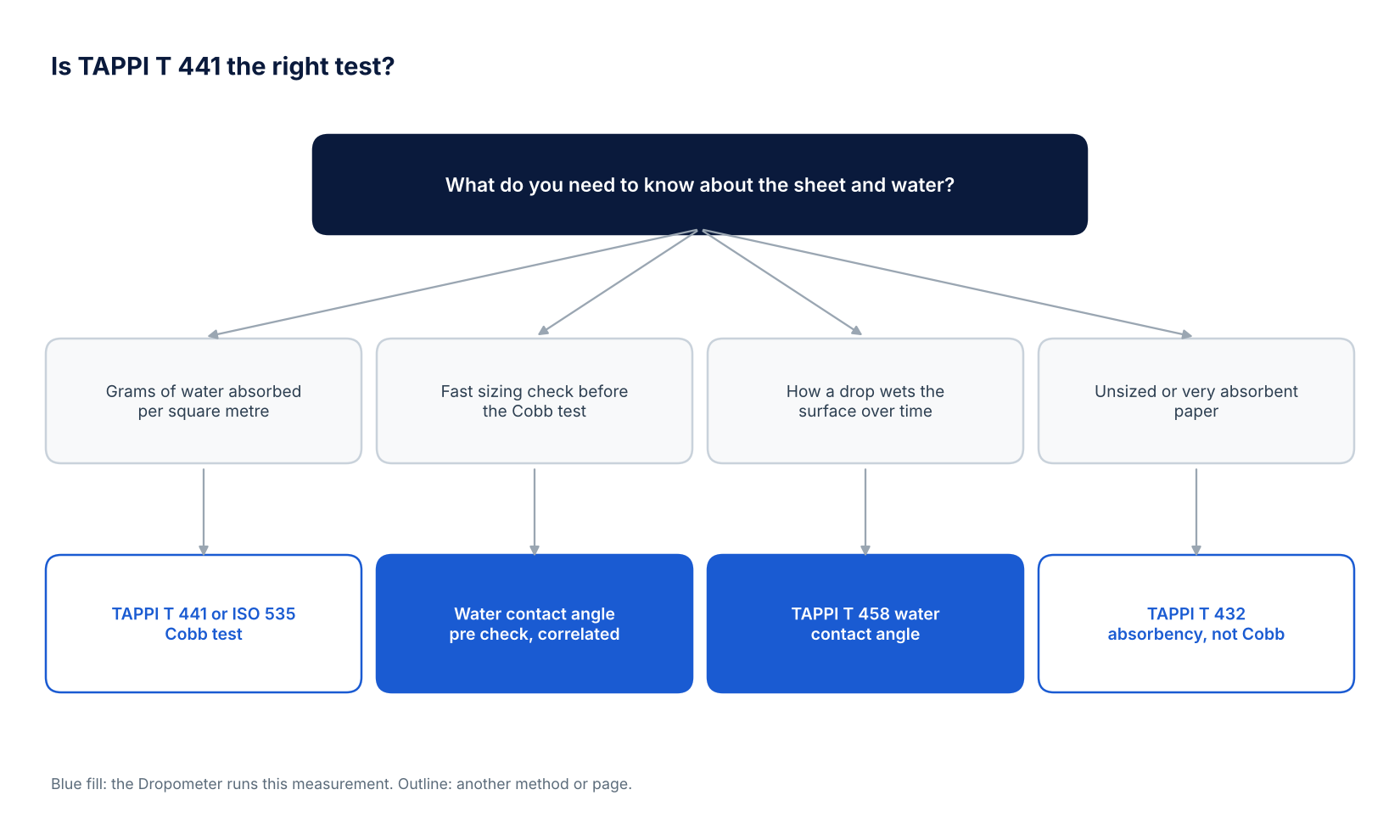
Is TAPPI T 441 the right test?
What the angle tells you about the Cobb value, and what it does not
Honest limits of the pre check and of the Dropometer
It measures the water absorptiveness of sized paper, paperboard and corrugated board: the mass of water one square metre takes up in a set time, found by weighing a test piece before and after one face is wetted. The result is the Cobb value in g/m², written with its time, for example Cobb120.
No. TAPPI T 441 weighs the water a sheet absorbs, and the Dropometer does not measure mass. It complements the test: it reads the water contact angle on the same side, which tracks sizing at the surface. Correlate that angle with your own Cobb results to flag weak lots early, and keep the Cobb tester for every TAPPI T 441 value you report.
The standard sets the test period, and longer or shorter periods can be agreed. US labs commonly run 120 s for paper and 30 min for combined board (source: SGS-IPS TAPPI T 441 page). Always write the time into the result, such as Cobb120 or Cobb1800, because values at different times do not compare.
US rules for fibreboard boxes that carry hazardous materials limit the outer surface to a gain of 155 g/m² in a 30 min Cobb test (source: 49 CFR 178.516). The rule names ISO 535 as the method. Otherwise your customer or grade specification sets the limit.
Both are Cobb tests that weigh the water a sized sheet takes up over a set time, and both report g/m². They are separate documents, so details such as conditioning, test period and apparatus tolerances can differ. Quote the one your customer or regulation names. See ISO 535.
They usually move in opposite directions: better sizing gives a higher angle and a lower Cobb value. A mill study on three paper machines saw that trend, but not a straight line across all samples (source: Lopes et al., 2010). Build your own correlation for each grade, side and Cobb time before you use the angle as a pre check.
Unsized and absorbent grades, such as towel or blotting paper, belong to TAPPI T 432. The Cobb test is also not recommended as a sizing test for writing paper (source: SGS-IPS). For ruling and writing quality, see TAPPI T 458, where the Dropometer is fully compliant.
This page summarises TAPPI T 441 in our own words and does not reproduce the standard. Buy the current edition from TAPPI or ANSI before you write a procedure. The Dropometer complements the workflow: it measures water contact angle, not the Cobb value. Droplet Lab does not certify compliance. Your own method validation does.
Sources, review and tools
ANSI/TAPPI T 441 om-24 listing (ANSI Webstore); TAPPI T 441 om-20 listing, superseded (ANSI Webstore); TAPPI T 441 scope and document history (GlobalSpec); TAPPI Standards Subject Index, November 2025, the Dropometer product specification and Droplet Lab validation papers.
Drafted with Claude (Anthropic) from the sources listed, then reviewed by Droplet Lab.
We did not copy text from the standard. Buy the current edition for the full procedure.
October 2026
Spotted an issue in this summary? Send a correction request and our team will review it.
Correction Request
We work hard to keep this page accurate and up to date. If you spot an error (wrong revision/year, missing requirement, incorrect interpretation, or broken link), tell us and we'll review it.
Contact us to report a correction