


Contents
Complements workflow

ISO 535 Cobb test: determination of water absorptiveness of paper and board

ISO 535 measures how many grams of water one square metre of paper or board takes up in a set time: the Cobb value. The Dropometer does not measure the Cobb value. It complements the test with a fast water contact angle check on sizing, which you correlate with your own Cobb data to catch a weak lot before the full test.

What brings you here?

Who this is for
Paper mills, board makers, corrugators and packaging converters who check sizing with the Cobb test.
Compliance tier
Complements workflow: the Dropometer does not measure the Cobb value. It adds a water contact angle pre check on sizing that you correlate with your Cobb data.
Measurement
ISO 535: water absorbed in g/m², by weighing. Dropometer: sessile drop water contact angle, 10° to 175°, ±0.35° accuracy (Dropometer datasheet).
Setup
About 2 minutes. Battery powered, 1 kg, runs at the machine or in the lab.
Last updated
October 20, 2026

Free one page checklist for running a water contact angle pre check next to the ISO 535 Cobb test: what to prepare, the settings to lock, how to pair results and what to record. Made for paper and board QC benches.

Talk to an expert

Book a 15 minute demo on your board

Tell us your grade, sizing and Cobb limits. We will measure the water contact angle live and tell you plainly where a pre check fits next to your Cobb tester and where it does not.

Book a 15 minute demo
View the official standard
Gurdeep-Saini-Photo
Written by
Gurdeep Singh Saini
Holds a BASc in Mechanical Engineering from Ryerson University (now Toronto Metropolitan University) and an MASc from York University. He develops the automatic edge and baseline detection behind the Dropometer's analysis.
COO at Droplet Lab
Read More
Droplet-Lab logo
Technical Review by
Droplet Lab Team
Droplet Lab builds precision instruments and software for surface science measurement, specialising in contact angle analysis and surface tension characterisation. Used by researchers across materials science, pharmaceuticals, coatings, and advanced manufacturing, Droplet Lab's Dropometer has contributed to studies published in peer-reviewed journals including Advanced Functional Materials (Impact Factor 19). The team combines instrument engineering with deep domain knowledge in wettability science with a focus on practical accuracy.
Read More
Verified against ISO 535
Gurdeep-Saini-Photo
Written By

Gurdeep Singh Saini

COO at Droplet Lab

Holds a BASc in Mechanical Engineering from Ryerson University (now Toronto Metropolitan University) and an MASc from York University. He develops the automatic edge and baseline detection behind the Dropometer's analysis.

Droplet-Lab logo
Reviewed By

Droplet Lab Team

Droplet Lab builds precision instruments and software for surface science measurement, specialising in contact angle analysis and surface tension characterisation. Used by researchers across materials science, pharmaceuticals, coatings, and advanced manufacturing, Droplet Lab's Dropometer has contributed to studies published in peer-reviewed journals including Advanced Functional Materials (Impact Factor 19). The team combines instrument engineering with deep domain knowledge in wettability science with a focus on practical accuracy.

Evidence box

Standard

ISO 535:2023, Paper and board: determination of water absorptiveness, Cobb method, fourth edition, from ISO/TC 6/SC 2. It replaces ISO 535:2014. It specifies a method of determining the water absorptiveness of sized paper and board, corrugated fibreboard included, under standard conditions (ISO listing).

Compliance tier

Complements workflow. The Cobb value is a mass of water per square metre, found by weighing. The Dropometer does not measure it. It measures the water contact angle on the sized surface, a pre check you correlate with your own Cobb results.

Instrument performance

Contact angle range 10° to 175°, accuracy ±0.35°, display resolution 0.01°, from the Dropometer product specification. The camera runs at 10 frames per second, which suits a reading at a fixed time such as 5 s.

Peer reviewed method

The drop shape method is validated against a KRUSS DSA100E in two peer reviewed papers. See our validation publications.

Customer evidence

Researchers developing a fibre based packaging film used the Dropometer to track water contact angle from placement to 30 s (Applied Sciences, 2025). The paper reports water absorption as a separate test. Read our analysis of the paper.

What it does not tell you

A contact angle reads the surface in the first seconds. It does not weigh the water the sheet takes up over 60 s or longer, so it cannot replace a reported ISO 535 Cobb value.
Executive summary

What this standard measures, who uses it and how the Dropometer fits

ISO 535 measures the water absorptiveness of paper and board by the Cobb method: the grams of water one square metre of the sheet takes up in a set time. Paper mills, board makers, corrugators and packaging converters use the Cobb value to check sizing and how a grade will hold up to water. The Dropometer complements this workflow. It does not measure the Cobb value, which needs weighing, but it adds a fast water contact angle check on sizing that you correlate with your own Cobb data.

The current edition is ISO 535:2023. The test weighs a test piece, exposes one face to a 10 mm head of water inside a ring of about 100 cm² for a set time, blots it with a roller and weighs it again. The mass gain per square metre is the result, written with its time, for example Cobb60 in g/m². A lower value means the sheet takes up less water. ISO excludes paper under 50 g/m², embossed paper and absorbent grades such as newsprint and blotting paper (source: ISO 535:2023 listing).

The Dropometer contact angle and surface energy kit reads the water contact angle on the same face at a fixed time, such as 5 s, with ±0.35° accuracy (Dropometer product specification). A drop that stays high points to good sizing at the surface; a drop that flattens and soaks in points to a weak spot. For how to run the reading, see the contact angle measurement guide and wettability in our glossary. To keep readings comparable between shifts, follow reproducible contact angle measurement, and sense check values against our water contact angle reference values for common surfaces.

Timed water contact angle on paper also drives wicking control for paper microfluidic and lateral flow tests. Researchers used the Dropometer to track water contact angle over time on a fibre based packaging film. If you are choosing a lab instrument for regulated QC, our buying guide for ISO and GLP regulated high throughput QC compares the options.

Further reading: the packaging and containers guide.

How the Dropometer fits beside the Cobb test procedure

A water contact angle pre check next to the ISO 535 Cobb test, step by step

From one sheet to a paired angle and Cobb value

These steps show where the Dropometer fits next to the Cobb test. They do not replace ISO 535. Buy the current edition and follow its apparatus, timing, blotting and test piece rules for any Cobb value you report.

±0.35°

Contact angle accuracy

From the Dropometer product specification. Display resolution is 0.01°.

About 2 min

Setup

Base plate, phone holder, LED and syringe. No PC needed.

10 fps

Camera frame rate

A reading at 5 s sits well inside what the camera captures.

1

Cut and condition both sets of test pieces

Take test pieces for the Cobb test and a strip for the contact angle from the same sheet, and mark the face under test. Condition them in the atmosphere the standard specifies. Handle them by the edges, since skin oils change both results.

2

Read the water contact angle

Lay the strip flat on the Dropometer stage, face under test up. Dispense a fixed drop of the same water you use for the Cobb test and read the angle at a fixed time, such as 5 s. Automatic edge and baseline detection gives the same reading from the same image.

3

Repeat and check against the pre check limit

Place several drops on fresh areas and take the mean. Compare it with your pre check limit for that grade. A low mean flags the lot for the Cobb test first; it does not fail the lot on its own.

4

Run the Cobb test

On your Cobb tester, weigh the test piece, clamp it under the ring and expose the same face to water for the test time. Pour off, blot with the roller and weigh it again, as the standard specifies. The mass gain per square metre is the Cobb value.

5

Pair the results and build the correlation

Plot the Cobb value against the angle for each lot of one grade. Add lots that passed and lots that failed. Set the pre check limit with a margin from that plot, not from a published table. See TAPPI T 458 for timed angle readings on paper.

6

Record and report each result by its method

Record the angle, reading time, drop volume and room conditions next to the Cobb value, its test time and the face tested. Report the Cobb value from the Cobb tester as the ISO 535 result in the test report. The angle stays a pre check.

7

Watch the full measurement

This video shows a complete Dropometer contact angle measurement, from setup to result. It covers the steps above in one run.

Dropometer contact angle measurement, start to finish.

Validated measurement approach

Independent benchmarking and publication-based validation references.

Peer reviewed method

The Dropometer drop shape method is validated against a KRUSS DSA100E in two peer reviewed papers, one in Review of Scientific Instruments and one in Colloids and Surfaces A. Published contact angle accuracy is ±0.35° (Dropometer product specification).

Read the validation papers

Customer evidence

We have no published client study that pairs the Dropometer with ISO 535. Researchers used it for timed water contact angle on a fibre based packaging film (Applied Sciences, 2025), and on marker ink barriers on filter paper (Chemosensors, 2020).

Read our analysis

Correlate the angle with your ISO 535 Cobb data

ISO 535 · Cobb value · paper and board QC

ISO 535 is a test method. The public summary gives no pass or fail Cobb value (source: ISO 535:2023 listing). Your grade specification or your customer sets the Cobb limit, and no published table converts a contact angle into a Cobb value.

The two results do tend to move together. In one mill study on three paper machines, mean water contact angles of 76.3°, 93.2° and 101.7° went with mean Cobb60 values of 33.4, 29.3 and 28.1 g/m². The same study found the link was not a straight line across all samples (source: Lopes et al., Tecnicelpa 2010).

So build your own correlation. For each grade, take lots that passed and lots that failed the Cobb test, read the water contact angle on the same face at a fixed time, then run the Cobb test as the standard specifies. Set a pre check limit with a margin, so lots near the line still go to the full Cobb test. Repeat the study when you change furnish, sizing agent, surface size or calender settings.

Example output

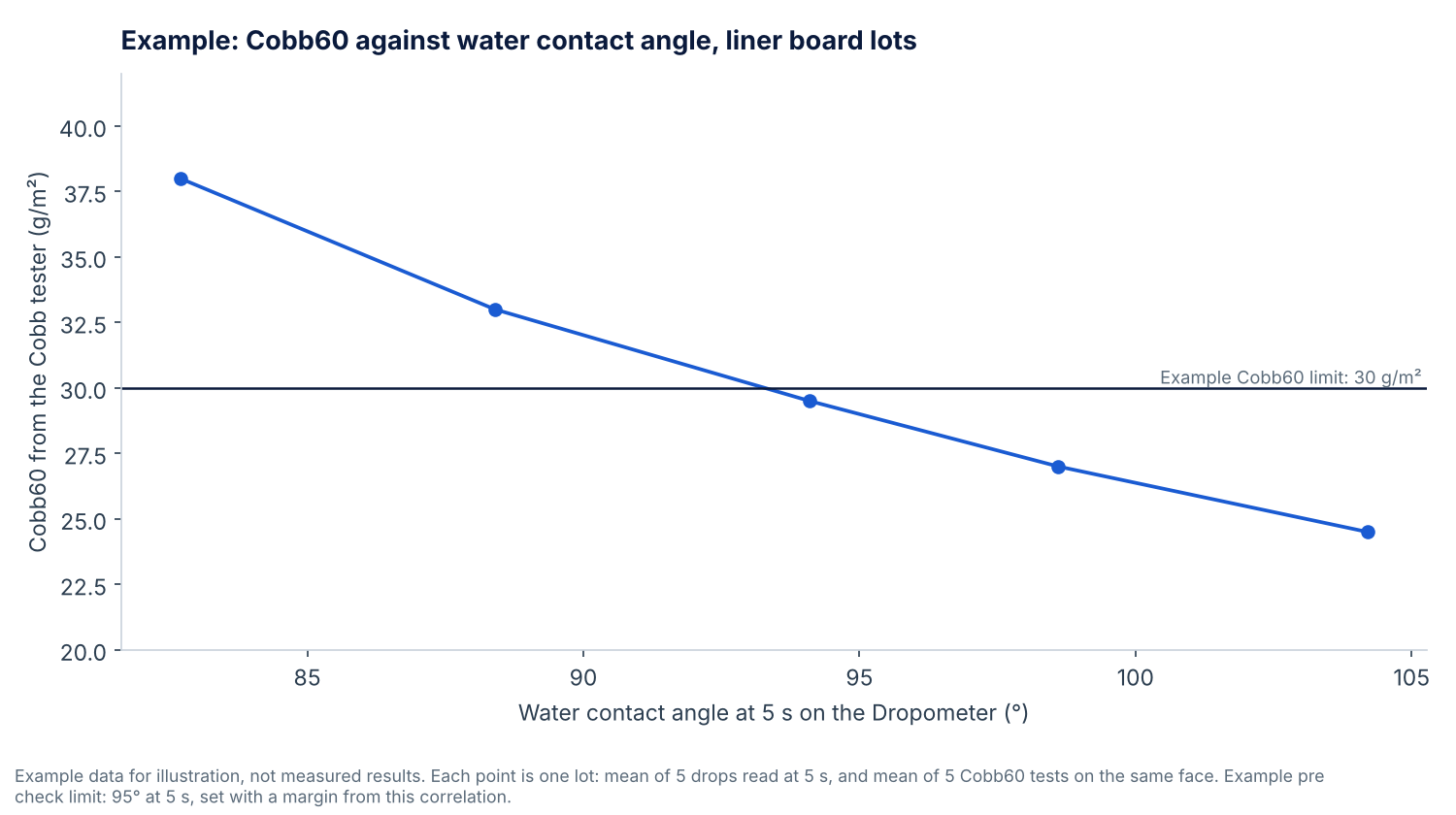
Example data for illustration only. These are not measured results. Your own grades, sizing and Cobb limits decide the numbers.

Example: liner board, five lots, top face, angle pre check and Cobb60

Lot Drops (n) Angle at 5 s (°) Pre check Cobb60 from Cobb tester (g/m²) Decision
Lot A5104.2Pass24.5Release
Lot B598.6Pass27.0Release
Lot C594.1Flag29.5Release on the Cobb result; close to both limits
Lot D588.4Flag33.0Hold the lot, check sizing
Lot E582.7Flag38.0Hold the lot, check sizing

How to read this table

Each angle is the mean of five drops read at 5 s on the Dropometer. Each Cobb60 value is the mean of five tests on a Cobb tester, not the Dropometer. The example pre check limit is 95° or higher at 5 s, set with a margin from this correlation. The example Cobb60 limit is 30 g/m² or lower, from an example customer specification.

Example output chart

The same example data as the table: Cobb60 from the Cobb tester plotted against the water contact angle at 5 s, with an example Cobb60 limit.

Line chart of example Cobb60 values falling from 38.0 to 24.5 g/m² as the water contact angle at 5 s rises from 82.7 to 104.2 degrees across five liner board lots, with an example 30 g/m² Cobb limit

Example data, not measured results.

Business impact

What changes when a contact angle pre check sits next to the Cobb test

Metric Before Dropometer With Dropometer Results
First sign of a sizing problem After the Cobb test and the second weighing From a water drop read at 5 s on the face under test No published benchmark
Which lots go to the Cobb tester first Tested in the order they arrive Flagged lots tested first No published benchmark
Where the check runs Laboratory with balance, Cobb ring and roller At the machine or converting line, on battery for up to 8 h Dropometer product specification
Reported ISO 535 value Cobb tester Still the Cobb tester ISO 535 scope

See the pre check on your own board

Bring two samples with known Cobb values: one that passed and one that failed. We will measure the water contact angle on both live.

ROI estimate

Estimate the cost of the sizing failures a pre check can catch

Enter your own numbers. The defaults are examples, not Droplet Lab results.

Quality cost snapshot

Estimate what wetting related failures cost you.

Example only. Use what you see in a trial on your own samples.
Your own figure.
Your own estimate.

Result

~0
Estimated annual cost today
~0
Estimated annual cost avoided
~0
Payback period

Annual exposure combines audit/CAPA cost, customer rejections, and recall probability; avoided exposure applies the risk reduction percentage.

Laboratory settings for the angle and the Cobb method

Lock these before you pair contact angle and Cobb results

Parameter Recommended Setting Technical Rationale
Cobb test time As the standard specifies or as agreed, for example 60 s Name it in every result, such as Cobb60. Values at different times do not compare.
Face tested The same face for the angle and the Cobb test Sizing and texture often differ between the two faces.
Test water The same distilled or deionised water for both tests Impurities change the angle and can change uptake.
Drop volume Fixed for every drop A changing volume adds spread that is not about sizing.
Angle reading time Fixed for every drop, for example 5 s On paper the angle falls as water spreads and soaks in, so time must not vary.
Fit model Young-Laplace or polynomial, the same for every run Both models are in the Dropometer software. Do not mix them within one study.
Pre check limit Set per grade from your own angle and Cobb data No published table converts a contact angle into a Cobb value.
Environment Conditioned room and water temperature as the standard specifies; record both The Dropometer has no temperature or humidity control and runs at 10 to 45 °C.

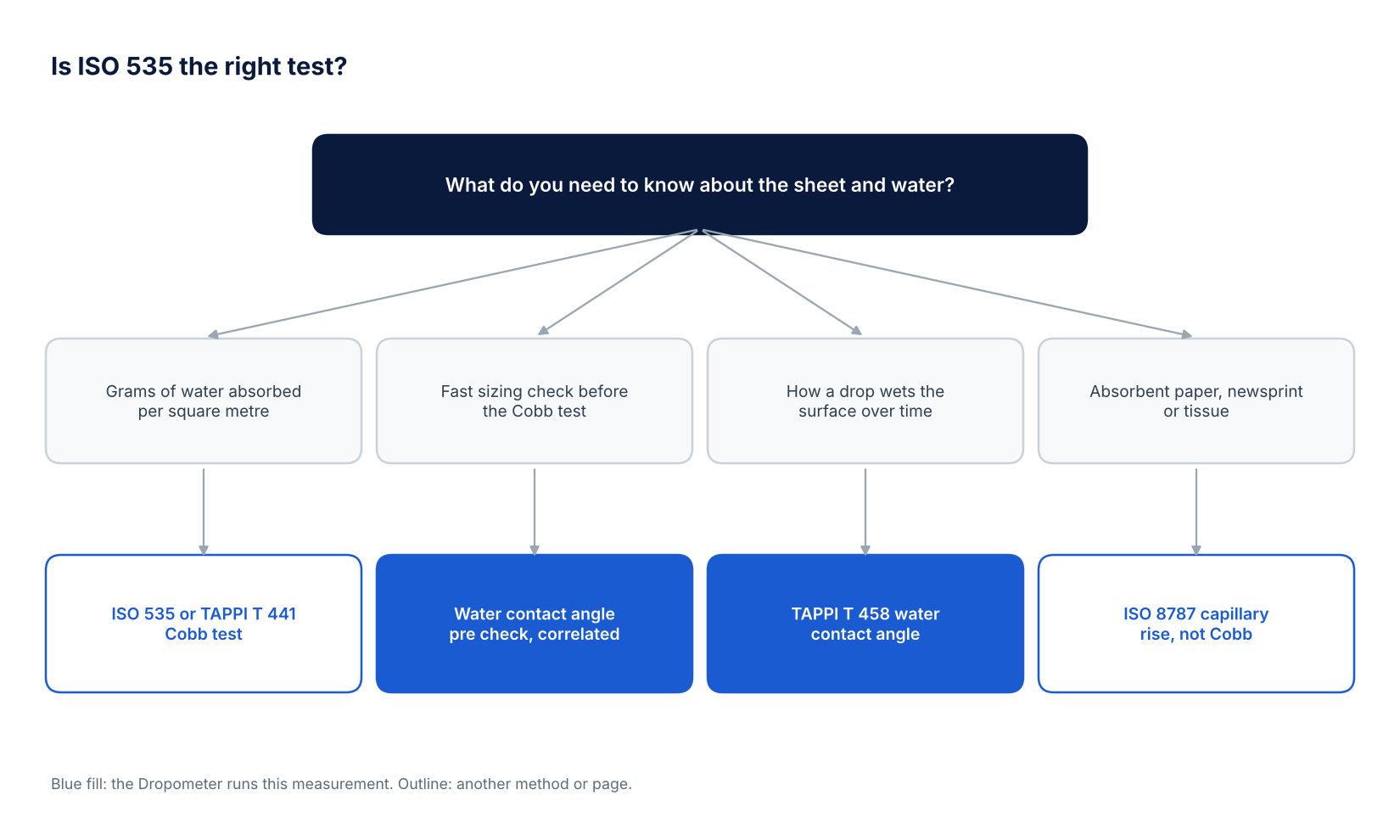
Is ISO 535 the right test?

Pick the method by the question you need answered

Start: What do you need to know about the sheet and water?

Grams of water taken up per square metre

Signals:

Your specification or customer asks for a Cobb value in g/m² at a set time.

Rule-out:

Use ISO 535, this page, or TAPPI T 441 on a Cobb tester. The Dropometer does not measure the Cobb value.

A fast sizing check before the Cobb test

Signals:

You want to flag a weak lot at the machine and decide which lots to test first.

Rule-out:

Read the water contact angle at a fixed time on the Dropometer and correlate it with your own Cobb data. It complements the Cobb test and does not replace it.

How a drop wets and soaks in over time

Signals:

You need the angle and absorbency over seconds, for sizing studies or ruling and writing quality.

Rule-out:

Use TAPPI T 458, where the Dropometer is fully compliant, or see TAPPI T 558 and ISO/TS 14778, where it runs part of the method.

Absorbent paper, newsprint or tissue

Signals:

Your grade is under 50 g/m², embossed or made to absorb water.

Rule-out:

ISO 535 does not cover it. ISO points to ISO 8787, a capillary rise method. Very absorbent paper can also take the angle below 10°, the bottom of the Dropometer range.

Decision tree at a glance

Start from the question you need answered. Blue boxes are measurements the Dropometer runs.

Decision tree for choosing between the ISO 535 or TAPPI T 441 Cobb test, a water contact angle pre check on the Dropometer, TAPPI T 458 timed contact angle and ISO 8787 for absorbent paper

Is ISO 535 the right test?

Interpreting water absorptiveness results

What the angle tells you about the Cobb value, and what it does not

Higher angle, usually lower Cobb: Good sizing holds the drop up and keeps water out of the sheet, so a high angle tends to go with a low Cobb value.
A trend, not a conversion: A mill study found the two move together but not in a straight line across all samples (Lopes et al., 2010). Correlate per grade.
Surface against the whole sheet: The angle reads the surface in seconds. The Cobb value weighs water taken into the sheet over the test time, so internal sizing and pores matter more.
Longer Cobb times drift further: The longer the Cobb time, the more the result depends on water moving through the sheet. Expect a weaker link to a 5 s angle.
Expert perspective

Why the surface reading and the Cobb value answer different questions

Pick the measurement to match the question: the same surface can read one way as a sessile drop and another on a tilted plate, and both can be the right answer.

Dr. Alidad Amirfazli

Department of Mechanical Engineering, York University, Co-founder and Scientific Advisor, Droplet Lab

Common pitfalls and limits

Honest limits of the pre check and of the Dropometer

The Dropometer does not measure the Cobb value. Report ISO 535 results from a Cobb tester only.
A correlation holds for one grade and sizing system. Rebuild it when you change furnish, sizing agent or surface size.
Very absorbent paper can take the angle below 10°, the bottom of the Dropometer range.
The camera runs at 10 frames per second. That suits a reading at 5 s, not millisecond absorption studies.
The Dropometer has no temperature or humidity control. Test in a conditioned room and record its conditions.
Rough, fibrous or embossed surfaces give an apparent angle that reflects texture as well as sizing.
FAQ

Frequently asked questions

What does ISO 535 measure?

It measures water absorptiveness: the mass of water one square metre of paper or board takes up in a set time, found by weighing a test piece before and after one face is exposed to water. The result is the Cobb value in g/m², written with its time, for example Cobb60.

Can the Dropometer run ISO 535?

No. ISO 535 weighs the water a sheet absorbs, and the Dropometer does not measure mass. It complements the test: it reads the water contact angle on the same face, which tracks sizing at the surface. Correlate that angle with your own Cobb results to flag weak lots early, and keep the Cobb tester for every ISO 535 value you report.

What does a Cobb60 value mean?

Cobb60 is the grams of water one square metre of the sheet took up in a 60 s test. A Cobb60 of 25 g/m² means 25 g of water per square metre. Lower values mean better water resistance. ISO 535 publishes no pass or fail value; your grade specification or customer sets the limit.

Which papers does ISO 535 not cover?

The method is not suitable for paper of grammage less than 50 g/m², embossed paper, or porous papers such as newsprint and blotting paper, which have a relatively high water absorptiveness. ISO also notes the method is not intended for precise evaluation of the writing properties of paper. For absorbent grades it points to ISO 8787, a capillary rise method (source: ISO 535:2023 listing).

Is ISO 535 the same as TAPPI T 441?

Both are Cobb tests that weigh the water a sized sheet takes up over a set time, and both report g/m². They are separate documents, so details such as conditioning and apparatus tolerances can differ. Quote the one your customer names. See TAPPI T 441.

How does water contact angle relate to the Cobb value?

They usually move in opposite directions: better sizing gives a higher angle and a lower Cobb value. A mill study on three paper machines saw that trend, but not a straight line across all samples (source: Lopes et al., 2010). Build your own correlation for each grade before you use the angle as a pre check.

What changed in ISO 535:2023?

ISO 535:2023 is the fourth edition, published in March 2023, and replaces ISO 535:2014. ISO lists added requirements for apparatus and test piece preparation, and revised clauses on blotting and test timing. Check your SOP against the current version.

Legal note

This page summarises ISO 535 in our own words and does not reproduce the standard. Buy the current edition from ISO before you write a procedure. The Dropometer complements the workflow: it measures water contact angle, not the Cobb value. Droplet Lab does not certify compliance. Your own method validation does.

How this page was created

Sources, review and tools

Transparency 4 checklist items
01

Sources

ISO 535:2023 listing; ISO 535:2023 preview (iTeh Standards); ISO 535:1991, earlier edition, procedure context (law.resource.org); ANSI/TAPPI T 441 om-24 listing (ANSI Webstore), the Dropometer product specification and Droplet Lab validation papers.

02

Drafting assistance

Drafted with Claude (Anthropic) from the sources listed, then reviewed by Droplet Lab.

03

What we did not do

We did not copy text from the standard. Buy the current edition for the full procedure.

04

Last checked

October 2026

Report a correction

Spotted an issue in this summary? Send a correction request and our team will review it.

Correction Request

We work hard to keep this page accurate and up to date. If you spot an error (wrong revision/year, missing requirement, incorrect interpretation, or broken link), tell us and we'll review it.

Contact us to report a correction

References

1. ISO 535:2023. iso.org/standard/80320.html
3. ISO 535:1991, earlier edition, procedure context (law.resource.org). law.resource.org/pub/us/cfr/ibr/inc/iso/iso.0535.1991.pdf
4. ANSI/TAPPI T 441 om-24 listing (ANSI Webstore). webstore.ansi.org/standards/tappi/ansitappi441om24
5. Droplet Lab. Peer reviewed validation papers in Review of Scientific Instruments and Colloids and Surfaces A. dropletlab.com/validation/publications/
6. Droplet Lab. Dropometer product specification, 2026. dropletlab.com/products/dropometer/