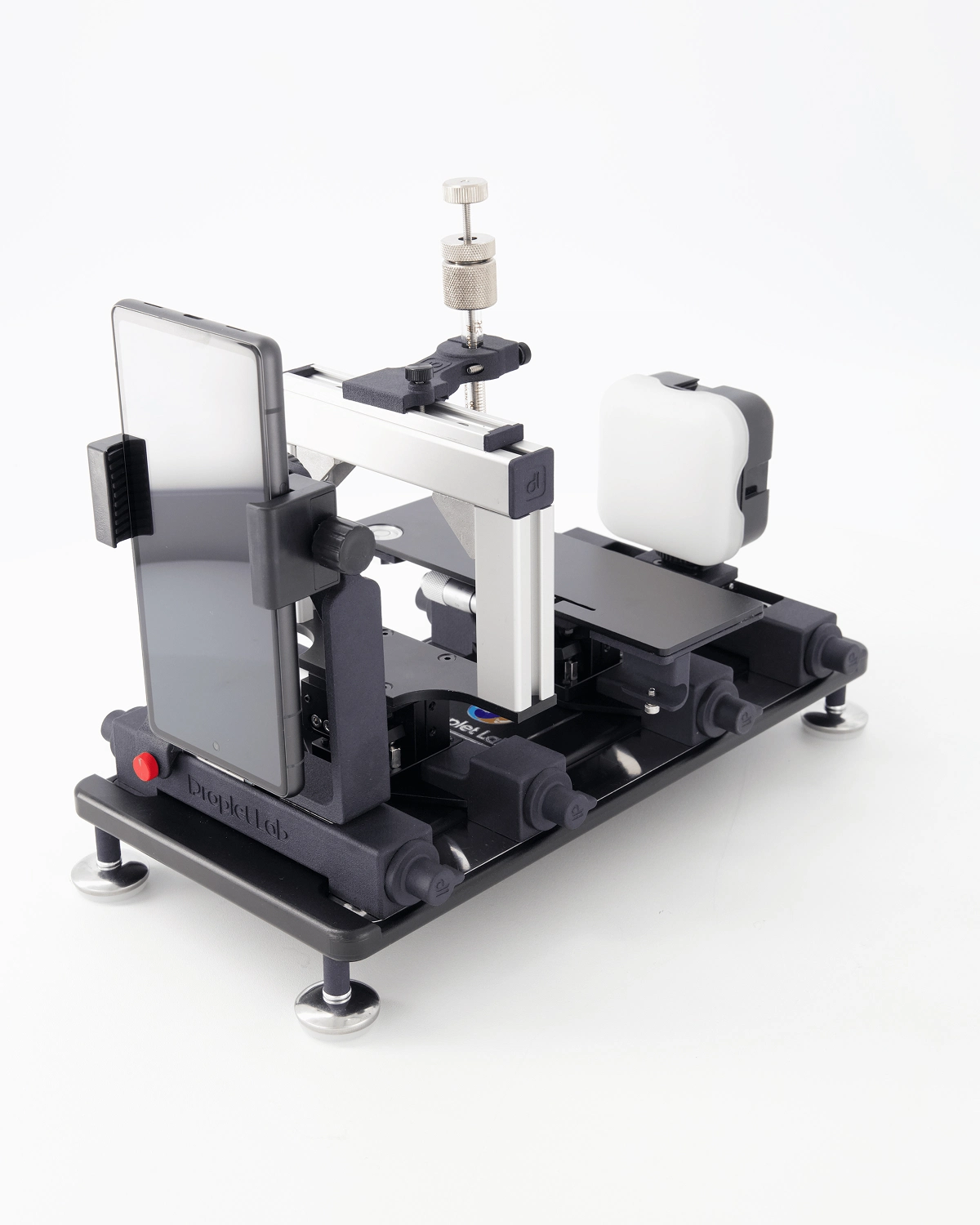
Dropometer
US$4,990 base kit, checked 25 October 2026, Droplet Lab

Surface tension tensiometer comparison
The KRÜSS K20 is a semi-automatic force tensiometer: it measures surface and interfacial tension with a du Noüy ring, a Wilhelmy plate or a rod. The Dropometer measures them optically, from the shape of a pendant drop. This page compares the two on method, range, standards, sample size, temperature, cost and what else each measures.
US$4,990 base kit, checked 25 October 2026, Droplet Lab
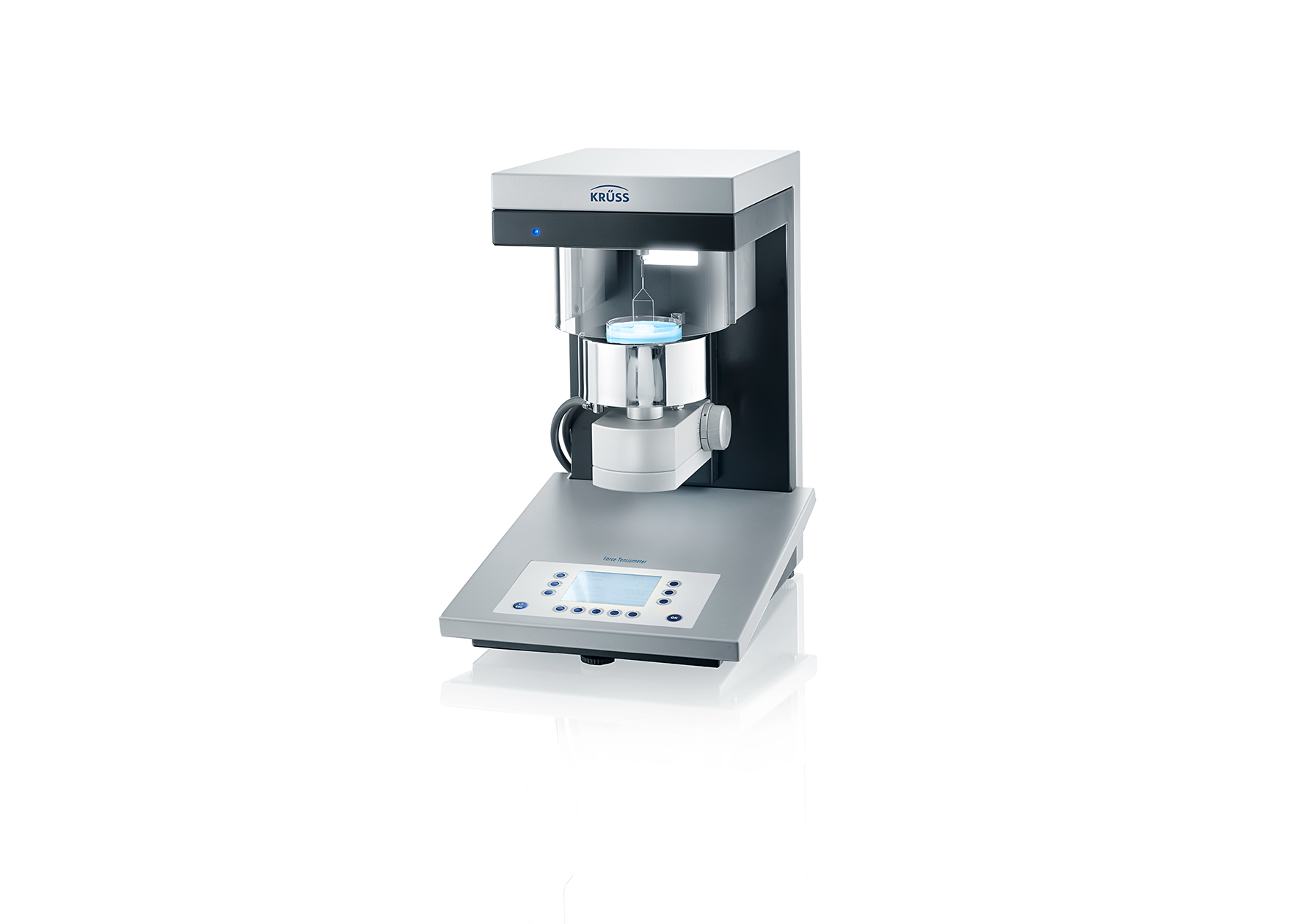
Quote only, no price on the KRÜSS page, checked 25 October 2026, KRÜSS


If your method names the ring or the plate, such as ASTM D1331 or ASTM D971 for transformer oil, or your liquids read above 75 mN/m, buy the KRÜSS K20. For microlitre samples, interfacial tension and contact angle from one kit, and a published price, the Dropometer (US$4,990) is the better buy.
Both instruments measure the surface tension of liquids and the interfacial tension between two liquids. The K20 measures force: its stage moves the liquid against a ring or plate, and the force on the probe becomes a tension. The Dropometer measures shape: its camera records a drop hanging from a needle and fits the Young–Laplace equation to the outline. New to the methods? Our surface tension measurement guide and our guide to optical vs force tensiometers cover both, and the tensiometer glossary entry defines the terms.
Both measure surface tension and liquid to liquid interfacial tension.
Both resolve 0.01 mN/m: the K20 with the ring, the Dropometer by pendant drop.
Both suit routine checks: the K20 runs stored measurement templates, and the Dropometer saves each result with its drop image.
The K20 weighs the pull of the liquid on a probe, so the probe must be clean and fully wetted. The Dropometer fits the outline of a drop, so it needs a sharp silhouette and the density difference between the drop and its surroundings.
The K20 covers 1 to 999 mN/m and needs a vessel of liquid. The Dropometer covers up to 75 mN/m from a drop of a few microlitres.
ASTM D1331 names the ring and the Wilhelmy plate. ASTM D971 and IEC 62961 name the ring. None of them names pendant drop.
KRÜSS sells the K20 by quote; its LabDesk data logger is optional. The Dropometer costs US$4,990 with the phone and app included; an automatic dropper is US$2,000.
The stage brings the liquid to the probe and moves it at 2.4 to 14 mm/min while the force sensor reads at 5 Hz, up to 50 g at 100 µg resolution. With the ring, the K20 records the maximum pull before the liquid film tears and applies a correction: Harkins-Jordan, Zuidema-Waters, linear or none. With the plate, it reads the force on the wetted plate. KRÜSS states −0.2/+0.1 mN/m for plate calibration.
A drop hangs from a needle in front of an LED backlight. The phone camera records the silhouette and the app fits the Young–Laplace equation to the outline, using the density difference you enter. Static mode gives one value; dynamic pendant mode follows the same drop over time. The datasheet states ±0.03 mN/m up to 75 mN/m, and two peer reviewed papers compared the method with a KRÜSS DSA100E. Our reproducible surface tension guide covers technique.
The K20 takes an optional flow through thermostat from −10 to 130 °C and an external sensor with ±0.5 °C accuracy. The Dropometer works at room temperature in the base kit; temperature control is a built to order upgrade with no published range yet.
KRÜSS lists three force tensiometers today, all quote only: the K6, a manual ring instrument for 1 to 90 mN/m at 0.5 mN/m; the K20, semi-automatic; and the Tensíío, automated with optional dosing for CMC curves, 1 to 2000 mN/m at ±0.15 mN/m. For unattended CMC work, see our surfactant and CMC buying guide.
Figures from each maker's own pages and data sheets, checked 25 October 2026.
| Criterion | KRÜSS K20 | Dropometer |
|---|---|---|
| What it is | Semi-automatic force tensiometer | Optical pendant drop tensiometer kit |
| Price (checked 25 October 2026) | Quote only | US$4,990 base kit, phone and app included |
| Method | du Noüy ring, Wilhelmy plate, rod | Pendant drop, Young–Laplace fit |
| Surface tension range | 1 to 999 mN/m | Up to 75 mN/m |
| Resolution | Ring 0.01, plate 0.1, rod 0.2 mN/m | 0.01 mN/m |
| Stated accuracy | −0.2/+0.1 mN/m (plate calibration) | ±0.03 mN/m (datasheet); compared with a KRÜSS DSA100E in peer review |
| Interfacial tension | Yes, ring or plate | Yes, pendant drop |
| Liquid density | Yes, 1 to 2200 kg/m³ by buoyancy | No; you enter it |
| Temperature | Optional thermostat, −10 to 130 °C | Room temperature in the base kit; built to order upgrade, ask for range |
| Sample | A vessel deep enough to immerse the probe | A few µL |
| Automation | Motorised stage, stored templates | Automatic edge detection; manual dosing, automatic dropper US$2,000 |
| Other measurements | Density | Contact angle, surface free energy |
| Standards named for the method | ASTM D1331 (ring, plate); ASTM D971 and IEC 62961 (ring) | None of these names pendant drop |
| Power | 100 to 240 V AC, 40 W; KRÜSS mentions a battery option | 5 V, battery up to 8 h |
| Size and weight | 270 × 350 × 430 mm, 11 kg | 1 kg |
| Software and export | Display and keypad; LabDesk data logger optional; USB and RS232 | App on the included phone; CSV and TIFF export |
| Warranty | Not stated on the KRÜSS page | 5 years |
Sources: KRÜSS K20 product page, K20 data sheet, Dropometer specification. All checked 25 October 2026. KRÜSS publishes no K20 price or warranty, so we show none.
We read the KRÜSS K20 product page and data sheet and the Dropometer specification on 25 October 2026. We did not run the two side by side, so this page gives no time per sample or repeatability figures for either.
Disclosure: Droplet Lab makes the Dropometer, so read this page knowing that. Every K20 figure links to KRÜSS's own pages. The verdict changes for a transformer oil lab working to ASTM D971: the K20 wins there, because the standard specifies the ring. Made with Claude Opus 5.5 and reviewed by Droplet Lab.
Ring, plate and pendant drop can each give a correct surface tension. Which one is right depends on your method and your samples, and the quote below makes the same point about contact angle.
Not all contact-angle measurements are created equal: the right method depends on the application. A sessile drop and a tilted plate can give very different, and equally correct, numbers.
What this means here: if your procedure or your customer names the ring, keep the ring. If it does not, choose by sample size and by what else you need to measure.
Pick: KRÜSS K20. The standard specifies the ring. See our ASTM D971 and IEC 62961 page.
Pick: KRÜSS K20, or the Tensíío if the series must run unattended. See the production QC guide.
Pick: Dropometer. A few microlitres per reading. See the surfactant and CMC guide.
Pick: Dropometer. One kit, published price. See the under US$5,000 guide.
Pick: the KRÜSS K6 for the ring method by hand; the Dropometer education unit for drop shape. See the teaching lab guide and our pendant drop experiment.
Choose the KRÜSS K20 when a standard names the ring or plate, when your liquids read above 75 mN/m, or when you need set temperatures and density now. Choose the Dropometer when sample is scarce, when you also measure interfacial tension, contact angle or surface free energy, or when you need a published price. Check either against the surface tension of common liquids. If you are unsure, book a 15 minute consult and bring a liquid you already measure on a ring.
It can be. The Dropometer datasheet states ±0.03 mN/m, and two peer reviewed papers compared it with a KRÜSS DSA100E. KRÜSS states −0.2/+0.1 mN/m for K20 plate calibration. Accuracy also depends on technique: a clean, fully wetted probe for the ring, a sharp drop outline and the right density for pendant drop.
Not for reporting to the standard. ASTM D971 and IEC 62961 specify the ring. Pendant drop is an alternative method that needs a correlation study on your own oils first; see our ASTM D971 and IEC 62961 page.
The maximum pull on a ring is not the surface tension by itself; the liquid lifted around the ring adds weight. Corrections such as Harkins-Jordan or Zuidema-Waters adjust for ring size and liquid density. The K20 applies the one you choose. Pendant drop needs no such factor.
A pendant drop uses a few microlitres. The K20 needs a vessel of liquid deep enough to immerse the ring or plate; KRÜSS does not state a minimum volume on the K20 pages.
The K20 page does not list CMC. KRÜSS offers automatic CMC dosing on the Tensíío. With the Dropometer you measure one drop per concentration and plot the curve; see our surfactant and CMC guide and the article on measuring surface tension with a smartphone.
How the Dropometer compares with other tensiometers and surface analysis instruments.
Where the Dropometer's accuracy figure comes from.
Dropometer contact angle and pendant drop surface tension were compared with a KRÜSS DSA100E in two peer reviewed papers: Review of Scientific Instruments (2018) and Colloids and Surfaces A (2017).
Customers have cited the Dropometer in 57 peer reviewed papers, theses and conference papers, listed with links.