



Contents
Case Study

A membrane bioreactor lab used contact angle to track how pulp mill sludge and membranes changed, in three publications from 2021 to 2025.

Last Updated
October 8, 2026
Industry
Environmental engineering and wastewater research
Location
Thunder Bay, Ontario, Canada
Customer since
December 2018
Published with the Dropometer
2 peer reviewed papers and 1 PhD thesis
Instrument
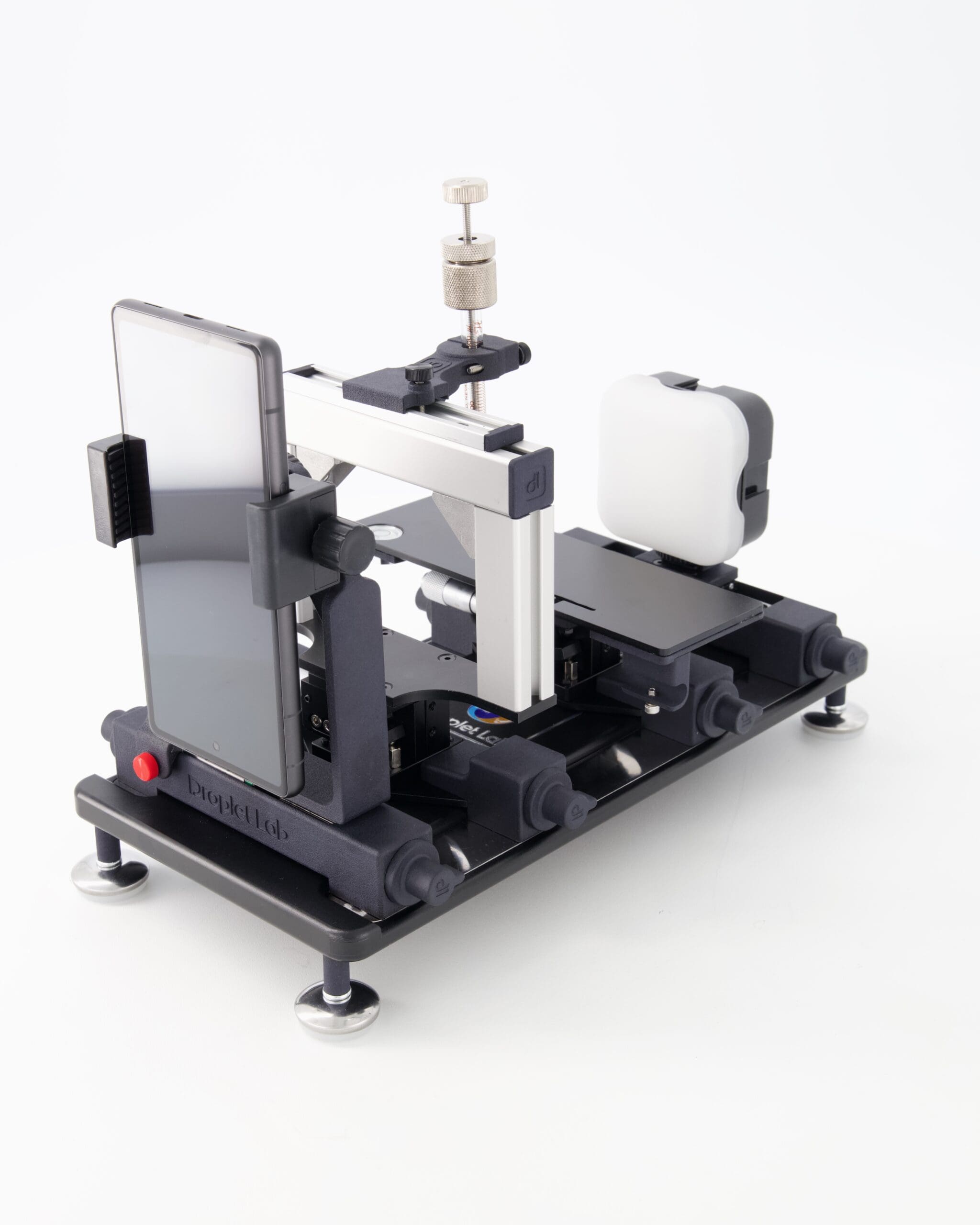
Dropometer M-3, manual (current model shown)
Drop shape method validated against a KRUSS DSA100E in peer review Named as the Dropometer M-3 in a peer reviewed paper and a PhD thesis 54 customer publications cite the Dropometer

Prof. Baoqiang Liao's group at Lakehead University turns pulp and paper mill sludge into biogas in a heated anaerobic membrane bioreactor. Membrane fouling decides how long such a system can run. The group added Dropometer water contact angle to its fouling tests, measuring sludge and membranes with 3 µL drops, and reported the values in a PhD thesis and two journal papers.

Manual Dropometer contact angle instrument with smartphone camera, sample stage and light source (current model)
Abhimanyu Photo
Written by
Abhimanyu Bhandankar
Holds an MBA from Schulich School of Business and a BE in IT. He joined Droplet Lab in July 2019 and now leads sales and marketing.
CEO at Droplet Lab
Read More
Gurdeep-Saini-Photo
Technical Review by
Gurdeep Singh Saini
Holds a BASc in Mechanical Engineering from Ryerson University (now Toronto Metropolitan University) and an MASc from York University. He develops the automatic edge and baseline detection behind the Dropometer's analysis.
COO at Droplet Lab
Read More
Abhimanyu Photo
Written By

Abhimanyu Bhandankar

CEO at Droplet Lab

Holds an MBA from Schulich School of Business and a BE in IT. He joined Droplet Lab in July 2019 and now leads sales and marketing.

Gurdeep-Saini-Photo
Reviewed By

Gurdeep Singh Saini

COO at Droplet Lab

Holds a BASc in Mechanical Engineering from Ryerson University (now Toronto Metropolitan University) and an MASc from York University. He develops the automatic edge and baseline detection behind the Dropometer's analysis.

Primary outcome: sludge surfaces tracked through three loading phases

Water contact angle of the reactor sludge at three organic loading rates

Thermophilic anaerobic membrane bioreactor, pulp mill primary sludge (Journal of Environmental Chemical Engineering, 2022)

Loading 2.2 kg TSS/m³·d 64.3 ± 3.2°
Loading 3.9 kg TSS/m³·d 24.6 ± 3.04°
Loading 1.5 kg TSS/m³·d 43.5 ± 5.8°

The reactor ran at 50 °C on primary sludge from a thermomechanical pulp mill. At a loading of 2.2 kg TSS/m³·d the sludge read 64.3 ± 3.2°. At 3.9 it fell to 24.6 ± 3.04°, and at 1.5 it rose again to 43.5 ± 5.8°. The 3.9 phase was also the one where pressure across the membrane reached 40.5 kPa in under 50 days. The paper reports both results side by side; it does not test a link between them.

64.3° → 24.6° sludge

Water contact angle of the reactor sludge as the organic loading rate rose from 2.2 to 3.9 kg TSS/m³·d.

39% lower

Membrane water contact angle after the 55 day solids retention time run, compared with an unused membrane.

3 µL water drops

Drop size used in the thesis and the 2025 paper, dispensed with a micropipette and measured in triplicate in 2025.

3 publications

A PhD thesis (2021) and two peer reviewed papers (2022, 2024) report Dropometer contact angles.

Executive Summary

Who

Prof. Baoqiang Liao's group in the Department of Chemical Engineering and the Faculty of Natural Resources Management at Lakehead University, Thunder Bay, Ontario. The group develops anaerobic membrane bioreactors that turn pulp and paper mill sludge into biogas, with NSERC funding.

Problem

Membrane fouling limits how long these reactors run between cleanings. Fouling depends on the sludge and the membrane surface, and no single test explains it. The group needed a direct reading of how water wets the sludge and the membranes as loading rate and solids retention time changed.

Solution

A manual Dropometer M-3 for contact angle, surface tension and surface free energy, invoiced in December 2018. The group measured 3 µL water drops on sludge and membrane samples, in triplicate in the 2025 study, alongside zeta potential, particle size, SEM, FTIR and XPS.

Time to Value

2018: first saw the Dropometer at the CSChE conference. 17 December 2018: invoiced. 1 March 2019: paid. January 2021: PhD thesis with Dropometer data. 11 March 2022: loading rate paper online (Journal of Environmental Chemical Engineering). 7 November 2024: solids retention time paper online (Separation and Purification Technology).

Results

Sludge contact angle moved from 64.3° to 24.6° and back to 43.5° across three loading rates. Membrane water contact angle fell 20%, 24% and 39% after runs at 32, 45 and 55 day solids retention times. The data appear in a PhD thesis and two peer reviewed papers.

Highlights

64.3° → 24.6°

Sludge contact angle as loading rose

39%

Lower membrane contact angle after a 55 day run

3 µL

Water drop, measured in triplicate

3

Publications with Dropometer data

Lakehead University, at a glance

Research focus

Anaerobic membrane bioreactors that turn pulp and paper mill sludge into biogas, and the membrane fouling that limits them.

Products / applications

A laboratory thermophilic submerged anaerobic membrane bioreactor treating primary sludge from a thermomechanical pulp mill, producing biogas with 52 to 60% methane.

Measurement stage

Characterising sludge and membranes during and after long reactor runs, at three loading rates and three solids retention times.

Users

A PhD researcher and two supervisors in Chemical Engineering and Natural Resources Management.

Materials and surfaces tested

Reactor sludge (mixed liquor) and flat sheet PVDF microfiltration membranes with 0.1 µm pores, unused and after cleaning.

Key constraints

Reactor at 50 °C; wet, changing biological samples; membranes recovered only after runs lasting months.

The challenge: membranes that foul while turning mill sludge into energy

Fouling depends on the sludge and the membrane surface, and no single test explains it.

What the lab was building

Primary sludge makes up about 70% of the sludge from a typical Canadian pulp and paper mill. Liao's group treats it in a heated anaerobic membrane bioreactor that makes biogas. A submerged membrane holds back the solids and lets treated liquid through. The longer the membrane stays clean, the longer the reactor runs well.

Why fouling is hard to read

Most of the resistance comes from a cake and gel layer on the membrane, about 97% in the 2025 study. That layer depends on sludge concentration, particle size, surface charge and surface chemistry. No single test explains it, so the group combined zeta potential, particle size, SEM, FTIR, XPS and contact angle.

What was at stake

In the 2022 study, the highest loading rate pushed the pressure across the membrane to 40.5 kPa in under 50 days. In the 2025 study, full cleaning recovered 94.3% of the flux after a 32 day solids retention time, but only 84.4% and 85.5% after 45 and 55 days.

What success would require

A direct number for how water wets the sludge and the membrane, taken on small samples and repeated across months of operation. It had to sit next to the other surface tests, and be reported with its spread so readers could judge it.

The insight: put a number on surface wetting next to the other fouling tests

What Was Deployed

Dropometer M-3, delivered configuration (invoiced 17 December 2018): a manual, smartphone based system for contact angle, surface tension and surface free energy measurement.

Method in the papers and thesis: pure water as the probe liquid, a drop of about 3 µL dispensed with a micropipette onto each sample, and the sessile drop contact angle recorded. The 2025 study ran mixed liquor and membrane samples in triplicate and reported the averages.

The Origin

From a conference meeting to three publications

Prof. Baoqiang Liao first saw the Dropometer at the CSChE conference in 2018. Droplet Lab offered conference attendees a discount, and the lab ordered a manual Dropometer M-3 with contact angle, surface tension and surface free energy. It was invoiced on 17 December 2018 and paid on 1 March 2019.

The group was running a heated anaerobic membrane bioreactor on primary sludge from a local thermomechanical pulp mill. Membrane fouling decided how long each run could last, so the group measured the sludge and the membranes in many ways. Water contact angle became one of those tests.

The first Dropometer data appeared in a PhD thesis in January 2021. Two peer reviewed papers followed, in 2022 and 2024, both using the same 3 µL water drop method.

Before vs After

Metric Before After
Sludge contact angle, loading 2.2 to 3.9 kg TSS/m³·d 64.3 ± 3.2° 24.6 ± 3.04°
Sludge contact angle, loading 3.9 to 1.5 kg TSS/m³·d 24.6 ± 3.04° 43.5 ± 5.8°
Average pressure across the membrane, loading 2.2 to 3.9 8.2 ± 3.3 kPa 16.5 ± 9.1 kPa
Sludge contact angle, solids retention time 32 to 55 days (thesis) 49.3 to 62.4° 19.1 to 26.7°
Membrane water contact angle, unused vs after 55 day run Unused membrane 39% lower
Flux recovered after full cleaning, 32 vs 55 day run 94.3% 85.5%

Rollout timeline

Timeline (high level)

2018: Conference and order

  • Prof. Liao sees the Dropometer at the CSChE conference
  • Manual Dropometer M-3 invoiced on 17 December 2018 with a conference discount

March 2019: Paid

Payment received on 1 March 2019

2019 to January 2021: Thesis work

  • Sludge contact angle at three solids retention times, about 3 µL water drops
  • PhD thesis dated January 2021

March 2022: Loading rate paper

  • Sludge contact angle at three organic loading rates, reported in Table 2
  • Published online on 11 March 2022 (Journal of Environmental Chemical Engineering)

March 2023: Software update

Free software update offered to the lab by Droplet Lab

November 2024: Solids retention time paper

  • Membrane and sludge contact angle in triplicate at 32, 45 and 55 days
  • Published online on 7 November 2024 (Separation and Purification Technology, 2025 issue)

Proof and validation: what the papers show, and what they do not

Test method

Sessile drop water contact angle with pure water as the probe liquid and a drop of about 3 µL from a micropipette. Samples were reactor sludge (mixed liquor) and flat sheet PVDF microfiltration membranes with 0.1 µm pores, unused and after each run.

Sample size and operators

The 2025 study measured every mixed liquor and membrane sample in triplicate and reported averages. The 2022 paper reports mean ± spread for each loading phase but does not state n. The thesis reports ranges for each solids retention time.

Repeatability / reproducibility

Sludge spreads of ± 3.04° to ± 5.8° across the three loading phases (2022). The effect of solids retention time on membrane contact angle was statistically significant (p < 0.01) in the 2025 study.

Notes / assumptions

The 2025 paper gives membrane results as percent changes, not absolute angles, and does not report its mixed liquor values. No paper states the fitting method or temperature for the contact angle step. A lower water contact angle means water spreads more easily on the surface. Contact angle is one of several fouling tests in these papers, not the main finding.

Outcomes to date

Measured Outcomes

24.6 ± 3.04°

Lowest sludge contact angle

Measured at the highest loading rate, 3.9 kg TSS/m³·d. The same phase had the heaviest fouling, with pressure across the membrane reaching 40.5 kPa in under 50 days.

20%, 24%, 39%

Lower membrane contact angle after each run

Compared with an unused membrane, after runs at 32, 45 and 55 day solids retention times. The effect of retention time was significant (p < 0.01).

49.3 to 62.4° vs 19.1 to 26.7°

Sludge at 32 vs 55 day retention

Thesis ranges show the sludge surface wetting more easily at the longest solids retention time.

Operational Outcomes

Fouling picture

Contact angle sits with zeta potential, particle size, SEM, FTIR and XPS in the group's account of residual fouling.

Cleaning insight

Full cleaning recovered 94.3%, 84.4% and 85.5% of flux after the three runs, showing residual fouling built up at longer retention times.

Biogas from mill sludge

The reactor produced biogas with 52 to 60% methane from pulp mill primary sludge in the 2022 study. This is a reactor result, not a Dropometer measurement.

Financial Context

One manual instrument, three publications

This page does not show the instrument price. The 2025 paper names NSERC funding for the research.

Purchase · conference offer

Ordered after the CSChE 2018 conference with a conference discount; invoiced 17 December 2018.

Coverage · 3 measurements

Contact angle, surface tension and surface free energy in one manual kit.

Output · 3 publications

A PhD thesis and two peer reviewed papers report Dropometer data.

Instrument pricing is available on request.

What's next

Delivered

Sludge contact angle across solids retention times (PhD thesis, 2021)
Sludge contact angle across organic loading rates (Journal of Environmental Chemical Engineering, 2022)
Membrane and sludge contact angle in a residual fouling study (Separation and Purification Technology, 2025)

In Pilot

Invited to contribute drop images and metadata to Droplet Lab's open contact angle dataset (October 2026)

Next Step

Measuring membranes, sludge or other wet, variable surfaces?

A water contact angle reading adds a direct surface number to fouling studies, next to charge, particle size and microscopy. The Dropometer measures contact angle, surface tension and surface free energy in one kit, with a drop shape method validated against a KRUSS DSA100E in peer review. Setup takes about 2 minutes. Book a 15 minute demo and bring a sample.