Contents
Case Study

A pharmaceutical CDMO measures formulation surface tension in house, so it can tailor formulations toward the droplet size its spray drying process needs.

Last Updated
October 18, 2026
Industry
Pharmaceutical development and manufacturing (CDMO)
Application
Spray dried formulation development
Customer since
2025
Measurement
Pendant drop surface tension
Drop shape method validated against a KRÜSS DSA100E in peer review Set up by the customer from Droplet Lab's tutorial videos 2 peer reviewed validation papers

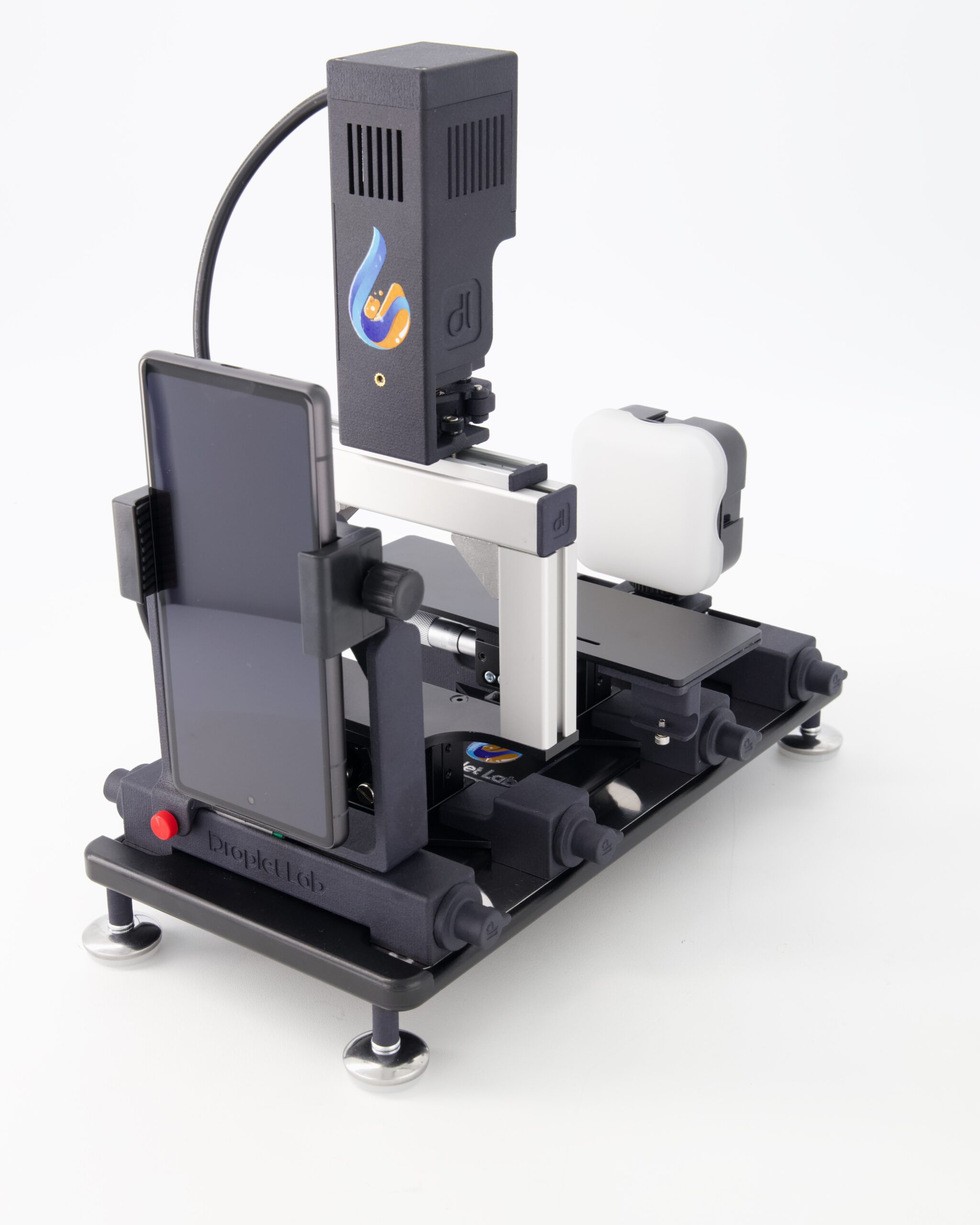
A pharmaceutical contract development and manufacturing organisation formulates client drug substances into solutions and powders, with spray drying as its standard process. Its formulation scientists use surface tension to see how each excipient changes a formulation, because surface tension affects the droplets a spray dryer forms. In July 2025 they set up a Dropometer with an automatic dropper and tilting stage, and their first trials showed that slight formulation differences give different surface tensions.

Standard Dropometer with automatic dropper (product photo; not the client's lab)
Abhimanyu Photo
Written by
Abhimanyu Bhandankar
Holds an MBA from Schulich School of Business and a BE in IT. He joined Droplet Lab in July 2019 and now leads sales and marketing.
CEO at Droplet Lab
Read More
Gurdeep-Saini-Photo
Technical Review by
Gurdeep Singh Saini
Holds a BASc in Mechanical Engineering from Ryerson University (now Toronto Metropolitan University) and an MASc from York University. He develops the automatic edge and baseline detection behind the Dropometer's analysis.
COO at Droplet Lab
Read More
Abhimanyu Photo
Written By

Abhimanyu Bhandankar

CEO at Droplet Lab

Holds an MBA from Schulich School of Business and a BE in IT. He joined Droplet Lab in July 2019 and now leads sales and marketing.

Gurdeep-Saini-Photo
Reviewed By

Gurdeep Singh Saini

COO at Droplet Lab

Holds a BASc in Mechanical Engineering from Ryerson University (now Toronto Metropolitan University) and an MASc from York University. He develops the automatic edge and baseline detection behind the Dropometer's analysis.

Executive Summary

Who

A pharmaceutical contract development and manufacturing organisation (CDMO) that formulates client drug substances into solutions and powders, with spray drying as a standard process. The Dropometer is used by its formulation development scientists.

Problem

In spray drying, a liquid's surface tension affects the size of the droplets the atomiser makes, and so the size of the dried particles. Clients were asking for many surface tension measurements, and the team wanted a fast way to see how each excipient changed a formulation without adjusting the spray dryer.

Solution

A Dropometer with pendant drop surface tension, contact angle and sliding angle apps, the automatic dropper and the automatic tilting stage, bought directly from Droplet Lab. The scientist assembled and started it from Droplet Lab's tutorial videos, and a remote onboarding call fine tuned the automatic dropper.

Time to Value

23 April 2025: quote request through the Droplet Lab website. 30 May 2025: order placed. 2 July 2025: instrument delivered; the scientist assembled it from the tutorial videos and ran first surface tension trials. 14 July 2025: remote onboarding call.

Results

Under 12 weeks after the first enquiry, the team was measuring surface tension in its own lab. Its first trials showed that slight differences in formulation give different surface tensions. The scientists use those measurements to tailor a formulation toward smaller or larger droplets without changing the spray drying process.

Highlights

Under 12 weeks

From website enquiry to in house measurements

3

Measurement apps on one instrument

1

Remote onboarding call after self setup

2025

Customer since

Quote teaser

Everything seems to be working great now. So very happy with it.

The CDMO, at a glance

Organisation

Pharmaceutical contract development and manufacturing organisation (CDMO).

Products / applications

Client drug substances formulated as solutions and spray dried powders.

Measurement stage

Formulation development, before and alongside spray drying.

Users

Formulation development scientists.

Materials and surfaces tested

Formulation liquids with different excipients; coated surfaces planned for adhesion work.

Key constraints

Many measurements for client formulations, a need for fast measurements, and confidential formulations.

The challenge: particle size starts with the liquid, not only the spray dryer

Every excipient a formulator adds can change surface tension, and surface tension changes the droplets a spray dryer makes.

Why surface tension matters in spray drying

A spray dryer atomises a liquid into droplets that dry into particles. In the team's words, a lower surface tension gives smaller droplets and so smaller particles, while a higher one gives larger droplets. Our use case on surface tension and droplet size in sprayed medicines explains the link.

Why formulation changes it

Each excipient a formulator adds can also change surface tension. The team's early trials showed that slight differences in a formulation give different surface tensions.

Why not just change the spray dryer

Process settings can also shift droplet size. The team's aim is to tailor the formulation instead, moving toward the droplet size it needs without doing too much to an established spray drying process.

The insight: measure surface tension before spray drying, and let the formulation do the work

What Was Deployed

Delivered configuration (2025): the Dropometer contact angle and surface tension kit with the pendant drop surface tension, contact angle and sliding angle apps, the automatic dropper with a 250 µl syringe, the manual and automatic tilting stages, and the supplied phone. The team measures pendant drops of each formulation with the pendant drop method, using the automatic dropper to form each drop the same way. The tilting stage on the same instrument is ready for adhesion and sliding measurements.
The Origin

From a website quote request to an in house surface tension screen

On 23 April 2025 a senior development scientist at the CDMO asked Droplet Lab for a quote through its website. He wanted surface tension, contact angle and sliding angle, with the automatic dropper. Clients were coming to the team needing many surface tension measurements for their formulations, and fast measurements mattered. He looked through lots of different apparatus before choosing. In his words, the Dropometer “looked the most interesting and newest way”, and he read the peer reviewed papers on Droplet Lab's website. Our guide to choosing a tensiometer for routine testing covers the same choice. The team ordered on 30 May 2025. The instrument arrived on 2 July, and the scientist assembled it and ran first trials from Droplet Lab's tutorial videos. On the onboarding call on 14 July, Droplet Lab also shared its surface science guide for the pharmaceutical industry.

Before vs After

Metric Before After
Surface tension measurements for clients Many client requests, and a search across lots of different apparatus Pendant drop surface tension on the team's own bench
Steering droplet size Spray drying process settings are one lever Formulation tailored first, guided by measured surface tension, with the spray drying process left as it is
Getting started A new instrument to learn Assembled and running from Droplet Lab's videos, then tuned on one remote call
Adhesion and sliding Planned adhesion work needs a tilted surface Automatic tilting stage on the same instrument, ready for that work

Rollout timeline

Timeline (high level)

23 April 2025: Enquiry

  • Quote request through the Droplet Lab website
  • Quotes with and without automation, papers and datasheet sent

30 May 2025: Order

Purchase order for surface tension, contact angle and sliding angle with automatic dropper and tilting stage

2 July 2025: Delivered and running

  • Assembled from Droplet Lab's tutorial videos
  • First surface tension measurements made by the team
  • A stage support damaged in transit, repaired in the lab

14 July 2025: Onboarding call

  • Remote call to set automatic dropper speeds and review the apps
  • Adhesion work on the tilting stage discussed

Proof and validation: what this case shows, and what it does not

Test method

Pendant drop surface tension of formulation liquids, with drops formed by the automatic dropper and analysed in the Dropometer's pendant drop app.

Sample size and operators

Operated by the CDMO's formulation development scientists. Set up by the team from Droplet Lab's tutorial videos, with one remote onboarding call.

Repeatability / reproducibility

The CDMO has not shared measurement data. The Dropometer's drop shape method, including pendant drop surface tension, is validated against a KRÜSS DSA100E in peer review.

Notes / assumptions

This page describes how the CDMO uses surface tension to guide formulation for spray drying. It does not report the CDMO's surface tension values, particle sizes or client formulations, which are confidential.

Outcomes to date

Measured Outcomes

Under 12 weeks

Enquiry to in house measurements

From the website quote request on 23 April 2025 to the team's own surface tension trials, run between delivery on 2 July and the onboarding call on 14 July.

3

Measurement apps on one instrument

Surface tension, contact angle and sliding angle, with the automatic dropper and tilting stage.

1

Remote onboarding call

The scientist assembled the kit and ran first trials from the tutorial videos, so one remote call on 14 July 2025 covered dropper speed and the apps.

Operational Outcomes

Formulation lever

Surface tension differences between formulations guide excipient choice toward the droplet and particle size needed.

Self setup

The scientist assembled the instrument and made first measurements from the tutorial videos.

Room to grow

Tilting stage ready for adhesion and sliding work.

Financial Context

Three measurements and automation on one instrument

This page does not show the price. The CDMO bought directly from Droplet Lab: surface tension, contact angle and sliding angle apps with the automatic dropper and tilting stage, on one portable instrument.

Purchase · direct

Bought directly from Droplet Lab in 2025.

Scope · 3 measurements

Surface tension, contact angle and sliding angle.

Automation · dropper and stage

Automatic dropper and automatic tilting stage.

Instrument pricing is available on request.

In the client's words

So it's really helpful for us to understand and this is a great technique to really do it with.
Senior Development Scientist - Formulation development, pharmaceutical CDMO

What's next

Delivered

Dropometer with surface tension, contact angle and sliding angle apps (July 2025)
Automatic dropper and automatic tilting stage

Planned

Adhesion measurements on the tilting stage

Frequently asked questions

Why measure surface tension before spray drying?

In spray drying, a liquid's surface tension affects the size of the droplets the atomiser makes, and so the size of the dried particles. In this CDMO's words, lower surface tension gives smaller droplets and higher surface tension gives larger ones. Measuring it lets the team tailor a formulation without changing the spray drying process.

Do small formulation changes affect surface tension?

Yes. The team's first trials showed that slight differences in formulation give different surface tensions, because each excipient can change it.

How quickly was the team measuring in house?

Under 12 weeks after its first website enquiry. The instrument arrived on 2 July 2025, the scientist assembled it from Droplet Lab's tutorial videos and ran first trials, and a remote call on 14 July tuned the automatic dropper.

Next Step

Formulating for spray drying, coating or atomisation?

The Dropometer measures pendant drop surface tension at the bench, with an automatic dropper for consistent drops, and adds contact angle and sliding angle on the same instrument. Its drop shape method is validated against a KRÜSS DSA100E in peer review. Book a 15 minute demo and bring two formulations you want to compare.