



Contents
Case Study

A physics lab at Emory University needed oil and water interfacial tensions for its own emulsions. After one method fix, its Dropometer values went into two Soft Matter papers.

Last Updated
November 9, 2026
Industry
Soft matter physics research
Location
Atlanta, Georgia, USA
Customer since
November 2019
Published with the Dropometer
2 Soft Matter papers and 1 PhD thesis
Instrument
Manual Dropometer, surface tension (current model shown)
Named in Soft Matter in 2021 and 2024 Drop shape method validated against a KRÜSS DSA100E in peer review Two peer reviewed validation papers

Prof. Eric Weeks's group studies emulsions, glasses and jamming, and scales its results by the tension between oil and water. The first oil it tried was lighter than water and climbed the needle. Droplet Lab's advice was to make the heavier liquid the drop. The lab then reported 3 mN/m for TPM oil in 2021 and about 10 mN/m for octane in 2024.

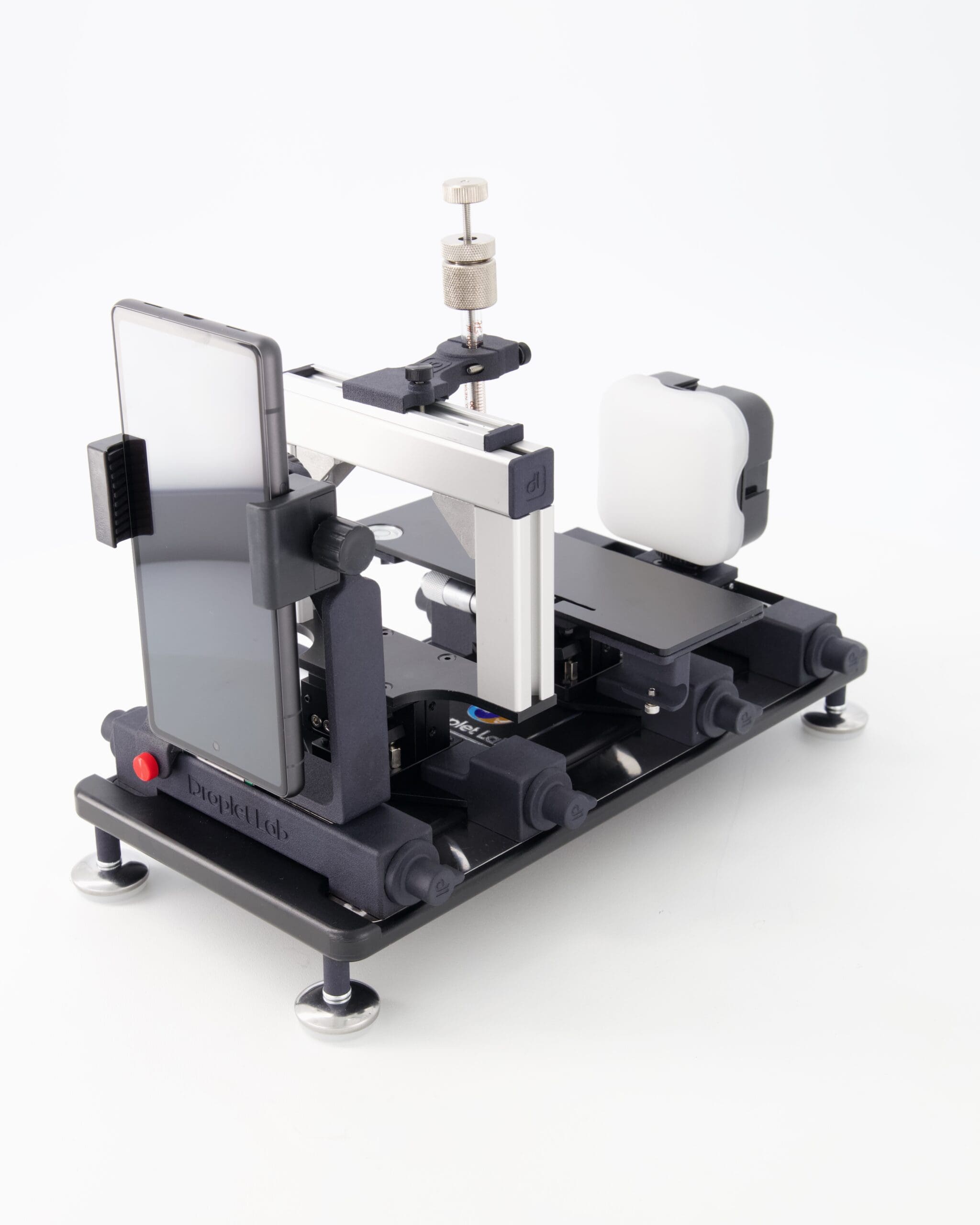
Dropometer contact angle and surface tension instrument with smartphone camera, sample stage and light source (current model)
Abhimanyu Photo
Written by
Abhimanyu Bhandankar
Holds an MBA from Schulich School of Business and a BE in IT. He joined Droplet Lab in July 2019 and now leads sales and marketing.
CEO at Droplet Lab
Read More
Gurdeep-Saini-Photo
Technical Review by
Gurdeep Singh Saini
Holds a BASc in Mechanical Engineering from Ryerson University (now Toronto Metropolitan University) and an MASc from York University. He develops the automatic edge and baseline detection behind the Dropometer's analysis.
COO at Droplet Lab
Read More
Abhimanyu Photo
Written By

Abhimanyu Bhandankar

CEO at Droplet Lab

Holds an MBA from Schulich School of Business and a BE in IT. He joined Droplet Lab in July 2019 and now leads sales and marketing.

Gurdeep-Saini-Photo
Reviewed By

Gurdeep Singh Saini

COO at Droplet Lab

Holds a BASc in Mechanical Engineering from Ryerson University (now Toronto Metropolitan University) and an MASc from York University. He develops the automatic edge and baseline detection behind the Dropometer's analysis.

Primary outcome: two measured interfacial tensions, each used in a peer reviewed paper

Oil and water interfacial tension, pendant drop on a Dropometer

Values as reported in the papers

TPM oil and water (Cao, Liao, Breedveld and Weeks, Soft Matter, 2021) 3 mN/m
Octane and water, 0.5% Tween 20 (Cheng et al., Soft Matter, 2024) About 10 mN/m

Both values come from the group's own papers (Cao, Liao, Breedveld and Weeks, Soft Matter, 2021; Cheng et al., Soft Matter, 2024). The 2021 paper notes that 3 mN/m "is consistent with previous work". Neither paper reports the number of drops, the temperature or a standard deviation.

2 + 1 papers + thesis

Two Soft Matter papers and one PhD thesis from the group used the instrument.

4 emulsions

Yield stress of four TPM emulsions, 1.03 to 2.03 µm droplets, scaled by the measured tension (Cao, Liao, Breedveld and Weeks, Soft Matter, 2021, Fig. 5b).

Executive Summary

Who

Prof. Eric Weeks's soft matter physics group at Emory University in Atlanta, which studies emulsions, colloidal glasses, jamming and the flow of deformable droplets.

Problem

The group needed the oil and water tension for its own oil to scale its data, because the earlier studies it compared with used other oils. The first oil it tried was lighter than water, the hard case for pendant drop measurement.

Solution

A manual Dropometer for pendant drop measurement, plus a method fix from Droplet Lab: make the heavier liquid the drop, backlight it as a silhouette and calibrate with the needle in use.

Time to Value

The first value was published in January 2021, about a year after first use and including a three month lab closure.

Results

The values went into two Soft Matter papers and a PhD thesis: 3 mN/m for TPM oil and water (2021) and about 10 mN/m for octane in water (2024).

Highlights

Someone from my lab was able to get feedback from your company ... they got good help.

Emory University, at a glance

Research focus

Soft matter physics: glass and jamming transitions in emulsions, colloidal glasses, and the flow and clogging of deformable droplets.

Products / applications

Fundamental research on emulsions, glasses and the flow of deformable droplets.

Measurement stage

Characterising each oil and water system before rheology or flow experiments, so results can be scaled by the measured tension.

Users

PhD students and postdocs, led by Prof. Eric Weeks.

Materials and surfaces tested

TPM oil emulsions with Synperonic F108 and NaCl; octane in water with Tween 20.

Key constraints

The first oil tried and octane are both lighter than water; low tensions of 3 to 10 mN/m; a lab closure from March to June 2020.

The challenge: an oil that would not hang from the needle

An oil lighter than water, low tensions, and a lab closure.

Why an oil lighter than water is hard

Pendant drop works when the drop is the heavier liquid. The group first injected oil into the aqueous solution and, in Prof. Weeks's words, "the droplet density was lighter than water so the droplet was climbing up the needle." The fitted contour then missed the drop edge. See also why water forms droplets in oil but oil spreads in water and our oil and water interfacial tension experiment. EN 14210 uses a ring or stirrup instead, so report each value with its method.

What success would require

A drop that hangs, calibration for the needle in use and a clean silhouette, repeatable by a student after a three month gap. The same basics apply to reproducible contact angle measurement.

The fix: make the heavier liquid the drop

What Was Deployed

Delivered configuration: a manual Dropometer with the surface tension module for pendant drop analysis, an LG G6 smartphone and manual drop dispensing. The method from Droplet Lab's support in 2020: let the heavier liquid form the drop, backlight it as a silhouette, calibrate in the app with the needle in use, and check the fitted contour against the drop edge before keeping a value. Pendant drop is covered in our surface tension measurement guide. Labs choosing an instrument can see our guide to the best tensiometer for surfactant and CMC research and our Chemicals guide.
The Origin

From first measurements to a question about oil drops

The lab began using its Dropometer in early 2020. On 21 March 2020, PhD student Cong Cao wrote to Droplet Lab: the oil was being injected into the aqueous solution, and the fitted contour did not match the drop. The reply named the cause. The oil was lighter than water, so the drop climbed the needle, and the heavier liquid has to form the drop. As Prof. Weeks put it in April 2020, "the problem was obvious in hindsight". When the lab reopened in June 2020, Droplet Lab helped with lighting and calibration, and arranged a video call for 2 July 2020 with Dr Alidad Amirfazli, Co-founder and Scientific Advisor of Droplet Lab. In August 2020 the student agreed to speak with another university that was considering the instrument.

Before vs After

Metric Before After
Interfacial tension for the lab's own oil Comparison studies used other oils, at 9.8 and 1.5 mN/m 3 mN/m for TPM oil and water (2021)
Pendant drop with an oil lighter than water Oil injected into water; the drop climbed the needle (March 2020) Heavier liquid used as the drop, so it hangs from the needle
Calibration Default value used with the lab's own needle after the supplied syringe broke Calibrate in the app with the needle in use
Lighting Dark outline with a bright centre (June 2020) Backlit silhouette, as in the surface tension guide
Publications with Dropometer values 0 2 Soft Matter papers and 1 PhD thesis

Rollout timeline

Timeline (high level)

November 2019 to early 2020: Purchase and first use

  • Purchase order 6 November 2019 for a manual Dropometer with surface tension
  • Invoiced 15 January 2020; lab begins measuring

March 2020: The oil drop problem

  • First support question on 21 March: the fit misses the drop
  • Cause found: the oil is lighter than water and climbs the needle

March to June 2020: Lab closure

  • Emory labs closed for COVID-19
  • Method picked up again when the lab reopened in June

June to August 2020: Method fixed

  • Lighting and calibration advice and the surface tension guide
  • Video call with Dr Alidad Amirfazli arranged for 2 July

2020 to 2021: First values published

  • PhD dissertation (2020) reports 3 mN/m measured with the Dropometer
  • 3 mN/m published in Soft Matter on 21 January 2021

2023 to 2024: Update and second paper

  • Free software update with the new interface in March 2023
  • About 10 mN/m for octane reported in Soft Matter with Yale, September 2024

Proof and validation: what the papers report, and what they leave out

Test method

Pendant drop interfacial tension on a Dropometer. 2021: TPM oil (3-(trimethoxysilyl)propyl methacrylate) and an aqueous phase; the emulsions were stabilised with 0.5 wt% Synperonic F108 and 5 mM NaCl. 2024: octane (0.703 g/mL) and water (0.997 g/mL) with 0.5% Tween 20.

Sample size and operators

Not reported in either paper. The first measurements in 2020 were made by a PhD student.

Repeatability / reproducibility

Not reported. The 2021 paper states that 3 mN/m is consistent with previous work. The 2024 paper gives the value to one significant figure.

Notes / assumptions

Each paper reports one interfacial tension value, and the 2020 thesis gives the same 3 mN/m; rheology, microscopy and simulation make up the rest of each study. In the 2024 paper the measured value places the experiments on a dimensionless surface tension scale; the simulations were fitted separately. Drop volume, temperature, number of drops and standard deviation are not reported. Droplet Lab gave method support only and took no part in the measurements.

Outcomes to date

Measured Outcomes

3 mN/m

TPM oil and water

Set the scale of droplet deformation energy, which the authors compared with thermal energy to tell glass from jamming behaviour (Cao, Liao, Breedveld and Weeks, Soft Matter, 2021).

About 10 mN/m

Octane and water, 0.5% Tween 20

Placed droplet flow experiments on a dimensionless surface tension scale for comparison with simulations (Cheng et al., Soft Matter, 2024).

4

Emulsions on common axes

Yield stress of four TPM emulsions divided by the measured tension and compared with two earlier studies that used other oils (Cao, Liao, Breedveld and Weeks, Soft Matter, 2021, Fig. 5b).

Operational Outcomes

Method that survived a lab closure

Measurements resumed after the three month closure, and the first value was published in January 2021.

A user willing to be a reference

In August 2020 the PhD student who ran the first measurements agreed to speak with another university considering the instrument.

Published output

Two Soft Matter papers and one PhD thesis credit Droplet Lab's instrument by name.

What the lab said

The image quality is great and all experiments went smoothly.
PhD researcher - Physics

PhD researcher, Department of Physics, Emory University

What's next

Delivered

Interfacial tension in Soft Matter (2021) and Soft Matter with Yale (2024)
PhD dissertation, Glassy and Jammed Systems: Structures and Dynamics (2020)
Free software update with the new interface (March 2023)

In Pilot

Raw drop images behind both papers invited into Droplet Lab's open interfacial tension dataset (October 2026)

Frequently asked questions

How do you measure interfacial tension when the oil is lighter than water?

Make the heavier liquid the drop so it hangs from the needle. When the lab injected a lighter oil into water, the drop climbed the needle and the fitted contour missed the edge. Backlight the drop as a silhouette and calibrate with the needle in use.

What interfacial tensions did the lab publish?

The group reported 3 mN/m for TPM oil and water in Soft Matter in 2021, and about 10 mN/m for octane in water in a 2024 Soft Matter paper with Yale. The 2020 PhD thesis reports the same 3 mN/m value.

Which configuration did the lab use?

A manual Dropometer with the surface tension module for pendant drop analysis.

Next Step

Is your oil lighter than water?

Oils lighter than water are the hard case for pendant drop measurement. Droplet Lab's advice to the Weeks lab was to make the heavier liquid the drop, light a clean silhouette and calibrate with the needle in use. The Dropometer's drop shape method is validated against a KRÜSS DSA100E in peer review, and setup takes about 2 minutes. Book a 15-minute consult about your liquids and their densities.