
Measurement explainer
Surface Tension vs Surface Energy: What Is the Difference?
Surface tension and surface energy describe the same thing: the energy cost of creating a surface. Surface tension is used for liquids and is measured directly in mN/m. Surface free energy is used for solids and is calculated from contact angles in mJ/m², so the result depends on the model and test liquids you choose.


Droplet Lab Team
Droplet Lab builds precision instruments and software for surface science measurement, specialising in contact angle analysis and surface tension characterisation. Used by researchers across materials science, pharmaceuticals, coatings, and advanced manufacturing, Droplet Lab's Dropometer has contributed to studies published in peer-reviewed journals including Advanced Functional Materials (Impact Factor 19). The team combines instrument engineering with deep domain knowledge in wettability science with a focus on practical accuracy.
Are surface tension and surface energy the same thing?
Short answer: physically, yes; in practice, they are used for different materials. For a pure liquid the two numbers are identical, because 1 mN/m equals 1 mJ/m², and both equal the older unit dyn/cm.
The difference is how you get the number. A liquid's surface tension can be measured directly, while a solid's surface free energy can only be inferred from how liquids wet it.
How is surface tension measured on a liquid?
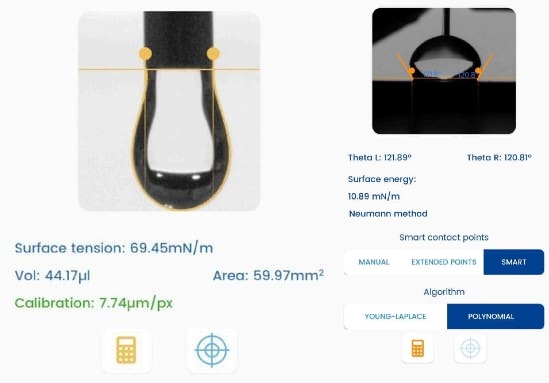
The pendant drop method images a hanging drop and fits its shape with the Young-Laplace equation. Force methods measure the pull of the liquid on a plate or ring.
Either way, you get one number for one liquid at one temperature. The surface tension measurement guide compares the methods, and ISO 19403-3 describes the pendant drop method for paints and varnishes.
How is surface energy measured on a solid?
A solid cannot be stretched like a liquid, so you place drops of known liquids on it and measure their contact angles. Young's equation links each angle to the solid's surface energy (Young, 1805).
A model then turns the angles into a number. Owens and Wendt (1969) split surface energy into dispersive and polar parts and need at least two liquids. Zisman's critical surface tension uses a series of liquids and extrapolates to complete wetting (Fox and Zisman, 1950).
Different models and liquid sets give different values for the same surface. Always report which model and liquids you used, as ISO 19403-2 describes. The surface energy measurement guide goes deeper, and the surface energy calculator runs the models on your own angles.
Expert Quote
Surface free energy is never read straight off a solid; it is calculated, and the model and the test liquids you choose are part of the answer. Report them with the number, or the number cannot be compared.

Surface tension or surface energy: which term applies?
| Aspect | Surface tension | Surface free energy |
|---|---|---|
| Applies to | Liquids | Solids |
| How it is obtained | Measured directly | Calculated from contact angles |
| Usual unit | mN/m | mJ/m² |
| Typical method | Pendant drop, plate or ring | Sessile drop with two or more liquids |
| Main sources of variation | Temperature, purity, surfactants | Model, test liquids, surface preparation |
Where do dyne levels fit in?
Dyne inks and pens are liquids of known surface tension brushed onto a solid. If the ink stays wet for a set time, the surface energy is taken to be at least that dyne level.
That gives a quick pass or fail threshold. A contact angle measurement gives a number you can trend over time and compare between operators and sites.
See the dyne pens and contact angle comparison and the corona treatment monitoring use case for how this plays out on a film line. Beyond 38 Dynes explains what a dyne level does and does not tell you about adhesion.
Why does the difference matter for coating and bonding?
A coating, ink or adhesive wets a surface well when its surface tension is lower than the solid's surface energy. So you need both numbers: the liquid's surface tension and the solid's surface free energy.
The Dropometer pendant drop tensiometer and contact angle goniometer measures both on one portable kit. Its drop shape method was validated against a KRÜSS DSA100E in peer review; the papers are in the validation library.
Where can you go deeper?
These pages cover the methods, standards and data behind this post.
- Standard: ISO 8296 and the "38 dyne" Guideline
- Case study: Fused silica and quartz R&D
- Buying guide: Dropometer vs KRUSS Mobile Surface Analyzer (MSA)
- Glossary: Critical surface tension (Zisman)
- Measurement quality: Reproducible surface energy calculation
- Classroom experiment: Exp 6: Surface free energy with multiple liquids
- Open dataset: Surface Free Energy of Common Polymers and Substrates
- Related post: Self-Assembled Monolayers
- Related post: Why Oil Spreads and Water Beads
Measure both numbers on one instrument
See surface tension and surface free energy measured on the same portable kit, in a short call.
Frequently Asked Questions
Is surface tension the same as surface energy?
For a pure liquid, yes: the values are equal and 1 mN/m equals 1 mJ/m². For solids, surface free energy is calculated from contact angles rather than measured directly.
Why do I get different surface energy values for the same polymer?
Different models and test liquids give different answers. Report the model, the liquids and the measured angles with every value (ISO 19403-2).
What is a dyne?
Dyne per centimetre is the older unit for surface tension and surface energy. 1 dyn/cm equals 1 mN/m.
Can I get surface energy from one liquid?
Models such as Owens and Wendt (1969) need at least two liquids, one with a strong polar part such as water and one mainly dispersive such as diiodomethane.