
Surface science explainer
The Science of Anti-Fog Coatings
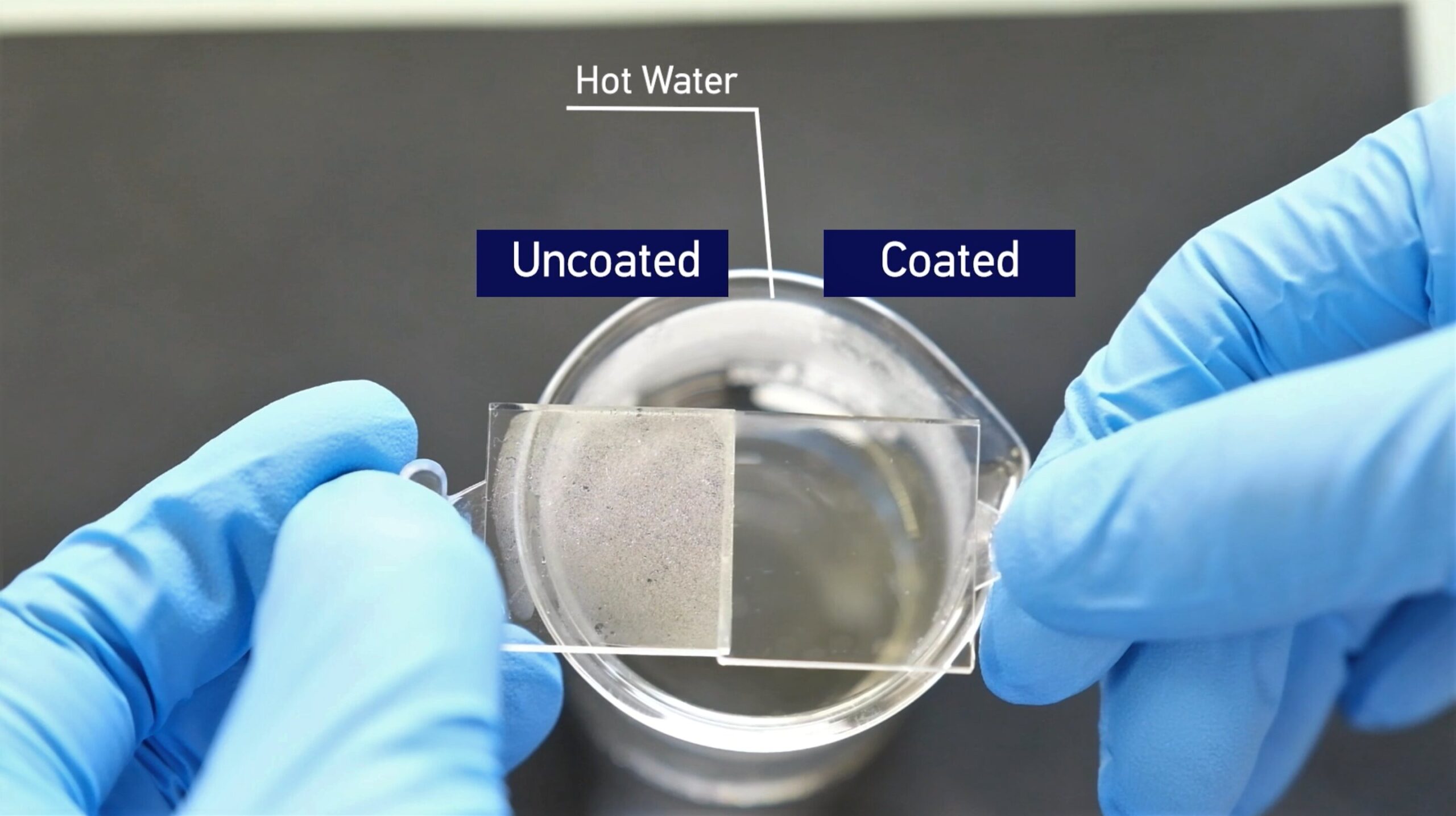
Fog is condensation that forms as many tiny droplets, which scatter light. Most anti-fog coatings make a surface so hydrophilic that condensed water spreads into a thin, clear film instead of beading (Howarter and Youngblood, 2008). Contact angle shows whether a coating wets enough, and whether it keeps doing so after cleaning, wear and ageing.


Droplet Lab Team
Droplet Lab builds precision instruments and software for surface science measurement, specialising in contact angle analysis and surface tension characterisation. Used by researchers across materials science, pharmaceuticals, coatings, and advanced manufacturing, Droplet Lab's Dropometer has contributed to studies published in peer-reviewed journals including Advanced Functional Materials (Impact Factor 19). The team combines instrument engineering with deep domain knowledge in wettability science with a focus on practical accuracy.
How do anti-fog coatings stop fogging?
Short answer: they change what condensed water does once it lands. On an untreated lens, water forms thousands of small droplets that scatter light. On an anti-fog surface, it spreads into a thin, even film you can see through.
The coating does not stop condensation. It controls the shape of the water, which is a wetting problem and can be measured with contact angle.
Why does a surface fog up in the first place?
When a surface is colder than the dew point of the air around it, water vapour condenses on it. On most plastics and glass, that water forms separate droplets rather than a film.
Each droplet acts like a small lens and scatters light in a different direction. Together they make the surface look white and hazy (Howarter and Youngblood, 2008).
What types of anti-fog coating are there?
Hydrophilic film formers. These coatings have a very low water contact angle, so condensate spreads flat. Many contain hydrophilic polymers or surfactants.
Absorbent coatings. Hydrogel type layers soak up early condensate before droplets can form.
Photocatalytic coatings. Titanium dioxide surfaces become highly hydrophilic under ultraviolet light (Wang et al., 1997). The ISO 27448 summary covers how water contact angle is used to test photocatalytic self-cleaning.
Water repellent designs. Some research surfaces aim for the opposite: droplets so mobile that they roll off before they scatter light.
Expert Quote
Repellency and mobility are not the same thing: a high contact angle says a drop is repelled, but whether it rolls off is a separate question — the two can even be mutually exclusive.

How do you test an anti-fog coating?
Product standards test fogging directly. For example, eye protectors that meet the anti-fog requirement of EN 166 can carry the N marking.
Contact angle complements that test during development and production. It is faster, needs a smaller sample and gives a number you can trend from batch to batch.
The anti-fog coating validation use case walks through a full test plan.
Which contact angle results should you track?
Static water contact angle right after deposition, at several spots across the part to check coverage.
Angle over time. On absorbent or surfactant based coatings the angle keeps falling for seconds after the drop lands, so record the time you read it.
Durability. Repeat after wiping, washing, abrasion and ultraviolet ageing. Anti-fog coatings usually fail by contamination, surfactant loss or wear, and the contact angle rises as they do.
For mobility based designs, add tilting tests from the sliding angle guide. The contact angle measurement guide covers the basics.
Where can you go deeper?
These pages cover the methods, standards and data behind this post.
- Case study: Aerospace and defense: oleophobic coating checks
- Customer study: Fullerene-Like Amorphous Carbon Nitride Film Surface Properties and Evaluating the Initial Adsorption Kinetics of Albumin and Fibrinogen
- Buying guide: Best Contact Angle Goniometer for Teaching & Academic Labs
- Glossary: Wettability
- Classroom experiment: Teaching Curriculum Hub (4 / 8 / 12-lab tracks)
- Open dataset: Contact Angle of Water on Common Surfaces
- Tool: Free Contact Angle Tool
- Related post: Why Does Contact Angle Matter for Coatings and Adhesives QC?
Validate your anti-fog coating with numbers
See contact angles measured on coated parts before and after wear, in a short call.
Frequently Asked Questions
What contact angle does an anti-fog coating need?
There is no single threshold that applies to every product. Set limits from your own fogging test results, then use contact angle to check each batch against them.
Why do anti-fog coatings stop working?
The usual causes are oily contamination, loss of surfactant from the coating and mechanical wear. Each raises the water contact angle, so trending it gives early warning.
Are anti-fog sprays the same as anti-fog coatings?
Sprays usually leave a temporary surfactant layer that washes off. Coatings are designed to keep the surface hydrophilic for much longer.
Can a water repellent surface be anti-fog?
Some research surfaces do this by making droplets roll off before they scatter light. Most commercial anti-fog products use the hydrophilic approach (Howarter and Youngblood, 2008).