
Surface science explainer
Why Oil Spreads and Water Beads
Whether a liquid spreads or beads depends on its surface tension compared with the surface energy of the solid. Most oils sit around 20 to 30 mN/m, below the surface energy of most solids, so they spread (Jasper, 1972). Water sits near 72.8 mN/m, so it beads on low energy surfaces such as PTFE and polyethylene (Vargaftik et al., 1983).


Droplet Lab Team
Droplet Lab builds precision instruments and software for surface science measurement, specialising in contact angle analysis and surface tension characterisation. Used by researchers across materials science, pharmaceuticals, coatings, and advanced manufacturing, Droplet Lab's Dropometer has contributed to studies published in peer-reviewed journals including Advanced Functional Materials (Impact Factor 19). The team combines instrument engineering with deep domain knowledge in wettability science with a focus on practical accuracy.
Why does oil spread while water beads?
Short answer: a liquid spreads when the solid attracts it more strongly than the liquid attracts itself. Oils hold themselves together weakly, so almost any solid wins. Water holds itself together strongly, so many solids lose.
In numbers: hexadecane has a surface tension of about 27.5 mN/m (Jasper, 1972), while water has about 72.8 mN/m at 20 °C (Vargaftik et al., 1983).
What decides whether a drop spreads or beads?
Young's equation balances three tensions at the edge of a drop: solid and vapour, solid and liquid, and liquid and vapour (Young, 1805). Their balance sets the contact angle.
Harkins and Feldman (1922) framed the same balance as a spreading coefficient. If the solid's surface energy is greater than the sum of the other two tensions, the coefficient is positive and the liquid spreads completely.
The same balance decides whether an oil spreads across water instead of a solid. Why water forms droplets in oil but oil spreads on water covers that liquid on liquid case.
How do liquid and solid values compare?
Liquid values from Vargaftik et al. (1983) and Jasper (1972); critical surface tensions from Zisman (1964).
| Material | Value (mN/m) | What it means |
|---|---|---|
| Water (liquid, 20 °C) | 72.8 | Beads on most plastics |
| Diiodomethane (liquid, 20 °C) | 50.8 | Common second test liquid |
| Hexadecane (liquid, 20 °C) | 27.5 | Typical oil |
| Polyethylene (critical surface tension) | 31 | Liquids below this spread |
| PTFE (critical surface tension) | 18 | Even most oils bead |
Why do most oils spread on most surfaces?
Zisman showed that each solid has a critical surface tension: liquids below it spread completely, and liquids above it bead (Zisman, 1964). Polyethylene sits near 31 mN/m and PTFE near 18 mN/m.
Most oils fall below 31 mN/m, so they spread on polyethylene and on almost every higher energy surface. Water, at 72.8 mN/m, sits far above both, so it beads.
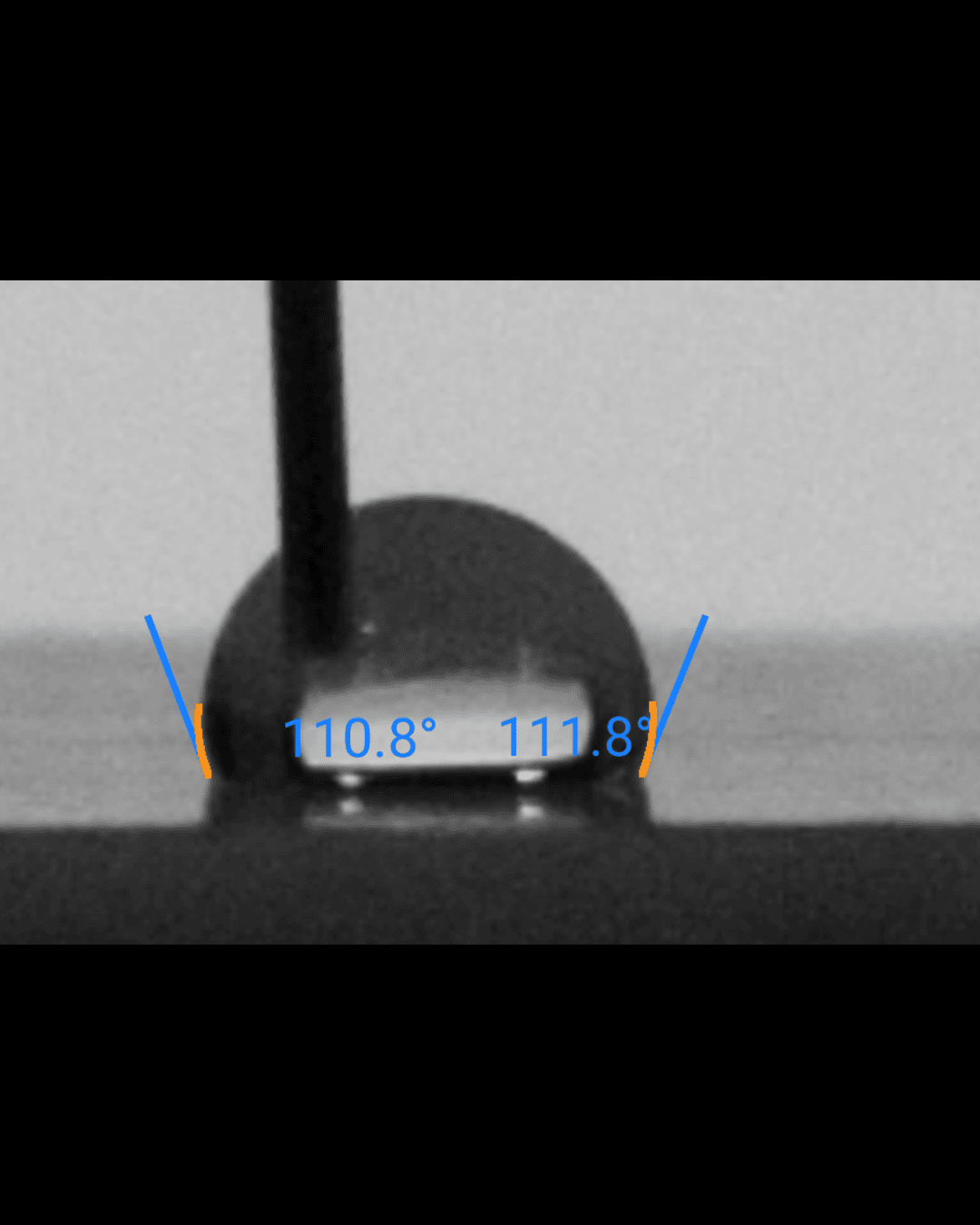
On smooth PTFE, water reaches a contact angle of about 108° (Fox and Zisman, 1950).
What does a beading drop look like when you measure it?
The higher the contact angle, the more the drop stands up from the surface. A contact angle instrument fits the drop outline and reads the angle where the outline meets the surface.
The contact angle measurement guide explains the method, and the sliding angle guide covers whether a beading drop actually rolls away.
Expert Quote
Not all contact-angle measurements are created equal: the right method depends on the application. A sessile drop and a tilted plate can give very different, and equally correct, numbers.

Can a surface make oil bead as well?
Yes, but it takes both very low surface energy and the right texture. Fluorinated surfaces with overhanging, re-entrant features can hold even low surface tension oils up as beads (Tuteja et al., 2007).
The superhydrophobic glass experiment shows how texture changes wetting in a teaching lab.
How do you measure which way a liquid will go?
Measure contact angles of water and a second liquid such as diiodomethane, then calculate the solid's surface free energy (Owens and Wendt, 1969). Compare that with the surface tension of the liquid you plan to apply.
The surface energy measurement guide explains the models, the contact angle to surface energy calculator runs the calculation, and ISO 19403-2 describes the method for paints and varnishes. For coatings, see the thin film and nanocoating use case.
Where can you go deeper?
These pages cover the methods, standards and data behind this post.
- Case study: Fused silica and quartz R&D
- Buying guide: Best Surface Energy Analyzer Under $5,000
- Glossary: Young equation
- Measurement quality: Reproducible surface energy calculation
- Classroom experiment: Exp 6: Surface free energy with multiple liquids
- Open dataset: Surface Free Energy of Common Polymers and Substrates
- Related post: Self-Assembled Monolayers
- Related post: Surface Tension vs Surface Energy: What Is the Difference?
- Related post: Why Does Contact Angle Matter for Coatings and Adhesives QC?
- Related post: Why Water Forms Droplets in Oil but Oil Spreads on Water
See spreading and beading measured
Watch contact angles and surface free energy measured on real samples, in a short call.
Frequently Asked Questions
Why does water bead on a waxed car?
Wax is a low energy surface, with a surface energy far below water's surface tension of about 72.8 mN/m. Water holds itself together more strongly than it sticks to the wax, so it beads.
What is the contact angle of water on PTFE?
About 108° on smooth PTFE (Fox and Zisman, 1950). Rough or textured PTFE can show much higher angles.
What is the spreading coefficient?
It compares the solid's surface energy with the sum of the solid-liquid and liquid-vapour tensions. A positive value means complete spreading (Harkins and Feldman, 1922).
Can a surface repel both water and oil?
Yes. It needs a fluorinated, very low energy chemistry plus a re-entrant texture that traps air under the drop (Tuteja et al., 2007).