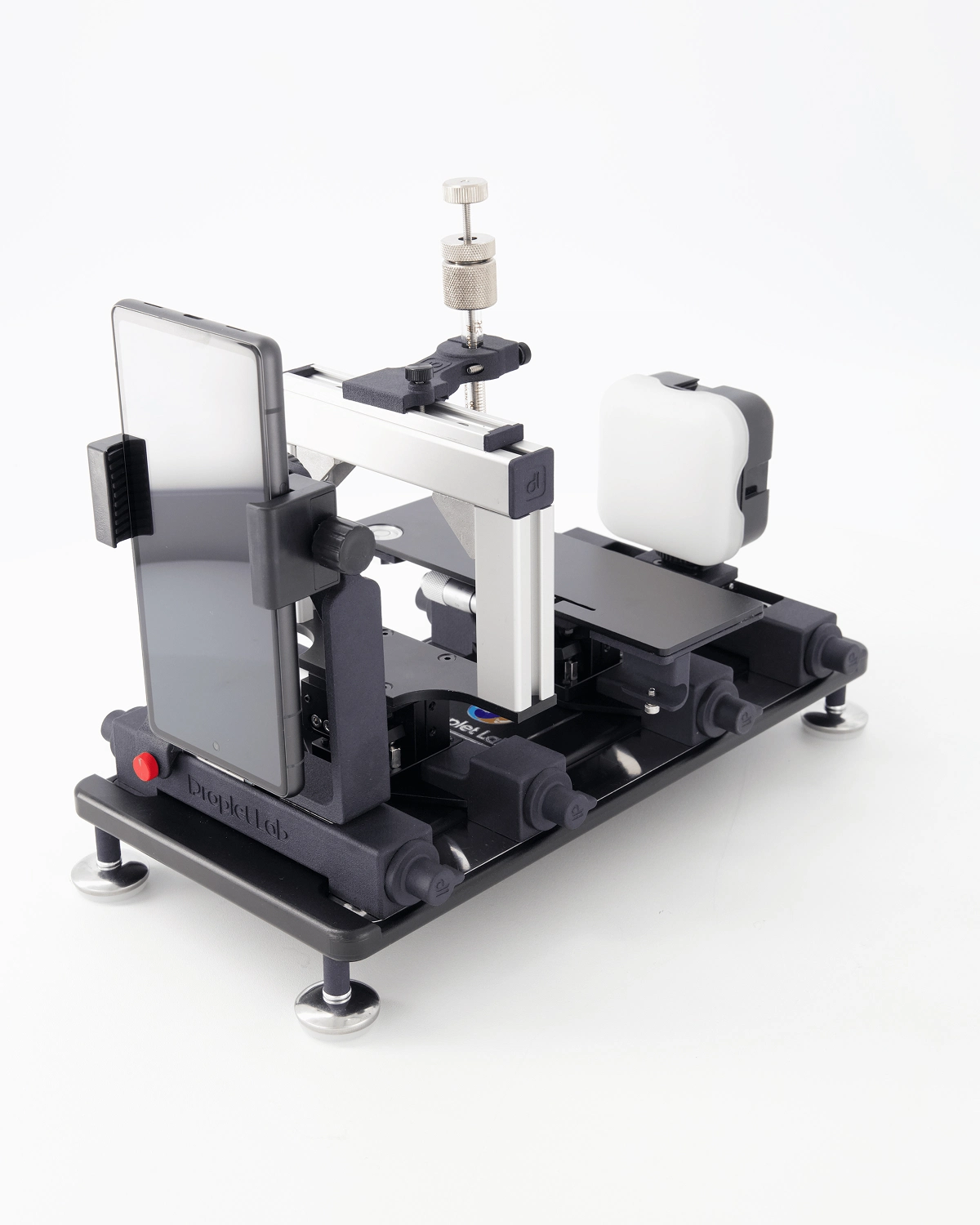
Dropometer
US$4,990 base kit, checked 12 November 2026, Droplet Lab

Surface tension tensiometer comparison
OpenDrop is free, open source software for pendant drop tensiometry and contact angle: you supply the camera, light, syringe and stage. The Dropometer is a complete pendant drop kit with a published accuracy and a warranty. This page compares the two on cost, accuracy, setup, scope and support, using OpenDrop's own documentation and paper.
US$4,990 base kit, checked 12 November 2026, Droplet Lab
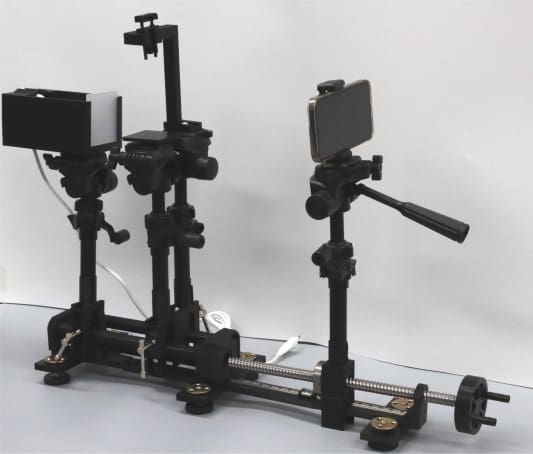
Software free (GPL 3.0); hardware you buy, camera about US$20 to US$1,000 per the authors; checked 12 November 2026


COO at Droplet Lab
Holds a BASc in Mechanical Engineering from Ryerson University (now Toronto Metropolitan University) and an MASc from York University. He develops the automatic edge and baseline detection behind the Dropometer's analysis.
If you have the skills and time to build, align and validate your own optics, and the goal is teaching or method development, OpenDrop is a capable free choice. For a published accuracy, a supported kit that works on day one, battery operation and a 5 year warranty, the Dropometer (US$4,990) is the better buy.
Both use the same physics. A drop hangs from a needle, its outline is recorded, and the Young–Laplace equation is fitted to the shape. The difference is everything around the fit. OpenDrop is the software only; its accuracy depends on the camera, lens, lighting, needle and alignment you choose. The Dropometer is the software plus the hardware, built and checked as one system. Our surface tension measurement guide explains the method.
Both measure pendant drop surface and interfacial tension and sessile drop contact angle.
Both come from academic research: OpenDrop from the group behind Berry et al. (2015), the Dropometer from Dr. Alidad Amirfazli's group, with its methods published in 2017 and 2018.
Both need careful technique: a clean needle, a sharp outline and the right density difference.
With OpenDrop you choose, buy and align the camera, lens, backlight, syringe, needle and stage. The Dropometer ships them as one kit with the phone included.
OpenDrop's documentation states no measured error figure, because the result depends on your rig. The Dropometer datasheet states ±0.03 mN/m and ±0.35°.
OpenDrop is free; the hardware and the staff time to build and validate it are not. The Dropometer is US$4,990 for the base kit.
OpenDrop is supported through its GitHub project and documentation. The Dropometer comes with a 5 year hardware warranty, 5 years of software updates and support from Droplet Lab.
OpenDrop is Python software for pendant drop tensiometry and contact angle, described in the Journal of Open Source Software (2021). It installs on Windows, macOS and Linux, and reads images from files, USB webcams or GenICam (GigE Vision, USB3 Vision) cameras. Its documentation covers installation and use.
The pixel scale, usually set from the needle diameter; lens distortion; a vertical camera and needle; a sharp, evenly lit outline; and a drop large enough to deform under gravity. Berry et al. (2015) show that small, nearly spherical drops give poor precision, and give a Worthington number to judge drop size. Each of these is yours to check on a home built rig.
A phone camera with 4x zoom and an LED backlight sit on a fixed stage with a needle holder, so camera, light and needle keep the same geometry from one session to the next. The app fits the Young–Laplace equation using the density difference you enter. Two peer reviewed papers compared it with a KRÜSS DSA100E. Try it with our pendant drop experiment.
Add the camera and lens, a light source, a syringe pump or manual syringe, needles, a stage and a PC, then the hours to build, align and validate against a reference liquid. For contact angle without pendant drop, see also DIY ImageJ vs Dropometer.
Figures from each maker's own pages and data sheets, checked 12 November 2026.
| Criterion | OpenDrop (home built rig) | Dropometer |
|---|---|---|
| What you get | Software only; you build the hardware | Complete kit: stage, light, needle holder, phone and app |
| Price (checked 12 November 2026) | Software free; camera about US$20 to US$1,000 (authors) | US$4,990 base kit |
| Surface and interfacial tension | Yes, pendant drop; range not stated | Up to 75 mN/m |
| Stated accuracy | None published; depends on your rig | ±0.03 mN/m; ±0.35° contact angle (datasheet) |
| Contact angle | Yes | 10° to 175° |
| Surface free energy | Not listed in the documentation | Equation of State, Fowkes, van Oss-Chaudhury-Good |
| Camera | Your choice: USB webcam or GenICam industrial camera | Phone camera, 10 fps, 4x zoom |
| Platform | Python on Windows, macOS or Linux | Android and iOS app |
| Power and weight | Depends on your rig; PC and light usually mains | Battery up to 8 h; 1 kg |
| Licence | GNU GPL 3.0, open source | Lifetime licence |
| Support and warranty | GitHub project and documentation | 5 year hardware warranty; 5 years of software updates |
Sources: OpenDrop on GitHub, OpenDrop documentation, Huang et al., JOSS (2021), Dropometer specification. All checked 12 November 2026.
We read OpenDrop's GitHub page, documentation and JOSS paper, Berry et al. (2015), and the Dropometer specification on 12 November 2026. We did not build an OpenDrop rig for this page, so it gives no time per sample or agreement figures.
Disclosure: Droplet Lab makes the Dropometer, so read this page knowing that. Every OpenDrop statement links to its own documentation or paper. The verdict changes for a lab that already has the optics and the skills to validate them, or that must change the fitting code: there OpenDrop wins. Made with Claude Opus 5.5 and reviewed by Droplet Lab.
OpenDrop and the Dropometer fit the same equation; the number you get depends on how the image was made. The quote below makes the same point about contact angle.
Not all contact-angle measurements are created equal: the right method depends on the application. A sessile drop and a tilted plate can give very different, and equally correct, numbers.
What this means here: whichever you use, check the setup against a reference liquid such as pure water before you trust a new result, and record that check.
Pick: OpenDrop, if staff can build and maintain the rigs; the Dropometer education unit if not. See the teaching lab guide.
Pick: OpenDrop. Open code you can inspect and extend.
Pick: Dropometer. A published figure and a warranty. See the production QC guide.
Pick: Dropometer. Battery powered, 1 kg, offline.
Pick: Dropometer, unless you already own the optics. See the under US$5,000 guide.
Use OpenDrop when you have the optics, the skills and the time to build and validate a rig, or when you need to change the code. Use the Dropometer when you need a published accuracy, a kit that works on day one, battery operation, surface free energy and a warranty. If you are unsure, book a 15 minute consult and bring a liquid you already measure.
The fitting is well founded, but a home built rig has no stated accuracy until you check it. Camera scale, lens distortion, alignment, lighting and drop size all set the result. Validate against a reference liquid such as pure water.
A camera (USB webcam or GenICam industrial camera), a lens, an even backlight, a syringe and needle, a stage, and a PC running Windows, macOS or Linux. Its authors put the camera at about US$20 to US$1,000.
OpenDrop can analyse images loaded from files, so in principle it can read exported drop images. We have not tested this, and the Dropometer's stated accuracy applies to its own app.
Its documentation does not list it. You can enter contact angles from any instrument into our free contact angle to surface energy calculator.
Yes, with good technique. The Dropometer was compared with a KRÜSS DSA100E in two peer reviewed papers. Our surface tension measurement guide covers the technique.
How the Dropometer compares with other tensiometers and surface analysis instruments.
Where the Dropometer's accuracy figure comes from.
Dropometer contact angle and pendant drop surface tension were compared with a KRÜSS DSA100E in two peer reviewed papers: Review of Scientific Instruments (2018) and Colloids and Surfaces A (2017).
Customers have cited the Dropometer in 59 peer reviewed papers, theses and conference papers, listed with links.