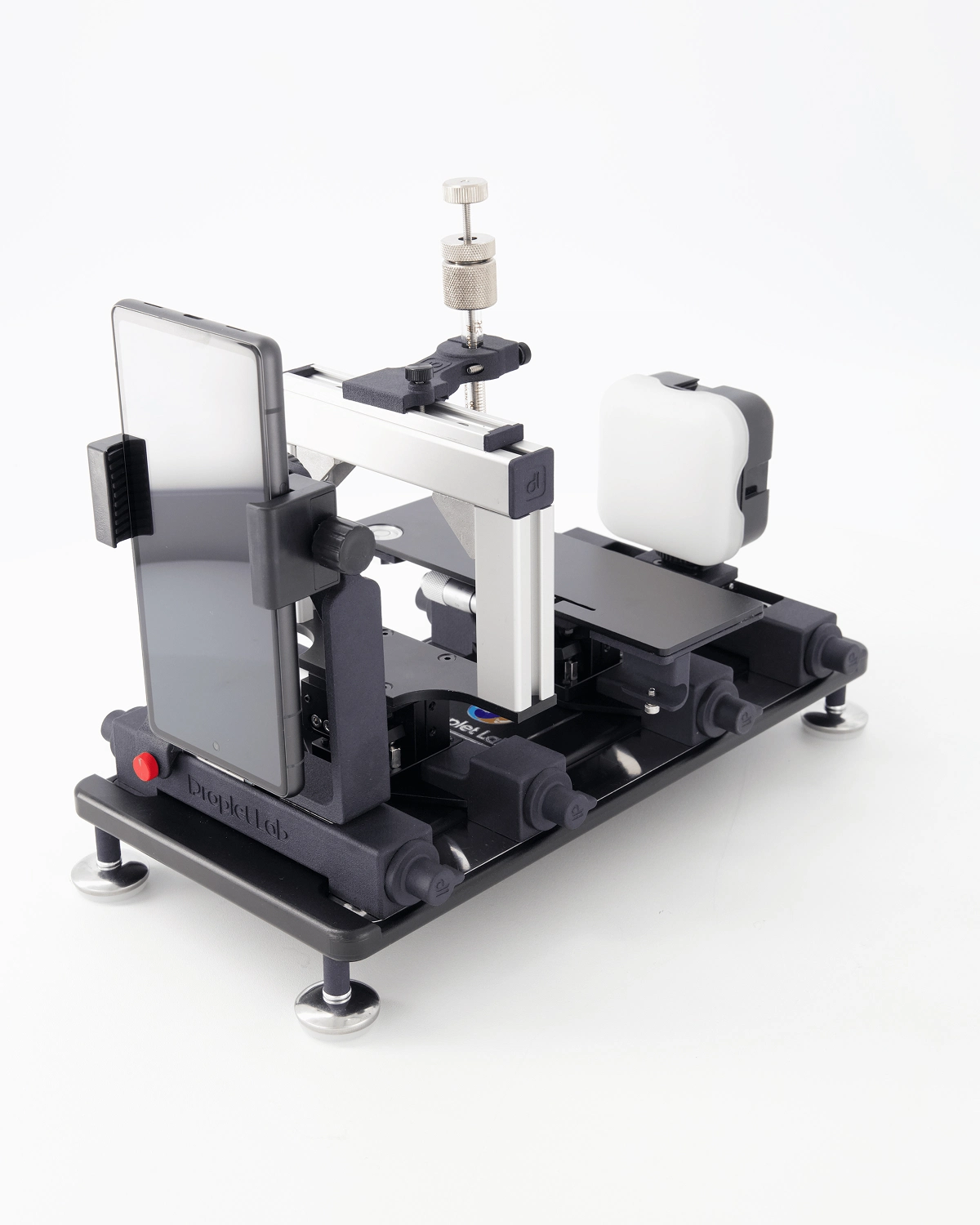
Dropometer
US$4,990 base kit, checked 12 November 2026, Droplet Lab

Surface tension tensiometer comparison
The SITA science line t100 measures dynamic surface tension by bubble pressure, from bubble lifetimes of 15 milliseconds to 100 seconds. The Dropometer measures surface and interfacial tension from the shape of a pendant drop. This page compares the two on surface age, accuracy, sample, scope and cost, using SITA's own technical data.
US$4,990 base kit, checked 12 November 2026, Droplet Lab
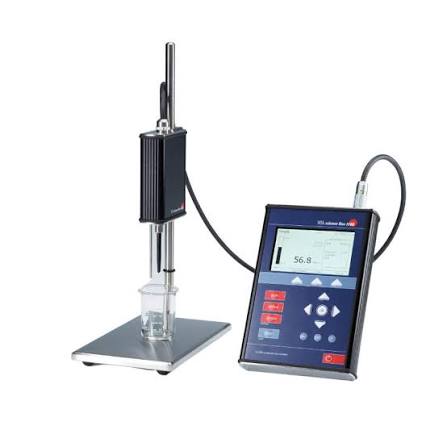
Not published (quote only), checked 12 November 2026, SITA


COO at Droplet Lab
Holds a BASc in Mechanical Engineering from Ryerson University (now Toronto Metropolitan University) and an MASc from York University. He develops the automatic edge and baseline detection behind the Dropometer's analysis.
If your process gives surfactants milliseconds to reach a new surface, as in spraying, inkjet printing or fast coating, or you control bath concentration on the line, use the SITA science line t100. For interfacial tension, microlitre samples, contact angle and surface free energy in one kit, and a published price, the Dropometer (US$4,990) is the better buy.
Bubble pressure measures pressure. Air is pushed through a capillary into the liquid, and the pressure needed to form each bubble gives the surface tension at the bubble lifetime you set. Short lifetimes show how fast surfactants reach a new surface. The Dropometer measures shape. A drop hangs from a needle, the camera records its outline, and the app fits the Young–Laplace equation, so it reads near equilibrium values and follows a drop as it ages. Our surface tension measurement guide explains both methods.
Both measure the surface tension of liquids and both can follow how it changes with time.
Both are portable and run on an internal battery: SITA states about 8 hours for the t100, the Dropometer up to 8 hours.
Both need clean hardware: a clean capillary for bubble pressure, a clean needle and a sharp drop outline for pendant drop.
The t100 sets bubble lifetimes from 15 ms to 100 s. The Dropometer's dynamic readings start from about 0.1 s and run for as long as the drop lasts. Below 0.1 s, only bubble pressure gives an answer.
The t100 reads surface tension against air only. The Dropometer reads surface and interfacial tension, and also contact angle and surface free energy on solids.
The t100 dips a capillary into a vessel; it ships with two 50 ml vessels and needs no density. The Dropometer needs a few microlitres and the density difference between the two phases.
SITA states a maximum deviation of 1% of full scale, 0.1 mN/m resolution and 0.5 mN/m reproducibility. The Dropometer datasheet states ±0.03 mN/m and 0.01 mN/m resolution up to 75 mN/m. The two makers define the figures differently, so compare them on your own liquids.
Air flows through a capillary of known radius into the liquid. The pressure rises as a bubble grows and peaks when the bubble is a hemisphere, and the Young–Laplace equation turns that pressure into surface tension. The t100 controls the bubble lifetime and records surface tension, bubble lifetime and liquid temperature. It runs in SINGLE, AUTO (a scan across bubble lifetimes) and ONLINE (continuous at one lifetime) modes.
A drop hangs from a needle in front of an LED backlight. The phone camera records the outline, and the app fits the Young–Laplace equation using the density difference you enter. The Dropometer datasheet states ±0.03 mN/m up to 75 mN/m, and two peer reviewed papers compared it with a KRÜSS DSA100E. Try it with our pendant drop experiment.
A fresh surface has had no time for surfactant to arrive, so its surface tension starts high and falls as molecules adsorb. A spray droplet or an inkjet drop wets in milliseconds, long before equilibrium. If your process is that fast, a static value overstates how well the liquid wets. If your process waits seconds or more, pendant drop gives the value that matters. Our surfactant experiment shows the effect.
We used the laboratory SITA science line t100, SITA's widest range model: 10 to 100 mN/m, bubble lifetime 15 ms to 100 s, liquid temperature measured from −20 to 125 °C, 1,870 g with sensor, LabSolution software for Windows, and PEEK, PTFE or glass capillaries. SITA also sells handheld and process units; SITA states that results from all its bubble pressure tensiometers are comparable. We did not check other makers' bubble pressure tensiometers for this page.
Figures from each maker's own pages and data sheets, checked 12 November 2026.
| Criterion | SITA science line t100 | Dropometer |
|---|---|---|
| Method | Bubble pressure in a capillary | Shape of a pendant drop, Young–Laplace fit |
| Price (checked 12 November 2026) | Not published (quote only) | US$4,990 base kit, phone and app included |
| Surface tension range | 10 to 100 mN/m | Up to 75 mN/m |
| Resolution | 0.1 mN/m | 0.01 mN/m |
| Stated accuracy | Max. deviation 1% of full scale; reproducibility 0.5 mN/m | ±0.03 mN/m (datasheet); compared with a KRÜSS DSA100E in peer review |
| Surface age | Bubble lifetime 15 ms to 100 s | From about 0.1 s (10 fps camera), then as long as the drop lasts |
| Interfacial tension | Not listed | Yes |
| Contact angle and surface free energy | No | Yes |
| Sample | Vessel for the capillary; two 50 ml vessels supplied | A few µL |
| Density input | Not needed (SITA) | Density difference entered |
| Temperature | Liquid temperature measured, −20 to 125 °C; thermostat accessory | Room temperature in the base kit; built to order upgrade, ask for range |
| Power and weight | Internal battery, about 8 h (SITA); 1,870 g with sensor | Battery up to 8 h; 1 kg |
| Software and data | LabSolution (Windows); USB; 64 methods stored on the device | Android and iOS app; email and cloud sharing |
Sources: SITA science line t100 technical data, SITA tensiometer FAQ (battery time, density, immersion depth), Dropometer specification. All checked 12 November 2026. SITA does not publish a price.
We read SITA's t100 technical data and tensiometer FAQ, and the Dropometer specification, on 12 November 2026. We did not run the two instruments side by side for this page, so it gives no time per sample or agreement figures.
Disclosure: Droplet Lab makes the Dropometer, so read this page knowing that. Every SITA figure links to SITA's own pages. The verdict changes for any process that needs surface ages below about 0.1 s: there bubble pressure wins, whatever the budget. Made with Claude Opus 5.5 and reviewed by Droplet Lab.
Bubble pressure and pendant drop are both correct methods; at short surface ages they answer a different question. The quote below makes the same point about contact angle.
Not all contact-angle measurements are created equal: the right method depends on the application. A sessile drop and a tilted plate can give very different, and equally correct, numbers.
What this means here: report the bubble lifetime or drop age with every dynamic surface tension value, and compare methods only at the same surface age.
Pick: SITA science line t100. Millisecond bubble lifetimes match the process. See the dynamic surface tension guide.
Pick: SITA science line t100, or one of SITA's handheld units, for concentration checks at a set bubble lifetime. See the production QC guide.
Pick: Dropometer. Pendant drop measures interfacial tension; SITA lists surface tension only.
Pick: Dropometer. A few microlitres per reading, followed as the drop ages.
Pick: Dropometer, with contact angle and surface free energy included. See the under US$5,000 guide.
Use the SITA science line t100 when surface age decides the result: sprays, inkjet, fast coating and bath concentration control, from 15 ms upwards. Use the Dropometer when you need interfacial tension, microlitre samples, tighter stated accuracy near equilibrium, or contact angle and surface free energy as well. If you are unsure, book a 15 minute consult and bring a formulation you already measure.
At short bubble lifetimes the surfactant has not finished reaching the new surface, so surface tension is still high. As lifetime grows the value falls toward the equilibrium value a pendant drop reads. Compare the two only at the same surface age.
Yes, from about 0.1 s, set by its 10 fps camera, and then for as long as the drop lasts. For surface ages in milliseconds, use a bubble pressure tensiometer.
SITA lists surface tension of liquids against air (or an inert gas) only. For interfacial tension between two liquids, use pendant drop or a ring or plate tensiometer.
Not for SITA's bubble pressure tensiometers, according to SITA. For pendant drop you enter the density difference between the drop and the surrounding phase; for water against air that is the density of water.
Yes, with good technique. The Dropometer was compared with a KRÜSS DSA100E in two peer reviewed papers. Our surface tension measurement guide covers the technique.
How the Dropometer compares with other tensiometers and surface analysis instruments.
Where the Dropometer's accuracy figure comes from.
Dropometer contact angle and pendant drop surface tension were compared with a KRÜSS DSA100E in two peer reviewed papers: Review of Scientific Instruments (2018) and Colloids and Surfaces A (2017).
Customers have cited the Dropometer in 59 peer reviewed papers, theses and conference papers, listed with links.