“
Surface tension versus concentration is one of the few measurements that lets you watch a surfactant reorganise an interface in real time: read the curve, not just the endpoint.

FDA's 510(k) guidance for contact lens care products asks daily cleaner submissions with surfactant ingredients to report surface tension and critical micelle concentration (CMC). Its Chem-Appendix B measures surface tension with a tensiometer across a dilution series. The Dropometer is a pendant drop tensiometer, so it runs that method as written.
What brings you here?
Regulatory affairs
You need surface tension and CMC data you can defend. Follow Chem-Appendix B step by step, then document settings, replicates and the regression.
Analytical chemist
You need a repeatable dilution series and a clear break point. The steps and method settings below cover both.
Formulation R&D
You need to compare surfactants and know how far above the CMC your product sits. Measure the series in your own buffer.
Free one page checklist for CMC by surface tension: dilution series, settings to lock, replicates, the two line fit and what to record for a submission file.
Talk to an expert
Tell us your surfactant, medium and current method. We will run a pendant drop live and tell you plainly where the Dropometer fits your validation plan and where it does not.


Droplet Lab builds precision instruments and software for surface science measurement, specialising in contact angle analysis and surface tension characterisation. Used by researchers across materials science, pharmaceuticals, coatings, and advanced manufacturing, Droplet Lab's Dropometer has contributed to studies published in peer-reviewed journals including Advanced Functional Materials (Impact Factor 19). The team combines instrument engineering with deep domain knowledge in wettability science with a focus on practical accuracy.
FDA CDRH, Premarket Notification (510(k)) Guidance Document for Contact Lens Care Products, issued May 1, 1997. For daily cleaners with surfactant active ingredients, the chemistry section should include the solution's surface tension and the surfactant's micelle concentration, using the method in Chem-Appendix B or another scientifically valid method. Contact lens care products are Class II medical devices, so a new cleaner reaches the market through a 510(k) premarket notification that shows it is substantially equivalent to a legally marketed predicate device.
Fully compliant. Chem-Appendix B dilutes the surfactant system in the cleaner's own medium, measures surface tension with a tensiometer, and fits least squares lines against log concentration. It does not specify a ring, plate or drop geometry. The Dropometer is a pendant drop tensiometer.
Surface tension up to 75 mN/m, accuracy ±0.03 mN/m, resolution 0.01 mN/m, Young-Laplace fit, static and dynamic pendant drops, from the Dropometer product specification.
The drop shape method is validated against a KRUSS DSA100E in two peer reviewed papers. See our validation publications.
Researchers used the Dropometer as a pendant drop tensiometer to measure polymer and surfactant mixtures. Read our analysis of the paper.
A university rheology lab put surface tension next to every flow curve and reported it in seven publications. Read the case study.
Surface tension and CMC support a cleaning claim. They do not prove cleaning effectiveness on their own. The guidance also asks for other chemistry, microbiology and clinical data.
What the guidance asks for, who uses it and how the Dropometer fits
FDA's 1997 510(k) guidance for contact lens care products asks daily cleaners with surfactant ingredients to report the solution's surface tension and the surfactant's critical micelle concentration (CMC). Regulatory, analytical and formulation teams use the data to support cleaning effectiveness. Chem-Appendix B measures surface tension with a tensiometer, and the Dropometer pendant drop tensiometer runs it as written. The results go into the chemistry section of the premarket submission, next to the comparison with the predicate device.
You find the CMC by measuring surface tension across a dilution series. Surface tension falls as surfactant is added, then levels off. The break between the two parts of the curve is the CMC.
The Dropometer pendant drop tensiometer reads each drop with a Young-Laplace fit. For the full workflow, see CMC assessment and surfactant efficiency. A university rheology lab has reported Dropometer surface tension data in seven publications. Background reading: our pharmaceutical guide, the surface tension measurement guide and the guide to surfactants.
Further reading: what critical micelle concentration means, what to look for in a tensiometer for surfactant and CMC research, how to show repeatability with repeatability, reproducibility and Gage R&R and our Gage R&R calculator, a classroom version in the effect of surfactants on surface tension, and reference values in CMC of common surfactants.
CMC by surface tension, step by step, in our own words
These steps follow the order of Chem-Appendix B, in our own words. Read the guidance itself before you write your SOP.
From the Dropometer product specification. Resolution is 0.01 mN/m.
Base plate, phone holder, LED and Hamilton syringe. No PC needed.
Manual dropper volume per rotation, so each drop uses very little solution.
Make Solution 1, the cleaner's medium without surfactants. Make Solution 2, a stock of the surfactant system in the product's ratio. Dilute Solution 2 with Solution 1 to make the Solution 3 series, spaced on a log scale from well below to well above the expected CMC.
Fit a clean needle to the Hamilton syringe and mount the phone and LED. Enter the density difference between the solution and air for the Young-Laplace fit.
Form a fresh pendant drop and read it at the same age every time. Surfactants take time to reach the surface, so use the dynamic mode to see when the value settles.
Measure several drops per concentration. Run from the lowest to the highest concentration, and rinse the syringe and needle between solutions.
Plot surface tension against log concentration. Fit one straight line to the falling part and one to the plateau. The point where they meet is the CMC.
Record room temperature, drop age, needle size, density values, replicates, fit quality and the regression rule. Keep the drop images with the data.
This video shows a complete Dropometer pendant drop surface tension measurement, from setup to result. Repeat it at each concentration in your series.
Independent benchmarking and publication-based validation references.
Peer reviewed method
The Dropometer drop shape method is validated against a KRUSS DSA100E in two peer reviewed papers, one in Review of Scientific Instruments and one in Colloids and Surfaces A.
Published client paper
Researchers used the Dropometer as a pendant drop tensiometer at room temperature to measure polymer solutions with added surfactants, reporting the average surface tension of repeated drops.
Pendant drop · CMC · method validation
Chem-Appendix B sets the steps but not the checks around them. Add your own: measure pure water against its reference value at your room temperature, run a reference surfactant with a published CMC, and repeat with two operators on different days.
The appendix notes that pH, tonicity and other inactive ingredients can shift the CMC. That is why the dilutions use the cleaner's own medium, not plain water.
Write the least squares rule into your SOP before you test the product, so the break point is not chosen by eye.
Example data for illustration only. These are not measured results. Your surfactant, medium and temperature decide the numbers.
| Concentration (% w/v) | Drops (n) | Mean γ (mN/m) | Std dev (mN/m) | Region | Note |
|---|---|---|---|---|---|
| 0.0001 | 5 | 68.12 | 0.08 | Falling | Near water |
| 0.001 | 5 | 54.60 | 0.11 | Falling | |
| 0.003 | 5 | 42.00 | 0.09 | Falling | |
| 0.01 | 5 | 36.21 | 0.07 | Plateau | Just above the break |
| 0.03 | 5 | 35.94 | 0.06 | Plateau | |
| 0.1 | 5 | 35.71 | 0.06 | Plateau | Typical use level sits here |
Each row is the mean of five pendant drops. Surface tension falls steeply, then flattens. In this example, straight lines fitted to the two parts meet near 0.008% w/v, the estimated CMC.
The same example data as the table, plotted on a log scale with the two fitted lines.
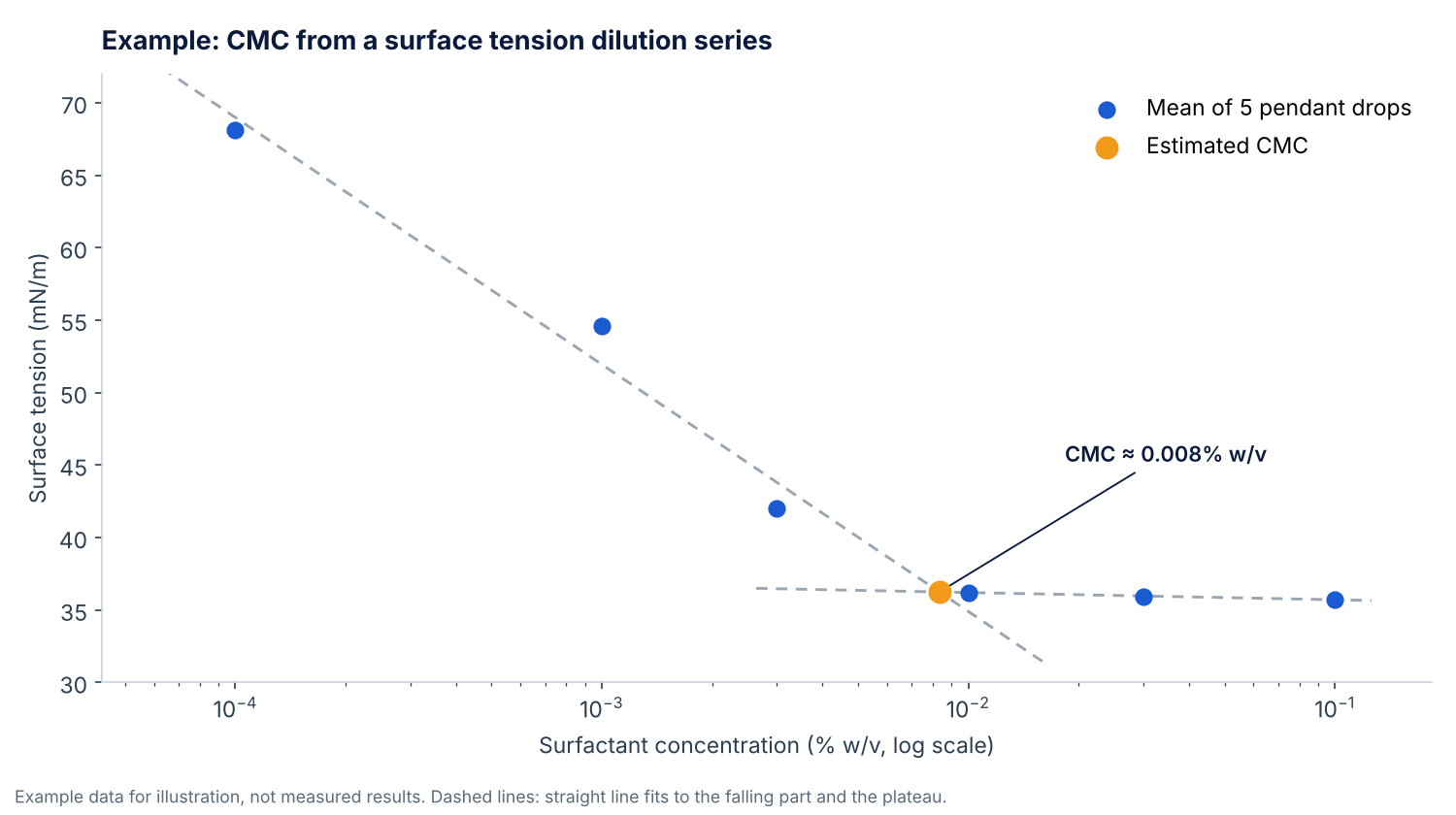
Example data, not measured results. Dashed lines are straight line fits to the falling part and the plateau.
What changes when surface tension runs on your own bench
| Metric | Before Dropometer | With Dropometer | Results |
|---|---|---|---|
| Where the test runs | Ring or plate tensiometer, often at a contract lab | Pendant drop on your own bench | No published benchmark |
| Solution per reading | A vessel of liquid per reading | One pendant drop; the manual dropper gives 5.29 µL per rotation | Dropometer product specification |
| Result format | A value per concentration | A value per drop, ±0.03 mN/m, with the drop image | Dropometer product specification |
| Record | Lab report | Drop images, fits and settings kept with the data | No published benchmark |
Bring your cleaner and its surfactant. We will measure a short dilution series live.
Enter your own numbers. The defaults are examples, not Droplet Lab results.
Quality cost snapshot
Result
Annual exposure combines audit/CAPA cost, customer rejections, and recall probability; avoided exposure applies the risk reduction percentage.
Lock these in your SOP before you test the product
| Parameter | Recommended Setting | Technical Rationale |
|---|---|---|
| Mode | Pendant drop, Young-Laplace fit | The Dropometer surface tension method. The model is in the software. |
| Density difference | Measured density of each solution | The fit needs it. Dilute solutions are close to water, but check it. |
| Drop age at reading | The same for every drop, set in the SOP | Surfactants adsorb over time, so an early reading reads high. |
| Concentration range | Well below to well above the expected CMC, log spaced | You need enough points on both lines to fit them. |
| Replicates | Several fresh drops per concentration | Shows repeatability and catches a bad drop. |
| Order | Lowest to highest, rinse between | Carryover from a strong solution lowers the next reading. |
| CMC rule | Two line regression, written before testing | Stops the break point being picked by eye. |
| Temperature | Record it, and keep the room steady | CMC shifts with temperature. The Dropometer runs at 10 to 45 °C and has no temperature control. |
Pick the reference by what you need to show
Start: What do you need to report?
Your daily cleaner has surfactant active ingredients.
Follow Chem-Appendix B. The Dropometer pendant drop tensiometer runs it as written.
You want a standard method name to cite for CMC.
See ISO 4311.
Your SOP or customer names a ring or plate method.
See ASTM D1331.
Your product is a conditioning solution, not a cleaner.
The same guidance lists wetting angle against soaking time. That is a contact angle measurement, which the Dropometer also runs.
Start from what you need to report. Blue boxes are measurements the Dropometer runs.
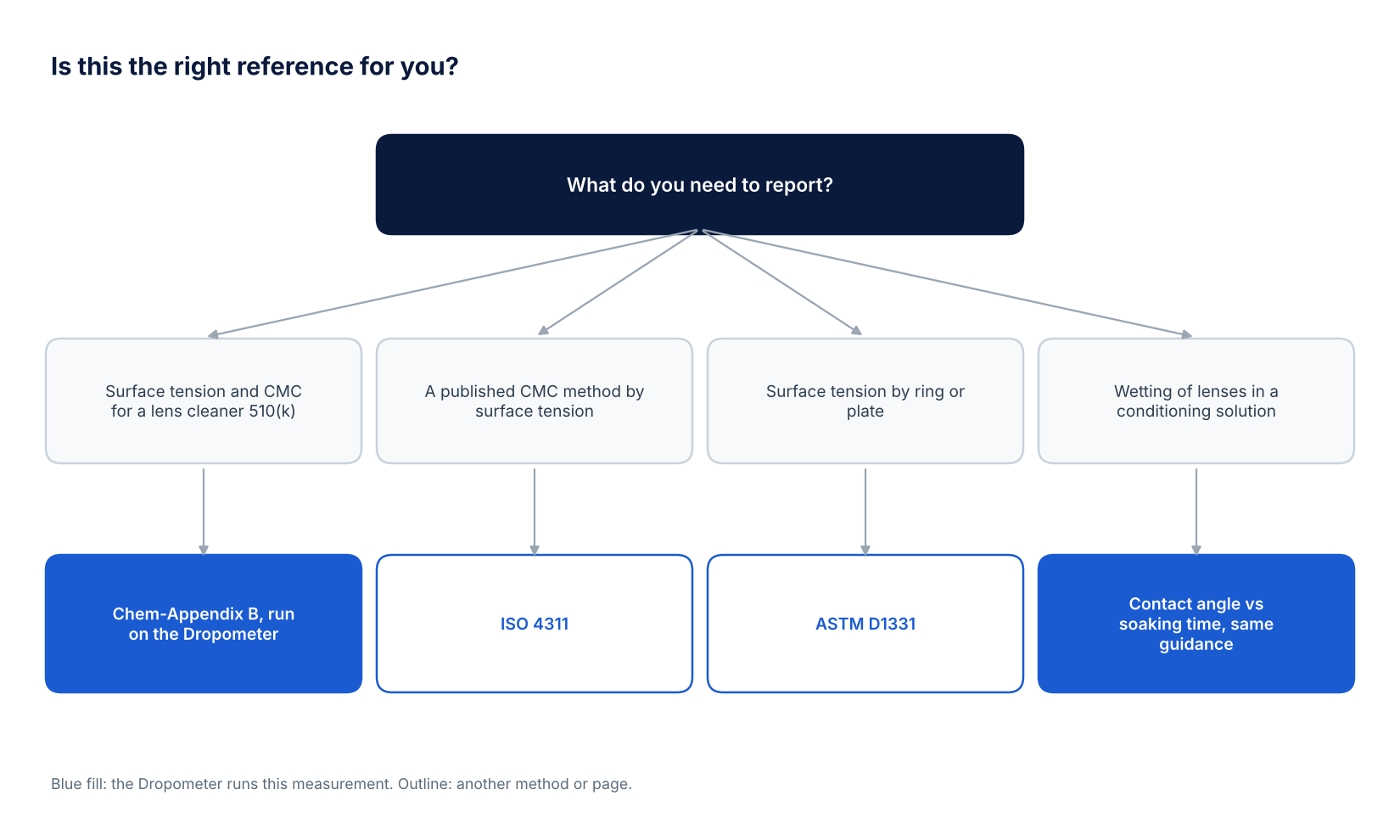
Pick the reference by what you need to report.
What the curve tells you, and what it does not
Honest limits of the method and of the Dropometer
For daily cleaners with surfactant active ingredients, FDA's 1997 510(k) guidance lists the solution's surface tension and the surfactant's micelle concentration in the chemistry section. Check the current FDA guidance documents for your product type before you plan the testing.
Chem-Appendix B dilutes the surfactant system in the cleaner's medium, measures surface tension with a tensiometer, plots it against log concentration and uses least squares regressions to find the CMC. It does not name a ring, plate or drop method, and the guidance also accepts another scientifically valid method.
It measures the surface tension at each concentration by pendant drop. You then plot surface tension against log concentration and fit two straight lines. The point where they meet is the CMC. Write that regression rule into your SOP before testing.
CMC and surface tension both change with temperature. The Dropometer has no temperature control, so keep the room steady, record the temperature for every series, and compare products only at matching conditions.
Long enough for the value to settle. Surfactant molecules take time to reach a fresh surface, so an early reading is too high. Use the dynamic mode to see when the trace flattens, then fix that drop age in your SOP.
Yes, for conditioning solutions. It lists the wetting angle of hydrophobic lenses in the solution as a function of soaking time. That is a contact angle measurement, which the Dropometer also runs.
A 510(k) premarket notification asks FDA to find that a new device is substantially equivalent to a legally marketed predicate device: as safe and effective, with the same intended use. For a daily cleaner with surfactant ingredients, the 1997 guidance lists surface tension and CMC in the chemistry section, alongside microbiology and clinical data. FDA's review goal for a 510(k) is 90 days, counted in FDA review days. A device that is not substantially equivalent may need a De Novo request, and Class III medical devices need premarket approval (PMA) instead. The Dropometer produces the surface tension data only: FDA clearance applies to your product, not to the instrument.
This page summarises FDA guidance in our own words. It is not regulatory advice. Check FDA's current guidance and talk to FDA before you rely on a method in a submission. Droplet Lab does not certify compliance. Your own method validation does.
Sources, review and tools
FDA's 1997 contact lens care 510(k) guidance, FDA 510(k) summary K050729, the Dropometer product specification and Droplet Lab validation papers.
Drafted with Claude (Anthropic) from the sources listed, then reviewed by Droplet Lab.
We did not copy text from the guidance, and this is not regulatory advice.
October 2026
Spotted an issue in this summary? Send a correction request and our team will review it.
Correction Request
We work hard to keep this page accurate and up to date. If you spot an error (wrong revision/year, missing requirement, incorrect interpretation, or broken link), tell us and we'll review it.
Contact us to report a correction