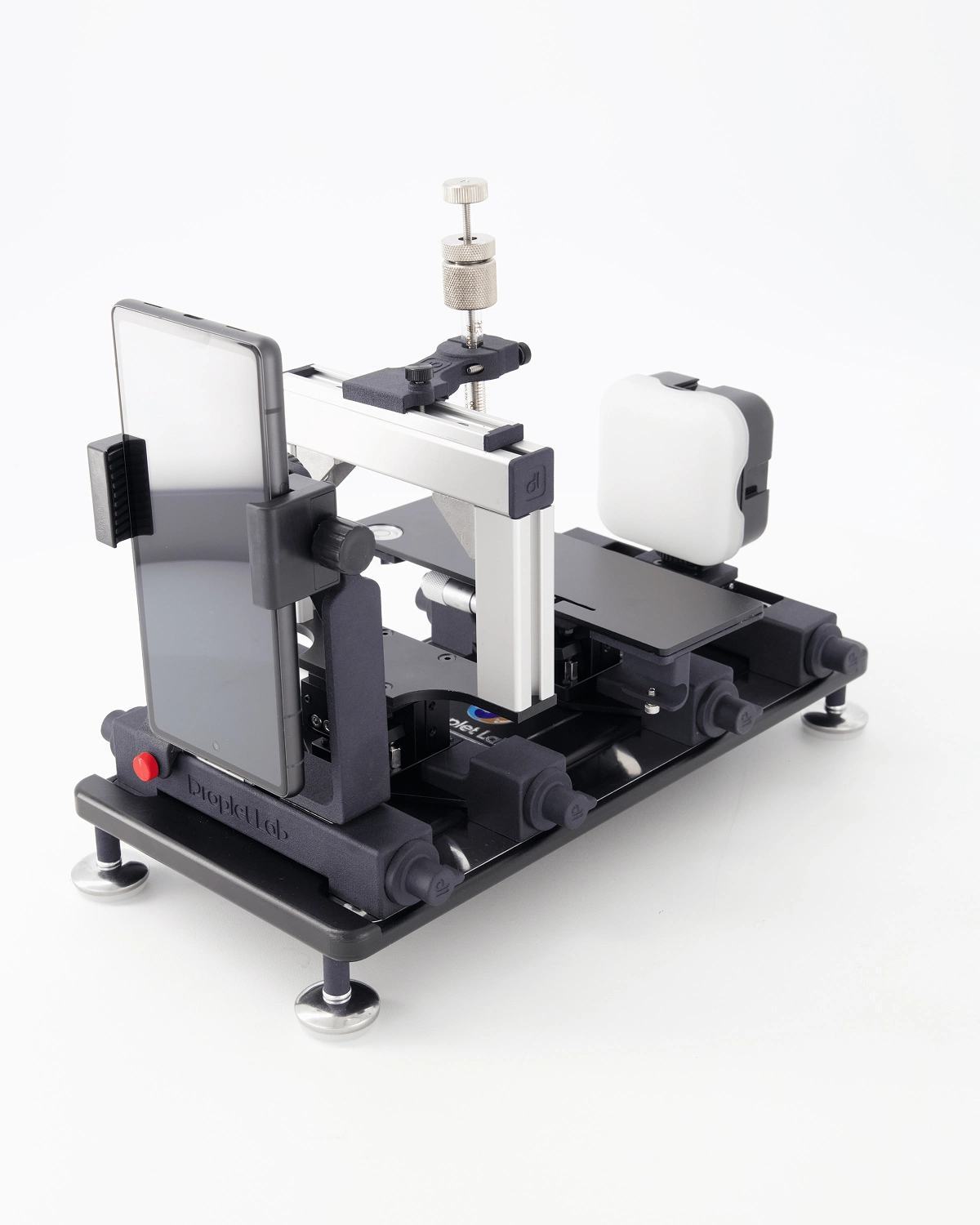
Dropometer
From US $4,990

Product comparison
Both measure contact angle to tell you about a surface but they're built for different jobs. The Surface Analyst 5001 is a rugged, handheld, one-button inspector that ballistically deposits a water droplet and returns a water contact angle in under two seconds, purpose-built for pre-bond cleanliness QC on the production floor. The Dropometer is a portable, smartphone-based analyzer that does the full picture; contact angle with multiple liquids, surface free energy (polar and dispersive parts), pendant-drop surface tension, and dynamic and sliding angles with published accuracy, at a fraction of the price. Pick on the axis that matters: point-and- shoot form factor and production integration, or measurement breadth and cost.
From US $4,990
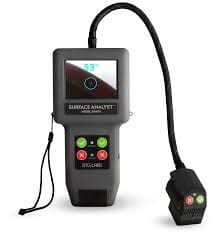
Quote only (premium instrument; not publicly listed)


Droplet Lab builds precision instruments and software for surface science measurement, specialising in contact angle analysis and surface tension characterisation. Used by researchers across materials science, pharmaceuticals, coatings, and advanced manufacturing, Droplet Lab's Dropometer has contributed to studies published in peer-reviewed journals including Advanced Functional Materials (Impact Factor 19). The team combines instrument engineering with deep domain knowledge in wettability science with a focus on practical accuracy.
The Surface Analyst 5001 is an excellent tool for one job: fast, one-button, non-contact water contact angle QC on real parts, with strong data and MES integration. If your need is high-volume pre-bond cleanliness inspection on large or awkward parts on the shop floor, its handheld ballistic form factor is genuinely hard to beat and the Dropometer isn't trying to. But that is a single-liquid cleanliness metric. It doesn't give you surface energy components, liquid surface tension, or dynamic and sliding angles; it doesn't publish accuracy specs or a price; and it runs on proprietary water cartridges. The Dropometer delivers the full quantitative picture, with published accuracy, at a fraction of the cost; as a place-a-drop instrument rather than a point-and-shoot handheld. Choose on form factor and production integration, or on measurement breadth and price. For most labs the second axis wins; for in-line inspection of big parts, the first can.
The Surface Analyst 5001 and the Dropometer overlap on the words "portable contact angle" and diverge almost everywhere else. The Surface Analyst is a production-hardened, handheld inspector optimised for one measurement; water contact angle for surface cleanliness done fast, non-destructively, and logged for QC. The Dropometer is a lower-cost, full-capability surface analyzer that measures the wider set of properties surface science actually uses.
Both measure contact angle optically, non-destructively, using water.
Both are portable and used in the same industries aerospace, automotive, medical devices, electronics, coatings and packaging.
Both log data for QC and traceability.
The Surface Analyst returns a single-liquid water contact angle (with a Dyne-Mode conversion); the Dropometer adds surface free energy with polar/dispersive components, surface tension, and dynamic and sliding angles.
Ballistic non-contact deposition lets the Surface Analyst measure large, vertical or in-situ parts a stage-based instrument can't reach; the Dropometer is a place-a-drop workflow.
The Dropometer publishes accuracy, resolution and range; the Surface Analyst brochure asserts superior accuracy without stating figures.
~$4,990 and ordinary test liquids versus a premium quote-only instrument running on proprietary 1,000-measurement water cartridges.
The Surface Analyst's speed comes from doing one thing: deposit a water drop, read the contact angle, done. For pre-bond cleanliness that's often enough — a change in water contact angle is a reliable flag that a surface's condition has shifted. What a single-liquid reading can't give you is why: the balance of polar and dispersive surface energy that decides whether a specific adhesive or ink will bond. Resolving that needs contact angle with more than one test liquid and a model such as Owens-Wendt — which the Dropometer does and a water-only device does not. The Surface Analyst's optional "Dyne Mode" converts a water angle into a dyne/cm figure, but that is a single-liquid estimate, not a component decomposition.
Ballistic, non-contact deposition is a real advantage, and we won't pretend otherwise. Because the Surface Analyst fires a droplet from a handheld head, it can measure a spot on a surface that you can't or don't want to place on a stage: a large composite panel, a vertical car body, an assembled part in the line. The Dropometer, like other drop-shape analyzers, works best with the sample presented to it. For in-situ inspection of big or fixed parts, that difference can decide the purchase on its own and it's the clearest case where the Surface Analyst is the right tool.
The Dropometer publishes what it does: ±0.35° accuracy, 0.01° resolution, a 10°–175° range, validated against established goniometry in peer-reviewed literature. The Surface Analyst brochure states its vision analysis exceeds "the accuracy of any other goniometer" but publishes no repeatability, resolution or range figures to check that against. For a buyer who needs to put numbers in a validation report, a published spec you can cite is worth more than a superlative you can't.
The Dropometer is ~$4,990 and uses ordinary test liquids, including plain water. The Surface Analyst is a premium, quote-only instrument that runs on proprietary, individually hand-assembled HPLC-water cartridges rated for 1,000 measurements; a recurring, single-source consumable. Both are non-destructive and harmless; the difference is capital outlay and who controls the consumable supply.
| Criterion | Dropometer | Surface Analyst 5001 |
|---|---|---|
| Contact angle (sessile) | Yes | Yes (water only) |
| Number of test liquids | Multiple | Water only (proprietary cartridge) |
| Surface free energy (polar/dispersive) | Yes (multi-liquid, Fowkes / Oss & Good) | No — Dyne Mode gives a single-liquid dyne/cm estimate |
| Surface tension (pendant drop) | Yes (aqueous, to ~75 mN/m) | No |
| Dynamic angles (advancing/receding, hysteresis) | Yes | No |
| Sliding / roll-off angle | Included (0–60° tilt stage) | No |
| Published accuracy | ±0.35° | Not published (accuracy claimed, no figures) |
| Published resolution / range | 0.01° / 10°–175° | Not published |
| Measurement speed | Seconds (place-a-drop) | Under 2 seconds, one button |
| Deposition method | Place-a-drop (syringe) | Ballistic, non-contact |
| Large / vertical / in-situ parts | Sample presented to instrument | Yes — handheld head, up to 6 m tether |
| Shop-floor ruggedisation | Portable, lab/field | Purpose-built for production |
| Production data integration | Cloud sharing, multi-user export | Trend logging, 40,000-image storage, pass/fail + near-failure alerts, Cpk, RS232/Ethernet MES output |
| Consumables | Ordinary test liquids, incl. plain water | Proprietary hand-assembled HPLC-water cartridges (~1,000 measurements) |
| Runs without a PC | On-device analysis | Self-contained handheld |
| Weight / power | 1 kg, battery up to 8 h | Handheld head + base unit |
| Warranty | 5 years + 5 years software upgrades | Not published |
| Starting price | US $4,990 | Not published (quote only) |
Surface Analyst 5001 specifications are drawn from the Brighton Science brochure and may change; accuracy figures, warranty and price are not published there — verify with the vendor before purchase.
This comparison draws the Surface Analyst 5001's details from Brighton Science's published brochure, and the Dropometer's from its own datasheet and peer-reviewed validation (including Review of Scientific Instruments, with Dropometer data contributing to studies in journals such as Advanced Functional Materials, Impact Factor 19). Because the two instruments target different jobs, we haven't forced a winner on every row; where the Surface Analyst is the better tool (non-contact in-situ measurement, one-button shop-floor speed, deep MES integration) we say so plainly. Note that the Surface Analyst brochure claims class-leading accuracy but publishes no repeatability, resolution or range figures, and lists no price; we flag those gaps rather than guess.
A ballistic single-drop reading is, by design, one drop placed and read — fast and repeatable for a cleanliness check, but it captures a single static value. The observations below explain what that single number leaves on the table, and why the advancing/receding and tilt workflows the Dropometer automates matter for anything past a go/no-go.
"Repeatable numbers don't come from dropping a droplet and reading it. They come from advancing and receding slowly enough that you are measuring thermodynamics, not fluid dynamics."
"The gap between the advancing and receding angle — the hysteresis — is where a surface reveals its roughness, its heterogeneity, and whether something is reacting."
The implication for this comparison: for fast pre-bond cleanliness, a single water contact angle does the job well. But when you need to understand why a surface behaves as it does; adhesion, coating, dewetting the dynamic and multi-liquid measurements live on the Dropometer, not on a single-shot handheld.
Surface Analyst 5001. Non-contact ballistic deposition and a handheld head are purpose-built for this, and a stage-based analyzer can't easily match it.
Surface Analyst 5001. Its logging, alerts and production-line integration are a genuine strength.
Dropometer. These are outside a single-liquid water-contact-angle device's scope.
Dropometer. Full capability with published accuracy at ~$4,990, using ordinary test liquids.
Dropometer. It states ±0.35° accuracy, 0.01° resolution and a defined range you can put in a validation report.
The Surface Analyst 5001 is the right tool when the job is fast, non-contact water contact angle QC on real production parts — especially large or awkward ones — with deep data and MES integration; for that, its handheld form factor is hard to beat. The Dropometer is the right tool when you need more than a single water number: surface free energy with polar/dispersive components, surface tension, dynamic and sliding angles, and published accuracy — at roughly a fraction of the price and without proprietary consumables. They aren't the same instrument doing the same job; decide by whether your constraint is in-situ form factor and line integration, or measurement breadth, transparency and cost.
It measures a water contact angle and can display a converted dyne/cm value (Dyne Mode), which is a single-liquid estimate. It does not decompose surface energy into polar and dispersive components; that requires contact angle with multiple test liquids, which the Dropometer does.
The brochure claims its analysis exceeds other goniometers but publishes no repeatability, resolution or range figures. The Dropometer publishes ±0.35° accuracy, 0.01° resolution and a 10°–175° range, validated in peer-reviewed literature. Without stated numbers on the Surface Analyst side, a head-to-head accuracy claim can't be verified.
Not in the same point-and-shoot way. The Surface Analyst's ballistic, non-contact head is designed to measure spots on large or vertical parts without a stage; the Dropometer works best with the sample presented to it. If in-situ inspection of big parts is your main need, that's the Surface Analyst's clearest advantage.
Independent benchmarking and publication-based validation references.
Dropometer contact angle and pendant-drop surface tension methods have been benchmarked against KRÜSS DSA100E reference measurements.
Our instruments are referenced in peer-reviewed journals, theses, and conference publications.