



Contents

Contact Angle Buyer's Guide

Best Value for Money Contact Angle Goniometer

Our pick when the question is not what fits a budget line but what returns the most measurement capability per dollar over five years, once software, consumables, calibration and service are counted. Every score below is calculated from published weights and criterion scores that you can check or replace with your own.

Scored 1–5 against 11 weighted criteria; full calculation shown on this page. Specifications and pricing last reviewed May 2026.

Abhimanyu Photo
Written by
Abhimanyu Bhandankar
Holds an MBA from Schulich School of Business and a BE in IT. He joined Droplet Lab in July 2019 and now leads sales and marketing.
CEO at Droplet Lab
Read More
Gurdeep-Saini-Photo
Technical Review by
Gurdeep Singh Saini
Holds a BASc in Mechanical Engineering from Ryerson University (now Toronto Metropolitan University) and an MASc from York University. He develops the automatic edge and baseline detection behind the Dropometer's analysis.
COO at Droplet Lab
Read More
Abhimanyu Photo
Written By

Abhimanyu Bhandankar

CEO at Droplet Lab

Holds an MBA from Schulich School of Business and a BE in IT. He joined Droplet Lab in July 2019 and now leads sales and marketing.

Gurdeep-Saini-Photo
Reviewed By

Gurdeep Singh Saini

COO at Droplet Lab

Holds a BASc in Mechanical Engineering from Ryerson University (now Toronto Metropolitan University) and an MASc from York University. He develops the automatic edge and baseline detection behind the Dropometer's analysis.

The short answer

Value is not the lowest quote. It is the ratio between the capability you will actually use and everything you will pay over the life of the instrument, including software renewals, proprietary consumables, calibration and downtime. The ranking below weights measurement scope and total cost of ownership at 16 percent each and modularity and upgrades at 14 percent, which is double the weight it carries on the under-$5,000 guide.

The ranking

Three options ranked on capability per dollar over five years, from a full-scope portable instrument to an entry benchtop and a near-zero-cost DIY rig.

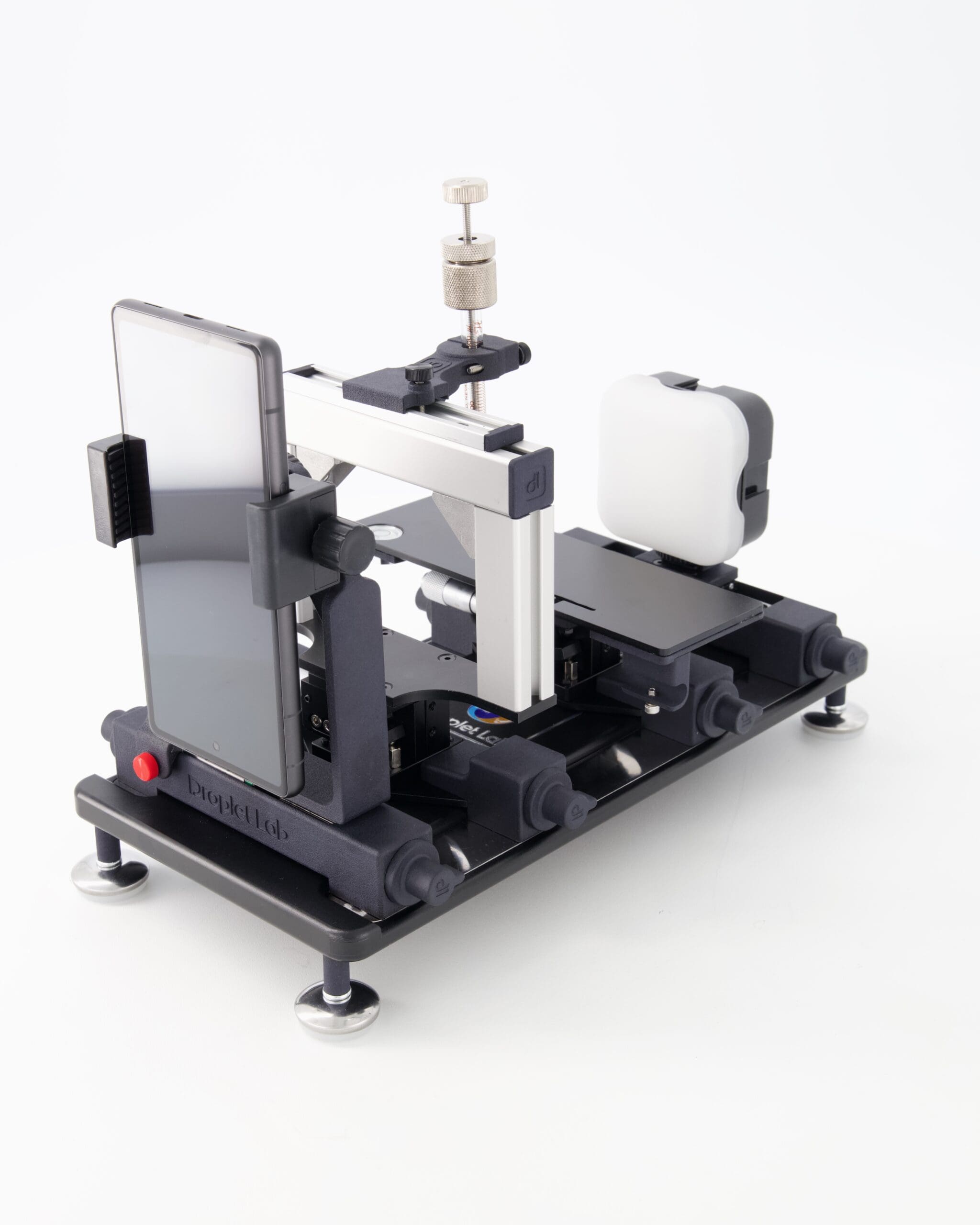
Droplet Lab Dropometer contact angle goniometer

Top pick

Dropometer

Droplet Lab

4.5/ 5

The Dropometer leads on value because it scores 5 out of 5 on both measurement scope and modularity, the two criteria that decide whether a purchase holds up over five years, while still scoring 4.5 on cost thanks to perpetual licensing and no consumable lock-in. It delivers close to research-grade capability at mid-tier pricing without a lab install.

Where it wins

Full contact angle, surface tension and surface energy scope in one purchase; no recurring software fees and a 10-year software-update commitment; no closed consumable dependency for core workflows; modular tilt, dosing and fixture upgrades instead of replacement; lease-to-own from about $2,000; no lab install, bench or climate infrastructure required.

Where it loses ground

At $4,990 the purchase price is higher than entry-level units, so it only pays back if the dynamic, sliding and surface-energy capability is genuinely used. Set measurement scope to a low weight and the ranking reverses.
Ossila contact angle goniometer benchtop unit

Runner-up

Ossila Contact Angle Goniometer

Entry benchtop

3.2/ 5

Ossila clears the bar and takes the maximum 5 out of 5 on total cost of ownership: around $3,000 buys accurate image-based measurement with integrated software, a two-year warranty and no recurring licence. It ranks second because value here is measured over five years, and a fixed-function platform scores 2 out of 5 on modularity at a 14 percent weight. Growth means a second purchase rather than an upgrade.

Where it wins

Low purchase price with no recurring licence; ±1° stated accuracy; integrated software with Young–Laplace and polynomial fitting; two-year warranty; standard laboratory liquids rather than proprietary consumables.

Where it loses ground

Static contact angle and pendant-drop surface tension only; manual dosing with no automation; no calibration logs or environmental control; no upgrade path, so the cost of adding dynamic or sliding-angle capability later is a whole new instrument.

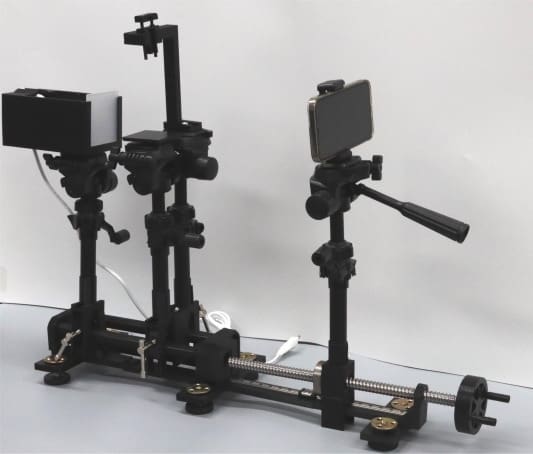
DIY contact angle measurement setup using a camera and ImageJ

Third

DIY (camera + ImageJ / LB-ADSA)

Self-assembled

2.1/ 5

A DIY rig scores 2.1, the lowest figure anywhere in this guide series, and that is the honest result of judging it on five-year value rather than purchase price. It takes the maximum 5 out of 5 on cost and scores 1 to 2.5 on everything else. Manual analysis time is a real and usually unbudgeted expense, and it compounds every year the rig stays in service.

Where it wins

About $150 to $300 in parts if you already own a camera; open-source analysis with no licence cost; ±1° achievable with care; a sensible way to establish what you actually need before committing to a purchase.

Where it loses ground

Manual analysis time is the dominant hidden cost and it scales with volume; static angle only; no traceability; results depend heavily on operator skill and lighting; no upgrade path at all, so nothing carries forward when requirements grow.

How we arrived at these scores

Every instrument is scored from 1 to 5 against the same 11 criteria, where 3 means it meets what this use case requires and 5 means it exceeds it. Each criterion then carries a weight for five-year value, and the weights sum to 100 percent. Multiply each score by its weight, add the rows, and you get the headline score. Every input is published below, so you can check the arithmetic or substitute your own weights.

Side-by-side specification comparison

Compare the three options across the cost factors that decide five-year value rather than purchase price alone.

SpecificationDropometerOssilaDIY (camera + ImageJ)
Purchase priceUS $4,990About US $3,000$0 software plus about $150 to $300 for the rig
Software licensingPerpetual, no recurring fees, 5 years of free upgradesIncluded, none statedFree and open source
Consumable lock-inNone for core workflowsStandard laboratory liquidsNone
Measurement scopeStatic, dynamic and sliding contact angle; surface tension; surface energyStatic contact angle; pendant-drop surface tensionStatic contact angle only
Upgrade pathModular tilt, dosing and custom fixturesLimited manual tilt accessory onlyNone without custom rigs
Analysis labour per sampleAutomated, about 1.1 minutesSoftware assisted, about 1 minuteFully manual, about 3.4 minutes
Infrastructure requiredNone, battery and offlineBench, mains power, Windows laptopCamera, lighting, stable rig
Warranty and support5-year warranty plus 5 years of free software upgradesTwo-year warrantyCommunity forums only

Expert perspective

The instrument quote is rarely the expensive part. Ask each vendor to price the workflow you will actually run for five years, including software renewals, accessories, calibration intervals, service response and the cost of downtime, and the value ranking often reorders itself.

Droplet Lab Editorial TeamBuyer's guide methodology note

We make the Dropometer and it ranks first here, so test the assumption behind the weighting. This page weights measurement scope at 16 percent and modularity at 14 percent, which assumes your requirements will grow. If your work is static contact angle only and will stay that way, drop both weights and recompute: Ossila wins at roughly $2,000 less.

Frequently Asked Questions

Software licence renewals, surface-energy calculation sold as a separate module, proprietary syringes or needles priced well above market, calibration intervals, service response times, and training. Ask for all of these in writing before comparing quotes.

It is common. Annual contracts of $1,500 to $3,000 are frequently attached to instruments quoted at an attractive hardware price. Confirm whether the licence is perpetual and whether calibration or software activation depends on the contract staying live.

That guide answers which instrument fits a hard purchase-price ceiling. This one answers which instrument returns the most capability per dollar over five years, so it weights modularity and upgrade headroom nearly twice as heavily. The two rankings agree on order but for different reasons.

It does when your requirements are likely to grow. Adding a tilt stage or automated dosing to a modular platform costs a fraction of replacing a fixed-function instrument, so the value of modularity scales with how uncertain your future scope is.

References

1.
Dropometer datasheetManufacturer specifications, pricing and update commitment.
2.
Ossila — Contact Angle Goniometer product pageManufacturer pricing, warranty and specifications.
4.
Zeus polymer extrusion manufacturing — Droplet Lab case studyMulti-unit production deployment referenced above.
5.
Droplet Lab — Scientific ValidationPeer-reviewed benchmarking of Dropometer methods.

Not sure this is your use case?

Configure a Dropometer for your workflow and see a live price, or compare the full range side by side.