



Contents
Case Study

A catheter coating that fights infection must change the surface it sits on. A Chilean university group measured how much, five drops at a time.

Last Updated
October 8, 2026
Industry
Biomaterials and medical device coatings research
Location
Temuco, Chile
Customer since
2020
Published with Droplet Lab
Bioengineering, 2026
Image
de América et al. 2026, Fig. 3A, cropped, CC BY
Named in a 2026 Bioengineering paper Drop shape method validated against a KRUSS DSA100E in peer review 54 customer publications cite the Dropometer

Dr. Jacobo Hernández Montelongo's group at Universidad Católica de Temuco develops antimicrobial coatings for urinary catheters. Using a Droplet Lab smartphone contact angle system, the group showed that two graphene oxide coatings lowered the water contact angle of silicone catheter segments from 98.3° to about 76°. The work was published in Bioengineering in 2026.

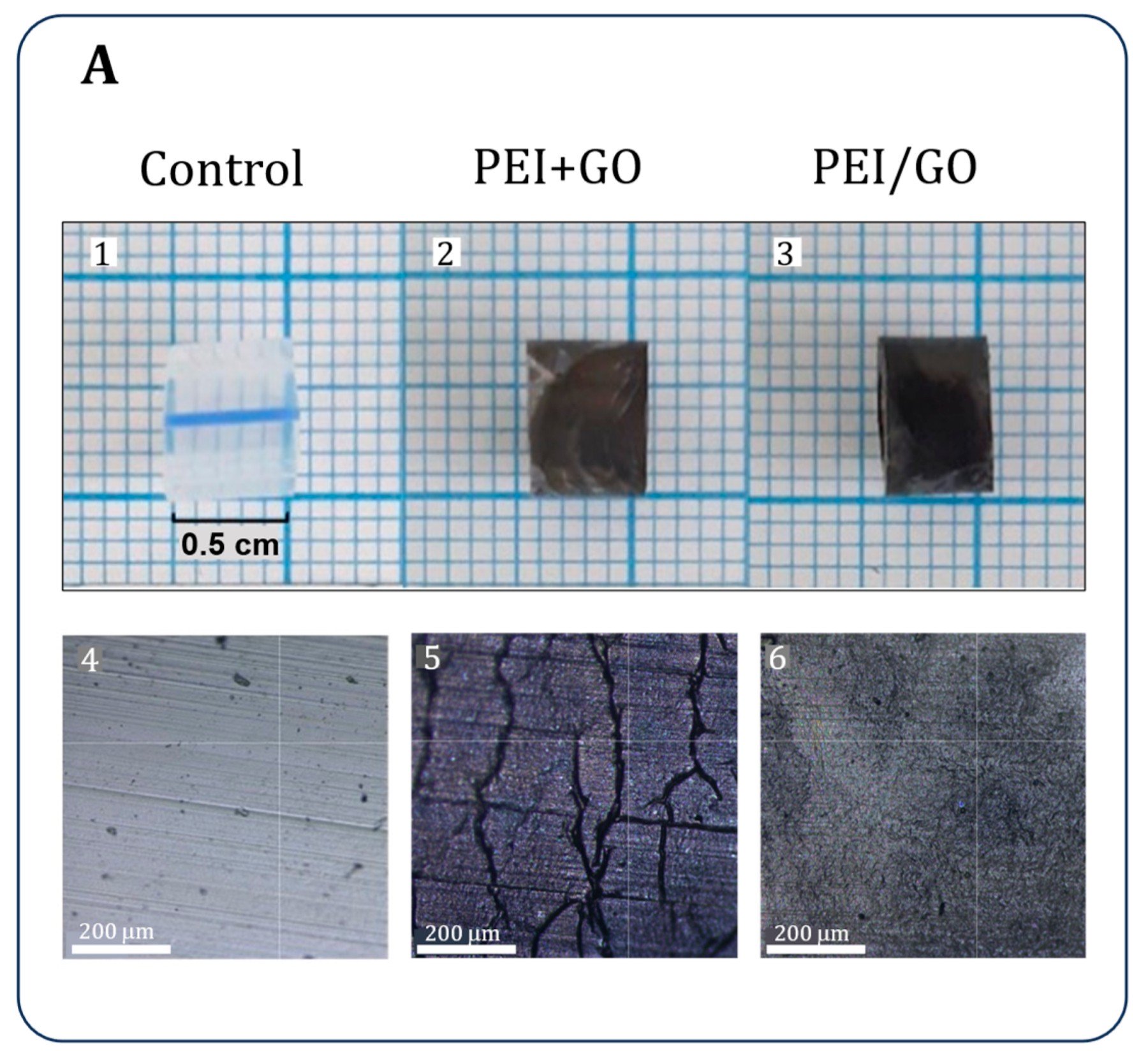
Uncoated and graphene oxide coated silicone urinary catheter segments, with optical microscopy of each surface (de América et al. 2026, Fig. 3A, cropped, CC BY 4.0)
Abhimanyu Photo
Written by
Abhimanyu Bhandankar
Holds an MBA from Schulich School of Business and a BE in IT. He joined Droplet Lab in July 2019 and now leads sales and marketing.
CEO at Droplet Lab
Read More
Gurdeep-Saini-Photo
Technical Review by
Gurdeep Singh Saini
Holds a BASc in Mechanical Engineering from Ryerson University (now Toronto Metropolitan University) and an MASc from York University. He develops the automatic edge and baseline detection behind the Dropometer's analysis.
COO at Droplet Lab
Read More
Abhimanyu Photo
Written By

Abhimanyu Bhandankar

CEO at Droplet Lab

Holds an MBA from Schulich School of Business and a BE in IT. He joined Droplet Lab in July 2019 and now leads sales and marketing.

Gurdeep-Saini-Photo
Reviewed By

Gurdeep Singh Saini

COO at Droplet Lab

Holds a BASc in Mechanical Engineering from Ryerson University (now Toronto Metropolitan University) and an MASc from York University. He develops the automatic edge and baseline detection behind the Dropometer's analysis.

Primary outcome: both coatings made the catheter surface clearly more hydrophilic

Water contact angle on silicone urinary catheter segments

Static sessile drop, 10 µl water, n = 5, as reported in de América et al., Bioengineering 13 (2026) 341

Uncoated silicone catheter 98.3 ± 1.0°
PEI+GO coating 76.4 ± 1.0°
PEI/GO coating 75.5 ± 1.0°

The uncoated silicone catheter read 98.3 ± 1.0°. The layered PEI+GO coating read 76.4 ± 1.0° and the embedded PEI/GO coating 75.5 ± 1.0°, a drop of more than 20° for both. The contact angles were measured after coating and before the antimicrobial peptides were loaded, so they describe the coating surfaces, not the antibacterial result.

22.8° drop

Largest change, uncoated to the PEI/GO coating (98.3° to 75.5°).

10 µl

Water drop volume on each catheter segment.

5 drops

Measurements per sample (n = 5).

6.7 mm

Outer diameter of the curved catheter segments measured.

Executive Summary

Who

Dr. Jacobo Hernández Montelongo's research group in the Department of Mathematical and Physical Sciences, Faculty of Engineering, at Universidad Católica de Temuco, Chile. The group works on biomaterials and antimicrobial coatings, combining experiments with molecular dynamics simulations.

Problem

Urinary catheters left in place can carry bacteria into the body. The group was developing graphene oxide and polyethylenimine (PEI) coatings that release antimicrobial peptides, and needed to confirm that each coating had changed the catheter surface, alongside microscopy, roughness and spectroscopy.

Solution

A Droplet Lab smartphone system with the contact angle, surface tension and surface energy apps, first ordered in 2020 on a national research grant. In 2022 Droplet Lab sent a do it yourself stage kit with 3D print files, and the group printed the parts in its own lab.

Time to Value

May 2020: first enquiry and order. November 2020: delivered to Chile after pandemic delays. 2022: support on surface energy methods, then a visit and a stage kit printed in the lab. 2023: software update. March 2026: paper published in Bioengineering.

Results

On curved silicone catheter segments 6.7 mm across, the water contact angle fell from 98.3 ± 1.0° uncoated to 76.4 ± 1.0° and 75.5 ± 1.0° for the two coatings, with 10 µl drops and n = 5. The paper, combining experiments and molecular dynamics, was published in Bioengineering in March 2026.

Highlights

98.3° to 75.5°

Water contact angle, uncoated to coated

n = 5

Measurements per sample

10 µl

Drop volume

2020

Customer since

Universidad Católica de Temuco, at a glance

Research focus

Biomaterials and antimicrobial coatings, combining experiments with molecular dynamics.

Products / applications

Antimicrobial peptide releasing coatings for silicone urinary catheters.

Measurement stage

Laboratory characterisation alongside microscopy, roughness, FTIR and Raman.

Users

Researchers and students in the group.

Materials and surfaces tested

Silicone urinary catheter segments, uncoated and with PEI+GO or PEI/GO coatings, with water.

Key constraints

Small, curved samples; a research grant budget; a supplier on another continent.

The challenge: proving a coating changed a small, curved catheter surface

An antimicrobial coating is only useful if it actually covers and changes the device surface.

Why catheter coatings matter

Urinary catheters left in place for days can let bacteria reach the body, and catheter associated urinary tract infections are a large share of hospital infections. Coatings that release antimicrobial peptides are one way to fight them.

Why the surface has to change

A graphene oxide coating only works if it covers the silicone and holds the peptides. Water contact angle is a quick check that the surface chemistry really changed after coating.

Why these samples are hard

The samples were 0.5 cm pieces cut from a catheter 6.7 mm across, so every drop sits on a small, curved surface rather than a flat coupon.

What success would require

Repeatable drops of the same volume on every sample, measured on the real device material, at a cost a university research group could fund.

The insight: a quick wetting check on the real device shows whether the coating took

What Was Deployed

Delivered configuration: a smartphone with Droplet Lab's contact angle, surface tension and surface energy apps (2020), later with a replacement phone, a software update and a do it yourself stage kit whose parts the group 3D printed in its lab (2022 and 2023).

In the published study, the group placed 10 µl water drops on 0.5 cm segments cut from a silicone urinary catheter, before and after coating, and measured the static contact angle five times per sample. The paper describes the instrument as “a Droplet Lab system (Brampton, ON, Canada)”.

The Origin

From reading a paper to publishing one

In May 2020 Dr. Hernández Montelongo contacted Droplet Lab after reading its paper on contact angle measurement with a smartphone. He ordered the contact angle, surface tension and surface energy apps on a smartphone, funded by a national research grant. The pandemic held up parcels to Chile, and the system arrived in November 2020. In 2022 Droplet Lab's engineers advised the group on surface energy methods, and that November Droplet Lab visited Temuco and met the group and other professors. Droplet Lab also sent a do it yourself stage kit, a simplified version of its flagship instrument, and the group printed the parts in its own lab. After a software update and quick help with app activation in 2023, the group used the system in its study of antimicrobial catheter coatings, published in Bioengineering in March 2026. Watch the customer story video.

Before vs After

Metric Before After
Water contact angle, PEI+GO coating 98.3 ± 1.0° (uncoated silicone) 76.4 ± 1.0°
Water contact angle, PEI/GO coating 98.3 ± 1.0° (uncoated silicone) 75.5 ± 1.0°
Sample stage Smartphone apps only (2020) Stage from Droplet Lab's kit, 3D printed in the group's lab (2022)

Rollout timeline

Timeline (high level)

May to November 2020: Order and delivery

  • Enquiry after reading Droplet Lab's smartphone contact angle paper
  • Ordered on a research grant
  • Delivered in November after pandemic shipping delays

2022: Methods support

Droplet Lab engineers advised on surface energy methods and probe liquids

November 2022: Visit and stage kit

  • Droplet Lab visited Temuco and met the group
  • Do it yourself stage kit sent; parts 3D printed in the lab
  • Replacement phone shipped

2023: Software

Software update and app activation fixes

March 2026: Published

Antimicrobial catheter coating study in Bioengineering

Proof and validation: what the paper shows, and what it does not

Test method

Static sessile drop, 10 µl water, on 0.5 cm segments (6.7 mm outer diameter) cut from a 20 Fr silicone Foley urinary catheter, plasma treated and coated with PEI+GO or PEI/GO and cured at 120 °C. Measured with a Droplet Lab system.

Sample size and operators

Five measurements per sample (n = 5), by researchers in the group.

Repeatability / reproducibility

Reported as ± 1.0° for all three samples. The paper does not state whether this is a standard deviation or a standard error.

Notes / assumptions

Source: A. de América, M. J. Fritte, P. Alarcón, K. Mena-Ulecia, G. Recio-Sánchez, K. Rischka, M. R. D. Silva, M. S. Dias, C. M. Maroneze, C. de Carvalho Castro Silva, J. Hernandez-Montelongo, “A Mechanistic, Architecture-Dependent Study Combining Experiments and Molecular Dynamics to Explain AMP Release from GO–PEI Coatings”, Bioengineering 13 (2026) 341, doi:10.3390/bioengineering13030341, CC BY. Contact angle was one of several characterisation methods. It was measured before peptide loading, so it shows the coating surfaces changed; the antibacterial results come from agar diffusion assays.

Outcomes to date

Measured Outcomes

76.4°

Layered PEI+GO coating

Down from 98.3° on uncoated silicone, ± 1.0°, n = 5 (de América et al., Bioengineering 13 (2026) 341).

75.5°

Embedded PEI/GO coating

A similar drop, confirming both coating routes changed the surface.

98.3°

Uncoated silicone catheter

The baseline for a hydrophobic medical grade silicone surface.

Operational Outcomes

Published output

Contact angle data in a 2026 Bioengineering paper, open access under CC BY.

Stage made in house

The group printed its own stage from Droplet Lab's kit.

Supported from abroad

Remote support, a visit and replacement parts delivered to Chile.

Financial Context

Grant funded, with the stage made in house

This page does not show prices. The group bought the smartphone system directly from Droplet Lab with research grant funding, and later printed its own stage from Droplet Lab's kit.

Purchase · direct

Bought directly from Droplet Lab in 2020.

Funding · research grant

Funded by a national research grant.

Output · 1 paper

Bioengineering, 2026.

Instrument pricing is available on request.

What's next

Delivered

Antimicrobial catheter coating study (Bioengineering, 2026)
Stage printed in the lab from Droplet Lab's kit (2022)

Next Step

Coating a medical device and need to show the surface changed?

Droplet Lab's systems measure water contact angle on real device parts, including small curved samples, and add surface tension and surface energy on the same phone. The drop shape method is validated against a KRUSS DSA100E in peer review. Book a 15 minute demo and bring a coated and an uncoated part.