
Surface science explainer
Why Water Forms Droplets in Oil but Oil Spreads on Water
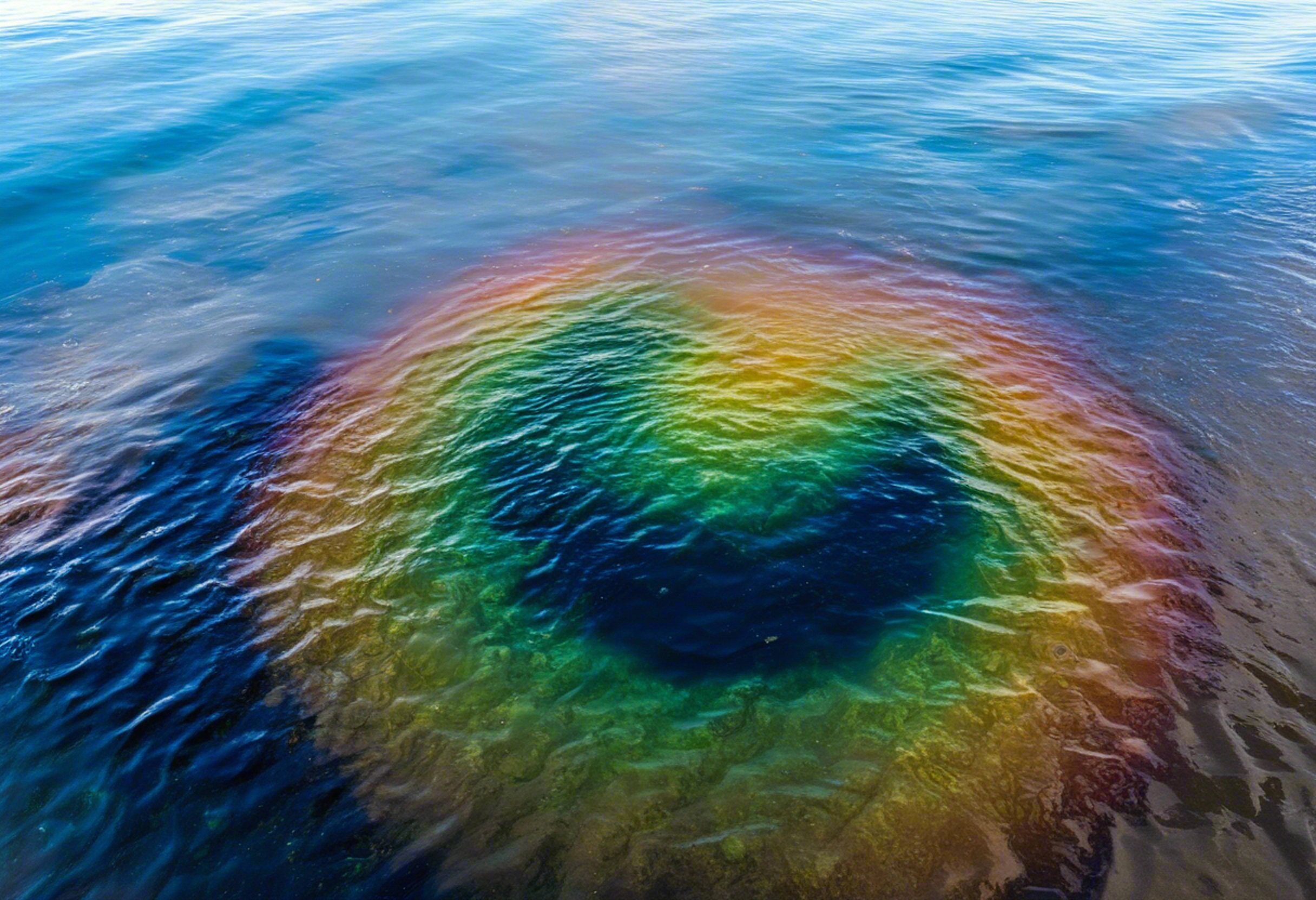
Water dropped into oil pulls itself into spheres because the oil and water interface costs energy, measured as interfacial tension. Whether an oil spreads across a water surface depends on the spreading coefficient: benzene initially spreads into a film, while heavier alkanes such as hexadecane stay as lenses (Harkins and Feldman, 1922; Adamson and Gast, 1997).


Droplet Lab Team
Droplet Lab builds precision instruments and software for surface science measurement, specialising in contact angle analysis and surface tension characterisation. Used by researchers across materials science, pharmaceuticals, coatings, and advanced manufacturing, Droplet Lab's Dropometer has contributed to studies published in peer-reviewed journals including Advanced Functional Materials (Impact Factor 19). The team combines instrument engineering with deep domain knowledge in wettability science with a focus on practical accuracy.
Why does water form droplets in oil?
Short answer: water and oil do not like sharing a boundary. Every square metre of oil and water interface costs energy, so water inside oil shrinks its contact area by forming round droplets.
That cost is the interfacial tension. For benzene against water it is about 35 mN/m (Adamson and Gast, 1997), and for alkane oils it is higher still.
What is interfacial tension?
Interfacial tension is surface tension at the boundary between two liquids that do not mix. Water molecules at the boundary lose hydrogen bonds they cannot replace with oil molecules.
The higher the interfacial tension, the more strongly droplets pull into spheres and the more energy it takes to break them into smaller ones. The surface tension measurement guide covers how it is measured, and the ASTM D971 summary describes a ring method for insulating oils against water.
When does oil spread across a water surface?
An oil drop on water feels three tensions: water and air, oil and air, and oil and water. If water's surface tension is bigger than the other two combined, the spreading coefficient is positive and the oil spreads (Harkins and Feldman, 1922).
For benzene on clean water the initial spreading coefficient is about +8.9 mN/m, so it races out into a film (Adamson and Gast, 1997). For hexadecane the coefficient is negative, so it sits as a floating lens.
Spreading can also change with time. As the two liquids saturate each other, the tensions shift and some spread films pull back into lenses (Adamson and Gast, 1997).
What decides whether you get oil-in-water or water-in-oil emulsions?
Shaking oil and water together makes droplets of one inside the other, but they soon merge again. Surfactants slow this down by lowering interfacial tension and coating the droplets.
Bancroft's rule says the liquid in which the surfactant dissolves better becomes the continuous phase (Bancroft, 1913). Water soluble surfactants tend to give oil-in-water emulsions, and oil soluble ones tend to give water-in-oil emulsions. Milk is a natural oil-in-water emulsion; butter is a water-in-oil one.
See the emulsion stability use case and two customer studies: a fluorophilic copolymer surfactant for complex emulsion droplets and flow and clogging of capillary droplets.
Expert Quote
The critical micelle concentration is not a number you look up; it is where the surface-tension curve flattens, and the only honest way to know it is to measure it.

How do you measure oil and water interfacial tension?
The pendant drop method hangs a drop of the denser liquid inside the lighter one, or holds a rising oil drop on an upturned needle in water. The drop shape and the density difference give the interfacial tension.
Ring and plate methods measure the force needed to pull a probe through the interface. For surfactant work, measure tension against concentration to find the critical micelle concentration, as in the CMC assessment use case.
Where can you go deeper?
These pages cover the methods, standards and data behind this post.
- Case study: University lab: emulsion interfacial tension
- Buying guide: Best Tensiometer for Surfactant and CMC Research
- Glossary: Interfacial tension (IFT)
- Classroom experiment: Exp 10: Oil/water interfacial tension
- Open dataset: Surface Tension of Common Liquids
- Related post: The Ultimate Guide to Understanding Surfactants
- Related post: Why Oil Spreads and Water Beads
- Related post: Surface Tension vs Surface Energy: What Is the Difference?
Measure interfacial tension with a pendant drop
See oil and water interfacial tension measured from a single drop image, in a short call.
Frequently Asked Questions
Why don't oil and water mix?
Water molecules bond strongly to each other through hydrogen bonds and cannot form those bonds with oil. Mixing would break bonds without replacing them, so the liquids separate.
What is a spreading coefficient?
It is water's surface tension minus the sum of the oil's surface tension and the oil and water interfacial tension. Positive means the oil spreads; negative means it forms a lens (Harkins and Feldman, 1922).
Why does dish soap break up oil?
Soap lowers the oil and water interfacial tension and coats oil droplets, so they can be broken up and kept apart in the water.
Which forms, oil-in-water or water-in-oil?
As a rule of thumb, the liquid in which the surfactant dissolves better becomes the continuous phase (Bancroft, 1913).