“
Surface tension versus concentration is one of the few measurements that lets you watch a surfactant reorganise an interface in real time: read the curve, not just the endpoint.

EN 14370 measures the static surface tension of liquids, mainly surfactant solutions, with a plate, a stirrup or a ring on a force tensiometer. The Dropometer is partially compliant: it measures the same property by pendant drop with ±0.03 mN/m accuracy (Dropometer datasheet). Pendant drop is an alternative method, not the plate, stirrup or ring method the standard specifies; if a contract or customer requires an EN 14370 result, run a correlation study on your own samples first.
What brings you here?
Quality manager
You need a surface tension number per lot that you can trend. A pendant drop read at a steady value gives you that, beside the plate or ring results your customers ask for.
R&D
You need to rank surfactants, find the CMC and see how fast each one settles at the surface. Use the decision tree to pick the method for each question.
Lab manager
You report to EN 14370 on a force tensiometer. Pendant drop adds small samples and dynamic readings. Keep your tensiometer for reported EN 14370 values until a correlation study supports pendant drop.
Free one page checklist for static surface tension by pendant drop beside EN 14370: what to prepare, the settings to lock, how to judge a steady reading and what to record. Made for surfactant QC and formulation labs.
Talk to an expert
Tell us your surfactant, its concentration and how you test it today. We will read its static surface tension live by pendant drop and tell you plainly where the Dropometer fits beside your plate or ring tensiometer and where it does not.


Droplet Lab builds precision instruments and software for surface science measurement, specialising in contact angle analysis and surface tension characterisation. Used by researchers across materials science, pharmaceuticals, coatings, and advanced manufacturing, Droplet Lab's Dropometer has contributed to studies published in peer-reviewed journals including Advanced Functional Materials (Impact Factor 19). The team combines instrument engineering with deep domain knowledge in wettability science with a focus on practical accuracy.
EN 14370:2004, Surface active agents, Determination of surface tension, from CEN/TC 276 (secretariat AFNOR). National versions include BS EN 14370:2004 and DIN EN 14370:2004-11, which replaced DIN 53914 in Germany. It covers static surface tension with a plate, a stirrup or a ring.
Partially compliant. The Dropometer gets the end result EN 14370 is after, the static surface tension of the liquid, by pendant drop. Pendant drop is an alternative method, not the plate, stirrup or ring method the standard specifies. If a contract or customer requires an EN 14370 result, run a correlation study on your own samples first.
Pendant drop surface tension up to 75 mN/m, accuracy ±0.03 mN/m, resolution 0.01 mN/m, static and dynamic, from the Dropometer product specification.
The drop shape method is validated against a KRUSS DSA100E in two peer reviewed papers. See our validation publications.
Researchers used a Droplet Lab pendant drop tensiometer to measure the surface tension of cationic polymer and anionic surfactant mixtures across a range of surfactant concentrations (Fluids, 2025). Read our analysis of the paper.
Static surface tension shows how far a surfactant lowers the tension of a liquid at rest. It does not predict foaming, cleaning or emulsion performance on its own. Pair it with the test your product needs.
What this standard measures, who uses it and how the Dropometer fits
EN 14370 measures the static surface tension of liquids against air, mainly solutions of surface active agents, from the force on a plate, a stirrup or a ring. Surfactant producers, detergent and personal care formulators and chemical QC labs in Europe use it to compare products and check lots. The Dropometer is partially compliant: it gets the same end result, surface tension, by pendant drop with ±0.03 mN/m accuracy (Dropometer datasheet). Pendant drop is an alternative method, not the plate, stirrup or ring method the standard specifies; if a contract or customer requires an EN 14370 result, run a correlation study on your own samples first.
The standard reads a static value. A plate stays still at the surface and gives an equilibrium value. A stirrup or ring is pulled slowly through the surface, a quasi static reading. Its sister standard EN 14210 uses a stirrup or ring for a different quantity: the tension between a surfactant solution and a second liquid. A common reason to read surface tension at several concentrations is the critical micelle concentration (CMC), as in CMC assessment and surfactant efficiency. To sense check your values, see CMC reference values for common surfactants.
The Dropometer pendant drop tensiometer reads surface tension up to 75 mN/m, static or dynamic, from one hanging drop. A university rheology lab uses the Dropometer for pendant drop surface tension, and researchers used it to measure the surface activity of cationic polymer and anionic surfactant mixtures. For background, read the chemicals guide, the surface tension measurement guide and our guide to understanding surfactants.
Further reading: reproducible surface tension measurement, choosing a tensiometer for surfactant and CMC research and a classroom experiment on how surfactants change surface tension.
Static surface tension of a surfactant solution by pendant drop, step by step, in our own words
These steps describe a pendant drop reading of the static surface tension EN 14370 is after. They are not the plate, stirrup or ring procedure of the standard and do not replace it. Buy the current edition and follow it for any result you report to EN 14370.
From the Dropometer product specification. Resolution is 0.01 mN/m, range up to 75 mN/m.
A hanging drop from the needle, not a vessel of liquid for a plate or ring.
Base plate, phone holder, LED and syringe. No PC needed.
Make up each solution in glassware cleaned with a solvent and rinsed with double distilled water, as EN 14370 describes for its vessels. Let the solution settle and reach room temperature. Note its density, because the pendant drop fit needs it.
Level the base plate, mount the phone and LED, and fit a clean needle. Hang a drop of pure water and compare the reading with the reference value for your room temperature before you test any surfactant.
Fill a clean syringe with the solution, free of air bubbles, and enter its density. Form a pendant drop large enough to show a clear neck, and keep the size similar for every drop.
EN 14370 is after a static value. Surfactant takes time to reach a fresh surface, so follow the drop in dynamic mode until the reading stops falling, then fix that drop age for every drop. Keep the air still so the drop does not dry.
The software fits the Young-Laplace equation to the drop profile, and automatic edge detection gives the same reading from the same image. Use a fresh drop for each reading. Reject drops with bubbles, a poor fit or a near round shape.
Record mean and spread, concentration, density, drop age and room temperature. Label the result as pendant drop, an alternative method to the EN 14370 plate, stirrup or ring. Compare it with limits from your own correlation study and bench practice.
This video shows a complete Dropometer pendant drop surface tension measurement, from setup to result. It covers the steps above in one run.
Independent benchmarking and publication-based validation references.
Peer reviewed method
The Dropometer drop shape method is validated against a KRUSS DSA100E in two peer reviewed papers, one in Review of Scientific Instruments and one in Colloids and Surfaces A. Published surface tension accuracy is ±0.03 mN/m (Dropometer product specification).
Customer evidence
Researchers measured the surface tension of cationic polymer and anionic surfactant mixtures with a Droplet Lab pendant drop tensiometer, published in Fluids in 2025. We have no published client study run to EN 14370 itself.
EN 14370 · static surface tension · surfactant QC
EN 14370 prepares the tensiometer by cleaning, levelling and zeroing it, and cleans glassware with a solvent and double distilled water (source: EN 14370 preview, clauses 4 and 5). For the Dropometer, check the setup with a pendant drop of pure water. The reference value is 72.74 mN/m at 20 °C and 71.97 mN/m at 25 °C (source: IAPWS R1-76(2014)). Water reads about 0.15 mN/m lower for each degree warmer (same source), so record room temperature.
EN 14370 is a test method. It sets no pass or fail value: your product specification or your customer does. Plate, ring and pendant drop values on surfactant solutions can differ, because each method reads the surface in a different way and at a different age. Pendant drop is an alternative method, not the plate, stirrup or ring method the standard specifies.
If you work to an EN 14370 limit, run a correlation study. Measure the same lots on your plate or ring tensiometer and on the Dropometer, at the same temperature, with both read at a steady value. Then set your pendant drop limits from that data. Repeat the study when you change surfactant family, concentration or solvent. See reproducible surface tension measurement for bench practice.
Example data for illustration only. These are not measured results. Your own surfactant, water quality, temperature and limits decide the numbers.
| Sample | Drops (n) | Static surface tension at 180 s (mN/m) | Std dev (mN/m) | Decision |
|---|---|---|---|---|
| Water check, 23 °C | 5 | 72.3 | 0.1 | Matches reference value: run the lots |
| Nonionic surfactant, lot A | 5 | 32.4 | 0.2 | Accept |
| Nonionic surfactant, lot B | 5 | 32.6 | 0.2 | Accept |
| Nonionic surfactant, lot C | 5 | 35.9 | 0.3 | Above band: check active content, confirm by plate |
Each row is the mean of five fresh pendant drops in a room at 23 °C. Each drop was read until its value changed by 0.2 mN/m or less over the last 60 s, which here took 180 s. The decision column uses an example accept band of 31.5 to 33.5 mN/m, set from a correlation study against the plate method. The water row checks the setup: the IAPWS value at 23 °C is about 72.3 mN/m.
The same three example lots as the table, read over drop age until the value settles, against an example accept band. The water check is left out of the chart.
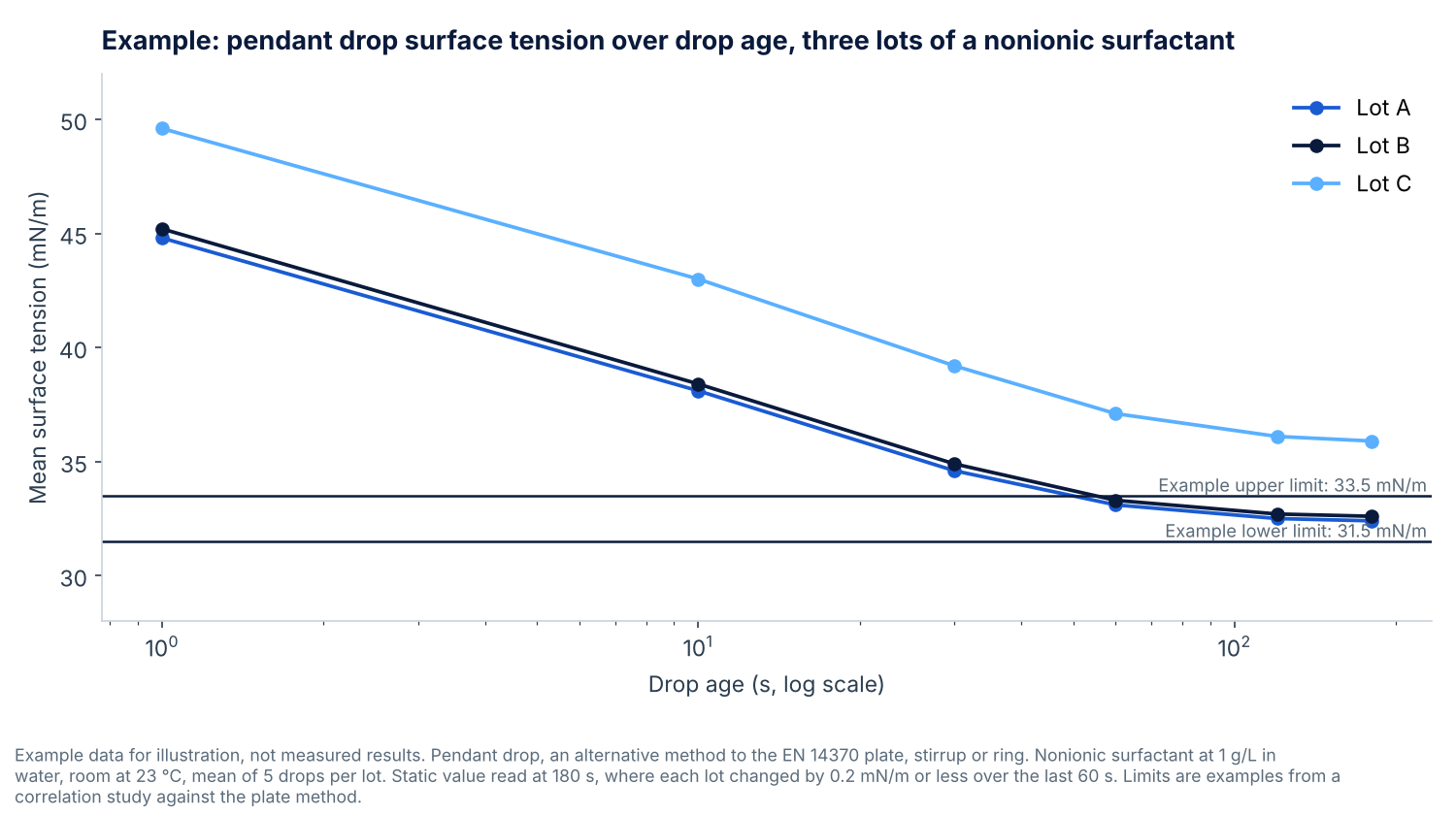
Example data, not measured results.
What changes when pendant drop sits next to your plate or ring tensiometer
| Metric | Before Dropometer | With Dropometer | Results |
|---|---|---|---|
| Sample per reading | A glass vessel at least 45 mm across for the plate, stirrup or ring | One hanging drop from the needle | EN 14370 apparatus clause; no published benchmark for drop volume |
| Result format | Force on the plate, stirrup or ring, converted to mN/m | Surface tension from the drop shape, 0.01 mN/m resolution, ±0.03 mN/m accuracy | Dropometer product specification |
| Surface age | One static or quasi static value | Dynamic reading over drop age from about 0.1 s, then a steady value | Dropometer product specification, 10 frames per second |
| Reported EN 14370 value | Plate, stirrup or ring tensiometer | Still needs the force tensiometer, or a correlation study first | EN 14370 scope |
Bring a lot that passed and one that did not. We will read both live by pendant drop and compare them with your plate or ring results.
Enter your own numbers. The defaults are examples, not Droplet Lab results.
Quality cost snapshot
Result
Annual exposure combines audit/CAPA cost, customer rejections, and recall probability; avoided exposure applies the risk reduction percentage.
Lock these before you compare pendant drop results with plate or ring results
| Parameter | Recommended Setting | Technical Rationale |
|---|---|---|
| Method | Pendant drop; label the result as pendant drop | EN 14370 specifies a plate, stirrup or ring on a force tensiometer. Pendant drop is an alternative method. |
| Reading | Static value: read once the drop has settled | The standard is after static surface tension. Surfactant solutions keep falling until the surface reaches equilibrium. |
| Drop age | Fixed for every drop, set from a dynamic run | A value read too early sits above the static value and varies between drops. |
| Liquid density | Entered for each solution | The Young-Laplace fit needs the density difference between the drop and the air. |
| Fit model | Young-Laplace | The pendant drop fit in the Dropometer software. |
| Replicates | Several fresh drops per sample | Report the mean and spread, as you would for plate or ring readings. |
| Cleaning | Solvent clean, rinse with pure water; rinse the needle between samples | Trace surfactant left on glass or the needle lowers the next reading. |
| Environment | Record room temperature; condition samples first | The Dropometer has no temperature control and runs at 10 to 45 °C. |
Pick the method by the question you need answered
Start: What do you need to know about your surfactant solution?
You want a surface tension value per lot or per formulation to trend or rank.
Use pendant drop on the Dropometer, read at a steady value. It measures the same property by an alternative method. Set limits from a correlation study against your plate or ring.
Your customer, specification or tender names EN 14370.
Pendant drop is an alternative method, not the plate, stirrup or ring method the standard specifies. Use a force tensiometer to EN 14370, or run a correlation study on your own samples first.
You need the tension between a surfactant solution and a second liquid, not against air.
That is EN 14210, by stirrup or ring. The Dropometer measures interfacial tension by pendant drop with the optional cuvette, an alternative method with no published accuracy figure, so correlate first.
You want the concentration where surface tension stops falling.
Run a pendant drop series on the Dropometer. For a standard CMC method, see ISO 4311, which uses a plate, stirrup or ring.
Start from the question you need answered. Blue boxes are the measurements the Dropometer runs: pendant drop surface tension, a pendant drop CMC series, and the tension between two liquids with the optional cuvette. A result reported to EN 14370 needs a plate, stirrup or ring tensiometer, or a correlation study first.
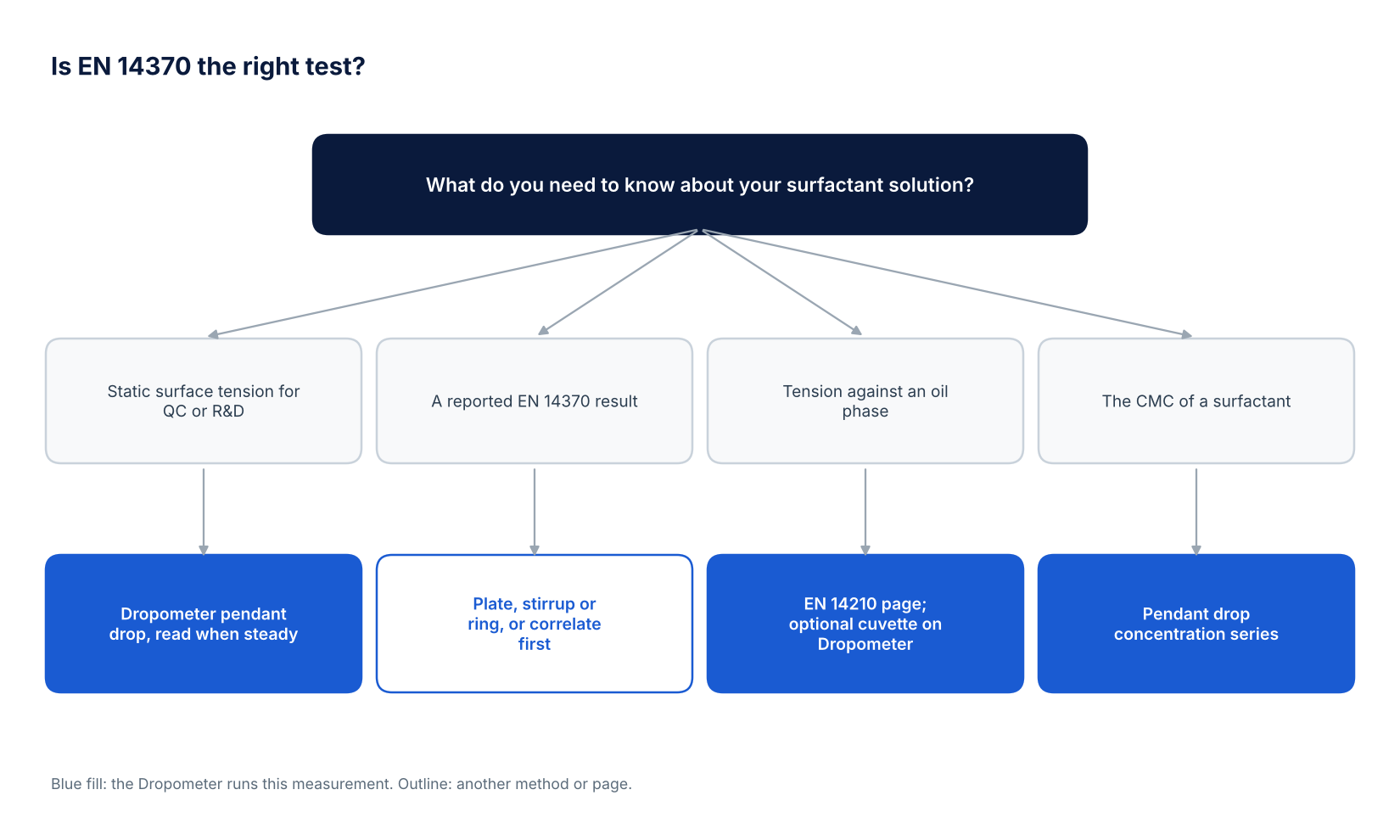
Is EN 14370 the right test?
What a static surface tension value tells you, and what it does not
Honest limits of the method and of the Dropometer
It measures the static surface tension of liquids against air, mainly solutions of surface active agents, and also other organic and inorganic liquids. A force tensiometer reads the pull on a plate that touches the surface, or on a stirrup or ring drawn slowly out of it, and converts that force to surface tension.
EN 14370 measures surface tension: the solution against air, with a plate, stirrup or ring. EN 14210 measures interfacial tension: the solution against a second liquid that does not mix with it, by stirrup or ring; the standard's scope covers 4 to 50 mN/m. Both come from CEN/TC 276. On the Dropometer, surface tension runs on the base kit, and interfacial tension runs by pendant drop with the optional cuvette.
It gets the same end result by a different method, so it is partially compliant. It measures static surface tension by pendant drop with ±0.03 mN/m accuracy (Dropometer datasheet). Pendant drop is an alternative method, not the plate, stirrup or ring method the standard specifies; if a contract or customer requires an EN 14370 result, run a correlation study on your own samples first.
The plate stays still at the surface and gives an equilibrium value. The stirrup and ring are pulled slowly through the surface, a quasi static reading, so slow steps keep them close to equilibrium. Follow the probe your customer or specification names, and buy the current edition for the full procedure.
Not automatically. Each method reads the surface in a different way and at a different surface age, and that matters for surfactant solutions. Measure the same lots by both methods at the same temperature, read at a steady value, then set your limits from that correlation study.
The public preview says no thermostat is needed for a test at room temperature, and that the vessel should allow temperature control when you test at another temperature. The Dropometer has no temperature control and runs at 10 to 45 °C, so record room temperature with each result. Water surface tension falls about 0.15 mN/m per degree (source: IAPWS R1-76(2014)).
Yes. EN 14370:2004 is listed as current by BSI as BS EN 14370:2004 and by DIN as DIN EN 14370:2004-11, which replaced DIN 53914 in Germany. Check with your national standards body before you write a procedure.





















This page summarises EN 14370 in our own words and does not reproduce the standard. Buy the current edition from CEN or your national standards body before you write a procedure. The Dropometer is partially compliant: pendant drop is an alternative method, not the plate, stirrup or ring method the standard specifies. If a contract or customer requires an EN 14370 result, run a correlation study on your own samples first. Droplet Lab does not certify compliance. Your own method validation does.
Sources, review and tools
BSI listing: BS EN 14370:2004, Surface active agents, Determination of surface tension; DIN Media listing: DIN EN 14370:2004-11 (replaces DIN 53914:1997-07); iTeh catalogue: EN 14370:2004 (CEN/TC 276, scope); SIST EN 14370:2005 preview pages: foreword, scope, principle, apparatus, preparation, the Dropometer product specification and Droplet Lab validation papers.
Drafted with Claude (Anthropic) from the sources listed, then reviewed by Droplet Lab.
We did not copy text from the standard. Buy the current edition for the full procedure.
October 2026
Spotted an issue in this summary? Send a correction request and our team will review it.
Correction Request
We work hard to keep this page accurate and up to date. If you spot an error (wrong revision/year, missing requirement, incorrect interpretation, or broken link), tell us and we'll review it.
Contact us to report a correction