“
On a real surface, the receding angle from a sessile drop and from a tilted plate can disagree wildly: one method is not a substitute for the other. The application decides.

IPC-TM-650 is the IPC manual of test methods for printed boards and assemblies. Its cleanliness and coating methods measure ionic residue by ROSE (2.3.25) or ion chromatography (2.3.28), surface insulation resistance on comb patterns in humid heat (2.6.3.7), and solder mask and conformal coating adhesion and insulation (2.4.28.1, 2.6.3.4). The Dropometer measures none of these quantities, and no current TM-650 method measures contact angle or surface tension. It complements the workflow with a room temperature water contact angle on the board, which flags non ionic films such as silicone, rosin residue or handling oils. ROSE does not detect those films, and they are a common reason conformal coating dewets.
What brings you here?
Process engineer
Your boards pass ROSE, yet conformal coating still beads or dewets on some of them. A water contact angle against a reference board flags the non ionic film before you coat.
Lab manager
You run ROSE, ion chromatography and SIR to TM-650. Logging a contact angle next to those results gives you the data to set a gate for the coating line.
R&D
You need to see how a cleaner, flux or solder mask changes the surface a coating meets. Use the decision tree to see which question each method answers.
Free one page checklist for a water contact angle check next to IPC-TM-650 cleanliness and coating tests: what to prepare, which boards to keep water off, the settings to lock and what to record. Made for assembly cleaning and coating lines.
Talk to an expert
Tell us your solder mask, cleaning process, conformal coating and the TM-650 tests you run today. We will measure a reference board and a problem board live and tell you plainly where the Dropometer fits next to ROSE and SIR, and where it does not.


Droplet Lab builds precision instruments and software for surface science measurement, specialising in contact angle analysis and surface tension characterisation. Used by researchers across materials science, pharmaceuticals, coatings, and advanced manufacturing, Droplet Lab's Dropometer has contributed to studies published in peer-reviewed journals including Advanced Functional Materials (Impact Factor 19). The team combines instrument engineering with deep domain knowledge in wettability science with a focus on practical accuracy.
IPC-TM-650 Test Methods Manual, published by IPC as separate methods, each with its own revision. Methods on this page: 2.3.25D ROSE (November 2012), 2.3.28B ion chromatography (November 2012), 2.3.28.2 bare board cleanliness by ion chromatography (December 2009), 2.6.3.7 surface insulation resistance (March 2007), 2.6.3.5 bare board cleanliness by SIR (January 2004), 2.6.3.4A conformal coating moisture and insulation resistance (July 2003) and 2.4.28.1F solder mask tape adhesion (March 2007). See the IPC test methods listing.
Complements workflow. The Dropometer measures none of the quantities these TM-650 methods report: extract resistivity, ion content, insulation resistance or mask removed by tape. No current TM-650 method measures contact angle or surface tension. The Dropometer adds a water contact angle check for non ionic films before coating.
Contact angle range 10° to 175°, accuracy ±0.35°, display resolution 0.01°, from the Dropometer product specification.
The drop shape method is validated against a KRUSS DSA100E in two peer reviewed papers. See our validation publications.
A plating chemistry maker uses the Dropometer for contact angle and surface tension work. Read the case study. We have no published client study run alongside IPC-TM-650.
A water contact angle does not measure ionic cleanliness, insulation resistance or coating adhesion. Only the TM-650 tests do. Any link between an angle and those results comes from your own correlation study.
What this standard measures, who uses it and how the Dropometer fits
IPC-TM-650 is the IPC test methods manual for printed boards and assemblies; for cleanliness and coatings, its methods measure ionic residue, surface insulation resistance and coating adhesion, not wetting. Board fabricators, assemblers, cleaning chemistry and conformal coating suppliers, and test labs use these methods to qualify materials and control processes. The Dropometer complements this workflow. It measures none of the TM-650 quantities. It adds a water contact angle on the board surface before coating, which shows non ionic films that the ionic tests do not see.
IPC publishes each method as its own document with its own revision. The methods closest to cleanliness and coating are 2.3.25D (ROSE: the resistivity of an isopropanol and water extract, reported as µg NaCl equivalent per cm²), 2.3.28B and 2.3.28.2 (ion chromatography), 2.6.3.7 and 2.6.3.5 (surface insulation resistance on comb patterns), 2.6.3.4A (moisture and insulation resistance of conformal coating), 2.4.28.1F (solder mask tape adhesion) and 2.3.42 (solder mask resistance to solvents and cleaning agents). The surface organic contaminant detection test, 2.3.38C, is listed as cancelled. The TM-650 wetting methods, such as edge dip (2.4.12A) and the flux wetting balance (2.4.14.2A), use molten solder, which the Dropometer cannot test.
The gap the Dropometer fills is non ionic residue. TM-650 2.3.25D states that ROSE reads only ionic material dissolved in the extract. Silicone, rosin residue and handling oils lower the wettability of the board, so a conformal coating can bead up, dewet or show fisheyes. The Dropometer contact angle and surface energy kit reads the water contact angle on solder mask areas from 10° to 175° with ±0.35° accuracy, so you can compare each board with a reference board that coated well. The PCB surface prep use case covers this check for solder mask, conformal coating and cleanliness. A plating chemistry maker uses the Dropometer for contact angle and surface tension work. For background, read the telecommunications guide and the contact angle measurement guide.
Further reading: reproducible contact angle measurement, water contact angle reference values for common surfaces and choosing a contact angle goniometer for industrial QA.
A water contact angle check next to IPC-TM-650 cleanliness and coating tests, step by step
These steps describe a check on the Dropometer that sits before conformal coating and next to IPC-TM-650 tests. It is not part of any TM-650 method and does not replace ROSE, ion chromatography, SIR or a tape test. Download the current revision of each method from IPC and follow it for every result you report.
From the Dropometer product specification. Display resolution is 0.01°.
Base plate, phone holder, LED and syringe. No PC needed.
Room temperature checks only. No humidity chamber, no electrical test and no molten solder.
Choose a reference board that coated well and passed your TM-650 cleanliness tests, with the same solder mask and cleaning process. Keep water off any board or area that goes to ROSE, ion chromatography or SIR, because a drop dissolves ionic residue. Handle boards by the edges with clean gloves.
Place the base plate on a level bench, mount the phone and LED, and fill a clean syringe with deionised water. Check the setup on a reference surface you keep for this purpose before the first board.
Mark flat solder mask areas larger than the drop footprint, away from components, text and vias. Use the same positions on every board, because residue collects in some areas more than others, such as near through hole joints.
Dispense a fixed drop volume on each area without touching the board. Capture at the same time after placement for every drop. Automatic edge and baseline detection reads the left and right angles, so two operators get the same reading from the same image.
Compare each board mean with the reference and your gate. A rise above the gate points to silicone, rosin residue, oils or an incomplete rinse. Hold the board, check the cleaning step, then decide whether to coat. The PCB surface prep use case lists common causes.
Run the ROSE, ion chromatography, SIR or tape tests your specification names, each as the IPC-TM-650 method specifies. Log the contact angles next to each result and each coating outcome. Over time, that log is the correlation study that sets your gate.
This video shows a complete Dropometer contact angle measurement, from setup to result. It covers the steps above in one run.
Independent benchmarking and publication-based validation references.
Peer reviewed method
The Dropometer drop shape method is validated against a KRUSS DSA100E in two peer reviewed papers, one in Review of Scientific Instruments and one in Colloids and Surfaces A. Published contact angle accuracy is ±0.35° (Dropometer product specification).
Customer evidence
A plating chemistry maker uses the Dropometer for contact angle and surface tension work. We have no published client study run alongside IPC-TM-650, and no published data linking contact angle to TM-650 results.
IPC-TM-650 · cleanliness · conformal coating
No IPC-TM-650 method sets a water contact angle or surface energy limit for board cleanliness or coating readiness. The TM-650 methods report ionic residue, insulation resistance or tape adhesion, and the documents that call them up, such as your customer specification or IPC-CC-830 for conformal coating, set the pass criteria (source: IPC-TM-650 2.6.3.4A). So any contact angle gate comes from your own data.
Measure boards that coated well and passed your ROSE, ion chromatography or SIR checks, and boards that dewetted or failed. Use the same solder mask, cleaning process and drop positions for both groups. Set the gate from the gap between them, for example a maximum rise above the reference board. Repeat the study when you change solder mask, flux, cleaning chemistry, packaging or coating.
Some coating suppliers give a minimum dyne level before coating (source: HumiSeal on PCB surface energy). A contact angle relates to a dyne level only through your own correlation. For what a dyne level does and does not tell you about adhesion, read Beyond 38 Dynes.
Example data for illustration only. These are not measured results. Your own solder mask, cleaning process and correlation data decide the numbers.
| Board | Drops (n) | Mean angle (°) | Std dev (°) | Change vs reference (°) | Next step |
|---|---|---|---|---|---|
| Reference board (coated well) | 5 | 64.0 | 1.3 | 0.0 | Reference |
| Board B | 5 | 65.8 | 1.5 | +1.8 | Inside example gate: coat |
| Board C | 5 | 70.9 | 1.9 | +6.9 | Near gate: coat, note the reading, check the rinse |
| Board D | 5 | 81.6 | 2.4 | +17.6 | Above example gate: hold, check for silicone or oils |
Each row is the mean of five drops of deionised water on flat solder mask areas, read at the same time after placement, on boards kept out of ROSE and SIR testing. The example gate is the reference reading plus 8°, set from a correlation study against boards that coated well and boards that dewetted. In this example all four boards met the site's ROSE limit: the angle flags a non ionic film that ROSE does not see.
The same example data as the table, with the reference reading and the example gate marked.
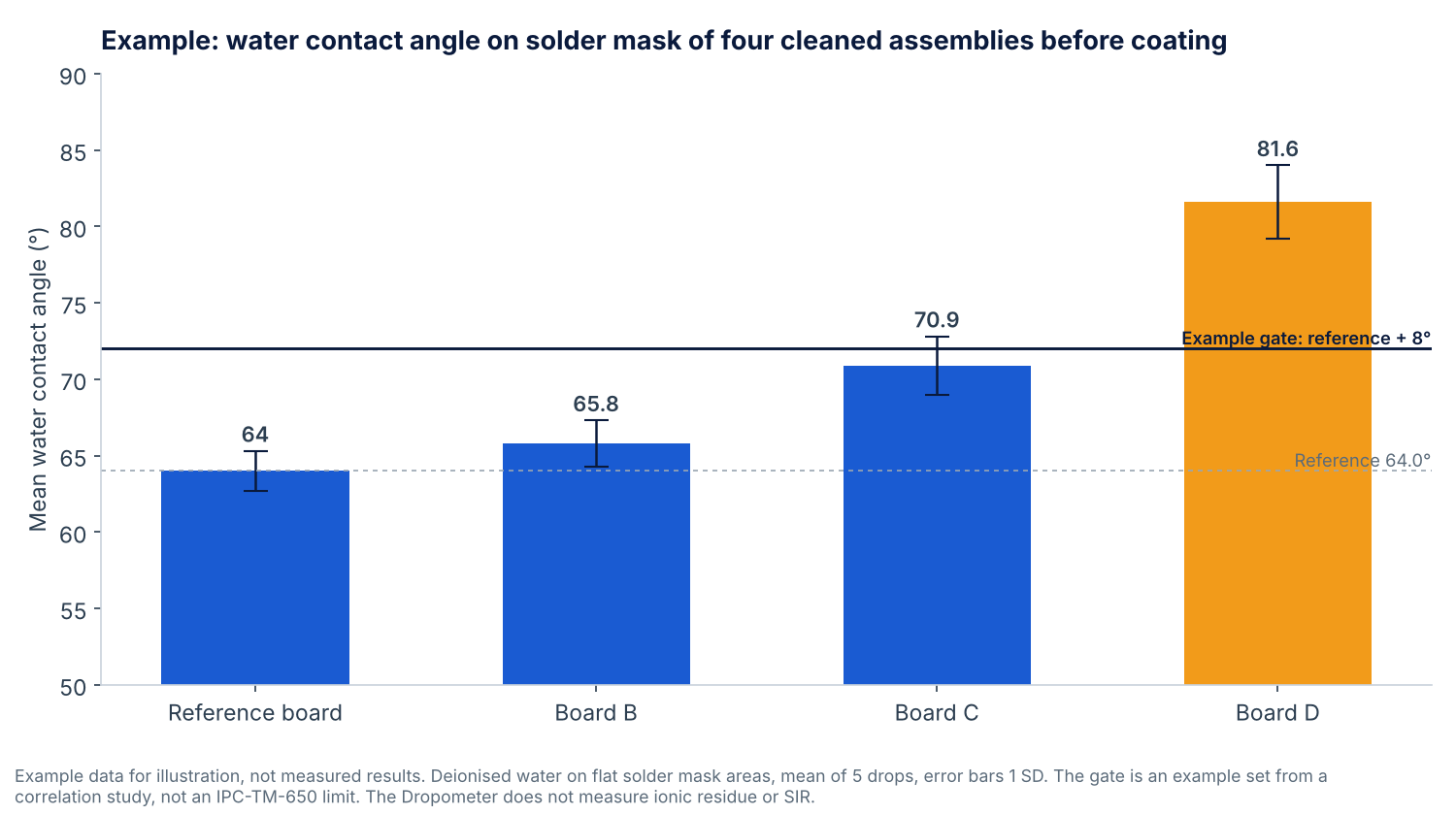
Example data, not measured results.
What changes when a contact angle check sits next to your TM-650 tests
| Metric | Before Dropometer | With Dropometer | Results |
|---|---|---|---|
| Non ionic residue such as silicone or oils | Not read by ROSE; found as dewetting after coating | Flagged by a water contact angle before coating | IPC-TM-650 2.3.25D scope; no published benchmark |
| Ionic cleanliness and SIR | ROSE, ion chromatography or SIR to TM-650 | Unchanged: still the TM-650 tests | IPC-TM-650 method scopes |
| Result format | Visual inspection of the cured coating | An angle per drop, ±0.35° accuracy, 0.01° display resolution | Dropometer product specification |
| Where it runs | Cleanliness lab, after the batch is coated | At the coating line, on battery for up to 8 h | Dropometer product specification |
Bring a board that coated well and one that dewetted. We will measure both live at room temperature.
Enter your own numbers. The defaults are examples, not Droplet Lab results.
Quality cost snapshot
Result
Annual exposure combines audit/CAPA cost, customer rejections, and recall probability; avoided exposure applies the risk reduction percentage.
Lock these before you compare readings between boards, shifts or sites
| Parameter | Recommended Setting | Technical Rationale |
|---|---|---|
| Role of the check | Before coating and next to TM-650 tests, never in place of them | The Dropometer measures none of the TM-650 quantities. |
| Specimen | Sibling board, or areas excluded from ROSE, ion chromatography and SIR | A water drop dissolves ionic residue and could change those results. |
| Test liquid | Deionised water | Water is most sensitive to hydrophobic films such as silicone and oils. |
| Drop volume | Fixed for every drop | A changing volume adds spread that is not about the surface. |
| Positions | The same mapped flat solder mask areas on every board | Residue varies across a board; the drop needs a flat area larger than itself. |
| Reading time | Fixed for every drop | Drops can spread or evaporate, so the time must not vary. |
| Fit model | Young-Laplace or polynomial, the same for every run | Both models are in the Dropometer software. Do not mix them within one study. |
| Environment | Record room temperature and humidity | The Dropometer runs at 10 to 45 °C and has no temperature or humidity control. |
Pick the method by the question you need answered
Start: What do you need to know about the board surface?
You need a number for ionic cleanliness for process control, or to know which ions are present.
Use ROSE to IPC-TM-650 2.3.25, or ion chromatography to 2.3.28 to identify the ions. The Dropometer does not run these tests.
You need reliability evidence for a flux, cleaning process or conformal coating.
Use surface insulation resistance to IPC-TM-650 2.6.3.7, or 2.6.3.4 for conformal coating. The Dropometer does not run these tests.
Coating beads, dewets or shows fisheyes, and ROSE still passes.
Use a water contact angle against a reference board on the Dropometer. See the PCB surface prep use case.
You are choosing a solder mask and coating pair, or a new cleaning chemistry.
Compare the solder mask surface free energy from two or three test liquids with the coating liquid's surface tension by pendant drop, both on the Dropometer. See ASTM D7490.
Start from the question you need answered. Blue boxes are measurements the Dropometer runs. The TM-650 tests themselves are not.
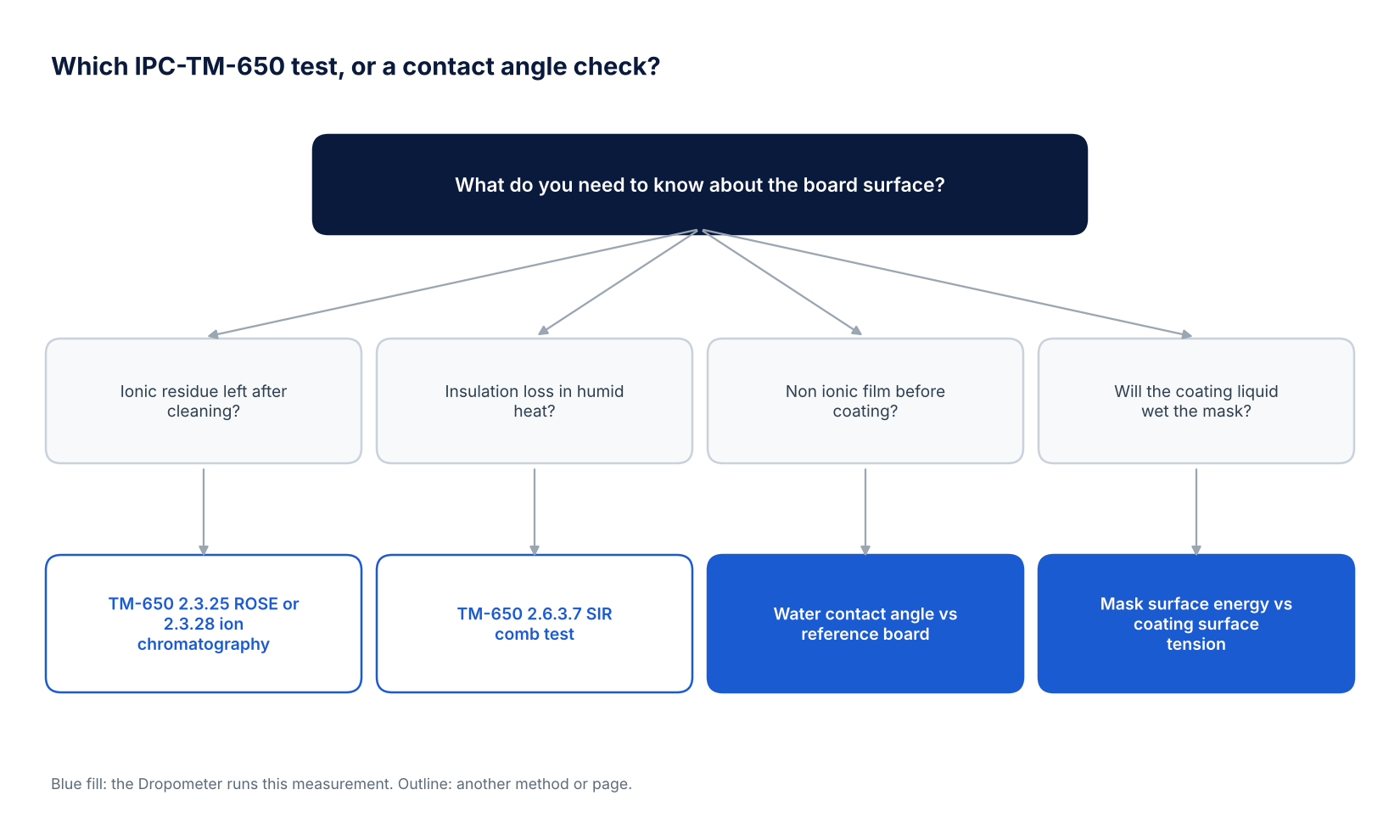
Which IPC-TM-650 test, or a contact angle check?
What the angle tells you, and what it does not
Honest limits of the check and of the Dropometer
It is the IPC test methods manual for printed boards, assemblies and their materials. IPC publishes each method as a separate document with its own number and revision, on its test methods page. Specifications such as IPC-CC-830 for conformal coating call up these methods and set the pass criteria.
ROSE (2.3.25 and 2.3.25.1) reads the resistivity of an isopropanol and water extract as µg NaCl equivalent per cm². Ion chromatography (2.3.28 and 2.3.28.2) identifies the ions. Surface insulation resistance (2.6.3.5 and 2.6.3.7) tests comb patterns under bias in humid heat. The surface organic contaminant detection test, 2.3.38, is listed as cancelled.
No. The Dropometer does not measure extract resistivity, ion content, insulation resistance or tape adhesion, and it cannot test molten solder. It complements the workflow with a water contact angle on the board before coating. That check flags non ionic films, such as silicone or oils, that ROSE does not read and that can make a conformal coating dewet.
Not in the current IPC listing. The TM-650 wetting methods, such as edge dip (2.4.12A), the flux wetting balance (2.4.14.2A), the solder paste wetting test (2.4.45) and the spread test (2.4.46A), all use molten solder. For room temperature checks before solderability testing, see our IPC J-STD-003 page.
ROSE reads only ionic material that dissolves into the extract, so non ionic films go unseen. Silicone, oils and some flux residues lower the surface energy of the board. A coating wets well only when the board's surface energy is higher than the coating's surface tension (source: HumiSeal on PCB surface energy). A higher water angle than your reference board is an early sign.
No IPC-TM-650 method sets one. Angles differ between solder mask products and cures, so compare each board with a reference board on the same mask that coated well. Set your gate from boards that coated well and boards that dewetted. If your line uses dyne pens, relate them to the angle only through your own data; see Beyond 38 Dynes.
This page summarises selected IPC-TM-650 methods in our own words and does not reproduce them. Download the current revision of each method from IPC before you write a procedure. The Dropometer complements the workflow: it measures water contact angle at room temperature and does not measure ionic residue, insulation resistance, tape adhesion or solder wetting. Droplet Lab does not certify compliance. Your own method validation does.
Sources, review and tools
IPC TM-650 Test Methods Manual listing (method numbers, titles, revision dates and status); IPC-TM-650 2.3.25D: Ionizable Surface Contaminants by ROSE; IPC-TM-650 2.6.3.7: Surface Insulation Resistance; IPC-TM-650 2.6.3.4A: Moisture and Insulation Resistance, Conformal Coating, the Dropometer product specification and Droplet Lab validation papers.
Drafted with Claude (Anthropic) from the sources listed, then reviewed by Droplet Lab.
We did not copy text from the standard. Buy the current edition for the full procedure.
October 2026
Spotted an issue in this summary? Send a correction request and our team will review it.
Correction Request
We work hard to keep this page accurate and up to date. If you spot an error (wrong revision/year, missing requirement, incorrect interpretation, or broken link), tell us and we'll review it.
Contact us to report a correction