“
What a liquid responds to is only the outermost few ångström of a surface: the skin, not the bulk. Change that skin and you change the wetting, even if the material underneath is identical.

Check how well corona treatment took on polymer film by reading the water contact angle, the measurement ASTM D5946 and ISO 15989 describe. A lower angle means a stronger treatment. The Dropometer runs this measurement at the line or in the lab, with ±0.35° accuracy (Dropometer product specification), on a drop shape method validated in two peer reviewed papers.
What brings you here?
Quality manager
You need a treatment check that gives a number, not a judgement call. The water contact angle gives you a value per drop that you can trend by roll and by shift.
Process engineer
You need to see treatment level across the web and after storage. Measure several positions, record the treatment date, and set limits from your own film.
R&D
You need to know whether water contact angle is enough, or whether you also need surface free energy. Use the decision tree to pick the method.
Free one page checklist for ASTM D5946 / ISO 15989: what to prepare, the settings to lock, how many drops to place and what to record. Made for film QC benches.
Talk to an expert
Tell us your film, treater and current check. We will show the measurement live and tell you plainly where the Dropometer fits your QC plan and where it does not.


Droplet Lab builds precision instruments and software for surface science measurement, specialising in contact angle analysis and surface tension characterisation. Used by researchers across materials science, pharmaceuticals, coatings, and advanced manufacturing, Droplet Lab's Dropometer has contributed to studies published in peer-reviewed journals including Advanced Functional Materials (Impact Factor 19). The team combines instrument engineering with deep domain knowledge in wettability science with a focus on practical accuracy.
ASTM D5946-24, Standard Test Method for Corona-Treated Polymer Films Using Water Contact Angle Measurements, from ASTM Subcommittee D20.19. ASTM states it is identical to ISO 15989:2004. Corona treatment is an electrical discharge treatment, one of several surface treating techniques used on polyolefins and other polymer films to increase the wetting tension, so that inks, coatings and adhesives wet and hold.
Fully compliant. The Dropometer measures the static water contact angle on the treated film, which is what this method reads.
Contact angle range 10° to 175°, accuracy ±0.35°, display resolution 0.01°, from the Dropometer product specification.
The drop shape method is validated against a KRUSS DSA100E in two peer reviewed papers. See our validation publications.
A labels and office products manufacturer uses the Dropometer to see how inks and adhesives wet film, paper, board and plastic. Read the case study.
ASTM notes that contact angle alone does not fully measure ink, coating or adhesive adhesion. Pair it with your adhesion test.
What this standard measures, who uses it and how the Dropometer fits
ASTM D5946 and ISO 15989 check corona treatment on polymer film by measuring the water contact angle: a lower angle means a stronger treatment. Film converters, printers and laminators use it for incoming and in process QC. The Dropometer is fully compliant with this measurement and reads each drop with ±0.35° accuracy.
The method uses deionised water on the treated side of the film. You read the contact angle of water droplets from the drop profile, repeat across the web, and compare the mean with your own limits. ASTM also gives a guide table that links angle ranges to the level of surface treatment.
The Dropometer contact angle and surface energy kit runs the test on battery power, so you can check film at the treater or in the lab. For a line focused workflow, see corona treatment monitoring for print quality. A labels manufacturer uses the Dropometer to check how inks and adhesives wet film, paper and board. For background on polymer films, read our plastics guide and the contact angle measurement guide.
Further reading: how to keep results comparable in reproducible contact angle measurement, what to look for in a goniometer for ISO and GLP regulated QC, reference values in surface free energy of common polymers, a classroom version in contact angle on treated and untreated surfaces, and why drying drops leave rings in the coffee ring effect.
The ASTM D5946 measurement, step by step, in our own words
These steps outline the procedure. They do not replace the standard. Buy the current edition and follow its drop volume, reading time and specimen rules.
From the Dropometer product specification. Display resolution is 0.01°.
Base plate, phone holder, LED and syringe. No PC needed.
5 V battery only operation, so the unit can sit at the treater.
Cut strips across the web width and mark the treated side. Handle them by the edges. Skin oils change the angle. Condition them as the standard describes.
Place the base plate on a level bench, mount the phone and LED, and fill the Hamilton syringe with deionised water. Lay the strip flat on the sessile stage with the treated side up.
Dispense the drop volume the standard specifies onto the film. Keep the volume the same for every drop. Do not touch the film with the needle.
Capture the drop at the reading time the standard sets. Automatic edge and baseline detection reads the left and right angles from the profile, so two operators get the same reading from the same image.
Place several drops at each position across the web. Treatment varies across the width and with surface texture, so one drop is not enough.
Record the mean, spread, positions, film grade, treatment date and room conditions. Compare the mean with your accept limit. If you also check the ink or fountain solution itself, see dynamic surface tension.
This video shows a complete Dropometer contact angle measurement, from setup to result. It covers all the steps above in one run.
Independent benchmarking and publication-based validation references.
Peer reviewed method
The Dropometer drop shape method is validated against a KRUSS DSA100E in two peer reviewed papers, one in Review of Scientific Instruments and one in Colloids and Surfaces A. Published contact angle accuracy is ±0.35°.
Customer evidence
We have no published client paper on corona treated film yet. A labels manufacturer uses the Dropometer in two labs to check how inks, adhesives and coatings wet film and other substrates.
ASTM D5946 · treatment level · film QC
ASTM gives a guide table that links water contact angle to treatment level. In summary: above 90° means little or no treatment, 85 to 90° is low, 78 to 84° is medium, 71 to 77° is high and below 71° is very high (source: ASTM D5946-24 summary).
ASTM also says each film and treatment needs its own capability study before you use the angle as a specification. So treat the table as a starting point. Measure film that printed and laminated well, and film that failed, then set your accept limit from that data.
Repeat the study when you change resin, slip additive or treater settings.
Example data for illustration only. These are not measured results. Your own film, treatment and limits decide the numbers.
| Position | Drops (n) | Mean angle (°) | Std dev (°) | ASTM guide band | Decision |
|---|---|---|---|---|---|
| Operator side | 5 | 74.2 | 1.1 | High | Accept |
| Centre | 5 | 76.8 | 0.9 | High | Accept |
| Drive side | 5 | 86.5 | 1.4 | Low | Hold the roll, check the treater |
Each row is the mean of five drops at one position. The band column uses the ASTM guide table. The decision column uses an example accept limit of 78° or lower, set from a capability study.
The same example data as the table, plotted against the ASTM guide bands and an example accept limit.
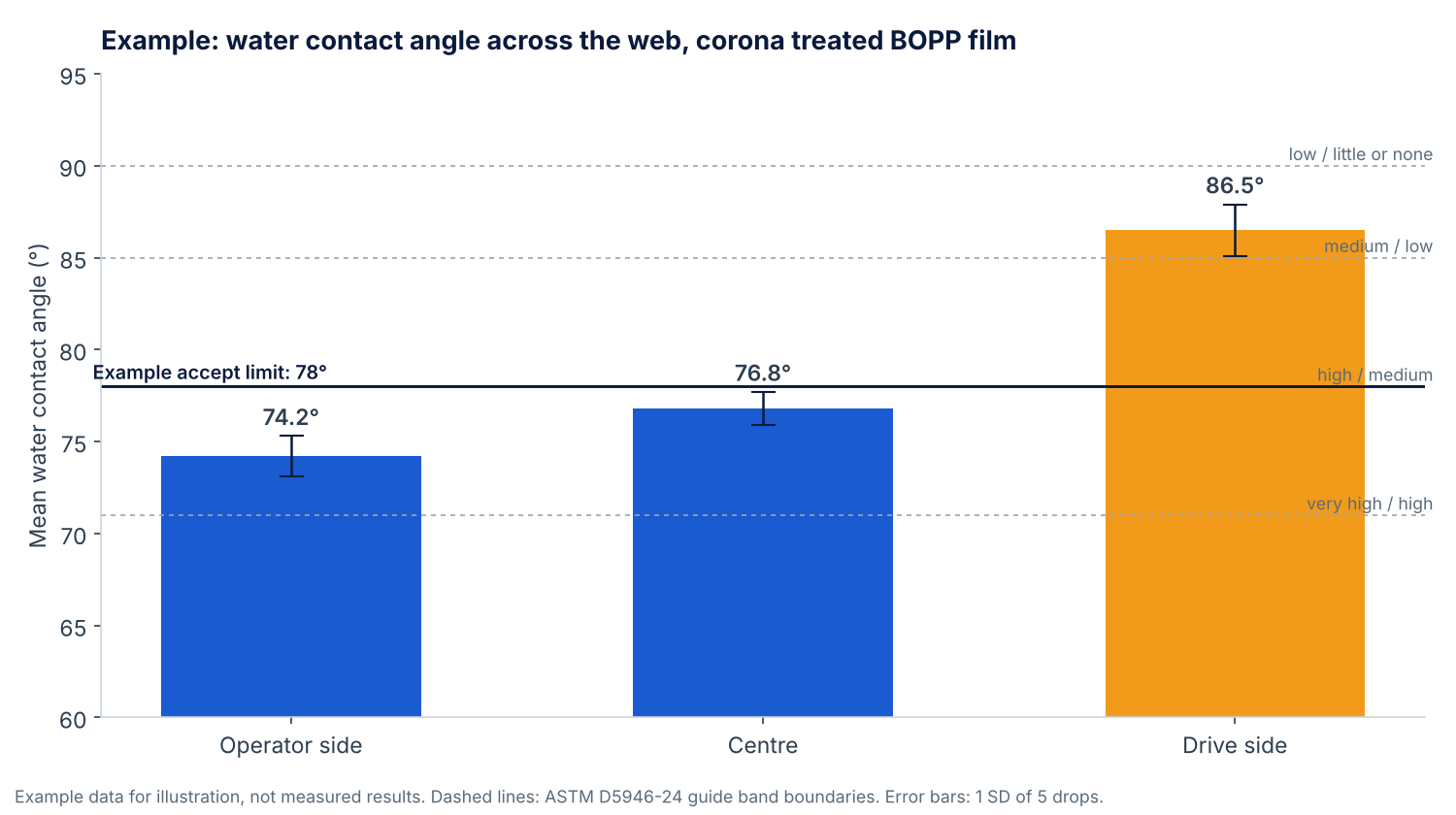
Example data, not measured results. Dashed lines are the ASTM D5946-24 guide band boundaries.
What changes when the check is a measured angle
| Metric | Before Dropometer | With Dropometer | Results |
|---|---|---|---|
| How the check is made | Dyne pens or test inks, read by eye | Water contact angle read from the drop image | No published benchmark |
| Result format | Pass or fail at each ink level | An angle per drop, 0.01° display, ±0.35° accuracy | Dropometer product specification |
| Record | Operator note | Drop image and angle saved per measurement | No published benchmark |
| Where it runs | Shared lab goniometer | At the treater, on battery for up to 8 h | Dropometer product specification |
Bring two rolls: one that printed well and one that did not. We will measure both live.
Enter your own numbers. The defaults are examples, not Droplet Lab results.
Quality cost snapshot
Result
Annual exposure combines audit/CAPA cost, customer rejections, and recall probability; avoided exposure applies the risk reduction percentage.
Lock these before you compare results between shifts or sites
| Parameter | Recommended Setting | Technical Rationale |
|---|---|---|
| Test liquid | Deionised water | This is a water contact angle method. Other liquids belong to other standards. |
| Drop type | Sessile drop, static angle | The method reads a resting drop on the treated side. |
| Drop volume | As the standard specifies, fixed for every drop | A changing volume adds spread that is not about treatment. |
| Reading time | As the standard specifies, fixed for every drop | Water can spread or evaporate on the film, so the time must not vary. |
| Fit model | Young-Laplace or polynomial, the same for every run | Both models are in the Dropometer software. Do not mix them within one study. |
| Replicates | Several drops at each position across the web | ASTM notes treatment and roughness vary, so multiple measurements are needed. |
| Side tested | Treated side, marked before cutting | The untreated side reads a much higher angle. |
| Environment | Record room temperature and humidity | The Dropometer runs at 10 to 45 °C and has no temperature control. |
Pick the method by the question you need answered
Start: What do you need to know about the treated surface?
You want a measured value per roll for film QC or treater control.
Use ASTM D5946 / ISO 15989, this page. The Dropometer is fully compliant.
Your customers specify a wetting tension in mN/m and you need a fast check at the line.
Use test inks to ISO 8296. Contact angle complements that check.
You need to know why a coating or adhesive fails, not just whether treatment is present.
Use a two liquid method such as ASTM D7490.
Your substrate absorbs water over time.
Start from the question you need answered. Blue boxes are measurements the Dropometer runs.
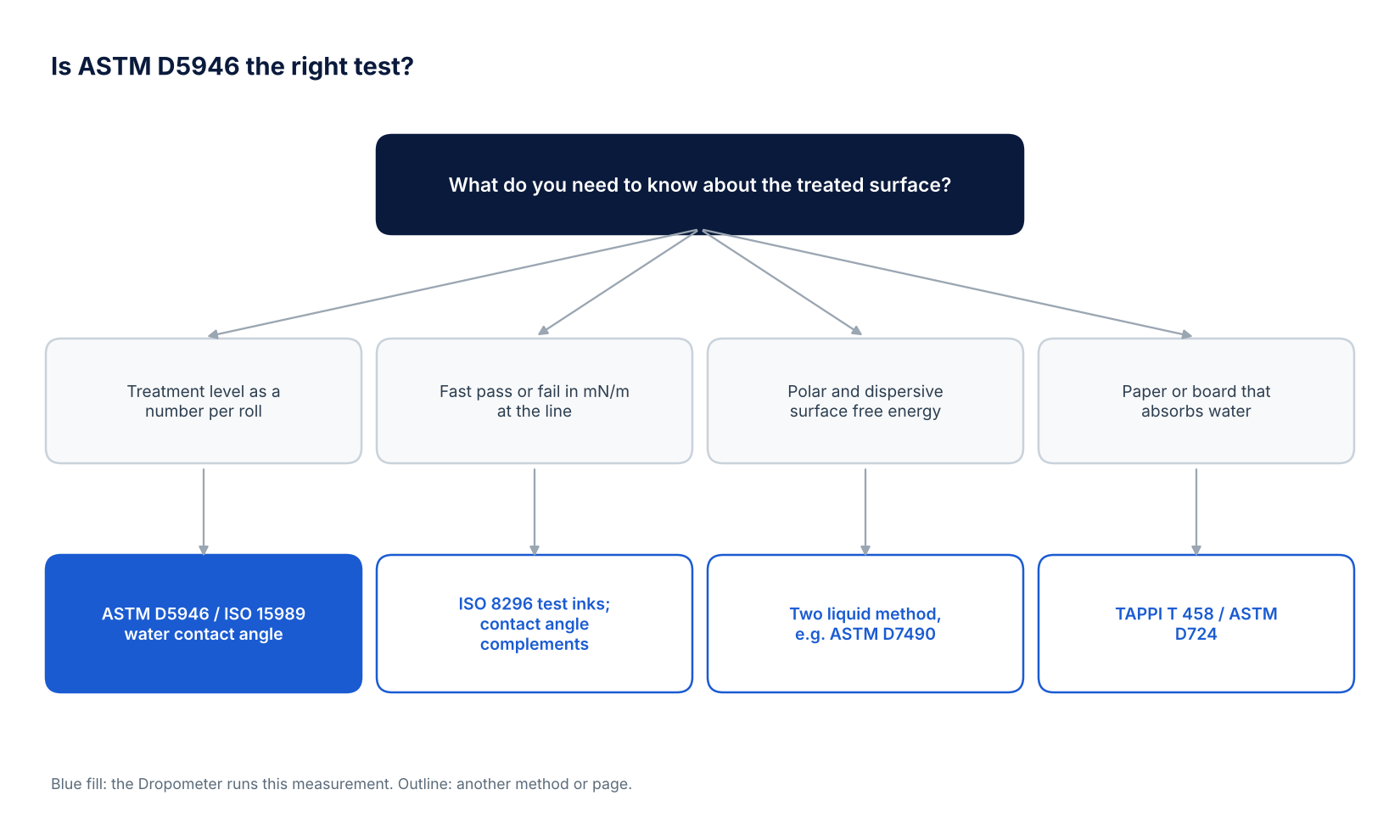
Pick the method by the question you need answered.
What the angle tells you, and what it does not
Honest limits of the method and of the Dropometer
Yes, in content. ASTM states that D5946 is identical to ISO 15989. Both measure the water contact angle on corona treated polymer film. Check which designation your customer names in the specification, and quote that one in your test report.
ASTM gives a guide: above 90° means little or no treatment, 78 to 84° is medium and below 71° is very high. ASTM also says each film needs its own capability study. Set your accept limit from film that printed and laminated well.
Yes. The Dropometer measures the static water contact angle on the treated film, which is what the method reads. Accuracy is ±0.35°. Buy the current edition of the standard, follow its drop volume and timing, and validate the method in your own lab.
Dyne pens and test inks give a pass or fail at set wetting tension levels, judged by eye. ASTM D5946 gives a measured angle per drop. Many converters use both: inks for a fast check, contact angle for a number they can trend. See ISO 8296.
No. A low angle shows the surface wets well. ASTM notes that contact angle alone does not fully measure ink, coating or adhesive adhesion. Keep your tape or peel test, and use the angle to catch treatment problems early.
More than one at each position. Treatment and surface roughness vary across the web, so ASTM calls for multiple measurements. Many labs place several drops at operator side, centre and drive side, then compare the means.
This page summarises ASTM D5946 and ISO 15989 in our own words and does not reproduce either standard. Buy the current edition from ASTM or ISO before you write a procedure. Droplet Lab does not certify compliance. Your own method validation does.
Sources, review and tools
ASTM D5946-24 summary from ASTM, ISO 15989:2004 listing from ISO, the Dropometer product specification and Droplet Lab validation papers.
Drafted with Claude (Anthropic) from the sources listed, then reviewed by Droplet Lab.
We did not copy text from the standard. Buy the current edition for the full procedure.
October 2026
Spotted an issue in this summary? Send a correction request and our team will review it.
Correction Request
We work hard to keep this page accurate and up to date. If you spot an error (wrong revision/year, missing requirement, incorrect interpretation, or broken link), tell us and we'll review it.
Contact us to report a correction