



Contents

Contact Angle Buyer's Guide

Best Contact Angle Goniometer Under $5,000

Our pick when the budget ceiling is real and the measurement list is not. Everything here lands under $5,000, so the ranking is decided by how much genuine capability each option returns per dollar. Every score below is calculated from published weights and criterion scores that you can check or replace with your own.

Scored 1–5 against 11 weighted criteria; full calculation shown on this page. Specifications and pricing last reviewed May 2026.

Abhimanyu Photo
Written by
Abhimanyu Bhandankar
Holds an MBA from Schulich School of Business and a BE in IT. He joined Droplet Lab in July 2019 and now leads sales and marketing.
CEO at Droplet Lab
Read More
Gurdeep-Saini-Photo
Technical Review by
Gurdeep Singh Saini
Holds a BASc in Mechanical Engineering (Ryerson) and an MASc from York University. He focuses on the custom AI behind the instrument.
COO at Droplet Lab
Read More
Abhimanyu Photo
Written By

Abhimanyu Bhandankar

CEO at Droplet Lab

Holds an MBA from Schulich School of Business and a BE in IT. He joined Droplet Lab in July 2019 and now leads sales and marketing.

Gurdeep-Saini-Photo
Reviewed By

Gurdeep Singh Saini

COO at Droplet Lab

Holds a BASc in Mechanical Engineering (Ryerson) and an MASc from York University. He focuses on the custom AI behind the instrument.

The short answer

Under $5,000 the deciding question is not which instrument is most capable in absolute terms, but which one covers the most of your measurement list without a second purchase later. The ranking below weights measurement scope and accuracy at 16 percent each and total cost of ownership at 18 percent.

The ranking

Three options that fit inside a $5,000 budget, from a full-scope portable instrument to an entry benchtop and a near-zero-cost DIY rig.

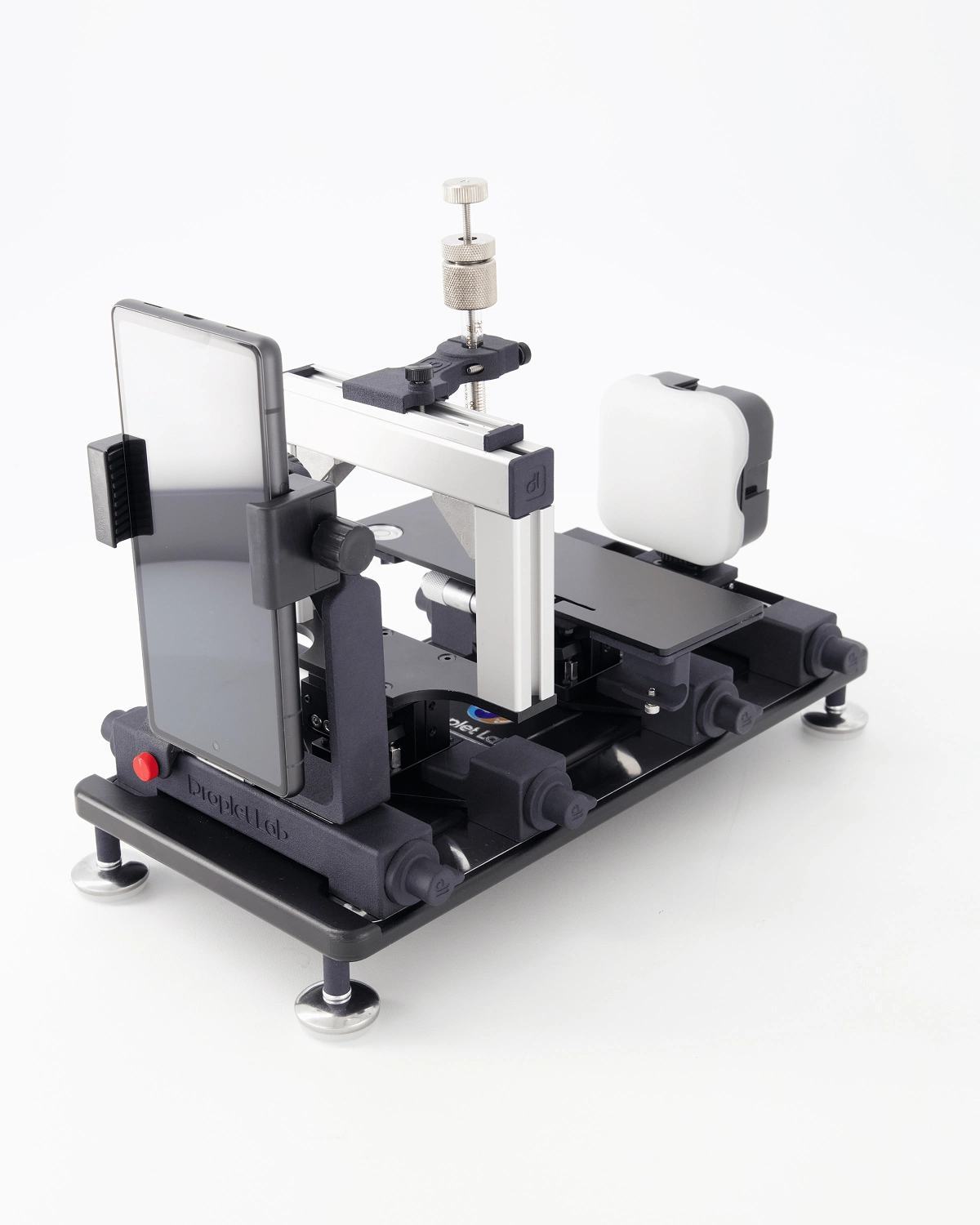
Dropometer

Top pick

Dropometer

Droplet Lab — from $4,990

4.5/ 5

The Dropometer takes first place because it is the only option under $5,000 that covers static, dynamic and sliding contact angle together with surface energy and pendant-drop surface tension, at 0.01° resolution, with offline logging and a documented upgrade path. It scores 5 out of 5 on measurement scope and 4.5 on cost despite being the most expensive option here, because there are no recurring fees and no consumable lock-in.

Where it wins

Full measurement scope in one instrument; 0.01° resolution and 0.35° datasheet accuracy; peer-reviewed fitting algorithms; exportable offline logs; modular tilt, dosing and fixture upgrades; no recurring software fees; lease-to-own from about $2,000.

Where it loses ground

It sits close to the ceiling at $4,990, so there is no headroom for accessories inside a hard $5,000 budget. Manual sample preparation and drop placement still matter, and it requires a smartphone plus initial setup.
Ossila Contact Angle Goniometer

Runner-up

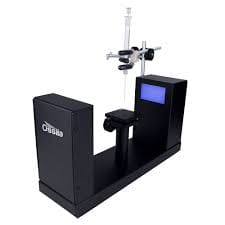
Ossila Contact Angle Goniometer

Entry benchtop — from about $3,000

3.3/ 5

Ossila ranks second and clears the bar: it is a real instrument at around $3,000 delivering static contact angle and pendant-drop surface tension with integrated software, and it scores a full 5 out of 5 on total cost of ownership. It loses 1.2 points to the top pick almost entirely on measurement scope and modularity, where a fixed-function static-angle platform scores 3 and 2.

Where it wins

Roughly $2,000 cheaper than the top pick, leaving budget for accessories or a second unit; ±1° stated accuracy; two-year warranty; integrated software with Young–Laplace and polynomial fitting; predictable bench workflow.

Where it loses ground

No dynamic or sliding angle; manual dosing and no tilt stage; mains power and a Windows laptop required; no environmental control, calibration logs or upgrade path, so added capability means a new instrument rather than a module.

DIY (camera + ImageJ / LB-ADSA)

Third

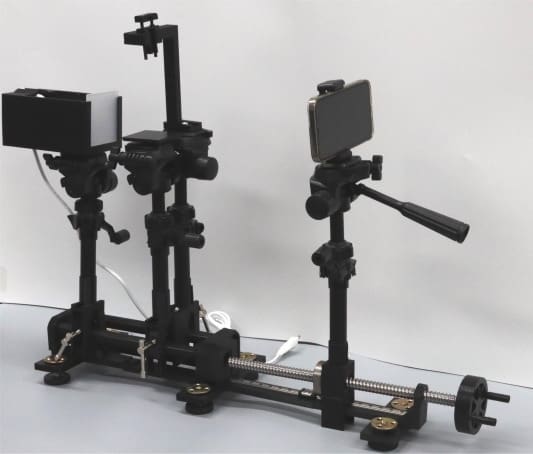
DIY (camera + ImageJ / LB-ADSA)

Self-assembled — $0 to $100

2.3/ 5

A DIY rig scores 2.3, below the 3 that marks meeting typical requirements. It takes the maximum 5 out of 5 on cost, but at 18 percent that is not enough to offset scores of 1 to 2.5 across scope, optics, traceability and automation. If you have a budget of up to $5,000 and a real measurement requirement, a DIY rig is the wrong answer even though it is the cheapest one.

Where it wins

Effectively no capital outlay; ±1° achievable with care and good lighting; free open-source analysis; excellent for learning the fundamentals of drop-shape analysis before committing budget.

Where it loses ground

Time-consuming manual workflow unsuited to volume; static angle only without custom add-ons; strong sensitivity to operator technique, lighting and optics; no calibration or traceability for QA or regulatory work.

How we arrived at these scores

Side-by-side specification comparison

Compare the three sub-$5,000 options across the specifications that decide value at this price point.

SpecificationDropometerOssilaDIY (camera + ImageJ)
Starting priceUS $4,990About US $3,000US $0 to $100
Measurement scopeStatic, dynamic and sliding contact angle; surface tension; surface energyStatic contact angle; pendant-drop surface tensionStatic contact angle only
Stated resolution and accuracy0.01° and 0.01 mN/m resolution; 0.35° contact angle datasheet accuracy±1° statedAbout ±1°, operator dependent
Optics and fittingSmartphone camera; DropletAI contact-point detection; peer-reviewed Young–Laplace and polynomial fitting1080p camera; polynomial and pendant-drop fittingManual image capture and tracing
AutomationAutomated analysis; optional dosing and tilt modulesManual, software assistedFully manual
TraceabilityBuilt-in calibration prompts and exportable logsBasic calibration sphereNone
Upgrade pathModular tilt, dosing and custom fixturesLimited manual tilt accessory onlyNone without custom rigs
Recurring costNo software feesNone statedNone

Expert perspective

A budget ceiling is only useful when it is measured against the whole workload. The cheapest instrument that covers 60 percent of the measurement list is not cheaper than one that covers all of it, because the missing 40 percent returns as a second purchase or as work that never gets done.

Droplet Lab Editorial TeamBuyer's guide methodology note

We make the Dropometer and it ranks first on this page, so check the assumption behind the weighting before you accept the result. This ranking weights measurement scope at 16 percent. If your work is static contact angle only, drop that weight and recompute: Ossila wins, at roughly $2,000 less.

Frequently Asked Questions

Not usually. Value at this price point is capability per dollar across your full measurement list. A $3,000 instrument that covers half the list and cannot be upgraded costs more over five years than a $4,990 instrument that covers all of it.

Ask every vendor whether the software licence is perpetual, whether surface-energy calculation is included or sold as a module, whether syringes and needles are proprietary, and what an annual service or calibration contract costs. Annual software maintenance of $1,500 to $3,000 is common in this category.

Because cost carries 18 percent of the weighting and everything else carries 82 percent. A DIY rig takes the maximum score on cost and scores 1 to 2.5 on scope, optics, traceability and automation. It is the right answer for occasional one-off testing, which is covered on a separate page with a different weighting.

Only if the platform is modular. Confirm before purchase that tilt stages, automated dosing and custom sample holders can be added to the instrument you buy, otherwise adding capability means replacing the whole system.

Not sure this is your use case?

Configure a Dropometer for your workflow and see a live price, or compare the full range side by side.