



Contents

Contact Angle Buyer's Guide

Best Contact Angle Goniometer for Field / On-site Testing

Our pick for measurement outside the lab, on installed assets, large parts and structures that cannot be brought to a bench. Portability, battery life, offline operation and setup time decide this ranking. Every score below is calculated from published weights and criterion scores that you can check or replace with your own.

Scored 1–5 against 11 weighted criteria; full calculation shown on this page. Specifications and pricing last reviewed May 2026.

Abhimanyu Photo
Written by
Abhimanyu Bhandankar
Holds an MBA from Schulich School of Business and a BE in IT. He joined Droplet Lab in July 2019 and now leads sales and marketing.
CEO at Droplet Lab
Read More
Gurdeep-Saini-Photo
Technical Review by
Gurdeep Singh Saini
Holds a BASc in Mechanical Engineering (Ryerson) and an MASc from York University. He focuses on the custom AI behind the instrument.
COO at Droplet Lab
Read More
Abhimanyu Photo
Written By

Abhimanyu Bhandankar

CEO at Droplet Lab

Holds an MBA from Schulich School of Business and a BE in IT. He joined Droplet Lab in July 2019 and now leads sales and marketing.

Gurdeep-Saini-Photo
Reviewed By

Gurdeep Singh Saini

COO at Droplet Lab

Holds a BASc in Mechanical Engineering (Ryerson) and an MASc from York University. He focuses on the custom AI behind the instrument.

The short answer

Field testing rules out most of the category before capability is even considered: if it needs mains power, a stable bench and a laptop, it is not a field instrument. The ranking below weights portability and power at 20 percent, and build quality and data handling at 14 percent each.

The ranking

Three options ranked for on-site work, from a fully portable full-scope instrument to a rugged one-button handheld and a pocketable threshold check. Ossila is not ranked: it needs mains power, a Windows laptop and a level, controlled setup, which makes it transportable between labs rather than usable on site.

Dropometer

Top pick

Dropometer

Droplet Lab

4.6/ 5

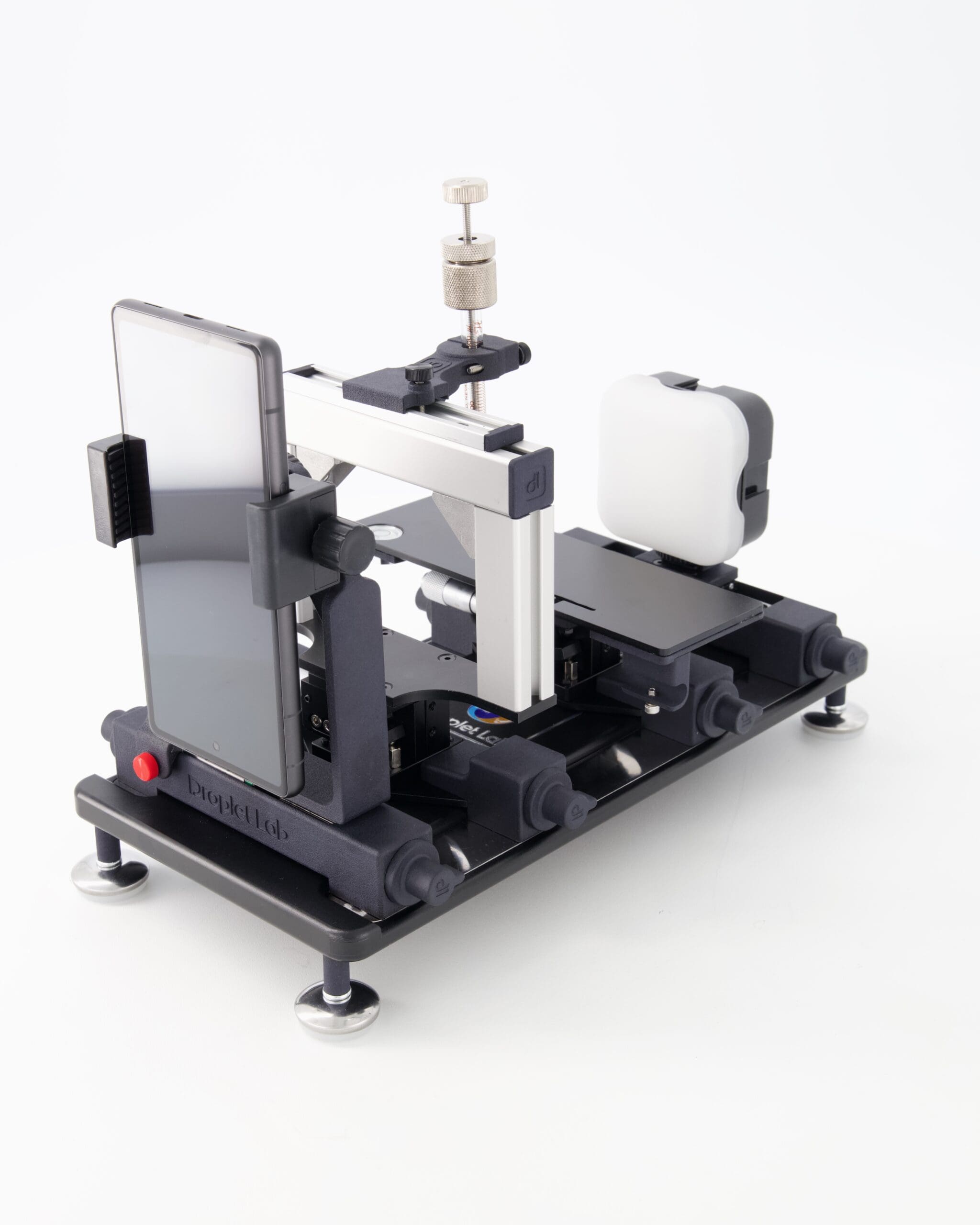
The Dropometer ranks first because it is the only instrument here that is built for field deployment without giving up lab-grade capability: about 1 kg, up to eight hours on battery, fully offline, and still able to measure contact angle, surface tension and surface energy with exportable data. It ties the handheld at 5 out of 5 on portability and then wins on data handling, which carries 14 percent.

Where it wins

About 1 kg and 30 × 15 × 45 cm; battery operation up to eight hours; fully offline with optional cloud sharing off by default, which suits secure and remote sites; full contact angle, surface tension and surface energy scope; clamp-on holders and fabric frames for in-situ slabs, countertops and textiles.

Where it loses ground

Slower per measurement than a one-button handheld, scoring 3.5 against 5 on automation and throughput. It still needs a reasonably stable surface, controlled drop placement and a smartphone, which some facilities restrict.
Brighton Science Surface Analyst 5001

Runner-up

Brighton Science Surface Analyst 5001

Handheld industrial

3.9/ 5

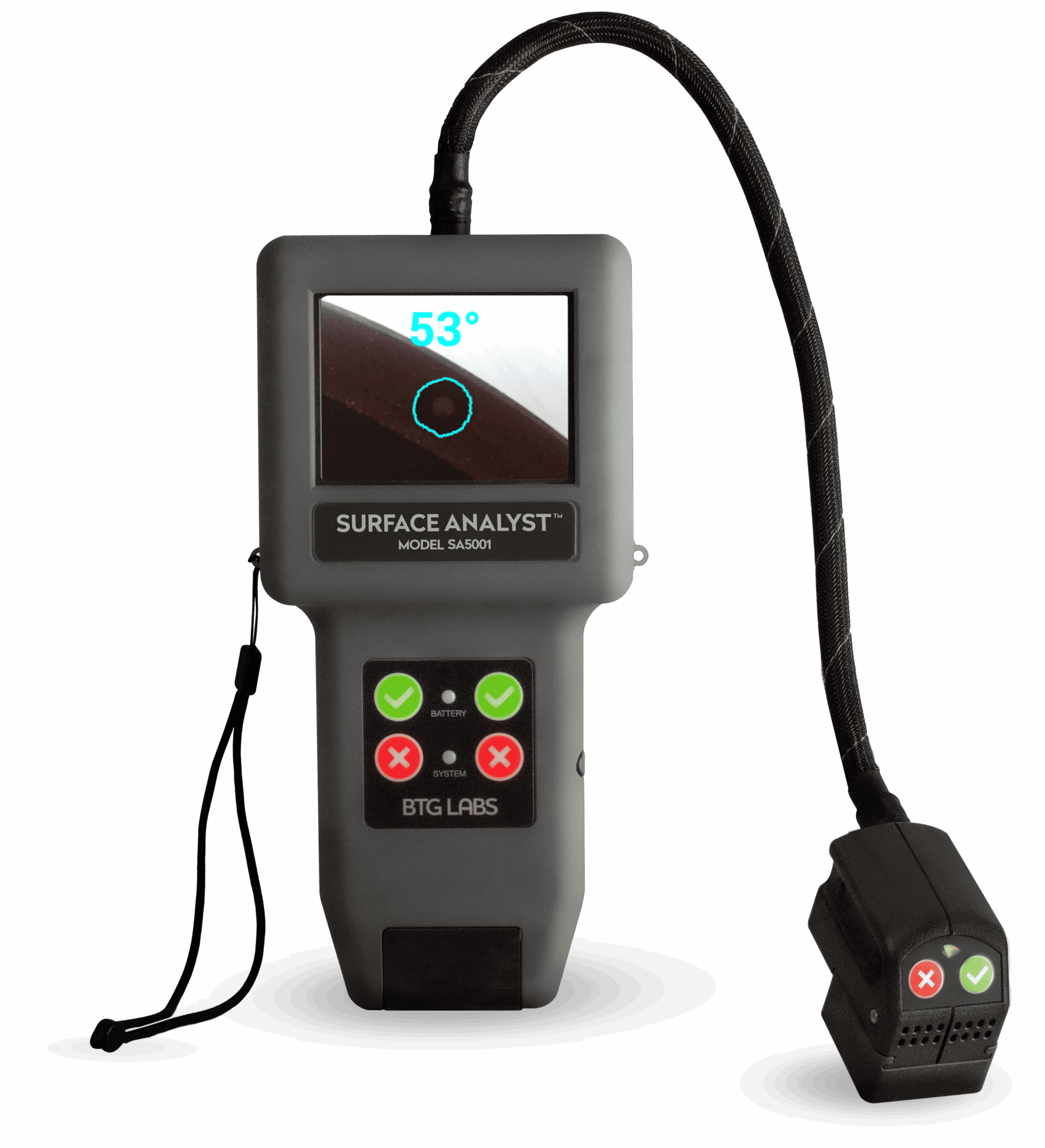
The Surface Analyst 5001 is the fastest way to answer a single question on site, and it takes a full 5 out of 5 on both portability and build quality, the two heaviest criteria here. It ranks second because the result is a static water contact angle with no imaging depth: it scores 2.5 on measurement scope and 3.5 on data handling, which is what separates it from the top pick.

Where it wins

About 0.5 kg and rugged enough for site conditions; roughly two-second one-button test; operator-independent so results hold across inspectors; on-device storage for approximately 40,000 tests.

Where it loses ground

Static water contact angle only, with no dynamic or sliding angle, surface tension or surface energy; no image record to review after the visit; proprietary water cartridges to carry and replace; accuracy is not stated in the datasheet.

Dyne test pens

Third

Dyne test pens

Threshold pens

2.9/ 5

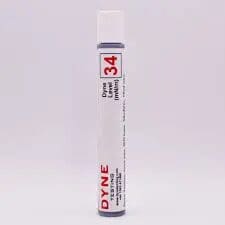
Dyne pens rank third because they are genuinely field-usable in a way no benchtop is: pocketable, no power, no host device, instant result, and a full 5 out of 5 on portability and cost. They score 2.9 overall, below the 3 that marks meeting typical requirements, because they answer a narrower question than the other two. A pen tells you whether a surface sits above a given surface energy. It does not give an angle, a number you can trend, or any record that survives the site visit.

Where it wins

The lightest option available at about $20 to $50 per pen; no power, host device or setup required; instant visual go/no-go; aligned with ISO 8296 threshold methods; useful as a fast pre-screen before deciding where to run a real measurement.

Where it loses ground

Qualitative only, with no contact angle, surface tension or hysteresis value; interpretation is operator-dependent and hard to standardise across inspectors; hazardous fluids with a shelf life of roughly six months, which complicates transport and storage; no digital record, so nothing is available for later diagnosis or dispute.

How we arrived at these scores

Side-by-side specification comparison

Compare the three options across the specifications that decide whether an instrument can be used on an installed asset rather than carried to one.

SpecificationDropometerBrighton Surface Analyst 5001Dyne test pens
WeightAbout 1 kgAbout 0.5 kgPocket-sized
PowerBattery, up to 8 hoursBatteryNone required
Host device requiredSmartphoneNoneNone
Offline operationFully offline; cloud sharing optional and off by defaultOn-deviceNot applicable
Measurement scopeStatic, dynamic and sliding contact angle; surface tension; surface energyStatic water contact angle onlySurface-energy threshold only
Result typeNumeric plus image and exportable dataNumeric and pass/failQualitative pass/fail
Typical test speedSeconds to about 1 minuteAbout 2 secondsInstant
Record kept on siteImages plus exportable numeric logsOn-device log of about 40,000 testsNone
ConsumablesNo closed consumable dependencyProprietary water cartridgesHazardous fluids, about 6-month shelf life
Starting priceUS $4,990Price on requestAbout US $20–$50 per pen

Expert perspective

Field measurement is defined by what you can carry and what you can defend afterwards. A number recorded on site with no image, no timestamp and no export is difficult to act on once the team has left, which is why record-keeping belongs in the portability decision rather than after it.

Droplet Lab Editorial TeamBuyer's guide methodology note

Ossila is excluded from this ranking despite frequently appearing on field shortlists. It is a capable bench instrument, but mains power, a Windows laptop and a requirement for level, controlled conditions make it transportable rather than field-capable. If your on-site work is really work in a second laboratory, see the value-for-money guide instead.

Frequently Asked Questions

Mains power, a required host computer, a need for a level bench and controlled lighting, and a setup time measured in tens of minutes. Any one of these turns a portable instrument into a transportable one, which is why Ossila is not ranked on this page.

Not with a standard sessile-drop workflow, which depends on gravity orienting the drop. On-site work on non-horizontal surfaces usually needs a purpose-built fixture, so confirm a repeatable holder exists for your geometry before buying.

Often yes, for policy rather than coverage. Many secure, defence and pharmaceutical sites prohibit devices that transmit, so an instrument that works fully offline and stores locally avoids an approval process rather than just a signal problem.

Often, as a pre-screen. They cost almost nothing, weigh nothing, and can tell you quickly which areas are worth a full measurement. They score 2.9 here because they cannot replace the measurement itself: no angle, no trend, no record.

References

1.
Dropometer datasheetManufacturer specifications for weight, battery life and offline operation.
2.
Brighton Science — Surface Analyst 5001 product pageManufacturer specifications for scope, speed and on-device data logging.
4.
Dyne test pens product data sheetManufacturer specifications, shelf life and handling.
5.
Zeus polymer extrusion manufacturing — Droplet Lab case studyMulti-unit deployment outside a controlled lab environment.

Not sure this is your use case?

Configure a Dropometer for your workflow and see a live price, or compare the full range side by side.