

Contents

Contact angle goniometer buyer's guide

Best Contact Angle Goniometer Under $5,000

Under $5,000 you can buy one instrument that covers most of your measurement list, or a cheaper one that covers part of it. This guide ranks the three realistic options, shows every weight and score, and says when the cheaper pick is the better buy.

Scored 1 to 5 on 11 weighted criteria. Prices and specifications checked 19 October 2026.

Abhimanyu Photo
Written by
Abhimanyu Bhandankar
Holds an MBA from Schulich School of Business and a BE in IT. He joined Droplet Lab in July 2019 and now leads sales and marketing.
CEO at Droplet Lab
Read More
Gurdeep-Saini-Photo
Technical Review by
Gurdeep Singh Saini
Holds a BASc in Mechanical Engineering from Ryerson University (now Toronto Metropolitan University) and an MASc from York University. He develops the automatic edge and baseline detection behind the Dropometer's analysis.
COO at Droplet Lab
Read More
Abhimanyu Photo
Written By

Abhimanyu Bhandankar

CEO at Droplet Lab

Holds an MBA from Schulich School of Business and a BE in IT. He joined Droplet Lab in July 2019 and now leads sales and marketing.

Gurdeep-Saini-Photo
Reviewed By

Gurdeep Singh Saini

COO at Droplet Lab

Holds a BASc in Mechanical Engineering from Ryerson University (now Toronto Metropolitan University) and an MASc from York University. He develops the automatic edge and baseline detection behind the Dropometer's analysis.

The short answer

The Dropometer (US$4,990) is our pick under $5,000 when you need more than static contact angle. In one kit it measures static and dynamic contact angle, pendant drop surface tension and surface free energy, with an accuracy of 0.35° checked against a KRÜSS DSA100E in peer review. The Ossila goniometer (about US$3,000) is the runner up and the better buy if you only measure static angle on flat samples and ±1° is enough.

Sliding angle is an add-on: the US$700 tilt stage takes the Dropometer to US$5,690, over this budget. We make the Dropometer, so every weight and score is published below for you to check. New to the method? Read our contact angle measurement guide or what a goniometer does.

The ranking

Three options that fit inside $5,000: a portable kit, an entry benchtop goniometer and a rig you build yourself.

Pick by situation

  • If you need contact angle plus surface tension or surface energy: Dropometer. One kit covers all three, with a published accuracy figure.
  • If you only measure static angle on flat, clean samples: Ossila goniometer. About US$2,000 less for the one measurement you need.
  • If you are learning the method or test once or twice a year: DIY camera and ImageJ. Free software and a camera you may already own, if you accept slow manual work.
  • If you equip a teaching lab: Dropometer education unit. US$999 per unit; see the teaching lab guide for class sizes.

Also checked and not ranked: Biolin Attension Theta Lite and ramé-hart Model 90 are quote only, and a third party guide puts entry optical tensiometers at US$5,000 to US$15,000. The Fibro PGX+ portable goniometer lists at US$17,750 and the ChemInstruments CAM-Plus at US$13,814 through Gardco. None has a published price under $5,000.

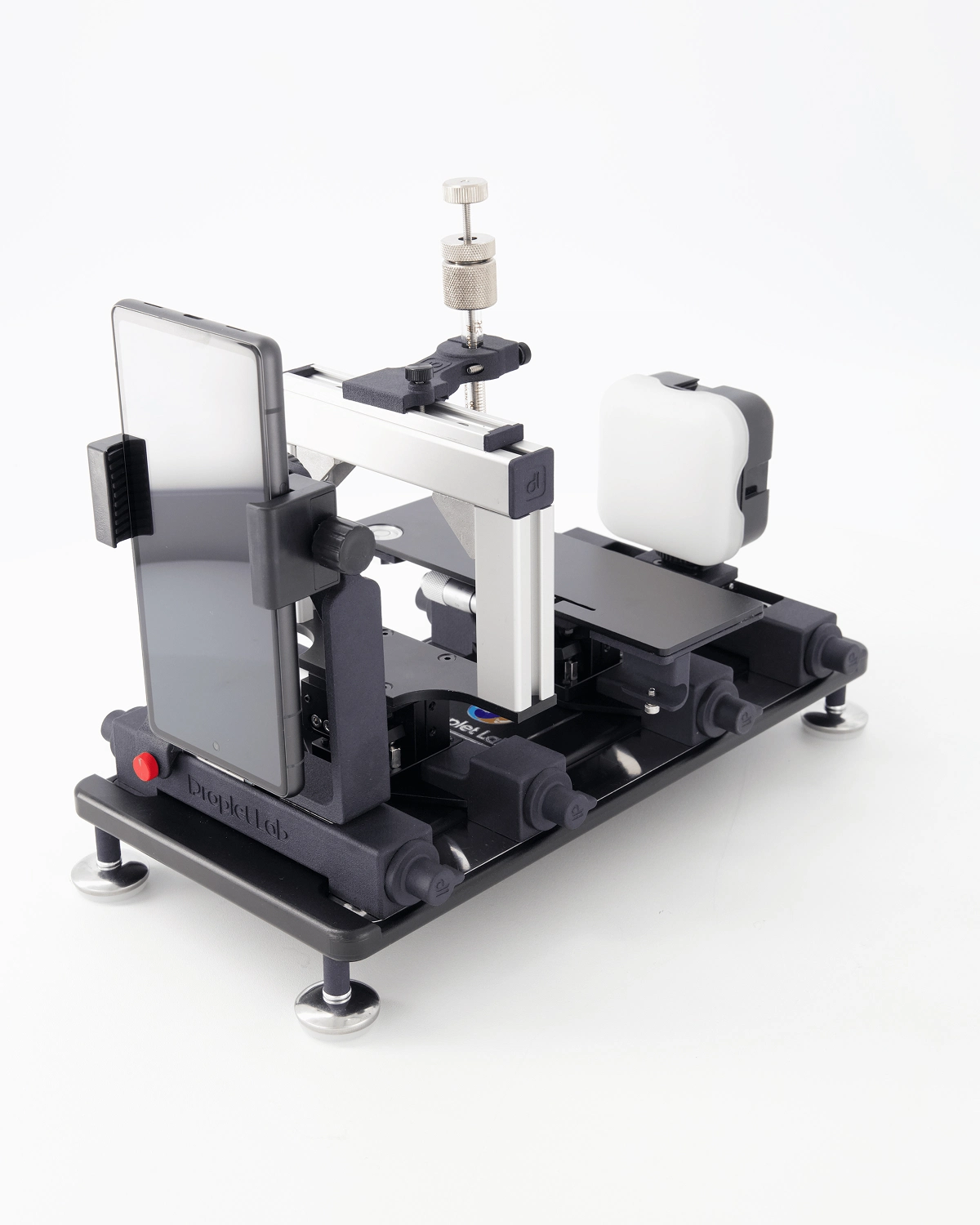
Dropometer contact angle kit: smartphone on a stage above a sessile drop, with a backlight

Top pick

Dropometer

Droplet Lab: US$4,990 list price, base kit, checked 19 October 2026

4.4/ 5

The Dropometer contact angle and surface tension kit ranks first because it covers the most of a typical measurement list inside the budget. It scores highest on scope, published accuracy and operator independence. It scores lowest of the three on cost because it uses almost all of the $5,000.

Where it wins

  • Static and dynamic contact angle, pendant drop surface tension and surface free energy in one kit
  • 0.35° accuracy, validated against a KRÜSS DSA100E in two peer reviewed papers
  • Automatic edge and baseline detection, so the same image gives the same reading
  • Sets up in about 2 minutes; lifetime software licence with no subscription
  • 5 year warranty and 5 years of software updates
  • Add tilt stage, auto dropper or auto tilt later instead of replacing the instrument

Where it loses ground

  • Sliding angle is an add-on: the US$700 tilt stage takes the total to US$5,690
  • US$1,990 more than Ossila for a lab that only needs static angle
  • Contact angle range is 10° to 175°, so extreme superhydrophobic or fully wetting surfaces sit at the edge
  • Manual dosing in the base kit; drop placement still takes practice
Ossila contact angle goniometer: benchtop unit with camera, sample stage and backlight

Runner up

Ossila Contact Angle Goniometer

Ossila: about US$3,000 list price excluding VAT, PC not included, checked 19 October 2026

3.3/ 5

Ossila is a real benchtop goniometer at about US$2,000 less than the top pick, and it takes the highest cost score of the two instruments. It loses ground on scope, published accuracy and upgrade path. If static angle on flat samples is all you measure, it is the sensible buy; our Dropometer vs Ossila comparison goes point by point.

Where it wins

  • US$3,000, about US$2,000 less than the Dropometer
  • Wider contact angle range: 5° to 180°
  • ±1° stated accuracy and a 1080p camera
  • Two year warranty; free software updates
  • Calibration sphere and glass syringe included

Where it loses ground

  • Ossila states two measurements only: static contact angle and pendant drop surface tension
  • No published validation against a reference instrument
  • Runs from mains through the included 24 V adapter, and needs a Windows 11 64 bit PC that your lab provides
  • No tilt stage or automatic dosing listed, so more capability means another instrument
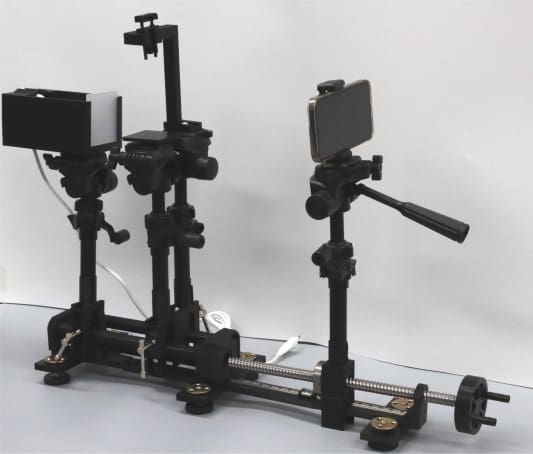
Home built contact angle rig: camera on a tripod, sample stage and light source

Third

DIY: camera and ImageJ

Self built: free software plus a camera, about US$20 to US$1,000, checked 19 October 2026

2.4/ 5

A DIY rig costs the least and teaches the method well, which is why it takes the top cost score. Everything else depends on your camera, lighting and patience, so it scores 1 to 2 on scope, operator independence and records. Our DIY ImageJ vs Dropometer comparison shows where the time goes.

Where it wins

  • Free software: the ImageJ Contact Angle plugin, LB-ADSA, or OpenDrop for surface tension too
  • The OpenDrop authors put the camera at about US$20 to US$1,000 depending on the application
  • The best way to learn drop shape analysis before you spend a budget

Where it loses ground

  • No stated accuracy; results depend on your camera, lighting and alignment
  • Manual or semi automatic tracing is slow for more than a few samples
  • Results vary between operators
  • No warranty, support or upgrade path

How we arrived at these scores

Each option is scored from 1 to 5 on the same 11 criteria. A 3 means it meets what a sub $5,000 buyer needs; a 5 means it exceeds it. Each criterion carries a weight for this budget, and the weights add to 100 percent. Multiply each score by its weight, add the rows and divide by 100: that is the headline score.

Criterion Weight Dropometer Ossila DIY (camera + ImageJ) Why these scores
Measurement scope
What it measures inside $5,000: static and dynamic angle, sliding angle, surface tension, surface free energy
16% 4.5 3 2 Dropometer covers all but sliding angle, which is a US$700 tilt stage add-on. Ossila states static angle and pendant drop surface tension. DIY: static angle with ImageJ; OpenDrop adds surface tension.
Published accuracy
Accuracy measured against a reference instrument, not display resolution
16% 5 3 1.5 Dropometer: 0.35° against a KRÜSS DSA100E in peer review. Ossila: ±1° stated by the maker. DIY: no stated figure; depends on your optics.
Five year cost of ownership
Purchase price plus software, computer and consumables over five years
18% 3.5 4.5 5 US$4,990 with phone and lifetime licence vs US$3,000 plus a Windows 11 PC if you lack one vs free software plus a camera.
Operator independence
The same image gives the same reading whoever measures
10% 5 3 1.5 Automatic edge and baseline detection vs software fitting with manual setup vs manual or semi automatic tracing.
Optics and image quality
Camera, lighting and focus for a sharp drop edge
8% 4 3.5 2 Pixel 7a 50 MP camera with LED backlight vs 1080p USB camera with manual focus vs whatever camera you own.
Upgrade path
Capability you can add later without a new instrument
8% 5 2 2 Dropometer: tilt stage US$700, auto dropper US$2,000, auto tilt US$1,500. Ossila lists no add on stages. DIY: rebuild the rig.
Time per sample
Hands on time from drop to recorded result
6% 4 4 1.5 Both instruments fit the drop in software; DIY tracing is slow.
Records
Saved images and results you can recheck later
6% 4 3.5 1.5 Both instruments save the image with the result; DIY depends on your own file discipline.
Portability and setup
Moving between benches or sites, and setup time
4% 5 2.5 2 Dropometer sets up in about 2 minutes; Ossila runs from mains through its included 24 V adapter and needs a lab PC; DIY rigs need realigning.
Warranty
Warranty length
4% 5 3 1 5 years vs 2 years vs none.
Software and platform
Licence terms and computer needs
4% 4 3.5 3.5 Lifetime licence on the included phone vs free software on your Windows 11 PC vs free open source plugins.
Weighted score 100% 4.4 3.3 2.4 Sum of weight × score ÷ 100

Side by side specifications

The specifications that decide value at this price, from each maker's own pages. Checked 19 October 2026.

SpecificationDropometerOssilaDIY (camera + free software)
PriceUS$4,990 base kit (phone included)US$3,000 excluding VAT (PC not included)Free software; camera about US$20 to US$1,000
Measurements under $5,000Static and dynamic contact angle, pendant drop surface and interfacial tension, surface free energyStatic contact angle, pendant drop surface tensionStatic contact angle (ImageJ); surface tension with OpenDrop
Sliding angleUS$700 tilt stage add-on (total US$5,690)Not listedNeeds your own tilting stage
Contact angle range10° to 175°5° to 180°Depends on optics
Stated accuracy0.35° (peer reviewed, vs KRÜSS DSA100E)±1° (maker's figure)Not stated
CameraGoogle Pixel 7a, 50 MP, with LED backlight1920 × 1080 USB camera, manual focusYour own
Computer and powerRuns on the included phoneWindows 11 64 bit PC from your lab (not included); mains power through the included 24 V adapterAny computer that runs ImageJ or OpenDrop
Add onsTilt stage US$700; auto dropper US$2,000; auto tilt US$1,500None listedBuild your own
Software licenceLifetime licence; no subscription neededFree software and updatesFree (ImageJ plugin, LB-ADSA, OpenDrop GPL 3.0)
Warranty5 years; 5 years of software updates2 yearsNone

Sources: Dropometer product page and quote configurator; Ossila product page; OpenDrop (Huang et al., 2021). All checked 19 October 2026.

When not to buy a Dropometer

Expert perspective

Not all contact-angle measurements are created equal: the right method depends on the application. A sessile drop and a tilted plate can give very different, and equally correct, numbers.

Dr. Alidad AmirfazliCo-founder and Scientific Advisor, Droplet Lab; Professor of Mechanical Engineering, York University

Frequently asked questions

Is the cheapest contact angle goniometer under $5,000 the best value?

Only if it covers everything you measure. Value at this price is capability per dollar across your whole measurement list. An instrument that measures static angle alone is good value for a static angle lab. For a lab that also needs surface tension or surface energy, the second purchase later costs more than the saving.

What is the difference between resolution and accuracy?

Resolution is how finely the software prints the number, such as 0.01°. Accuracy is how close that number is to the true angle, measured against a reference instrument. Ask every vendor for a published accuracy figure. The Dropometer's is 0.35° against a KRÜSS DSA100E, in two peer reviewed papers.

What costs should I check besides the purchase price?

Ask whether the software licence is perpetual or yearly, whether surface energy is included or a paid module, and whether syringes and needles are standard parts. Ask what a computer, a calibration standard and any service visit cost. Then compare five year totals, not list prices.

Can I build my own goniometer with a camera and ImageJ?

Yes. A camera, a light, a sample stage and the free ImageJ contact angle plugin will measure static angle. Expect slow manual tracing and results that depend on the operator. Our DIY comparison and occasional testing guide cover when that is enough.

Is there a cheaper Dropometer for teaching labs?

Yes. The education unit is US$999 per unit and is built for classroom experiments. Our teaching lab buying guide compares it with other classroom options.

Can I start under $5,000 and add features later?

With the Dropometer, yes: the manual tilt stage (US$700), auto dropper (US$2,000) and auto tilt stage (US$1,500) add to the same kit. With a fixed function instrument, more capability usually means a second instrument. Check before you buy.

References

1.
Dropometer product page and specifications, Droplet LabPrice, add ons and specifications; checked 19 October 2026
2.
Ossila Contact Angle Goniometer (L2004A1), product pagePrice, range, accuracy, warranty, power and PC requirements; checked 19 October 2026
4.
Droplet Lab validation papersBoth peer reviewed validation studies
5.
Brugnara M. Contact Angle plugin for ImageJFree ImageJ plugin for static contact angle
8.
Nanoscience Instruments. How much does a contact angle meter cost?Third party price bands for entry optical tensiometers; updated 11 July 2025

See it on your own samples

Book a 15 minute consult and we will measure a sample like yours on a call, or configure a kit and get a price.