
Surface science explainer
The Coffee-Ring Effect: Why Drying Drops Leave a Ring
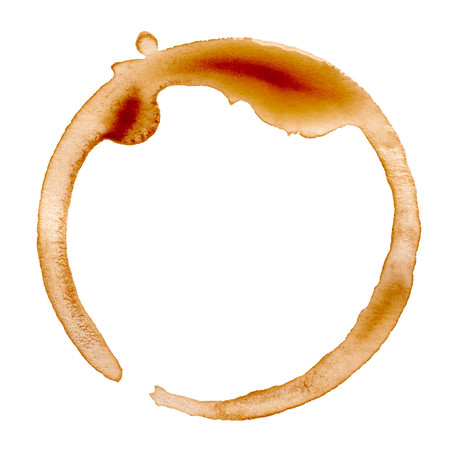
A coffee ring forms because the edge of a drying drop stays pinned while evaporation is fastest at that edge. An outward flow inside the drop carries particles to the rim and leaves them there (Deegan et al., 1997). Unpinning the edge, adding Marangoni flows or changing particle shape can weaken or reverse it.


Droplet Lab Team
Droplet Lab builds precision instruments and software for surface science measurement, specialising in contact angle analysis and surface tension characterisation. Used by researchers across materials science, pharmaceuticals, coatings, and advanced manufacturing, Droplet Lab's Dropometer has contributed to studies published in peer-reviewed journals including Advanced Functional Materials (Impact Factor 19). The team combines instrument engineering with deep domain knowledge in wettability science with a focus on practical accuracy.
Why does a drying drop leave a ring?
Short answer: the drop's edge gets stuck to the surface, so the drop cannot shrink inwards as it dries. Liquid evaporates fastest at the thin edge, and liquid from the centre flows outwards to replace it.
That flow carries coffee particles, pigment or salt with it. When the liquid is gone, most of the solids sit in a dark ring at the old edge. Deegan et al. (1997) first explained the effect this way in Nature.
Why does the edge of the drop stay pinned?
Real surfaces are never perfectly smooth or uniform. Tiny bumps, scratches and chemical patches hold the contact line in place as the drop thins.
In contact angle terms, the drop must fall below its receding contact angle before the edge can move. Surfaces with a large gap between advancing and receding angles pin drops more strongly.
The contact angle measurement guide explains advancing and receding angles, and the sliding angle guide covers how pinning shows up when a surface is tilted.
Expert Quote
What a liquid responds to is only the outermost few ångström of a surface — the skin, not the bulk. Change that skin and you change the wetting, even if the material underneath is identical.

How can you prevent the coffee-ring effect?
Add a Marangoni flow. A surface tension difference along the drop surface drives flow back towards the centre. Hu and Larson (2006) showed this can reverse ring formation and deposit particles in the middle.
Change particle shape. Yunker et al. (2011) found that stretched, ellipsoidal particles lock together at the surface and deposit evenly.
Let the edge move. A lower receding contact angle gap lets the drop shrink instead of staying pinned. Substrate treatment, cleanliness and drying temperature all change this.
Why does the coffee-ring effect matter in printing and coatings?
In inkjet printing, rings make lines and dots thicker at the edges than in the middle. For printed electronics that means uneven conductivity; for graphics it means visible banding.
The same physics affects biosensor spots, spray droplets on leaves and drying coating films. The ink adhesion and abrasion testing use case and the corona treatment monitoring use case show where wetting control fits in a print line.
What should you measure to control drying rings?
Start with the ink's surface tension, measured by pendant drop. ISO 19403-3 describes this method for paints and varnishes.
Then measure static and receding contact angles of the ink, or of water, on the substrate. Track both after any change in substrate lot, cleaning or surface treatment.
The surface tension measurement guide covers the liquid side in more detail.
Where can you go deeper?
These pages cover the methods, standards and data behind this post.
- Case study: Labels manufacturer: ink and adhesive wetting
- Buying guide: Best Contact Angle Goniometer for Teaching & Academic Labs
- Glossary: Dynamic surface tension (time-resolved pendant)
- Classroom experiment: Teaching Curriculum Hub (4 / 8 / 12-lab tracks)
- Open dataset: Contact Angle of Water on Common Surfaces
- Tool: Free Contact Angle Tool
- Related post: Dynamic Surface Tension
Control wetting before you print
See ink surface tension and substrate contact angle measured on one portable kit, in a short call.
Frequently Asked Questions
Who explained the coffee-ring effect?
Deegan and colleagues at the University of Chicago explained it in Nature in 1997: a pinned contact line plus faster evaporation at the edge drives an outward flow (Deegan et al., 1997).
Does the coffee-ring effect need particles?
It needs something left behind. Suspended particles, pigments and dissolved salts all collect at the edge; a perfectly pure liquid leaves no ring.
How do ink formulators avoid coffee rings?
Common routes are solvent blends that create a Marangoni flow back to the centre, controlled substrate wetting so the edge can recede, and heated or controlled drying (Hu and Larson, 2006).
Does contact angle affect the coffee-ring effect?
Yes. A drop whose edge stays pinned, because of a low receding contact angle or a large hysteresis, is the condition that produces a ring.