Contents
Coating Defect Troubleshooting

Fix Orange Peel Paint Texture: Coating Failure Prevention with a Pre-Spray Wetting and Surface Tension Gate

Add a numeric, audit-ready wetting and coating surface-tension screen before you respray. Rule substrate contamination and coating drift in or out fast, and stop guessing between wetting, formulation, and application-technique causes of orange peel texture.

Who this is for: Coating engineers, QA/QC teams, finishing supervisors, and manufacturing leads responsible for appearance quality across spray, dip, and conformal coating lines where orange peel texture drives rework.

Positioning: Dropometer does not replace gloss/DOI checks or visual inspection, and it does not measure viscosity, atomization, or flash/cure conditions directly, the factors most commonly cited as the primary drivers of orange peel. It adds a fast, quantitative check on two specific levers, substrate wetting and coating surface-tension stability, so you can rule those in or out before assuming the cause is viscosity or spray technique.

Last updated
July 10, 2026
Gurdeep-Saini-Photo
Written by
Gurdeep Singh Saini
Holds a BASc in Mechanical Engineering (Ryerson) and an MASc from York University. He focuses on the custom AI behind the instrument.
COO at Droplet Lab
Read More
Droplet-Lab logo
Technical Review by
Droplet Lab Team
Droplet Lab builds precision instruments and software for surface science measurement, specialising in contact angle analysis and surface tension characterisation. Used by researchers across materials science, pharmaceuticals, coatings, and advanced manufacturing, Droplet Lab's Dropometer has contributed to studies published in peer-reviewed journals including Advanced Functional Materials (Impact Factor 19). The team combines instrument engineering with deep domain knowledge in wettability science with a focus on practical accuracy.
Read More
Gurdeep-Saini-Photo
Written By

Gurdeep Singh Saini

COO at Droplet Lab

Holds a BASc in Mechanical Engineering (Ryerson) and an MASc from York University. He focuses on the custom AI behind the instrument.

Droplet-Lab logo
Reviewed By

Droplet Lab Team

Droplet Lab builds precision instruments and software for surface science measurement, specialising in contact angle analysis and surface tension characterisation. Used by researchers across materials science, pharmaceuticals, coatings, and advanced manufacturing, Droplet Lab's Dropometer has contributed to studies published in peer-reviewed journals including Advanced Functional Materials (Impact Factor 19). The team combines instrument engineering with deep domain knowledge in wettability science with a focus on practical accuracy.

The Cost Of Getting It Wrong

15–20%

of annual revenue consumed by Cost of Poor Quality in typical manufacturing operations

Fabrico COPQ Guide, citing American Society for Quality estimates

10×

higher hidden cost vs. visible scrap cost: rework, re-inspection, downtime, and warranty claims are rarely captured

Fabrico COPQ Guide 2026

1 → 10 → 100

the well-documented "1-10-100 Rule": a defect caught at prevention costs roughly 1x, caught internally (rework/scrap) roughly 10x, and escaping to the customer (warranty, recall, lost business) roughly 100x, for the specific failure modes a given upstream screen actually catches, not every possible cause of a defect

1-10-100 Rule of Quality Costs (Making Strategy Happen; AIGPE)

Fabrico, "The Cost of Poor Quality (COPQ) in Manufacturing: 2026 Guide" (fabrico.io); Making Strategy Happen and AIGPE on the 1-10-100 Rule. Figures are industry-wide benchmarks, not Droplet Lab claims, not specific to any one failure mode, and on this page specifically, only the wetting- and coating-tension-driven share of orange peel falls under this instrument's own prevention step, see Executive Summary and Honest Scope.

QC-Ready Summary

What this workflow does and what it does not

Quick technical reference for engineers and QA managers evaluating fit before reading further.

Evidence Box (QC-Ready)

Problem this solves

Orange peel, an uneven, wavy texture where sprayed droplets fail to level into a smooth finish, discovered only after cure, when the only remaining options are wet sanding, buffing, polishing, or a full repaint.

Dropometer role in workflow

Fast screening of substrate wetting readiness (contact angle, surface energy) and coating surface-tension stability (pendant drop) before spray, to rule those two levers in or out. Does not measure viscosity, atomization, spray-gun settings, or flash/cure conditions, which published paint-defect literature identifies as the more common primary drivers of orange peel.

Primary outputs

Water contact angle (substrate wetting) before spray
Pendant-drop surface tension of the coating, to catch mix, thinner, or additive drift
Optional surface energy trend using Fowkes or van Oss–Good models
Optional tilt/droplet-mobility diagnostics to detect non-uniform surface treatment

Calibration requirement

10 to 20 representative panels spanning smooth and orange-peel outcomes
Minimum 2 operators
Fixed droplet volume, fixed capture time, at least 5 replicates per zone, standard probe liquid, tracked per substrate and coating system

Known limitation

Orange peel is multi-factor. Viscosity, atomization, spray-gun setup, and flash/cure conditions are commonly cited in the paint-defect literature as primary drivers and are not measured by this workflow. Rough substrates increase measurement variability, and optical detection may need validation for pigmented or opaque coatings.

Gate requirement

PASS / MONITOR / FAIL thresholds must be set by correlating measured wetting and coating surface-tension signals to your actual smooth-versus-orange-peel outcomes; substrate- and coating-system-specific, not universal.

Who this is for

What are you trying to solve?

The Dropometer serves four roles across a coating operation dealing with orange peel. Each has a different primary risk. Jump to yours.

Coating Engineer

Investigating batch-to-batch or shift-to-shift variation in orange-peel rate with no clear root cause, especially after a change in thinner ratio, coating lot, or substrate supplier.

Unexplained process drift

QA / QC Manager

Needing a fast way to rule wetting and coating-tension issues in or out before committing to a full viscosity/atomization investigation, to cut rework cycles (sand, buff, polish) and recover first-pass yield.

Rework and scrap cost

Compliance Officer

Requiring documented, defensible evidence of surface and coating readiness for NCR files, CAPA responses, or customer/supplier audits.

Audit non-conformance

Lab Manager

Setting up a reproducible measurement protocol for incoming substrate or coating-batch verification across operators and shifts.

Operator-to-operator variability
workflow fit

Is this the right screen for your process?

This is not a universal solution, and it is not a full orange-peel diagnostic on its own. Check the conditions below before investing further time.

Good fit if

You want to quickly rule substrate contamination or coating surface-tension drift in or out before starting a viscosity/atomization investigation
Your orange-peel rate varies across lots, operators, or shifts and you suspect a substrate or coating-batch cause rather than a spray-parameter cause
You need a documented, numeric pre-spray record, not a visual pass/fail judgment
Your QA or compliance process requires a traceable pre-spray inspection record
You currently have no way to track coating surface-tension drift between batches

Less relevant if

Your orange peel correlates cleanly with air pressure, nozzle settings, film build, or reducer ratio, in which case the root cause is very likely viscosity/atomization, which this instrument does not measure directly
Your orange peel correlates with booth temperature, humidity, or flash time rather than substrate or coating readings
Your acceptance test is purely a final gloss/DOI or visual inspection with no appetite to add an upstream gate
You need a single tool that diagnoses all five common orange-peel causes end to end, this workflow covers two of them; see Honest Scope
Root Cause Context

Why Orange Peel Is Rarely Just One Thing

Orange peel is one of the most costly paint defects because it is usually discovered only after cure, when the only remaining options are to sand, buff, polish, or repaint. It is also one of the more multi-factor defects in the coatings literature, and Dropometer screens two of its known contributors, not all of them.

Orange peel is a wavy, uneven texture that forms when sprayed droplets fail to merge and level into a smooth film before the coating gels or cures. Independent paint-industry sources are consistent that the dominant drivers are typically coating viscosity, spray-gun atomization and air pressure, film build and reducer content, and the rate of solvent evaporation relative to leveling time [1][2]. Substrate wetting is not usually presented as a primary cause in that literature; where it is discussed, it appears as a secondary or contributing factor rather than the dominant one.

That does not make wetting and coating surface tension irrelevant. Two upstream, measurable levers still matter here. First, a substrate that carries contamination or has low surface energy will resist coating spread locally, which can contribute to uneven leveling on top of whatever the viscosity/atomization conditions are doing. Second, and more directly supported by the coatings-science literature, surface-tension gradients within the wet film itself, driven by uneven solvent evaporation or temperature differences, are a well-documented mechanism (Marangoni instability) for exactly this kind of leveling defect [3]. A coating surface-tension check before spray can catch a batch that has drifted toward that instability before it goes on the part.

This workflow adds two upstream gates: measure substrate wetting readiness before spray, and measure coating surface tension before it is loaded into the gun. If both come back within range and orange peel is still occurring, that is a meaningful, data-driven signal to redirect the investigation toward viscosity, atomization, film build, or flash/cure conditions, factors this workflow does not measure directly, rather than continuing to guess.

Recognition

What Does Orange Peel Actually Look Like?

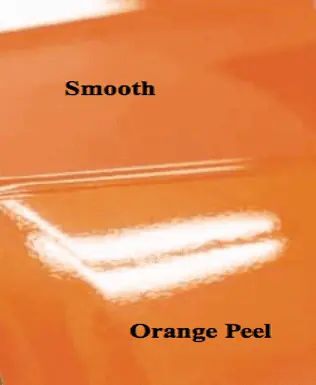
Orange peel is an uneven, wavy texture caused by poor leveling of sprayed droplets. Instead of forming a smooth coat, the paint dries with a bumpy, orange-skin-like texture, and teams often cannot tell from the finish alone whether the cause is upstream (substrate, coating batch) or downstream (spray parameters, environment).

Paint looks bumpy or uneven immediately after spray, before it has even fully cured.
Texture visually resembles the skin of an orange rather than a smooth, level film.
Defect requires wet sanding, buffing and polishing, or a full repaint to correct, all after cure.
Variation across operators, booths, or shifts with the same nominal coating and substrate.
Paint appears to dry too quickly under certain conditions, locking texture in before it can level.
Increasing consumption of sandpaper, compound, and polish to correct recurring defects, with no numeric baseline to say whether the cause is upstream or downstream.
Diagnosis

Root Causes

Why:

  • Incorrect coating viscosity or spray-gun setup (air pressure, nozzle, fan pattern) prevents sprayed droplets from merging and leveling before the film gels. This is the cause most frequently identified as primary in published paint-defect analyses [1][2].

How to detect:

  • Texture changes when you adjust air pressure or nozzle settings, with no change to substrate or coating Substrate wetting and coating surface tension both read stable within baseline

Corrective action:

  • Adjust spray gun setup, air pressure, and viscosity Verify reducer ratio and atomization conditions

Why:

  • Changes in thinner ratio, additive dosing, or contamination in the liquid coating alter its surface tension. Uneven surface tension within the wet film, from solvent-evaporation or temperature gradients, is a documented mechanism (Marangoni instability) for uneven leveling [3].

How to detect:

  • Pendant-drop surface tension deviates from your baseline High variability between replicate readings on the same batch

Corrective action:

  • Correct mix ratio or additive dosing Re-test coating surface tension before spray

Why:

  • Low substrate surface energy or contamination prevents the coating from spreading evenly, which can contribute to uneven leveling independent of the coating's own properties.

How to detect:

  • High contact angle versus baseline Large variability across the substrate surface

Corrective action:

  • Improve cleaning or pretreatment Re-measure substrate wetting before coating

Why:

  • If the coating dries or gels before the film has time to level, the wavy texture is locked in place. This is commonly linked to solvent evaporation rate outpacing leveling time [1].

How to detect:

  • Correlates with airflow, booth temperature, or humidity logs rather than substrate or coating readings

Corrective action:

  • Adjust flash time and airflow Optimize booth temperature and humidity conditions

Why:

  • Inconsistent spray distance, overlap, or gun speed creates an uneven film independent of the substrate or coating.

How to detect:

  • Defect rate is strongly operator-dependent Substrate wetting and coating surface tension read stable

Corrective action:

  • Standardize spray-gun technique and distance Retrain operators against a documented spray procedure

Not sure which root cause applies to your process?

A surface science specialist can review your failure history and help you identify whether a surface screen would add a useful upstream gate.

For Compliance Officers and QA Managers

Building a defensible pre-bond inspection record

Surface and coating readiness measurement produces the type of numeric, traceable output that subjective visual methods cannot. If your quality system requires documented evidence of process control at each stage for NCR responses, CAPA files, incoming inspection records, or supplier audits, contact angle and surface tension measurement provide that evidence in a format your QA documentation already requires. No specific external regulation governs coating pre-spray wetting inspection, so this is offered as internal QC documentation value, not a compliance-avoidance claim.

Audit trail

Numeric contact-angle and surface-tension values with replicate spread, timestamps, operator records, and substrate/coating lot identification, replacing subjective "surface looked clean" notes with defensible numeric logs.

CAPA evidence

When orange-peel rates trigger a Corrective and Preventive Action file, contact-angle and surface-tension data provide quantitative before/after evidence of substrate and coating condition, not anecdotal process descriptions.

NCR documentation

Non-conformance reports that include numeric pre-spray data let you assign or rule out root cause, substrate, coating, or process, with evidence rather than inference.

Coating-system qualification

Incoming substrate or new coating-lot verification using contact angle and surface tension provides a numeric acceptance criterion, applicable to ISO 9001, IATF 16949, and similar quality systems.

Process control records

Contact-angle and surface-tension trend logs demonstrate statistical process control at the pre-spray step, relevant to Six Sigma, SPC, and DMAIC programs targeting coating-line COPQ.

Treatment verification

For pretreatment steps that are difficult to verify visually, contact angle measurement provides objective confirmation that treatment reached the required level before spray.

What to Measure

Primary screen

Surface tension (pendant drop) of the coating

Why it matters: Controls flow and leveling of the paint film; surface-tension gradients within the wet film are a documented mechanism for uneven leveling.

How to interpret: Compare to your known-good baseline. Drifting values indicate instability worth investigating before spray.

When it is not enough: Does not capture viscosity or atomization, both commonly cited as more dominant orange-peel drivers.

Primary screen

Contact angle (substrate wetting)

Why it matters: Indicates how well the coating spreads on the substrate.

How to interpret: Higher angle versus baseline suggests poorer wetting and added orange-peel risk from the substrate side.

When it is not enough: Rough surfaces increase variability, and this does not diagnose viscosity- or technique-driven orange peel.

Optional

Surface energy trend

Why it matters: Helps separate substrate contamination from an intrinsic, unchanging low-energy substrate material.

How to interpret: A shifting trend versus a flat low baseline points toward contamination rather than the substrate material itself.

When it is not enough: Model-dependent; do not compare values from different models as absolute numbers.

Optional

Droplet mobility (tilt test)

Why it matters: Detects non-uniform surface treatment or contamination that a static angle can miss.

How to interpret: Irregular sliding behavior indicates a non-uniform surface.

When it is not enough: The instrument's tilting stage covers 0 to 60 degrees per datasheet; confirm this covers any internal spec requiring a wider range.

Validated Measurement Approach

Independent benchmarking and publication-based validation references.

Benchmark Validation

Dropometer contact angle and pendant-drop surface tension methods have been benchmarked against KRÜSS DSA100E reference measurements. The instrument is referenced in peer-reviewed journals including Bioactive Materials (Impact Factor 20) and Advanced Functional Materials (Impact Factor 19).

See peer-reviewed validation

Publication Evidence

Our instruments are referenced in peer-reviewed journals, theses, and conference publications.

Browse citations
QC Protocol

How Dropometer Fits Your Workflow

Dropometer is best used as a pre-spray QC screen and as a first-pass triage step when orange-peel rates begin to trend, before committing to a viscosity or spray-parameter investigation.

1

Establish baseline

Define your own smooth-versus-orange-peel outcomes: Capture contact-angle and coating surface-tension ranges for known-good panels

2

Troubleshoot defects

When orange peel appears: Check coating surface tension against baseline Check substrate wetting against baseline Compare affected vs. good areas of the same part

3

Take corrective action or redirect the investigation

If coating tension has drifted, correct the mix or additive dosing If wetting has failed, clean or re-treat the substrate If both read stable, redirect to spray parameters, viscosity, or flash/cure conditions PASS: proceed to spray / MONITOR: repeat and check handling / FAIL: hold, re-clean, re-treat, or re-mix

We completed our gage R&R study on the unit and it performed very well.

Brandon Barbee

Corporate Quality Engineer - Zeus Industries - Polymer Manufacturing

Download the Pre-Bond Surface Screening SOP Template

An editable SOP template your team can adapt for your substrate, adhesive, and preparation route. Includes measurement protocol, gate-setting guidance, and a QC log format ready for your documentation system.

Example Outputs

Sample Pre-Spray Contact Angle and Coating Tension Log

Representative output format. Values are illustrative, not a universal specification.

Actual measurement output

Dropometer contact angle measurement, DI water on glass. Left contact angle and right contact angle shown with fitted tangent lines at each contact point and the baseline overlay. Glass is used here as the representative clear/gloss substrate from the available reference image set; substitute a coating-line-specific substrate image if available.
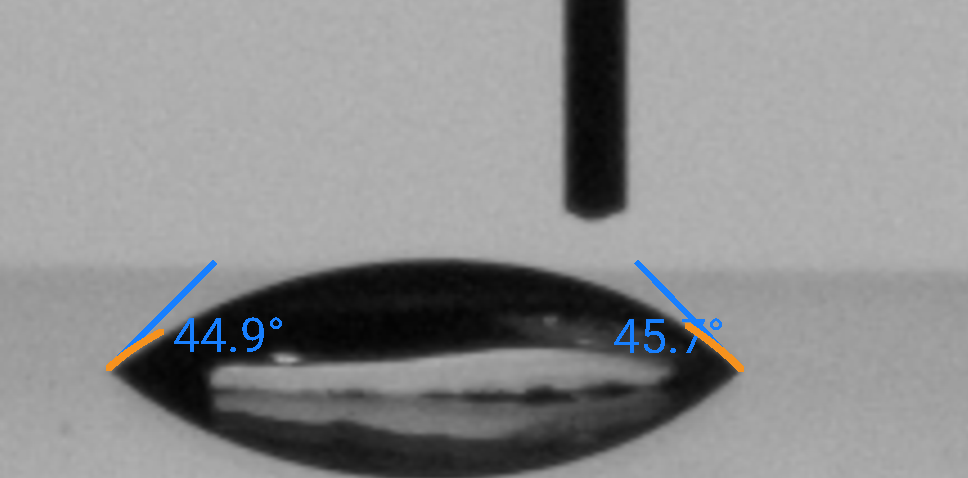
Sessile drop contact angle measurement: DI Water on Teflon surface, left contact angle 44.9°, right 45.7°

Sample Pre-Spray Contact Angle and Coating Tension Log

Zone / Sample Reading Value vs. Baseline
Panel A — Substrate, centre Contact angle 61.8° Within range
Panel B — Substrate, edge near fixture Contact angle 82.4° +20.6° above median
Coating batch 1 (freshly mixed) Surface tension 31.2 mN/m Within range
Coating batch 2 (held 4h, re-check) Surface tension 27.6 mN/m 3.6 mN/m below baseline (drift)
Panel C — Orange peel present, substrate + coating both in range Contact angle / Surface tension Both within range No wetting/tension signal; redirect to viscosity/atomization

Panel B shows elevated contact angle at a fixture-contact point, flagged for re-cleaning. Coating batch 2 shows surface tension drifting below baseline after a 4-hour hold, consistent with solvent loss or additive settling, flagged before it reaches the gun. Panel C is the important case: orange peel is present, but both substrate wetting and coating tension read within range. That result is itself informative, it rules out the two levers this workflow measures and points the investigation toward viscosity, atomization, or application technique instead.

FAQ

Common questions before adoption

No, not fully. It screens two specific, measurable levers, substrate wetting and coating surface-tension stability. Published paint-defect literature identifies viscosity, atomization, spray-gun setup, and flash/cure conditions as the more commonly cited primary drivers, and this workflow does not measure those directly. Use it to rule wetting and coating-tension causes in or out quickly, then redirect to a viscosity/application investigation if both read clean.

There is no universal threshold. Acceptable values depend on your substrate, coating chemistry, and application method. Establish your own PASS / MONITOR / FAIL gates by correlating measured values to your historical smooth-versus-orange-peel outcomes.

A five-spot contact angle check plus a coating surface-tension reading typically takes under 10 minutes including setup, measurement, and logging.

No. It rules out the two things this workflow measures. A coating can still have a viscosity or formulation issue that affects leveling through mechanisms other than surface tension, such as its flow behavior under shear. Wetting and tension readings in range are a strong signal to look elsewhere, not proof the coating is fully fine.

Yes, more directly than it diagnoses orange peel's own root cause. Fisheye and crater defects are strongly linked to contamination-driven surface-tension differentials, which this workflow measures well. Orange peel has a wider set of causes, several of which this workflow does not measure.

Yes. The Dropometer produces numeric contact-angle and surface-tension logs with replicate data, timestamps, and operator records, usable in NCR documentation, CAPA files, incoming inspection records, and supplier audit packages.

A gloss/DOI check tells you the finish failed. It does not tell you whether the cause was upstream (substrate, coating batch) or downstream (spray parameters, environment). This screen narrows that down before you commit time to a full viscosity/atomization investigation.

Business Impact

What Changes When You Screen Wetting and Coating Readiness

Before and with Dropometer; operational outcomes

Metric Before Dropometer With Dropometer Indicative Benchmark
Failure discovery point Post-cure, once sand/buff/polish or repaint are the only options Pre-spray screen on two known levers, before the coating is committed "Repaint/refinish costs several times more than an upstream hold and re-check"
Root-cause triage Multi-day, opinion-driven, no numeric baseline, viscosity/technique/substrate all blamed at once Same-shift: substrate and coating-tension readings rule two causes in or out immediately, narrowing the remaining investigation "Structured elimination vs. iterative trial-and-error"
Coating-batch drift Unmeasured; additive or thinner drift discovered only after defects appear Tracked via pendant-drop surface tension before the batch is loaded into the gun "Catches formulation drift before it reaches the part"
Operator-to-operator variation Unmeasured; technique-driven defects mistaken for material issues Substrate/coating readings stable across operators isolates technique as the remaining variable "Replicate spread separates material causes from technique causes"
Audit documentation Subjective notes; not defensible under audit Numeric contact-angle/surface-tension logs with timestamps, operator records, and lot ID "Applicable to NCR, CAPA, incoming inspection, and supplier qualification records"
Rework and scrap cost Included in cost standards and often treated as unavoidable Wetting- and coating-tension-driven orange peel intercepted before spray "COPQ from rework typically 15–20% of revenue for manufacturers without upstream gates"

Instant ROI Snapshot

Orange Peel ROI Snapshot

Estimate avoided sand/buff/repaint cost from wetting- and coating-tension-driven orange peel.

Each Dropometer unit is $5,000, default models 1 unit.
Rework events per month specifically tied to wetting- or coating-tension-detectable causes, not total orange-peel volume
Labor + materials to wet-sand, buff, polish, or respray an orange-peel panel.
Substrate-wetting and coating-tension screening is expected to address roughly 20-35% of orange-peel events overall
Share of scrap cost specifically attributable to unrepairable orange-peel panels, not blanket line scrap.
Reduced engineering/troubleshooting time from faster elimination of substrate and coating-tension

Result

~0
Monthly savings
~0
Payback period
~0
Year-1 net benefit

Monthly savings = preventable rework cost + preventable scrap cost + other monthly savings.

Honest scope

What Contact Angle and Surface Tension Measurement Cannot Tell You

Knowing the limits of any measurement tool is part of using it responsibly, and orange peel is one of the clearer cases where that matters.

Orange peel is multi-factor. Viscosity, atomization, air pressure, film build, and flash/cure time are commonly cited as primary drivers in the paint-defect literature, and none of them are measured by this workflow.
A clean substrate-wetting and coating-tension reading does not rule out a coating problem entirely, it rules out the two things this workflow measures, not viscosity- or rheology-driven leveling issues.
No universal contact-angle or surface-tension threshold exists for every substrate/coating combination. PASS/FAIL gates must be built per substrate, coating system, and application method.
Rough or textured substrates increase replicate scatter, requiring more measurement spots per zone for reliable statistics.
Optical contact-angle detection may need additional validation for heavily pigmented or opaque coatings.
Surface energy values are model-dependent, do not compare values calculated using different models (Fowkes vs. van Oss–Good) as absolute indicators.
Contact angle and surface tension are process-risk indicators, not direct proof of a defect-free finish, always correlate to your gloss/DOI or visual acceptance standard.

Use this page to quickly rule two known levers in or out, not as a complete orange-peel diagnostic. The Dropometer is one layer in a quality system, not a substitute for one.

How this page was created

Editorial and technical transparency notes for this page.

Transparency Details 4 checklist items
01

Drafting assistance

Initial draft created with AI assistance (ChatGPT 5.2 Pro), then rewritten for technical clarity.

02

Technical review

Reviewed and edited for technical accuracy by a surface-science specialist.

03

Verification steps

Identifiers, units, thresholds, and key claims checked against cited sources before publication.

04

Updates

Reviewed every 12 months or when the underlying standard changes.

Report a correction

Spotted an issue in this summary? Send a correction request and our team will review it.

Correction Request

We work hard to keep this standards summary accurate and up to date. If you spot an error (wrong revision/year, missing requirement, incorrect interpretation, or broken link), tell us and we'll review it.

Contact us to report a correction


References

Sources

1.
Saint Clair Systems. "Understanding Paint Defects: The Case of Orange Peel." Identifies viscosity and solvent/reducer content as primary drivers of orange peel. https://viscosity.com/understanding-paint-defects-the-case-of-orange-peel/
2.
Infinita Lab. "What Is Orange Peel? Coating Surface Defect, Causes and Guide." Identifies spray-application parameters, film build, reducer content, and solvent evaporation rate as primary drivers; does not discuss substrate wetting as a cause. https://infinitalab.com/blog/what-is-orange-peel-coating-defect-guide/
3.
Abbott, S. "Marangoni and Rayleigh." Practical Coatings Science. Documents surface-tension-gradient (Marangoni) instability as a mechanism for uneven film leveling during drying. https://www.stevenabbott.co.uk/practical-coatings/marangoni.php
4.
Chen, X. et al. Contact angle measurement with a smartphone. Review of Scientific Instruments, 89, 035117 (2018). https://pubs.aip.org/aip/rsi/article-abstract/89/3/035117/368179/Contact-angle-measurement-with-a-smartphone
5.
Fabrico. "The Cost of Poor Quality (COPQ) in Manufacturing: 2026 Guide." Source for the 15–20%-of-revenue and 10× hidden-cost figures used in the Post-Hero Highlights. https://www.fabrico.io/blog/cost-of-poor-quality-copq-manufacturing-guide/
6.
Making Strategy Happen, "The Cost of Quality: The 1-10-100 Rule." https://www.makingstrategyhappen.com/the-cost-of-quality-the-1-10-100-rule/