Contents

Surface Science Hub

Wettability Testing Methods: Choosing the Right Approach for Your Research

A comprehensive method-selection guide covering all ten common wettability and interfacial-tension testing techniques, with a decision flowchart and industry applications.

What Are the Most Effective Wettability Testing Methods for Surface Science?

Wettability testing methods help scientists understand how liquids interact with solid surfaces. This fundamental surface property affects everything from medical implants to smartphone screens. Whether you’re developing new coatings, testing biocompatibility, or teaching surface science, choosing the right testing approach makes all the difference in your research outcomes.

The right wettability testing method depends on your specific research goals, sample characteristics, and available resources. Modern instruments including AI-assisted analysis software now bring laboratory-grade precision to educational settings and field research, making accurate surface analysis more accessible than ever before.

Understanding Wettability and Why It Matters in Research

Wettability describes how a liquid spreads across or beads up on a solid surface. This property determines whether water slides off a raincoat, how well paint adheres to metal, or if a medical implant will integrate with body tissue. The way surfaces interact with liquids affects product performance across nearly every industry.

In the coatings industry, wettability testing ensures paints and protective layers bond properly to substrates. Medical device manufacturers rely on these measurements to verify biocompatibility and predict how implants will behave in the body. Electronics producers use wettability analysis to optimize soldering processes and circuit board treatments. Materials scientists study wetting behavior to develop self-cleaning surfaces, anti-fog coatings, and advanced composites.

Wettability influences quality control protocols, product development timelines, and innovation strategies. A coating that performs well in one application might fail completely if the surface wettability isn’t properly characterized. Understanding these interactions helps researchers predict product behavior, troubleshoot manufacturing issues, and develop new materials with specific surface properties.

Research institutions worldwide now use wettability testing as a standard tool for surface characterization. The measurements provide quantitative data that can be compared across studies, validated against standards, and used to make informed decisions about material selection and surface treatments.

Contact Angle Methods

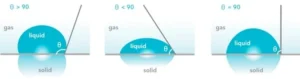
Contact angle measurement is the most widely used method for assessing wettability: the angle formed where a liquid droplet meets a solid surface. A small angle means good wetting; a large angle means the liquid beads up. Three variants cover almost every situation you’ll encounter. For full method detail, accuracy specifications, and step-by-step protocol on the technique overall, see our Contact Angle Measurement: The Definitive Guide.


contact angle θ labeled,shown at three angles — under 90° (wetting), 90°, and over 90° (non-wetting)

Sessile Drop (Static Contact Angle)

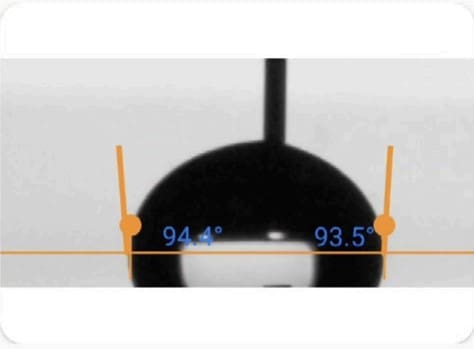
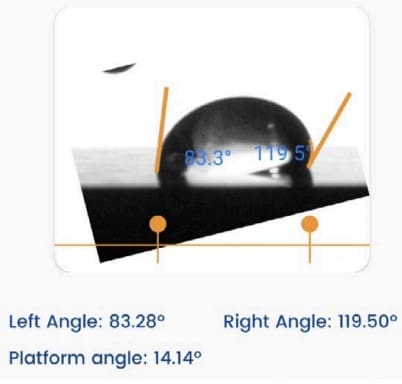
The sessile drop method is the standard approach: a droplet is placed on the surface and the angle is measured from a side-view image, captured at a single moment in time. It remains the default for most flat, dry samples because it’s fast, needs minimal sample prep, and has decades of published reference data behind it — a full measurement takes seconds and works well for initial screening, quality checks, and homogeneous, well-characterized surfaces where you need a fast answer rather than a complete picture.

Sessile drop measurement on the Dropometer

Static contact angle measurement using the sessile drop method.

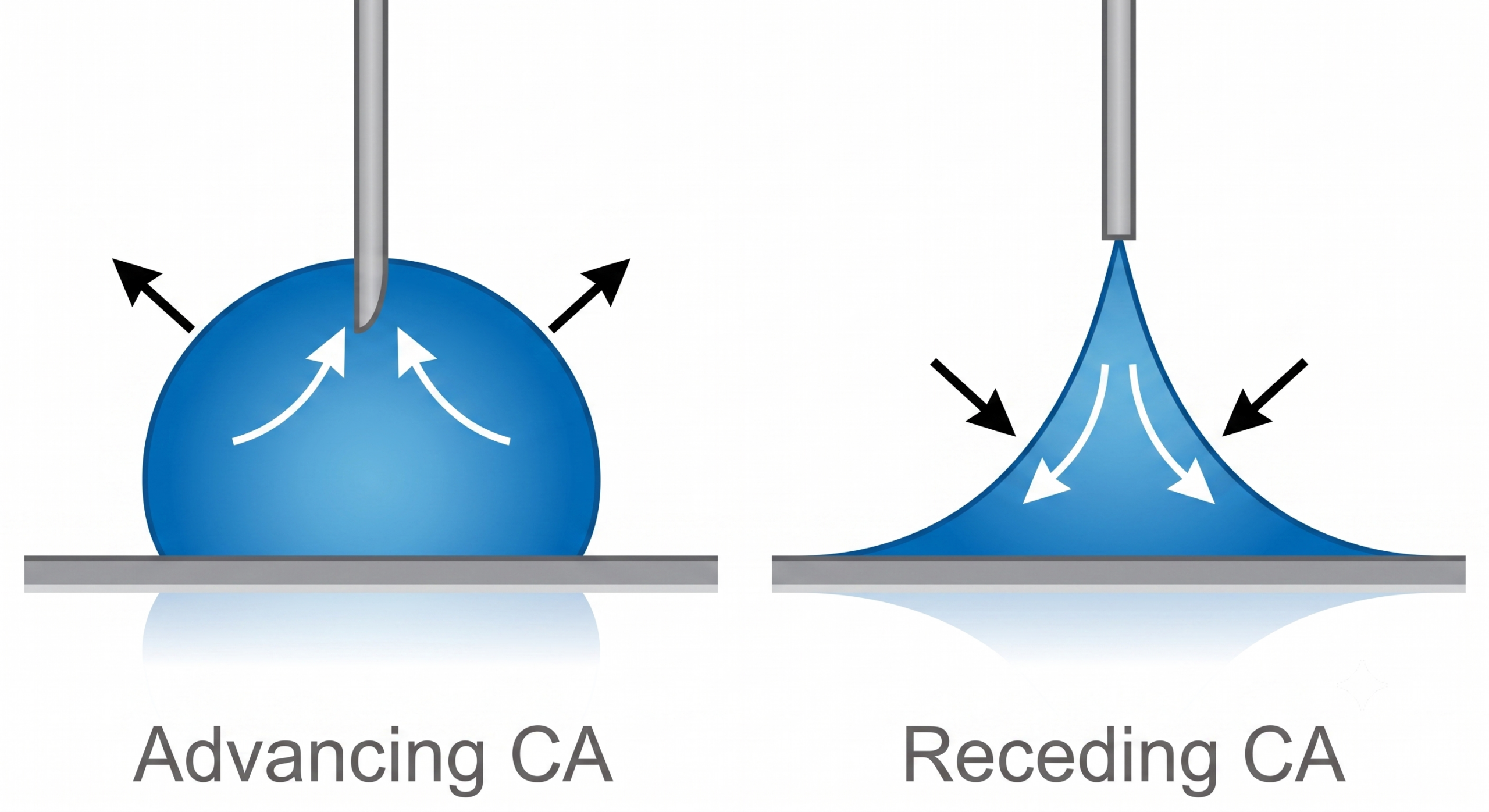
Dynamic Contact Angle (Advancing/Receding)

Dynamic contact angle measurements track how the angle changes as liquid is added (advancing angle) or removed (receding angle) from the droplet, rather than capturing one static snapshot. The difference between advancing and receding angles; the hysteresis reveals surface heterogeneity, roughness effects, and chemical variations that a static measurement can miss entirely. Use this when studying complex surfaces, developing new materials, or investigating fundamental wetting phenomena; many projects run static measurements to screen samples quickly, then dynamic analysis on the most interesting cases.

Contact angles below 90 degrees, at 90 degrees, and above 90 degrees

Contact angle indicates whether a liquid wets or beads on a surface.

Captive Bubble

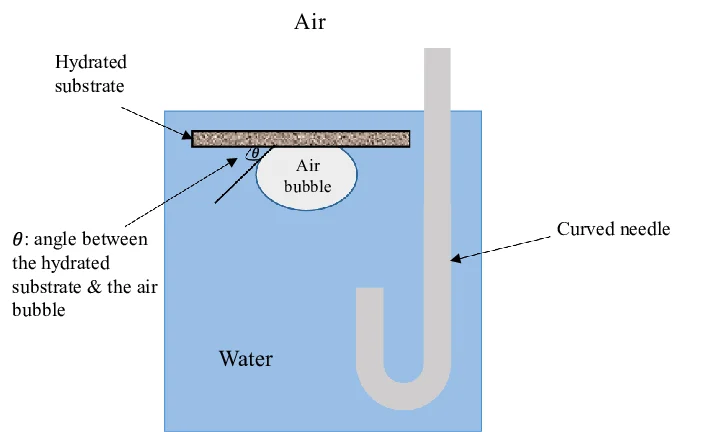
The captive bubble method turns the standard setup upside down. Instead of placing a droplet on a dry surface, the sample is fully submerged in the test liquid, and a small air or oil bubble is introduced from below through a curved, inverted needle until it presses up against the underside of the sample. The contact angle is measured through the liquid phase, at the three-phase line where bubble, sample, and surrounding liquid meet.

Because the sample never leaves the liquid, this sidesteps the two biggest error sources in sessile-drop work on delicate samples: evaporation changing the droplet mid-measurement, and the sample surface itself changing the moment it dries out. That makes captive bubble the right choice for hydrogels, contact lenses, cell-culture substrates, and other biomaterials that behave differently wet versus dry — at the cost of needing a dedicated immersion cell, careful bubble-size control (an oversized bubble distorts the reading through buoyancy), and a setup that doesn’t translate to routine, high-throughput production QC.

Captive bubble contact angle measurement schematic

Captive bubble measurement keeps the sample fully submerged.

Surface Tension Methods

Surface tension methods characterize the liquid phase rather than the solid surface, through the cohesive forces that determine whether a liquid can spread at all. Both connect directly to wettability through the Young equation, which balances three interfacial tensions; solid-vapor, solid-liquid, and liquid-vapor (the liquid’s own surface tension) against the cosine of the contact angle. A cleaning solution might have perfect chemistry but fail if its surface tension prevents proper spreading. For full method comparison and accuracy data, see our Surface Tension Measurement: The Definitive Guide.

Pendant Drop

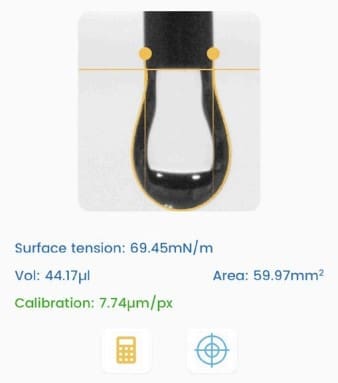
The pendant drop method analyzes the shape of a droplet hanging from a needle under gravity, fitting the profile to the Young-Laplace equation to extract surface or interfacial tension. One setup handles both surface tension (liquid in air) and interfacial tension (liquid in a second, immiscible liquid), which makes it the most versatile of the tensiometry methods — though the fit is sensitive to needle geometry and vibration during capture.

Pendant drop surface tension measurement on the Dropometer

Pendant drop analysis extracts surface or interfacial tension from droplet shape.

Du Noüy Ring

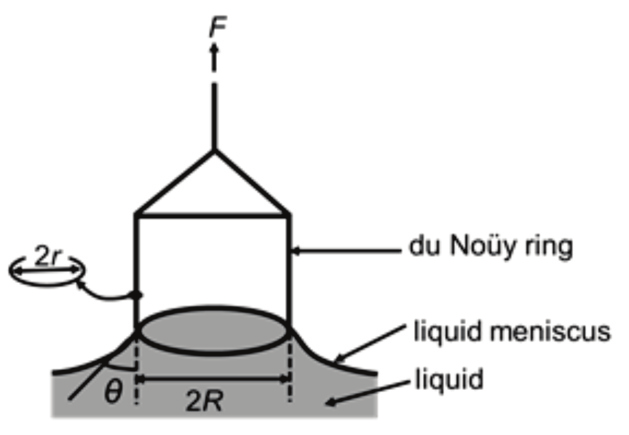
The du Noüy ring method measures the force required to pull a wire ring through a liquid surface, using a balance or force sensor rather than an optical droplet image. It’s long-established and easy to interpret directly as a force reading, which is why it remains common for simple, well-characterized liquids like paints and inks but it needs careful ring cleaning and calibration between runs, and it’s weaker on viscous or fast-evaporating liquids than pendant drop.

Du Noüy ring surface tension measurement schematic

The ring method measures the force required to detach a wire ring from the liquid surface.

Spinning Drop

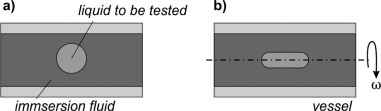
The spinning drop method matters only in a narrow but real case. A droplet of the lighter liquid (or a gas bubble) is injected into a liquid-filled glass capillary, which is then spun at high speed around its long axis. Centrifugal force pushes the denser liquid outward and stretches the droplet along the tube’s axis, while interfacial tension resists that stretching and pulls it back toward a sphere. At a known rotation speed, droplet radius, and density difference between the two liquids, that balance solves directly for interfacial tension (via the Vonnegut equation).

This is the only practical way to measure ultra-low interfacial tensions — below roughly 0.1 mN/m — that pendant drop and ring methods can’t resolve accurately, because at that scale gravity is too weak relative to interfacial tension to produce a measurable pendant-drop shape at all. That makes it essentially a specialist tool for surfactant formulation and enhanced-oil-recovery work; most QC and coatings applications will never generate interfacial tensions low enough to need it.

Spinning drop capillary tube at rest and rotating

Rotation elongates the droplet so ultra-low interfacial tension can be calculated.

Surface Energy: Turning Contact Angle Data Into One Comparable Number

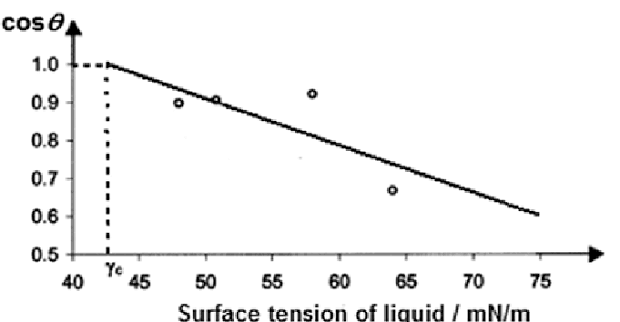
Surface energy methods aren’t a separate physical measurement so much as a calculation applied to contact angle data collected with several different test liquids. Zisman’s method is the original version: measure contact angle with a homogeneous series of liquids of known, decreasing surface tension, plot cos θ against each liquid’s surface tension, and extrapolate the resulting line to cos θ = 1 — that intercept is the critical surface tension, an estimate of the solid’s surface energy.

Later models refined this for surfaces with mixed polar and non-polar character: Owens-Wendt/Fowkes (OWRK) and the acid-base van Oss-Good approach use just two or three liquids (typically water and diiodomethane) to split surface energy into dispersive and polar (or acid and base) components, rather than requiring Zisman’s full liquid series. This is the number coatings and adhesion teams actually want to compare across surface treatments, because “contact angle with water was 72°” doesn’t transfer between labs using different test liquids the way a surface energy value does.

The tradeoff: results depend on which liquids and which model you pick, so two labs can legitimately report different surface energy numbers for the same surface if they used different methods — always state which model you used. Full protocol and liquid-selection guidance is in our Surface Energy Measurement: The Definitive Guide. Our ISO 19403-6 use-case guide covers the standardized version of this workflow if you need it tied to a recognized standard rather than a general method.

Zisman plot of cosine contact angle against liquid surface tension

A Zisman plot extrapolates the fitted line to cos θ = 1 to estimate critical surface tension.

Sliding (Roll-Off) Angle Testing

Sliding angle sometimes called roll-off or tilt angle measures the angle at which a substrate must be tilted before a droplet of known volume starts moving. It’s a direct, practical measurement of repellency: a surface can have a high static contact angle and still not shed water well if the droplet sticks in place, and sliding angle is what catches that. This makes it the right test for anti-icing coatings, self-cleaning surfaces, and textile water-repellent finishes, where the real-world question is “does water actually run off,” not just “does it bead up.” It’s a poor fit outside that use case — a mid-range wetting surface won’t produce a meaningful roll-off reading at all, since the droplet may never move even at a full tilt. See our Sliding Angle Measurement: The Definitive Guide for equipment requirements and test-liquid recommendations, or our ISO 19403-6 use-case guide if you need this tied to that specific standard’s roll-off procedure.

Sliding angle measurement on the Dropometer

Sliding angle records the tilt at which a droplet starts moving.

Wilhelmy Plate Technique for Dynamic Wettability Assessment

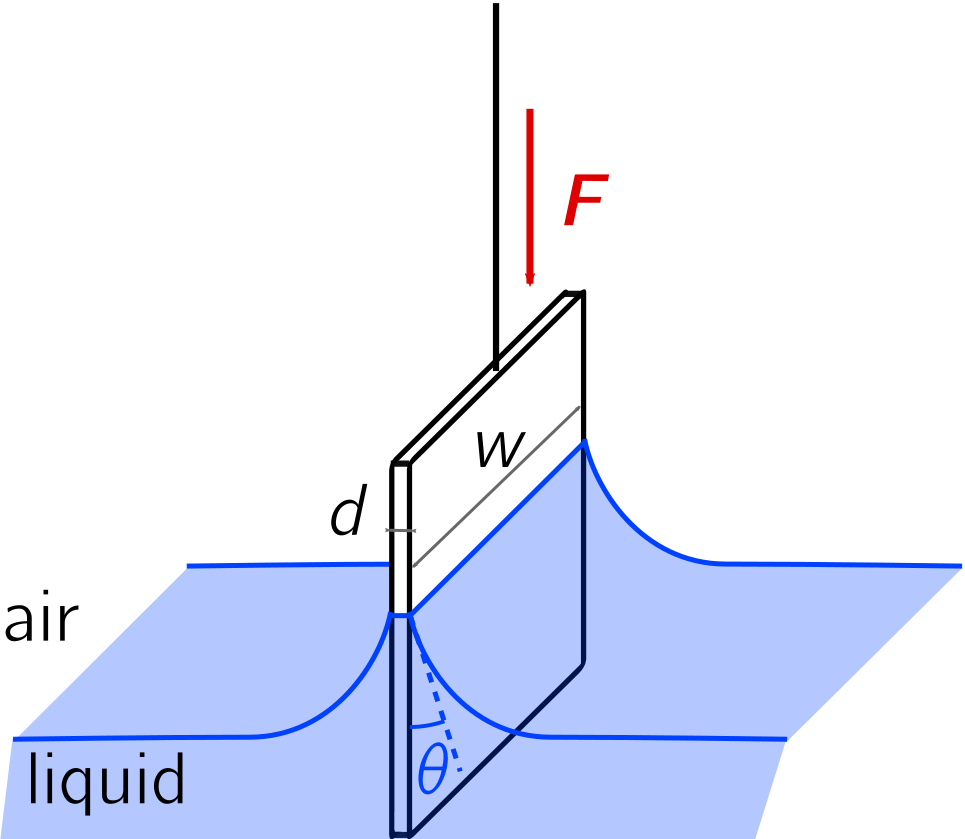
The Wilhelmy plate method measures wetting forces as a thin plate is slowly immersed into or withdrawn from a liquid. The technique records the force on the plate throughout the wetting cycle, providing detailed information about dynamic wetting processes. This approach captures time-dependent behavior that single-point measurements miss.

Wilhelmy plate measurements excel at studying how quickly surfaces wet, how wetting changes over time, and how repeated wetting cycles affect surface properties. The continuous force measurement reveals subtle effects like liquid penetration into porous materials or changes in surface chemistry during exposure. Researchers gain insight into practical wetting scenarios that better match real-world conditions.

Fiber and textile researchers frequently use the Wilhelmy plate technique to characterize how treatments affect fabric wetting. Our ASTM D8597 use-case guide and AATCC TM193 use-case guide cover the standardized versions of this workflow. Paper scientists study liquid absorption and sizing effectiveness. Coating developers evaluate how quickly treatments establish hydrophobicity and how durable the effect remains. The method works particularly well for samples that can be cut into thin strips or plates.

Sample preparation requires more care than sessile drop methods. The plate must be clean, uniform, and properly oriented. Data interpretation considers factors like plate geometry, immersion speed, and liquid properties. Despite these considerations, the Wilhelmy plate provides unique insights into dynamic wetting that make it valuable for specific research applications.

Wilhelmy plate force measurement schematic

The immersion and withdrawal cycle reveals time-dependent wetting forces.

Testing Powders and Porous Media: The Capillary Rise (Washburn) Method

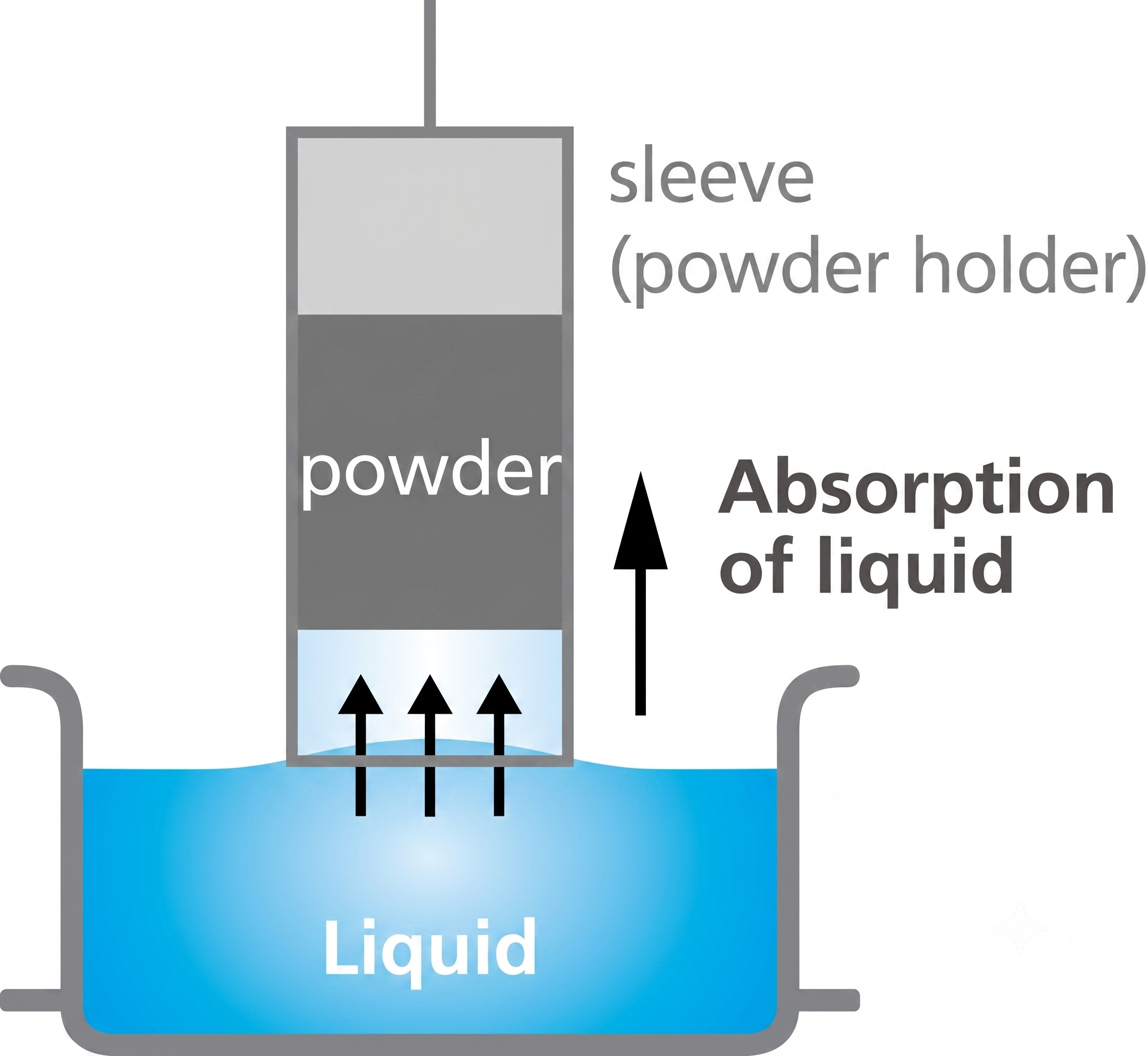
None of the droplet-based methods above work on loose powder — there’s no flat surface to put a droplet on. For powders, packed beds, and porous solids, the standard approach is the capillary rise (Washburn) method: a powder is packed into a tube, one end is brought into contact with a test liquid, and the rate at which liquid climbs into the bed is measured and fit to the Washburn equation to back-calculate an effective contact angle and wetting rate.

This is a genuinely different measurement category — pharmaceutical solids, powder coatings, paper, and textile finishing all rely on it, and it requires dedicated instrumentation (a packed-bed rig and balance or liquid-height sensor) rather than an optical droplet system. If your samples are powders or highly porous, plan for this as a separate technique and separate equipment line, not an extension of a droplet-based goniometer.

Washburn capillary rise method for powders and porous solids

The Washburn method measures liquid rise through a packed powder bed or porous solid.

Wettability Testing Methods at a Glance

Compare what each method measures, where it fits best, and the main advantage and limitation to consider.

MethodWhat It MeasuresBest Use CaseAdvantageLimitation
Sessile drop (static contact angle)Equilibrium angle at the solid-liquid-vapor lineFast QC screening, batch-to-batch comparisonFast, simple, decades of published reference dataA single time-point reading can miss real surface heterogeneity
Dynamic contact angle (advancing/receding)Angle as liquid volume increases or decreasesDetecting surface heterogeneity, roughness, contaminationReveals hysteresis that static measurement can’t seeSlower per sample; needs precise, controlled liquid dispensing
Captive bubbleContact angle with the sample fully submergedHydrogels, biomaterials, anything that changes when driedAvoids evaporation and drying artifactsNeeds an immersion cell; impractical for routine production QC
Pendant dropSurface or interfacial tension from droplet shapeLiquid/formulation work, interfacial tension between two liquidsOne setup handles both surface and interfacial tensionSensitive to needle geometry and vibration
Du Noüy ringSurface tension from force to detach a ringSimple, well-characterized liquids (paints, inks)Long-established, easy to interpretNeeds careful ring cleaning/calibration; weaker on viscous or fast-evaporating liquids
Spinning dropUltra-low interfacial tensionSurfactant/EOR systems below ~0.1 mN/mOnly practical method at that sensitivitySpecialized, higher-cost equipment; narrow use case
Surface energy calculation (Zisman / OWRK / acid-base)Solid surface energy, from multi-liquid contact angle dataComparing surface treatments, predicting adhesion/coating compatibilityProduces one comparable number instead of several anglesResult depends on liquid choice and model — must be stated
Sliding / roll-off angleTilt angle at which a droplet starts movingAnti-icing, self-cleaning, water-repellent finishesDirectly measures real-world shedding behaviorMeaningless on mid-range wetting surfaces; droplet may never move
Wilhelmy plateWetting force through an immersion/withdrawal cycleFibers, textiles, coating durability over repeated wettingCaptures time-dependent dynamic wetting other methods missMore sample prep (thin strips/plates); more complex data interpretation
Capillary rise (Washburn)Wetting rate through a packed powder bed or porous solidPharmaceutical powders, paper, porous coatings, textilesOnly practical direct method for powders and porous solidsRequires dedicated packed-bed instrumentation, separate from droplet systems

How to Select the Right Wettability Testing Method for Your Application?

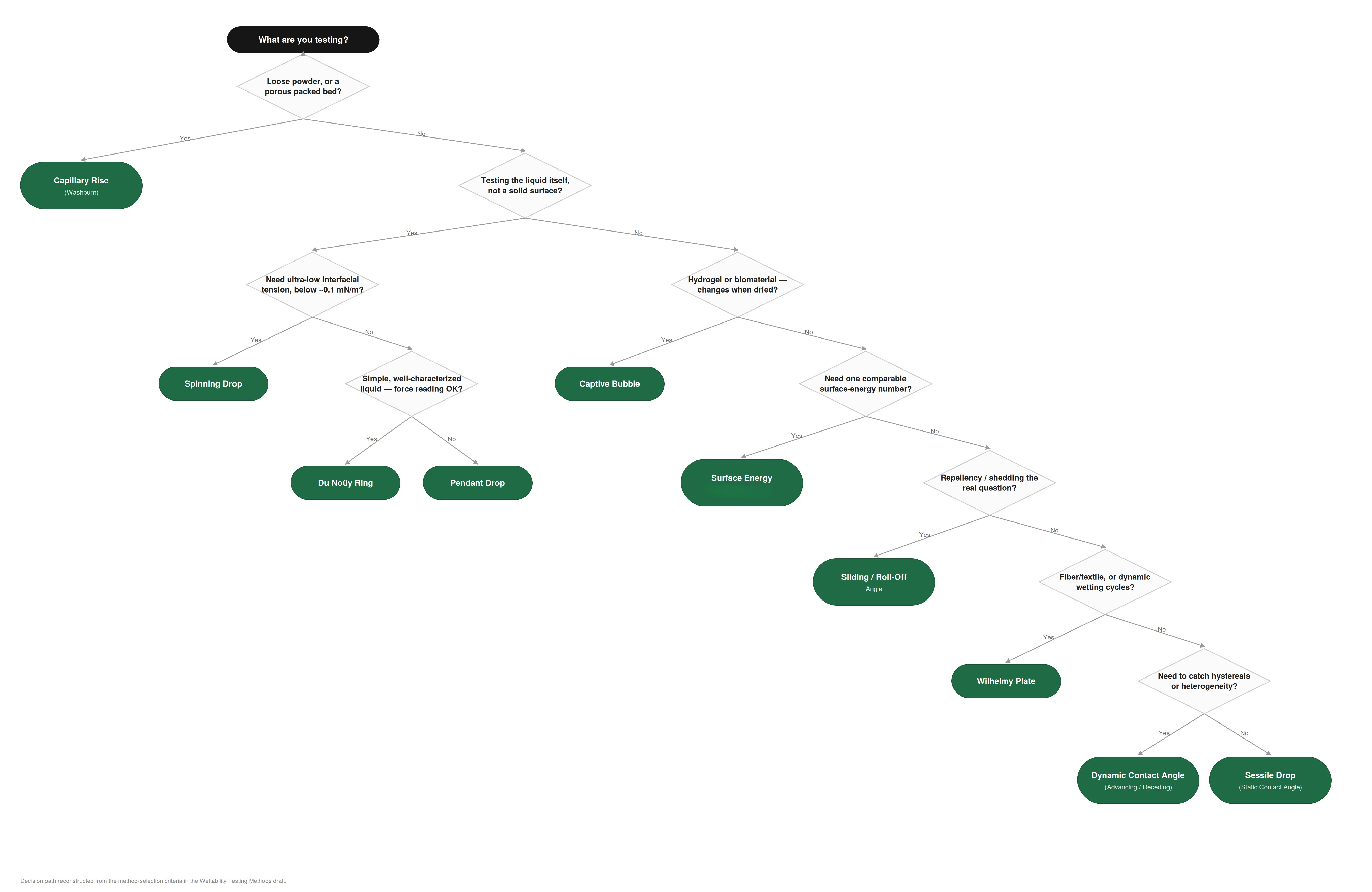
The flowchart below covers all ten methods from the table above in one decision path: start at the top and follow the branch that matches your sample.

Selecting the right method starts with defining your objective: characterizing new materials, troubleshooting production issues, teaching surface science concepts, or conducting fundamental research since different goals need different levels of precision, speed, and analytical depth. Sample characteristics matter just as much: flat, smooth surfaces work with almost any technique, while rough, porous, or curved surfaces need specialized approaches, and sample size determines whether you can even use methods that require cutting or destructive prep.

Contact angle measurement offers the best balance of accuracy, ease of use, and versatility for most applications. It handles diverse sample types, requires minimal training, and produces results that connect directly to practical wetting behavior. Surface tension methods make sense when you’re characterizing liquids or developing formulations. Surface energy calculations are the right call when you need one comparable number across surface treatments rather than raw angles. Sliding angle testing fits repellency-focused work, Wilhelmy plate techniques suit dynamic studies and fiber-based materials, and capillary rise is the only realistic option once your sample is a powder rather than a solid surface.

Educational institutions benefit from intuitive instruments that students can operate confidently. Systems with AI-powered analysis reduce the learning curve and help students focus on interpreting results rather than struggling with technique. The Dropometer was designed specifically to meet these needs, combining precision with accessibility at a price point that fits academic budgets.

Decision flowchart for choosing a wettability testing method

Wettability testing method decision flowchart.

Factors to Consider When Choosing Testing Equipment

The right equipment choice comes down to a handful of tradeoffs: sample geometry (flat coupons versus fibers, films, or curved parts), the precision your application actually needs rather than the highest number on a spec sheet, total cost of ownership beyond the purchase price, and whether you need field/production-floor portability or a fixed lab setup with more features.

Educational institutions benefit from intuitive instruments that students can operate confidently. Systems with AI-powered analysis reduce the learning curve and help students focus on interpreting results rather than struggling with technique. The Dropometer was designed specifically to meet these needs, combining precision with accessibility at a price point that fits academic budgets.

For a full walkthrough of these tradeoffs, including what to ask any vendor before you buy, see our Contact Angle Goniometer Buying Guide.

Best Practices for Accurate Wettability Measurements

Four things drive most of the variability in wettability results, regardless of which method you’re using: surface contamination (even invisible residue from handling changes wetting behavior — clean immediately before testing and handle by edges), environmental control (temperature and humidity shift surface tension and evaporation rates, so control or at least record them), liquid purity and selection (match the test liquid to your actual use case, not just convenience), and calibration against reference materials with known contact angles to catch instrument drift before it reaches your data.

We’re publishing detailed, step-by-step measurement protocols for each method on protocols.io, specific to the Dropometer’s workflow — watch our blog for the link once they’re live. This section stays as the general, instrument-agnostic version of these principles.

Common Pitfalls and How to Avoid Them

Surface contamination

Surface contamination causes more measurement problems than any other factor. Oils from skin, airborne particles, and cleaning residues alter surface chemistry and wetting behavior. Prevention starts with proper sample handling: always use gloves, avoid touching measurement areas, and store samples in clean environments. When contamination occurs, proper cleaning usually restores original surface properties. Establish and follow cleaning protocols appropriate for your materials.

Drop volume effects

Drop volume effects can significantly impact measurement accuracy. Very small droplets experience different forces than larger drops. The relationship between drop size and contact angle depends on surface roughness and chemistry. Use consistent drop volumes across all measurements in a study. For comparative work, match drop sizes to published methods or standards. Modern AI-powered instruments help maintain consistent droplet volumes automatically.

Time-dependent phenomena

Time-dependent phenomena affect many surfaces and liquids. Contact angles can change immediately after droplet placement due to liquid spreading, evaporation, or chemical reactions. Some surfaces rearrange when exposed to liquids, gradually changing wettability. Measure at consistent times after droplet placement, typically after angles stabilize. For volatile liquids, work quickly or use saturated chambers to minimize evaporation. Document and report measurement timing.

Operator variability

Operator variability stems from subjective decisions about droplet placement, baseline selection, and edge detection. Two operators measuring the same sample might report different values due to technique differences. AI standardization removes most operator subjectivity by automatically detecting features and calculating angles. Instruments like the Dropometer use machine learning to identify droplet edges and baselines consistently, regardless of who performs the measurement.

Emerging Technologies in Wettability Testing

AI-powered analysis is transforming traditional wettability measurement — automatically detecting droplet edges, compensating for optical distortions, and recognizing measurement artifacts that could skew results, learning from large image sets to catch patterns a human might miss. We’ve written in detail about how we built and validated this specifically for contact angle measurement in Developing AI for Automating Contact Angle Measurement.

Automated systems minimize human error by standardizing every measurement step. Robotic liquid dispensing ensures consistent drop volumes. Automated staging positions samples precisely. Computer vision captures images at optimal moments. Software analyzes results using validated algorithms. This automation particularly benefits high-throughput applications where manual measurements would be tedious and variable. Educational settings gain from automation that lets students focus on concepts rather than technique.

Multi-modal measurements combine multiple techniques in single instruments. A system might measure contact angle, surface tension, and interfacial tension from the same setup. Integration reduces sample handling, saves time, and ensures measurements share identical conditions. Correlation between different parameters provides deeper insight into surface behavior than isolated measurements. These comprehensive approaches help researchers understand complex wetting phenomena.

Future trends point toward increasingly accessible, affordable precision instruments that serve global researchers. As manufacturing costs decrease and machine-learning-based analysis improves, laboratory-grade measurements become available to smaller institutions and developing regions. This democratization of surface science tools accelerates innovation by enabling more researchers to investigate wetting phenomena.

Real-World Applications of Wettability Testing Across Industries

Medical devices

Medical device development relies heavily on wettability testing to ensure biocompatibility and proper device function. Implant surfaces must achieve specific wetting properties to promote tissue integration while preventing bacterial adhesion. Contact lens manufacturers optimize surface treatments to maintain comfortable hydration. Diagnostic devices use controlled wetting to direct fluid flow through microchannels. Each application requires precise wettability characterization during development and quality control — see our Medical Device industry guide for the full picture.

Coatings

The coating industry depends on wettability measurements to predict adhesion, evaluate durability, and optimize application processes. Paint formulators adjust surface tension to ensure proper spreading and leveling. Anti-fog coatings are characterized by their ability to spread water into thin films. Hydrophobic treatments are verified by measuring high contact angles. Wettability testing connects coating chemistry to real-world performance.

Electronics

Electronics manufacturing uses wettability analysis to optimize soldering processes and circuit board surface treatments. Solder wetting determines joint strength and reliability. Conformal coatings must wet complex topographies uniformly. Flux formulations are developed based on their wetting and spreading properties. As electronics become smaller and more complex, precise wetting control becomes increasingly critical — our Electrical & Electronics industry guide goes deeper on this.

Academic research

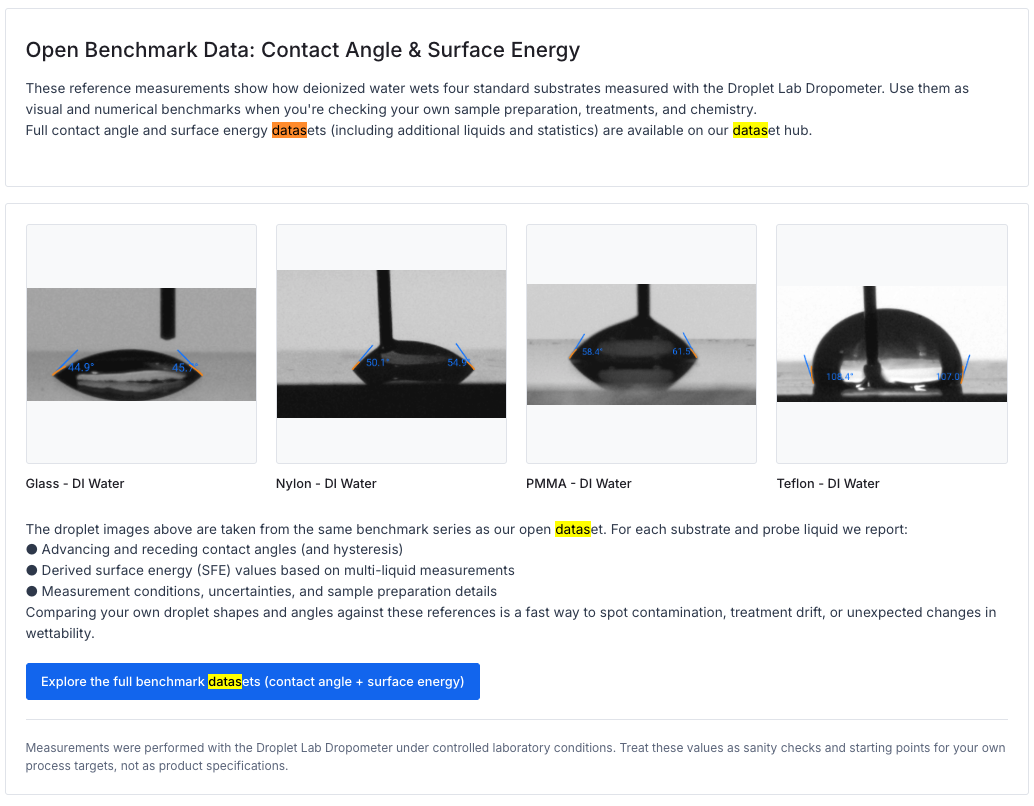
Academic research employs wettability testing to advance fundamental understanding of surface science. Researchers investigate how surface chemistry, roughness, and structure affect wetting. Studies explore superhydrophobic surfaces inspired by nature, stimuli-responsive materials that change wettability on command, and novel coatings with unique properties. These investigations generate knowledge that drives innovation across all application areas. For substrate-specific reference data, our open benchmark dataset reports contact angle and surface energy values across common materials under controlled conditions, and our citations page tracks peer-reviewed papers that have used our measurements directly.

Beyond these four, our Surface Science Hub carries dedicated guides for semiconductors, pharmaceuticals, textiles, packaging, agriculture, and 20 others — worth checking if your industry isn’t covered above.

Droplet Lab open wettability dataset

Open benchmark data supports substrate-specific comparison under controlled conditions.

Frequently Asked Questions

Wettability is the general term describing how well a liquid spreads on a surface. Contact angle is the specific measurement used to quantify wettability. The angle tells you whether wetting is good (low angles, liquid spreads) or poor (high angles, liquid beads). Contact angle provides the numerical value that lets you compare wettability across different surfaces and liquids.

A basic static contact angle measurement takes less than one minute per sample. This includes placing the droplet, capturing the image, and calculating the angle. Dynamic measurements require several minutes as liquid is added or removed from the droplet. Multiple measurements for statistical analysis add time proportionally. AI-powered instruments speed the process by automating analysis that would otherwise require manual image processing.

Yes, but rough and porous surfaces present special challenges. Rough surfaces may show apparent contact angles that differ from true material wettability. Porous surfaces can absorb liquid during measurement, changing droplet size and angle — our ISO 14778 use-case guide covers the standardized fixed-time approach for paper and board specifically. Specialized techniques like the Wilhelmy plate method or modified contact angle approaches work better for these materials, and loose powders need a different approach entirely — see the capillary rise (Washburn) method above. Consider the surface characteristics when selecting your measurement method.

Water is the standard choice for general wettability characterization. It’s safe, inexpensive, well-characterized, and relevant to many applications. Use deionized or distilled water to ensure consistent surface tension. For specific applications, match the test liquid to actual use conditions. Medical devices might be tested with saline solution. Coating studies might use organic solvents. The key is using high-purity liquids and documenting exactly what you tested.

Temperature influences both liquid surface tension and surface chemistry. Surface tension decreases as temperature increases, generally leading to better wetting and lower contact angles. Some surfaces change properties with temperature due to molecular rearrangement or phase transitions. Temperature variations of just a few degrees can produce measurable changes. Control temperature during measurements or at least monitor and report it. Most laboratories standardize on room temperature (20-25°C) for consistent results.

Measuring wettability on curved surfaces is possible but more complex than flat surface measurements. Fibers and small tubes can be tested using the Wilhelmy plate technique. Contact angle measurements on curved surfaces require corrections for surface geometry. Some specialized instruments can handle moderate curvature. Severely curved or irregular shapes might need alternative approaches like captive bubble methods. Consider whether you need to measure the actual curved object or if testing a flat sample of the same material provides sufficient information.

Required accuracy depends on your research questions. Distinguishing between hydrophobic and hydrophilic surfaces needs accuracy within a few degrees. Investigating subtle surface modifications might require sub-degree precision. For publication-quality research, look for instruments offering ±1° accuracy or better. Reproducibility often matters more than absolute accuracy: consistent measurements let you detect real differences between samples. Modern AI-assisted systems, including our own Dropometer, are designed to support this kind of precision and reproducibility at a lower price point than traditional benchtop goniometers — but any stated accuracy figure is only as good as the calibration and validation behind it, so ask a vendor for their published validation data rather than the spec sheet number alone.