
Contents
Surfactants, CMC, Emulsions and Foams

Lipid Vesicle Manufacturing Yield: Screen Lipids by Oil and Water Interfacial Tension Before You Make Vesicles

In emulsion transfer methods, vesicles form only where lipids pack well at the oil and water interface. A pendant drop interfacial tension reading for each lipid formulation shows how well it assembles there, so teams can rank lipid choices before spending time and material on fabrication runs.

Who this is for: Researchers and process scientists making liposomes, asymmetric vesicles and giant vesicles by emulsion transfer, droplet transfer or inverted emulsion methods.

Where it fits: Choosing lipids, oils and lipid concentration for the interface step, and checking batches of lipid solution before fabrication.

What it does not do: It does not measure vesicle size, lamellarity, encapsulation, asymmetry or any delivery or biological outcome.

Method
Pendant drop interfacial tension, buffer against lipid in oil, with Young Laplace fitting at a locked drop age
Standard
No standard for lipid interfacial tension; the method follows general pendant drop practice
Setup
About 2 minutes
Abhimanyu Photo
Written by
Abhimanyu Bhandankar
Holds an MBA from Schulich School of Business and a BE in IT. He joined Droplet Lab in July 2019 and now leads sales and marketing.
CEO at Droplet Lab
Read More

Droplet-Lab logo
Technical Review by
Droplet Lab Team
Droplet Lab builds precision instruments and software for surface science measurement, specialising in contact angle analysis and surface tension characterisation. Used by researchers across materials science, pharmaceuticals, coatings, and advanced manufacturing, Droplet Lab's Dropometer has contributed to studies published in peer-reviewed journals including Advanced Functional Materials (Impact Factor 19). The team combines instrument engineering with deep domain knowledge in wettability science with a focus on practical accuracy.
Read More

Abhimanyu Photo
Written By

Abhimanyu Bhandankar

CEO at Droplet Lab

Holds an MBA from Schulich School of Business and a BE in IT. He joined Droplet Lab in July 2019 and now leads sales and marketing.

Droplet-Lab logo
Reviewed By

Droplet Lab Team

Droplet Lab builds precision instruments and software for surface science measurement, specialising in contact angle analysis and surface tension characterisation. Used by researchers across materials science, pharmaceuticals, coatings, and advanced manufacturing, Droplet Lab's Dropometer has contributed to studies published in peer-reviewed journals including Advanced Functional Materials (Impact Factor 19). The team combines instrument engineering with deep domain knowledge in wettability science with a focus on practical accuracy.

Why it matters

Why interfacial tension matters for vesicle yield

12 to 25 mN/m

interfacial tension of POPS, POPC and EPC formulations in mineral oil against buffer, measured by pendant drop; the authors observed higher asymmetric vesicle yield at lower tension.

Yang et al., Advanced Functional Materials 35:2505738, 2025

30 to 40% humidity

dehumidifying to this range cut the variability of lipid adsorption kinetics, tracked by pendant drop interfacial tension, in an optimized vesicle production method.

Van de Cauter et al., ACS Synthetic Biology 10:1690, 2021

About 100 per second

giant vesicles produced by a continuous droplet interface method with charged lipids and ionic solutions, once the oil and lipid conditions were right.

Blosser, Horst and Keller, Soft Matter 12:7364, 2016

Sources: Yang C. et al., Engineering asymmetric nanoscale vesicles for mRNA and protein delivery to cells, Advanced Functional Materials, 2025; Van de Cauter L. et al., Optimized cDICE for efficient reconstitution of biological systems in giant unilamellar vesicles, ACS Synthetic Biology, 2021; Blosser M.C., Horst B.G., Keller S.L., cDICE method produces giant lipid vesicles under physiological conditions of charged lipids and ionic solutions, Soft Matter, 2016. Figures come from these sources, not from Droplet Lab measurements.

Quick reference

What this lipid interface screen does and what it does not

A quick reference for vesicle and liposome teams checking fit before reading further.

Evidence Box

Problem this solves

Lipid formulations chosen by trial fabrication runs, with low or variable vesicle yield and no measure of how the lipids behave at the interface.

Standards

No standard covers lipid interfacial tension. Lock your own method, and report oil, lipid concentration and drop age.

Peer reviewed method

The Dropometer drop shape method was validated against a KRUSS DSA100E in two peer reviewed papers, in Review of Scientific Instruments and Colloids and Surfaces A.

Customer case study

A Harvard University shared facility runs one Dropometer for several research groups, with published interfacial tension, surface tension and contact angle data.

Published research

Harvard researchers measured lipid interfacial tension from 12 to 61.5 mN/m and saw higher asymmetric vesicle yield at lower tension (Advanced Functional Materials, 2025).

Honest limit

Interfacial tension predicts the interface step only. Vesicle size, quality and function need their own tests.

Who this is for

What vesicle manufacturing question are you trying to answer?

Pick the card closest to your role. Each one points to the part of this page that answers it.

Vesicle and liposome researcher

You make asymmetric or giant vesicles by emulsion transfer and want to know which lipid mix will give a usable yield. Interfacial tension for each formulation ranks the candidates before you run the method.

Measure in the same oil, buffer and lipid concentration you use for fabrication.

Process or formulation scientist

You scale a vesicle process and need lipid solutions to behave the same from batch to batch. A pendant drop reading on each new lipid solution catches oxidised lipid, wrong concentration or contaminated oil before a run.

Set acceptance ranges from batches that gave good yield, not from published values.

Shared facility manager

You support many groups with different lipids and oils. One pendant drop instrument gives each group comparable interfacial tension data, as the Harvard shared facility does.

Keep a reference lipid solution and measure it each session.
Fit check

Is this the right screen for your vesicle process?

It measures how lipids lower the tension of the oil and water interface. It does not measure the vesicles.

Good fit if

You use emulsion transfer, droplet transfer or inverted emulsion methods.
You compare lipids, charged lipids or cholesterol content.
You compare oils or lipid concentrations for the interface step.
You check lipid solution batches before fabrication.
You report interfacial tension in vesicle papers.

Less relevant if

You make vesicles by film hydration and extrusion only.
You need vesicle size, polydispersity or lamellarity.
You need encapsulation or asymmetry measured directly.
You need delivery or biological results.
Summary

How interfacial tension helps predict vesicle yield

The answer in under a minute.

Measure the interfacial tension between your buffer and each lipid in oil formulation by pendant drop, at a fixed drop age. Lower tension means the lipids cover the interface better, and in a 2025 Harvard study it went with higher asymmetric vesicle yield. Use it to rank lipid choices before fabrication.

The Dropometer pendant drop tensiometer runs the measurement. Our pendant drop method entry and surface tension measurement guide explain the method. A Harvard University shared facility supports the asymmetric vesicle study, and our pharmaceutical guide covers wider formulation work.

The problem

Why vesicle yield is hard to predict

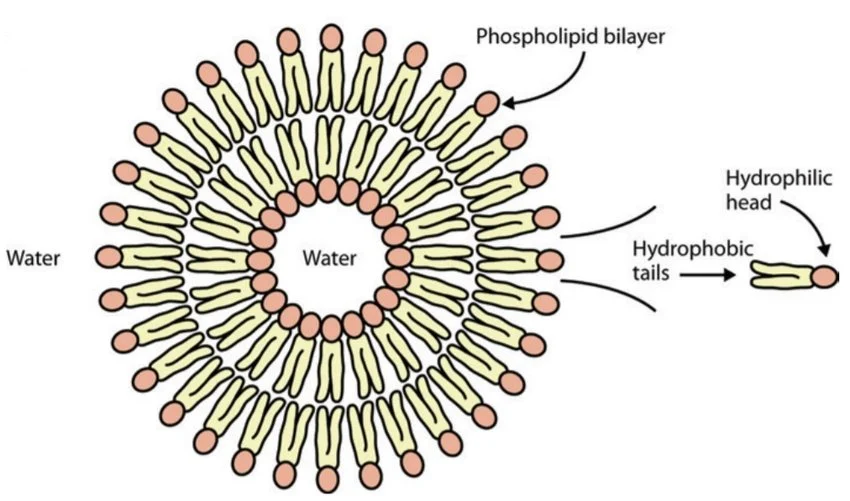
Emulsion based methods make vesicles in two steps at an oil and water interface. Lipids dissolved in oil first assemble into a monolayer at the interface; water droplets coated with lipid then cross that interface, picking up a second leaflet to become vesicles. This is how asymmetric vesicles with different inner and outer leaflets are made, and how inverted emulsion, droplet transfer and cDICE methods produce giant vesicles. Yield depends on how well the lipids cover the interface before transfer. Optimization studies found yield rises with lipid concentration and incubation time, that the choice of oil matters, and that humidity changes how fast lipids adsorb. Each new lipid mix, oil batch or buffer changes these conditions, and fabrication runs are slow and use expensive lipids. The difficulty is that these studies optimize by trial and error. Teams change one variable, run the method, count vesicles, and repeat. Interfacial tension measured by pendant drop gives a direct reading of how the lipids behave at the interface, and in a 2025 Harvard study lower tension went with higher yield. It is a fast way to rank lipid choices and check lipid solutions before committing a fabrication run.

Few vesicles form, or yield varies from run to run.
A new lipid mix gives far fewer vesicles than the old one.
Oil droplets fail to cross the interface during centrifugation.
Results change after a new batch of oil or lipid stock.
Vesicles carry visible oil or look defective.
Troubleshooting

Why vesicle yield drops and what to check

Why:

  • Lipids need time to adsorb at the oil and water interface before droplets cross it.

How to detect:

  • Interfacial tension is still falling at the time you start fabrication.

Corrective action:

  • Extend incubation until the tension curve flattens, or raise lipid concentration.

Why:

  • Some lipids, especially charged or ionizable ones, lower interfacial tension much less than others.

How to detect:

  • The formulation reads close to the lipid free baseline.

Corrective action:

  • Blend in a lipid that lowers tension well, or change the ratio, and measure again.

Why:

  • Surface active impurities in oil or buffer compete with lipids at the interface.

How to detect:

  • The lipid free baseline reads lower than usual.

Corrective action:

  • Use a new oil lot, filter the buffer, and record lot numbers with every run.

Why:

  • Water taken up by the oil speeds lipid adsorption and adds variation.

How to detect:

  • Adsorption curves vary from day to day.

Corrective action:

  • Control humidity during preparation, as Van de Cauter and colleagues did, and measure at the same conditions.

Why:

  • Old lipid stock changes how lipids pack at the interface.

How to detect:

  • A reference formulation reads differently from earlier batches.

Corrective action:

  • Replace the stock and keep a reference solution for each session.

Why:

Drop age, densities and temperature change the reading. Our guide to reproducible surface tension measurement covers fair comparisons.

How to detect:

  • Repeat measurements of one solution spread widely.

Corrective action:

  • Write the method down and report drop age, densities and temperature with every value.

Not sure which lipids to screen first?

Send your lipid list and oil, and we will plan a screen with you on a call.

Lab records

What a lipid interface screening record contains

Each screen produces a record you can file with the formulation and the fabrication run, so yield can be traced back to the interface step.

Formulation

Lipids and ratios, lipid concentration, oil and its lot, and the buffer.

Method settings

Drop configuration, densities, temperature and drop age at reading.

Readings

Interfacial tension per drop, the median and spread, and the curve over drop age.

Run link

The fabrication run that used this solution and its vesicle yield.

Decision

Use, adjust concentration, or reject the solution.

Drop images

Automatic edge and baseline detection gives the same reading from the same image, so a reviewer can recheck any result.

Measurements

What to measure at the lipid interface

Rank

Interfacial tension of each lipid formulation

Why it matters: Lower tension shows better lipid coverage of the oil and water interface.

How to interpret: Rank formulations measured the same way; compare with the lipid free baseline in the same oil.

When it is not enough: It does not prove the vesicles will be stable or asymmetric.

Kinetics

Interfacial tension against drop age

Why it matters: Lipids take time to adsorb, so the tension falls over seconds to minutes.

How to interpret: Compare at the same drop age, and match it to your incubation time before fabrication.

When it is not enough: It does not show how the monolayer behaves during transfer.

Baseline

Lipid free oil against buffer

Why it matters: It catches contaminated oil or buffer before you blame the lipids.

How to interpret: A baseline well below the expected value suggests surface active contamination.

When it is not enough: It does not identify the contaminant.

Batch

Reference lipid solution each session

Why it matters: It checks lipid stock, oil lot and method together.

How to interpret: Keep it inside a range set from batches that gave good yield.

When it is not enough: A good reading does not guarantee a good run.

Validation

Validated measurement approach for lipid interfacial tension

How the Dropometer itself has been validated, and where vesicle researchers have used it.

Peer reviewed method

The Dropometer drop shape method is published in Review of Scientific Instruments and Colloids and Surfaces A. Contact angle was validated against a KRUSS DSA100E, with a published accuracy of 0.35°.

See the validation papers

Customer evidence in vesicle fabrication

In a 2025 Advanced Functional Materials study from David Weitz's group at Harvard, researchers measured interfacial tension between mineral oil with lipid and buffer by pendant drop on a Droplet Lab instrument. Values ran from 12 mN/m for POPS to 61.5 mN/m for DODMA, and the authors observed higher asymmetric vesicle yield at lower tension.

Read the paper analysis
QC Protocol

How to screen lipids by interfacial tension

Six steps per lipid formulation. Repeat for each new lipid, oil or concentration.

1

Prepare the phases

Dissolve lipids in the oil at your fabrication concentration and prepare the buffer you use for the outer phase.

3

Form the drop

Form a drop of one phase in the other, as your method needs, with densities entered for both.

5

Rank formulations

Repeat for each lipid formulation and rank them against the baseline.

We completed our gage R&R study on the unit and it performed very well.

Brandon Barbee

Corporate Quality Engineer, Zeus Industries, Polymer Manufacturing

Download the lipid interfacial tension screening SOP

A two page SOP you can adapt for your vesicle process, with the method lock, drop age, baseline checks, a troubleshooting table and a record sheet.

Pendant drop surface tension measurement with the Dropometer

Pendant drop surface tension measurement with the Dropometer

Example output

Example lipid interfacial tension screen

Example data only. Your values will differ and must come from your own lipids, oil and fabrication runs.

How to read this screen

Lower interfacial tension than the lipid free baseline shows lipid at the interface. In this example, formulations B and C lowered the tension most and gave the highest yield in the matching runs; formulation D barely moved it. The yield column comes from fabrication runs, not from the instrument.

Example lipid formulation interfacial tension screen

Formulation Lipids IFT at locked drop age (mN/m) Change vs baseline (mN/m) Relative vesicle yield Decision
Baseline No lipid 48 0 None Reference
A Zwitterionic lipid 22 26 lower Medium Keep
B Zwitterionic lipid with cholesterol 18 30 lower High Keep
C Zwitterionic and anionic lipid 14 34 lower High Keep
D Ionizable lipid only 45 3 lower Low Adjust

Example data, not customer data. Mineral oil with lipid against buffer; read at a fixed drop age; median of 3 drops.

Signal order

The order to check signals in a lipid screen

Check these in order. Each one rules out a cause before you look at the next.

1

Method and densities

Rules out fitting and density errors.

2

Lipid free baseline

Rules out contaminated oil or buffer.

3

Reference lipid solution

Confirms the method and stock read as before.

4

Formulation ranking

Shows which lipids cover the interface best.

5

Fabrication yield

Confirms the ranking; our page on emulsion stability covers related interface work.

FAQ

Common questions about lipid interfacial tension and vesicle yield

Questions vesicle researchers ask about pendant drop screening.

Vesicles form when lipid coated droplets cross an interface already covered by a lipid monolayer. Lower interfacial tension shows denser lipid coverage of that interface. Yang and colleagues observed higher asymmetric vesicle yield at lower tension across four lipid formulations, while noting the mechanism was not tested directly. Treat it as a strong screening signal.

Whichever suits your densities and optics. In the 2025 Harvard study, the oil drop with lipid was analysed against buffer with a Young Laplace fit. Enter both densities at the test temperature, keep the same configuration for every formulation, and report it.

Long enough for the tension to approach a plateau, and ideally matched to your incubation time before fabrication. Lipids adsorb over seconds to minutes depending on oil, concentration and humidity. Record the curve over drop age and compare all formulations at the same age.

Yes. Moga and colleagues found mineral oil most suitable for the inverted emulsion method among the oils they tried, and Van de Cauter and colleagues found decane gave much faster adsorption but caused pendant drops to detach within seconds. Measure in the oil you will use for fabrication.

Pendant drops detach when interfacial tension is very low. Use a smaller needle or drop, or a different drop configuration, and keep it the same for every sample. If tensions are ultralow, a spinning drop method may suit better.

No. FDA's liposome drug product guidance lists attributes such as particle size, lamellarity, net charge, phase transition temperature and leakage, not interfacial tension. Interfacial tension is a development and process tool. Our page on the FDA 510(k) surface tension appendix covers a different case, contact lens care products.

No. This screen covers the fabrication step only: how lipids behave at the interface and how many vesicles form. Vesicle size, asymmetry, stability, encapsulation and any delivery outcome need their own tests.

A pendant drop tensiometer with an optical cell, density entry and drop age tracking. The Dropometer does this at the bench, and the Harvard shared facility runs one for several groups. Our CMC assessment page covers related surfactant work.

Business impact

What changes when you screen lipids first

Typical changes in how teams work. Benchmarks are given only where a published source exists.

Before and with lipid interfacial tension screening

Metric Before Dropometer With Dropometer Indicative Benchmark
Lipid selection Trial fabrication runs Interfacial tension ranking first Higher yield at lower tension observed across four lipids (Yang et al., 2025)
Incubation time Fixed by habit Set from the adsorption curve Yield depends on a sufficiently assembled monolayer (Moga et al., 2019)
Day to day variation Unexplained Adsorption tracked with humidity Lower variability at 30 to 40% humidity (Van de Cauter et al., 2021)
Lipid solution QC None before the run Reference solution each session No published benchmark; track on your own batches

See the screen on your own lipids

Send your lipid list and oil. We will show the measurement on a call.

Estimate saved fabrication runs

Enter your own numbers. The result is an estimate, not a Droplet Lab claim.

Vesicle fabrication estimate

Estimate saved fabrication runs.

Each Dropometer unit is US$5,000; the default models one unit.
Lipids, oil, buffer and consumables for one run.
Preparation, fabrication, vesicle counting and analysis.
No published benchmark. Use your own estimate and start low if unsure.

Result

~0
Candidates saved per month
~0
Monthly savings
~0
Payback period
~0
First year net benefit

Monthly savings = materials saved + technician time saved from reduced iterations.

Limits

What interfacial tension cannot tell you about vesicles

Honest limits, so you know when to reach for another test.

It predicts the interface step only, not the finished vesicle.
The link to yield is a correlation; confirm it on your own runs.
Readings depend on drop age; lock it.
Oil and buffer must match the fabrication method.
Very low tensions make pendant drops detach; adjust drop size.
It does not apply to film hydration or extrusion methods.

Pendant drop interfacial tension shows how well lipids cover the oil and water interface before fabrication. Vesicle size, lamellarity, asymmetry, encapsulation, stability and any delivery outcome need their own tests.

How this page was created

Editorial and technical transparency notes for this page.

Transparency Details 4 checklist items
01

Drafting assistance

Drafted with Claude Opus 5.5 (Anthropic) using web search for sources, then edited by the Droplet Lab team.

02

Technical review

Reviewed and edited for technical accuracy by the Droplet Lab Team.

03

Verification steps

Standard identifiers, units, thresholds and key procedural claims are checked against cited sources before publication.

04

Updates

Reviewed every 12 months or when the underlying method changes.

Report a correction

Spotted an issue in this summary? Send a correction request and our team will review it.

Correction Request

We work hard to keep this page accurate and up to date. If you spot an error (wrong revision/year, missing requirement, incorrect interpretation, or broken link), tell us and we'll review it.

Contact us to report a correction
Sources

References

1.
Yang, C., Menge, J., Zhvania, N., Yu, M., Yang, H., Chen, D., Zheng, Z., Weitz, D.A., Jahnke, K. Engineering asymmetric nanoscale vesicles for mRNA and protein delivery to cells. Advanced Functional Materials 35:2505738, 2025. See our analysis of this paper. https://dropletlab.com/validation/citations/analysis/engineering-asymmetric-nanoscale-vesicles-for-mrna-and-protein-delivery-to-cells/
2.
Moga, A., Yandrapalli, N., Dimova, R., Robinson, T. Optimization of the inverted emulsion method for high yield production of biomimetic giant unilamellar vesicles. ChemBioChem 20(20):2674 to 2682, 2019. https://doi.org/10.1002/cbic.201900529
3.
Van de Cauter, L. et al. Optimized cDICE for efficient reconstitution of biological systems in giant unilamellar vesicles. ACS Synthetic Biology 10(7):1690 to 1702, 2021. https://doi.org/10.1021/acssynbio.1c00068
4.
Blosser, M.C., Horst, B.G., Keller, S.L. cDICE method produces giant lipid vesicles under physiological conditions of charged lipids and ionic solutions. Soft Matter 12(35):7364 to 7371, 2016. https://doi.org/10.1039/c6sm00868b
5.
Pautot, S., Frisken, B.J., Weitz, D.A. Engineering asymmetric vesicles. PNAS 100(19):10718 to 10721, 2003. https://doi.org/10.1073/pnas.1931005100
6.
Venkatesan, G.A. et al. Adsorption kinetics dictate monolayer self assembly for both lipid in and lipid out approaches to droplet interface bilayer formation. Langmuir 31(47):12883 to 12893, 2015. https://doi.org/10.1021/acs.langmuir.5b02293
7.
US FDA. Liposome drug products: chemistry, manufacturing, and controls; human pharmacokinetics and bioavailability; and labeling documentation. Guidance for industry, 2018. https://www.fda.gov/regulatory-information/search-fda-guidance-documents/liposome-drug-products-chemistry-manufacturing-and-controls-human-pharmacokinetics-and-bioavailability
8.
Chen, X. et al. Contact angle measurement with a smartphone. Review of Scientific Instruments 89(3):035117, 2018. https://pubs.aip.org/aip/rsi/article-abstract/89/3/035117/368179/Contact-angle-measurement-with-a-smartphone
9.
Surface tension measurement with a smartphone using a pendant drop. Colloids and Surfaces A: Physicochemical and Engineering Aspects. https://www.sciencedirect.com/science/article/abs/pii/S0927775717307744