
Quality control
Why Does Contact Angle Matter for Coatings and Adhesives QC?
A coating or adhesive only bonds well if it first wets the surface, and contact angle is the most direct number for whether that will happen. Measuring it before you coat or bond catches contamination, under-treatment and ageing of treated surfaces while the fix is still cheap.


Droplet Lab Team
Droplet Lab builds precision instruments and software for surface science measurement, specialising in contact angle analysis and surface tension characterisation. Used by researchers across materials science, pharmaceuticals, coatings, and advanced manufacturing, Droplet Lab's Dropometer has contributed to studies published in peer-reviewed journals including Advanced Functional Materials (Impact Factor 19). The team combines instrument engineering with deep domain knowledge in wettability science with a focus on practical accuracy.
Why does contact angle matter for coatings and adhesives QC?
Short answer: wetting comes before adhesion. If a coating or adhesive cannot spread across a surface, it cannot make full contact, and the bond or finish suffers.
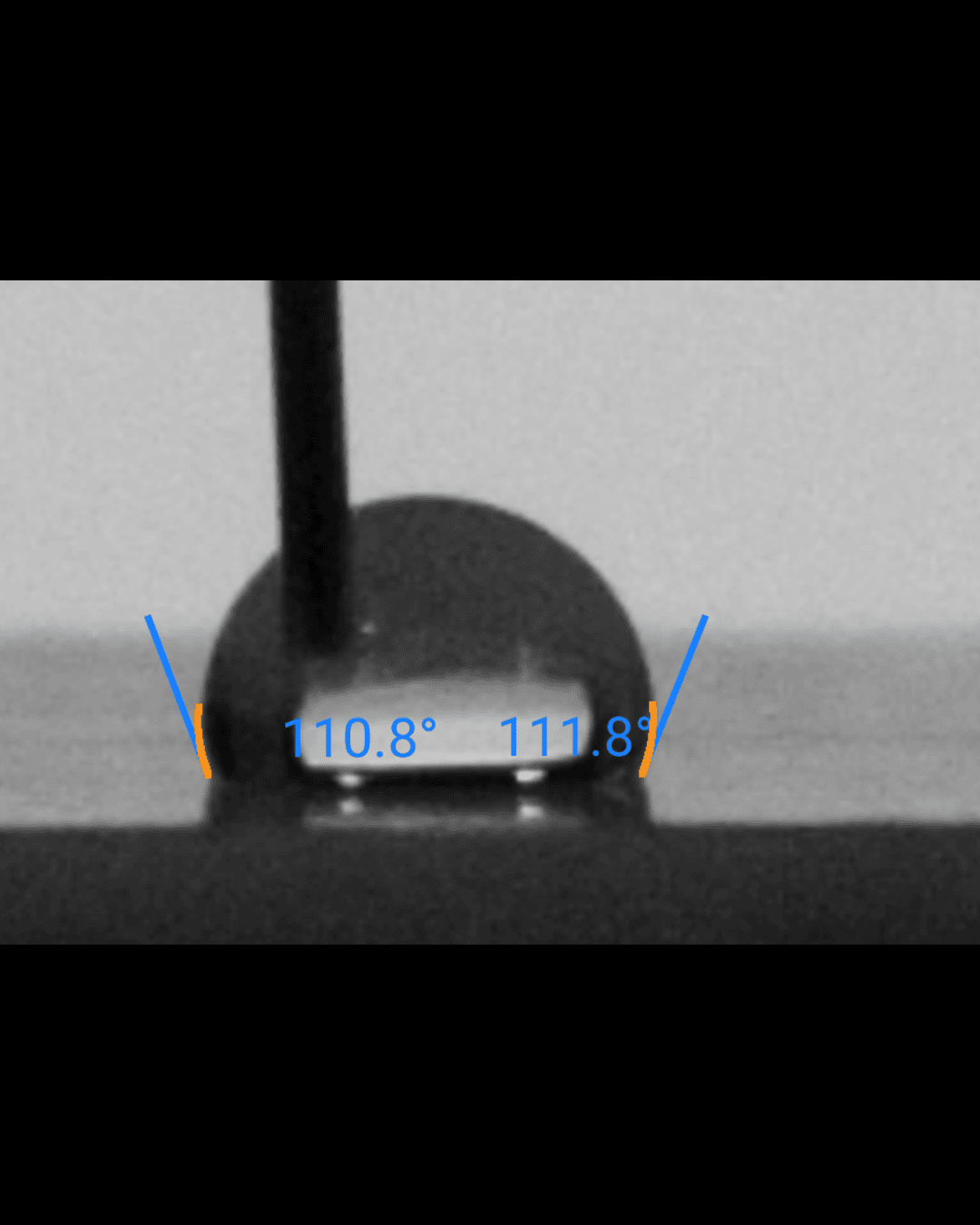
A contact angle measurement tells you how well a liquid wets that surface today. A low water contact angle usually means a clean, well treated surface; a rising angle is an early warning.
What does a contact angle measurement tell a QC lab?
The angle a drop makes with a solid reflects the balance between the liquid's surface tension and the solid's surface energy (Young, 1805). Water alone is a quick, sensitive check for contamination and treatment level.
Add a second liquid, such as diiodomethane, and you can calculate surface free energy with its dispersive and polar parts (Owens and Wendt, 1969). The contact angle measurement guide and the surface energy measurement guide explain both.
Why do coatings fail when wetting is poor?
A liquid spreads on a solid when its surface tension is lower than the solid's surface energy (Zisman, 1964). When that gap closes, paints pull back from low energy spots.
The result shows up as craters, fisheyes, crawling and orange peel. See the coating defects troubleshooting use case and the orange peel use case for causes and checks, and the paint and automotive industry guides for sector detail.
Expert Quote
Craters, fisheyes and orange peel are wetting stories told after the fact; measured surface tension and contact angle let you read the ending before you commit the coat.

Why do adhesive bonds fail when wetting is poor?
Most adhesive failures that start at the interface trace back to the surface, not the adhesive. Release agents, handling oils and airborne films all lower surface energy without being visible.
Plasma and corona treatments raise surface energy, but treated polymers lose some of that gain over time. A contact angle check at the bonding station tells you the surface is still ready.
See the adhesive failure prevention use case, the plasma treatment verification use case and Beyond 38 Dynes by Prof Steven Abbott.
Which standards cover contact angle for coatings and films?
Several standards describe contact angle methods for this work. Choose the one your customer or industry already references.
- ISO 19403-2: surface free energy of solid surfaces from contact angles.
- ISO 19403-6: measurement of dynamic contact angle.
- ASTM D5946: corona treated polymer films using water contact angle.
- ASTM D7334: surface wettability of coatings, substrates and pigments by advancing contact angle.
How do you set up a contact angle check on the line?
Fix the method first: the same liquid lot, the same drop volume and the same reading time after the drop lands. Then choose where to sample, such as right after treatment and right before coating or bonding.
Set pass and fail limits from your own good and bad parts, not from a generic number. Before you rely on the check, run a Gage R&R study to show the measurement is repeatable across operators.
Zeus ran its own Gage R&R on the Dropometer portable contact angle goniometer, and it passed. The Zeus case study describes how they use it in extrusion manufacturing. The Dropometer can be set up in about 2 minutes.
Should you use contact angle or dyne pens?
Dyne pens give a quick pass or fail threshold, read by eye. Contact angle gives a number you can trend, set limits on and compare between shifts and sites.
Many lines use both during a changeover period and compare results side by side. The dyne pens and contact angle comparison sets out the trade offs.
Where can you go deeper?
These pages cover the methods, standards and data behind this post.
- Case study: Fortune 500 adhesives R&D lab
- Customer study: Fullerene-Like Amorphous Carbon Nitride Film Surface Properties and Evaluating the Initial Adsorption Kinetics of Albumin and Fibrinogen
- Buying guide: Dropometer vs Brighton Science Surface Analyst 5001
- Glossary: Work of adhesion
- Measurement quality: Reproducible surface energy calculation
- Classroom experiment: Exp 6: Surface free energy with multiple liquids
- Open dataset: Surface Free Energy of Common Polymers and Substrates
- Tool: Surface Free Energy Calculator
- Related post: Self-Assembled Monolayers
- Related post: Why Oil Spreads and Water Beads
- Related post: The science of anti-fog coatings
Put a number on wetting before you coat or bond
See a contact angle check set up for a coating or bonding line, in a short call.
Frequently Asked Questions
What contact angle indicates good adhesion?
There is no universal value. Measure parts that bond well and parts that fail, then set your limits from that data and trend each batch against them.
Is contact angle better than dyne pens for QC?
They answer different questions. Dyne pens give a threshold read by eye; contact angle gives a number you can trend, set limits on and check with a Gage R&R study.
Which liquids should I use?
Water is the quick check for contamination and treatment level. For surface free energy, add a mainly dispersive liquid such as diiodomethane and use a model such as Owens and Wendt (1969).
Where should contact angle be measured on a production line?
Typically right after surface treatment and right before coating or bonding, so you see both the treatment result and any decay or contamination before the next step.