Use caseRead the use case
Surface Cleanliness Verification
Water contact angle on a cleaned food contact surface, compared with a known clean reference, can flag oily or fatty films that an ATP test does not detect.

Industry guide


This is a practical guide to surface science for teams working in the Food & Beverages industry.
In this guide: the four measurements that matter, where they decide yield in Food & Beverages, and the standards, use cases and studies behind them.
How food and beverage teams use surface and interfacial tension, contact angle and surface free energy. Each measurement is tied to a real problem, such as edible coatings, emulsions, foam, cleaning checks and packaging films.
An edible coating protects produce only when it spreads into an even film on the peel. Published packaging studies on the Dropometer show many bio based films are hydrophilic, with water contact angles that fall over the first 30 seconds.
Wetting checks screen coating formulations, emulsifiers and packaging films before long shelf life trials. One portable kit covers surface tension, contact angle and surface energy, so a food lab can compare candidates on the same measured values.
ASTM D5946 and ISO 15989 describe water contact angle on corona treated polymer film, which is relevant to printed and laminated packaging. No wetting standard covers edible coatings or food emulsions, so record liquid, temperature and drop age every time.
Measure surface and interfacial tension while you formulate, and contact angle when a coating or package meets a surface. Start with the measurement that matches your problem, then book a 15-minute consult about testing it on your own samples.
In food and beverage work, many quality problems start at an interface. A coating that beads on a waxy peel leaves gaps, and an emulsion that separates fails on the shelf. A packaging film that soaks up moisture can lose its barrier.
Surface Cleanliness Verification
Water contact angle on a cleaned food contact surface, compared with a known clean reference, can flag oily or fatty films that an ATP test does not detect.
Edible Coatings on Fresh Produce
Coating surface tension and contact angle on the peel show whether an edible coating formulation will spread into an even film on waxy fruit and vegetable skins.
Biodegradable Packaging Film Water Resistance
Water contact angle read at fixed times on the food contact side shows how fast a bio based film takes up moisture from the food it wraps.
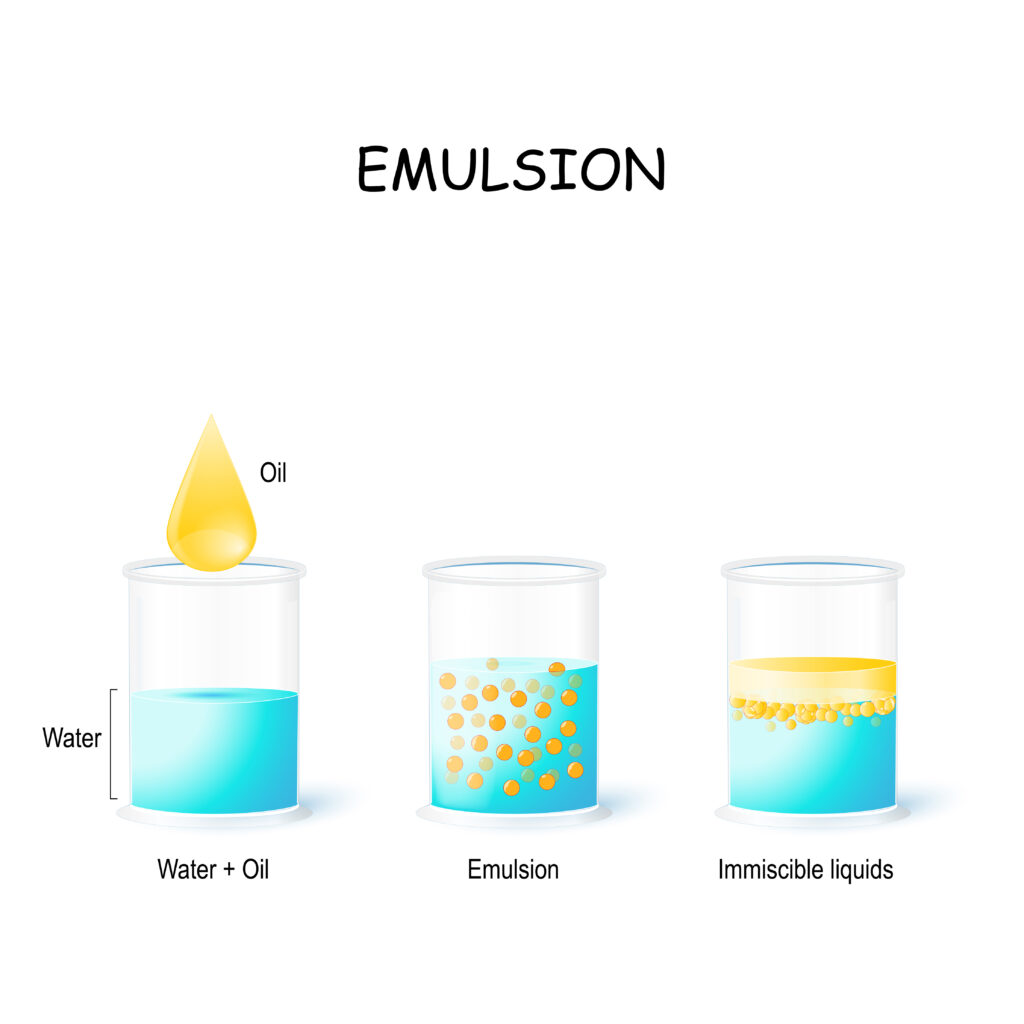
Oil and water interfacial tension by pendant drop screens emulsifiers for creams, dressings and sauces before you commit to long storage trials.
Foam Control And Foam Quality Tuning
Surface tension across a concentration series shows how surface active an ingredient or antifoam is, so foam in processing and fermentation can be tuned on the bench.
PFAS-Free Reformulation & Repellency
Water and oil contact angles, fresh and after abrasion, show whether a PFAS free wrapper, bowl or carton coating still repels grease as well as water.
The Dropometer drop shape analysis kit measures contact angle, surface and interfacial tension, surface free energy and sliding angle with one portable setup. Its method was validated against a KRUSS DSA100E in two peer reviewed papers. If you are new to the terms, start with wettability.
A dot means the measurement is the main check for that problem.
| Problem | Contact angle | Surface and interfacial tension | Surface energy | Sliding angle |
|---|---|---|---|---|
| Surface Cleanliness Verification | ||||
| Edible Coatings on Fresh Produce | ||||
| Biodegradable Packaging Film Water Resistance | ||||
| Emulsion Stability Mechanism | ||||
| Foam Control And Foam Quality Tuning | ||||
| PFAS-Free Reformulation & Repellency |
Not sure which test you need? Start with how to choose a wettability testing method.
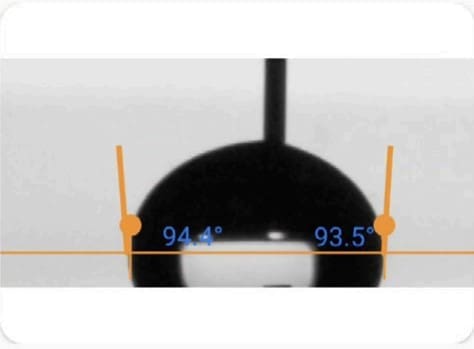
The angle a liquid drop makes where it meets a solid, in degrees. A low angle means the liquid spreads; a high angle means it beads. Use static angles for quick checks, and advancing and receding angles on real, rough or patchy surfaces, where one static value can mislead.
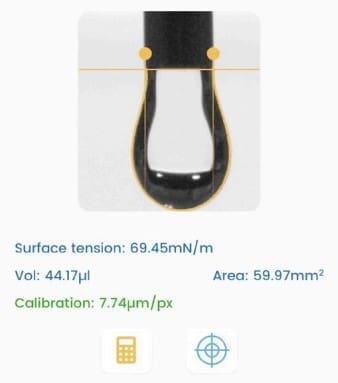
The force at a liquid surface that pulls it to the smallest area, in mN/m. The Dropometer measures it from the shape of a hanging (pendant) drop, and interfacial tension from a drop of one liquid inside another. Use static values for batch checks and dynamic values when interfaces form fast.
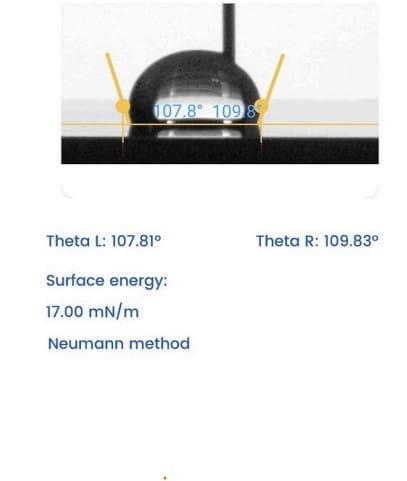
The energy needed to create new solid surface, in mJ/m². It is worked out from contact angles of two or more probe liquids. Use it before bonding, printing or coating to check that a surface is clean and treated enough.
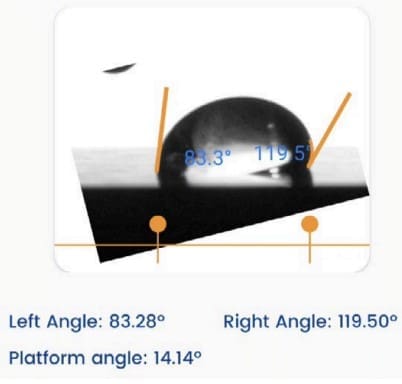
The tilt, in degrees, at which a drop starts to roll or slide off a surface. Use it for water and oil repellent surfaces, where a high contact angle alone does not show that drops will shed.
These reference measurements show how deionized water wets four standard substrates measured with the Droplet Lab Dropometer. Use them as visual and numerical benchmarks when you're checking your own sample preparation, treatments, and chemistry.
Full contact angle and surface energy datasets (including additional liquids and statistics) are available on our dataset hub.
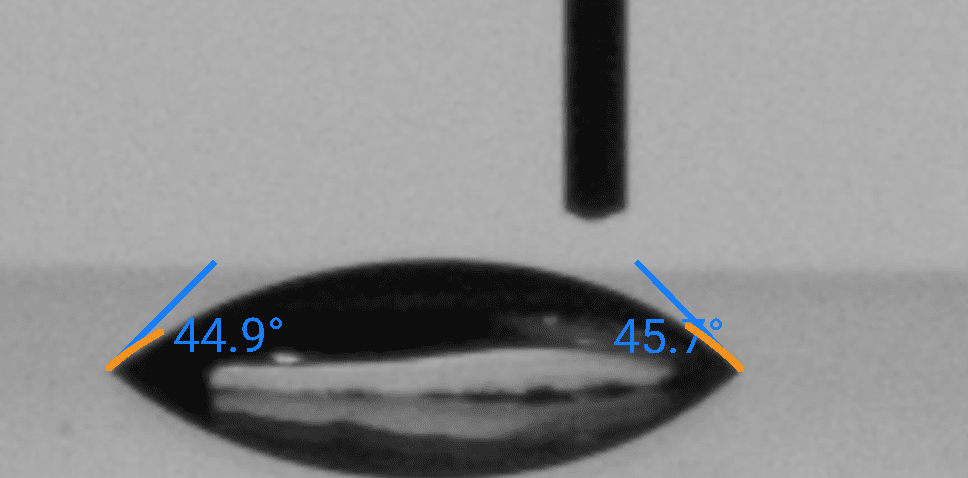
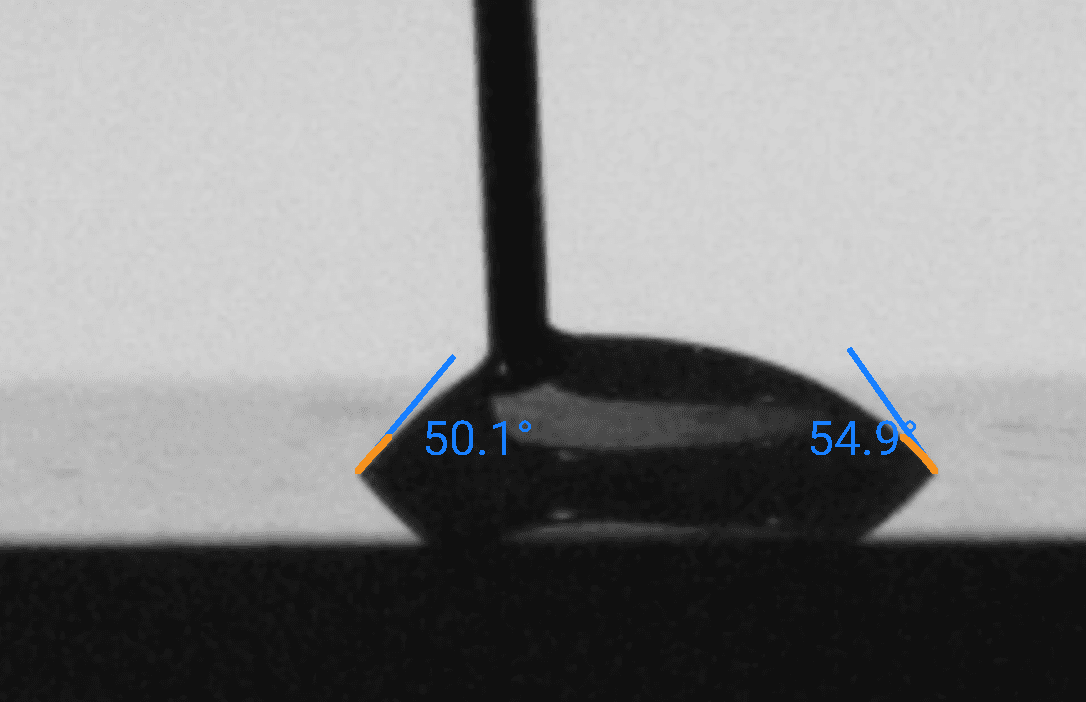
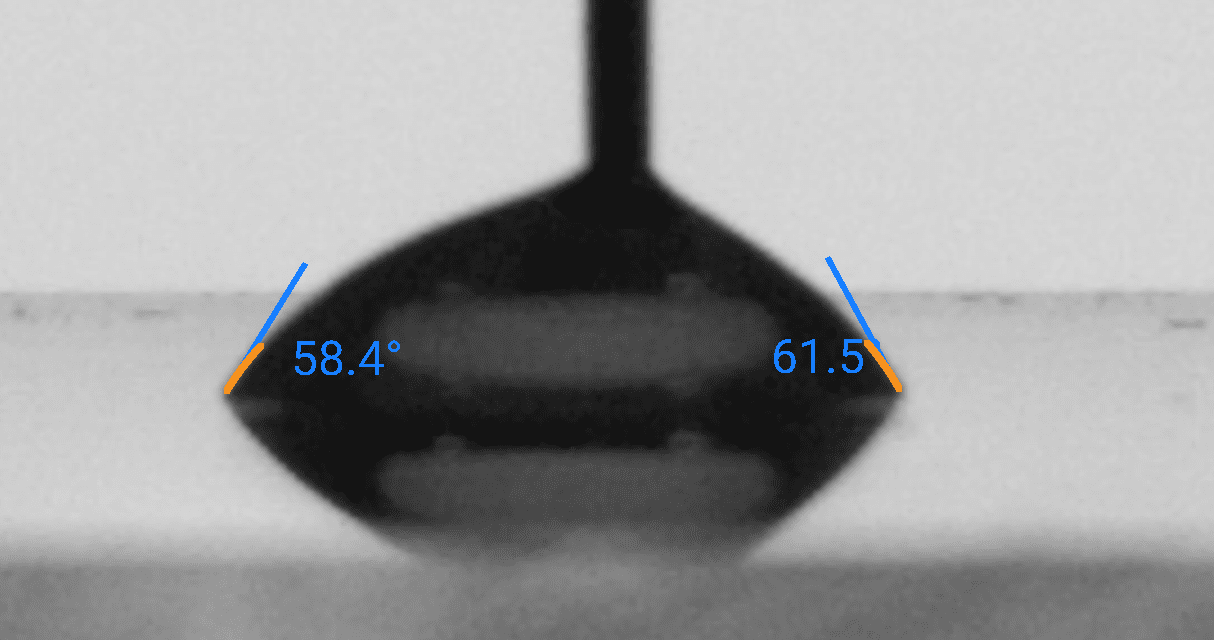
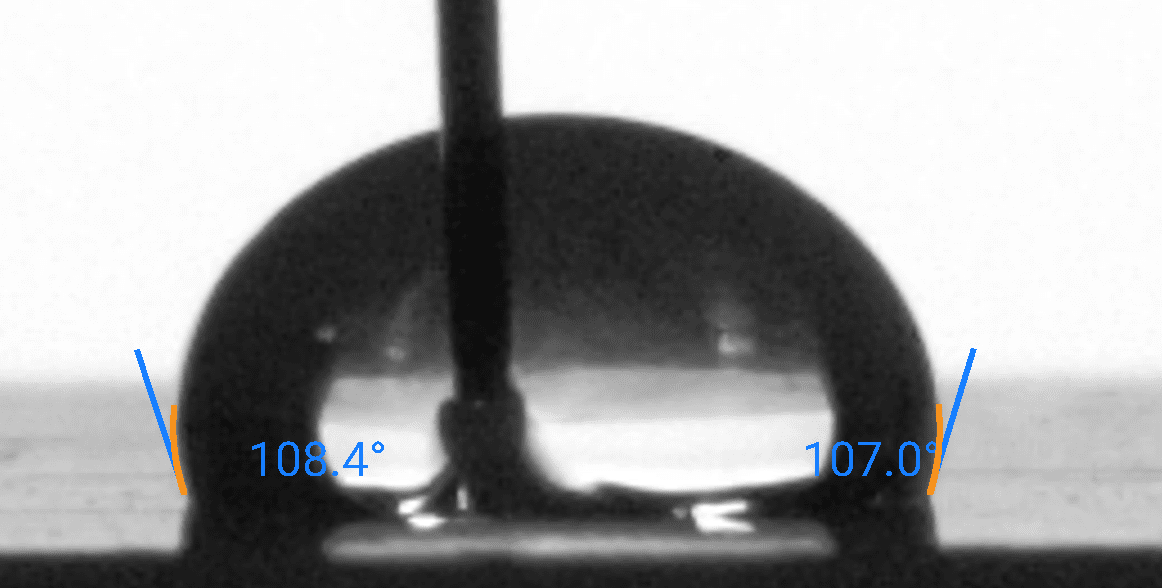
The droplet images above are taken from the same benchmark series as our open dataset. For each substrate and probe liquid we report:
Comparing your own droplet shapes and angles against these references is a fast way to spot contamination, treatment drift, or unexpected changes in wettability.
Measurements were performed with the Droplet Lab Dropometer under controlled laboratory conditions. Treat these values as sanity checks and starting points for your own process targets, not as product specifications.
Food & Beverages teams using the Dropometer.
An oils and fats ingredient supplier added the Dropometer for water contact angle work on hydrophobicity, showing how an ingredient lab sets up wetting tests in house.
A paper microfluidics lab measured water contact angle on marker treated filter paper to choose barrier inks for a low cost test strip that checks water hardness.
 Case study
One shared Dropometer runs pendant drop interfacial tension on emulsion and lipid oil interfaces plus contact angle, the same modes a food lab uses for emulsifiers and coatings.
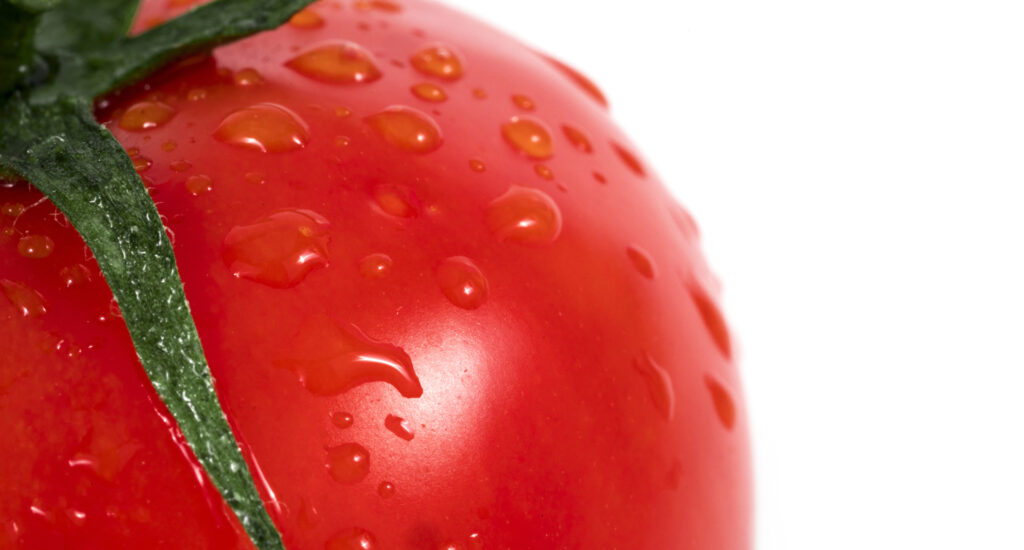
A bioscience institute measured coating surface tension and probe liquid contact angles on tomato skin, calculating its surface free energy to compare edible coating formulations.
A food packaging lab measures water contact angle on films made from soyhull, corncob, alfalfa and wheat straw residues to judge how each film handles moisture from produce.
Published studies that measured with the Dropometer. Our analysis explains what was measured and how; the original paper is linked beside it.
Biodegradable films based on alfalfa cellulosic residue and carrageenan blends for sustainable food packaging
Carrageenan lowered water contact angle in every alfalfa residue film, from 74.7 degrees for the control to 60.9 degrees, a trade off food packaging developers must weigh.
Biodegradable films from soyhull cellulosic residue with UV protection and antioxidant properties improve the shelf-life of post-harvested raspberries
The optimised soyhull residue film read 72.6 degrees water contact angle, hydrophilic next to 98.6 degrees for LDPE, in a film developed for raspberry packaging.
Corncob-Derived Biodegradable Packaging Films: A Sustainable Solution for Raspberry Post-harvest Preservation
The corncob residue film for raspberry packaging measured 63.4 degrees water contact angle, which the authors class as hydrophilic since hydrophobic films suit food packaging better.
Development of Eco-Friendly Packaging Films from Soyhull Lignocellulose: Towards Valorizing Agro-Industrial Byproducts
Water contact angle on the soyhull film fell from 76.9 degrees at first contact to 49.2 degrees at 30 seconds, showing why food packaging films need timed readings.
Development of a Dual-Modal Microfluidic Paper-Based Analytical Device for the Quantitative and Qualitative Detection of The Total Hardness of Water.
The author measured water contact angle on marker treated filter paper, 144 to 158 degrees at 10 seconds, to pick barrier inks for a paper water hardness test.
Dual-Modal Assay Kit for the Qualitative and Quantitative Determination of the Total Water Hardness Using a Permanent Marker Fabricated Microfluidic Paper-Based Analytical Device
This Chemosensors paper paired contact angles on four marker inks with a leakage test to choose green and blue barriers for a paper strip that tests water hardness.
Engineering Functional Microcapsules for Controlled Cargo Delivery
Pendant drop interfacial tension fell from 71.6 to 38.5 mN/m with both additives, yet only the combined system resisted coalescence, a lesson for encapsulation and emulsion work.
Green Valorization of Alfalfa into Sustainable Lignocellulosic Films for Packaging Applications
Water contact angle on the alfalfa film fell from 78.9 to 54.5 degrees over 30 seconds, and the authors position the film for fresh fruits and vegetables.
Valorization of Wheat Straw Cellulose into Biodegradable Packaging Films for Fresh Produce Preservation
Water contact angle fell from 77.3 to 65.6 degrees over 30 seconds on a wheat straw film that kept packed grapes in shape for 15 days.
Rheology of Cellulose Nanocrystal and Fumed Silica Suspensions: Influence of Ionic Surfactants
Pendant drop surface tension located HTAB break points near 229 to 352 ppm in particle suspensions, a method food formulators can apply to particle and surfactant blends.
Zein Protein Nanoparticles: Fabrication and Rheology of Their Dispersions in Polysaccharides
Surface tension of zein dispersions in CMC and xanthan gum fell sharply with the first 1 wt% zein; the authors suggest plant based emulsifiers for egg free mayonnaise.
Start with the problem. Use interfacial tension for emulsions, and surface tension for foams, beverages and coating liquids. Use contact angle when a coating, cleaner or package meets a solid surface, such as a peel or a film. Surface free energy comes from contact angles of two or more probe liquids. Our surface tension and contact angle guides explain each method.
Yes. Measure the coating surface tension by pendant drop, then the contact angles of probe liquids on the peel to work out its surface free energy. The Research Institute for Bioscience and Biotechnology in Nepal used this approach to compare edible coatings for tomatoes. Read the RIBB edible coatings case study. Peel values vary with cultivar, ripeness and washing, so test matched samples.
Measure oil and water interfacial tension for each emulsifier across a concentration range, at a fixed temperature and drop age. Lower tension is a useful screen, but it does not guarantee stability, so storage tests are still needed. University of Waterloo researchers measured surface tension of zein protein dispersions in food thickeners and suggest them for egg free mayonnaise.
Yes. A drop of one liquid is formed inside the other, and the drop shape gives the interfacial tension. You need the density of both liquids at the test temperature. Users of a shared facility at Harvard University run this mode, including a study of capsules for controlled delivery that found lower tension alone did not explain stability.
It can flag residues that other checks miss. A higher water contact angle than on a clean reference suggests an oily or fatty film remains, even when ATP results pass. It does not detect microorganisms or prove a surface is sanitary, and it may miss residues that wet well. See surface cleanliness and hygiene verification.
ASTM D5946 and ISO 15989 describe water contact angle on corona treated polymer film, a common packaging material. The Dropometer measures static water contact angle by the sessile drop method. No published wetting standard covers edible coatings, food emulsions or beverage foam. For those, write your own method and record liquid, temperature, drop volume and drop age.
The drop shape method was validated against a KRUSS DSA100E in two peer reviewed papers, one in Review of Scientific Instruments and one in Colloids and Surfaces A. Contact angle accuracy is 0.35 degrees in the Dropometer product specification. Automatic edge and baseline detection gives the same reading from the same image. See our validation papers.
Yes. Food scientists have measured water contact angle on bio based films from corncob, alfalfa and carrageenan, alfalfa lignocellulose and soyhull lignocellulose. A Concordia University thesis used it to choose marker inks for a paper based water hardness test, also published as a journal paper. See all client citations.
Book a 15 minute consult and we will show the Dropometer measuring the kind of surface or liquid your team works with.
Every page and paper referenced in this guide, grouped by type.