
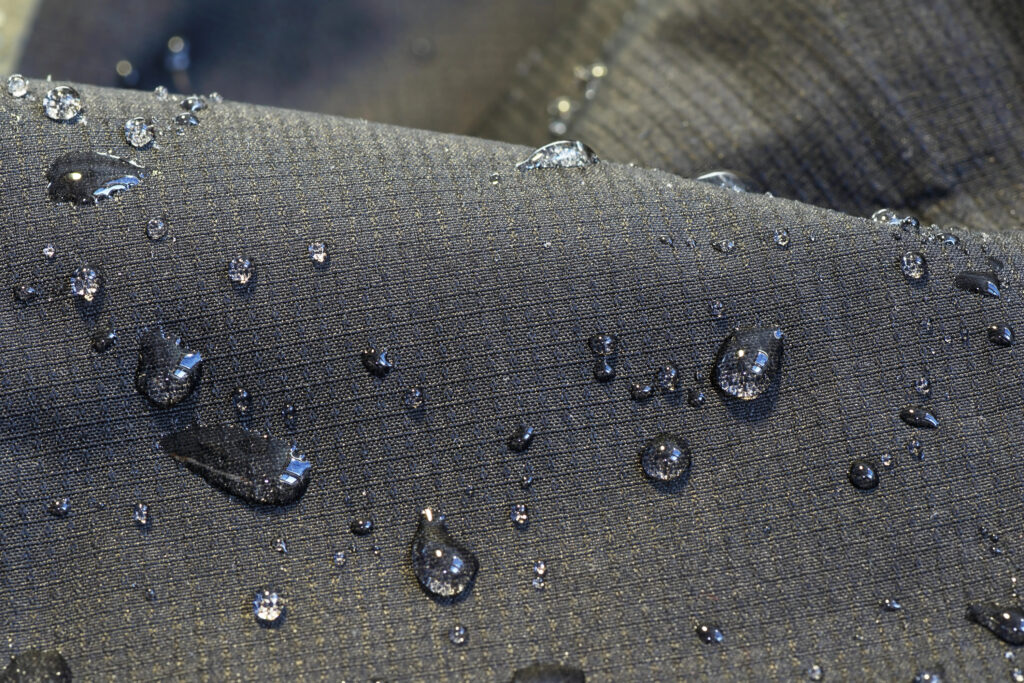
Use caseRead the use case
Textile DWR Water Repellency Testing
Contact angle with roll off angle compares DWR finishes and lots, including fluorine free ones, as a complement to the TM22 spray grade rather than a replacement.

Industry guide


This is a practical guide to surface science for teams working in the Fabrics industry.
In this guide: the four measurements that matter, where they decide yield in Fabrics, and the standards, use cases and studies behind them.
How textile teams use contact angle, sliding angle and surface tension to screen water and oil repellent finishes and printing on fabric. Each measurement is tied to a textile problem, an AATCC method and published client work.
The AATCC TM22 spray test gives the final water repellency grade, and contact angle data can anticipate and explain it. A Cornell fiber study found that adding lignin raised the water contact angle of PLA fiber mats in nearly every case. Drops can sink into fabric, so always report when the angle was read.
Contact angle screening lets you sort finish lots before a full spray test run and find the likely cause of a poor grade. One portable kit covers contact angle, sliding angle and the surface tension of your test liquids.
AATCC TM22 is a spray test with a visual grade, and contact angle complements it rather than replacing it. AATCC TM118 and TM193 grade oil and aqueous liquid repellency with test liquids, and AATCC TM 79 times how fast fabric absorbs a water drop.
Calibrate contact angle against your own TM22 grades for each fabric family, then use it to screen lots and finishes. Book a 15-minute consult about testing it on your own swatches.
In textiles, many returns and rework start at the fabric surface. A water repellent finish that wets out in the rain fails the wearer, even when the fabric passed its strength tests. An ink that spreads too far into the yarn blurs a printed design.
Textile DWR Water Repellency Testing
Contact angle with roll off angle compares DWR finishes and lots, including fluorine free ones, as a complement to the TM22 spray grade rather than a replacement.
PFAS-Free Reformulation & Repellency
Water and oil contact angles, fresh and after washing or abrasion, show whether a PFAS free finish still repels oil as well as water once fluorinated chemistry comes out.
The Dropometer contact angle and sliding angle kit measures contact angle, surface and interfacial tension, surface free energy and sliding angle with one portable setup. Its method was validated against a KRUSS DSA100E in two peer reviewed papers. If you are new to the terms, start with wettability.
A dot means the measurement is the main check for that problem.
| Problem | Contact angle | Surface and interfacial tension | Surface energy | Sliding angle |
|---|---|---|---|---|
| Textile DWR Water Repellency Testing | ||||
| PFAS-Free Reformulation & Repellency |
Not sure which test you need? Start with how to choose a wettability testing method.
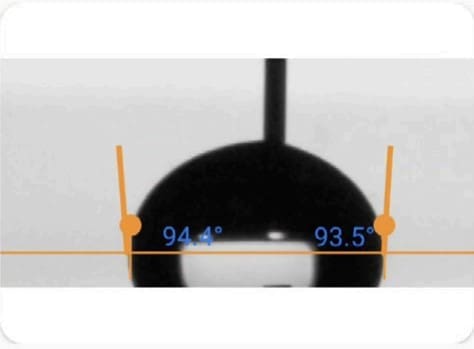
The angle a liquid drop makes where it meets a solid, in degrees. A low angle means the liquid spreads; a high angle means it beads. Use static angles for quick checks, and advancing and receding angles on real, rough or patchy surfaces, where one static value can mislead.
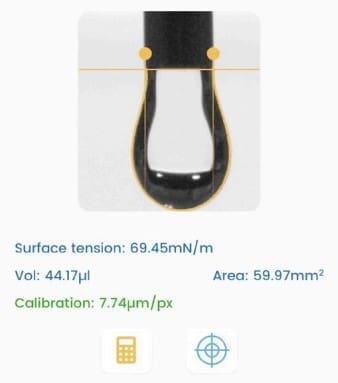
The force at a liquid surface that pulls it to the smallest area, in mN/m. The Dropometer measures it from the shape of a hanging (pendant) drop, and interfacial tension from a drop of one liquid inside another. Use static values for batch checks and dynamic values when interfaces form fast.
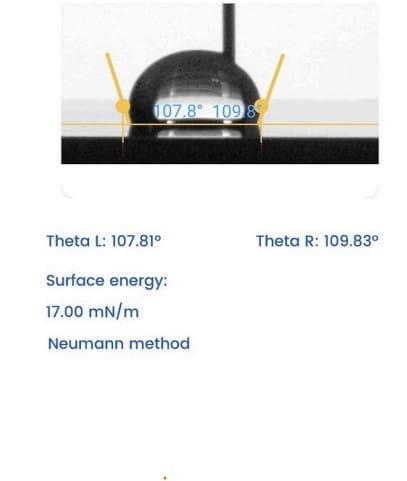
The energy needed to create new solid surface, in mJ/m². It is worked out from contact angles of two or more probe liquids. Use it before bonding, printing or coating to check that a surface is clean and treated enough.
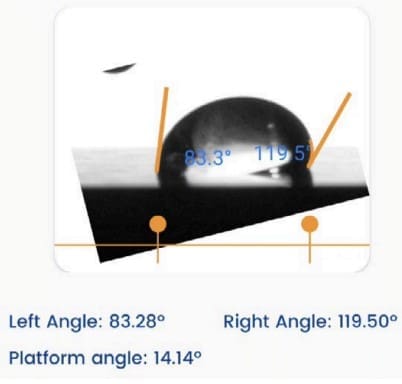
The tilt, in degrees, at which a drop starts to roll or slide off a surface. Use it for water and oil repellent surfaces, where a high contact angle alone does not show that drops will shed.
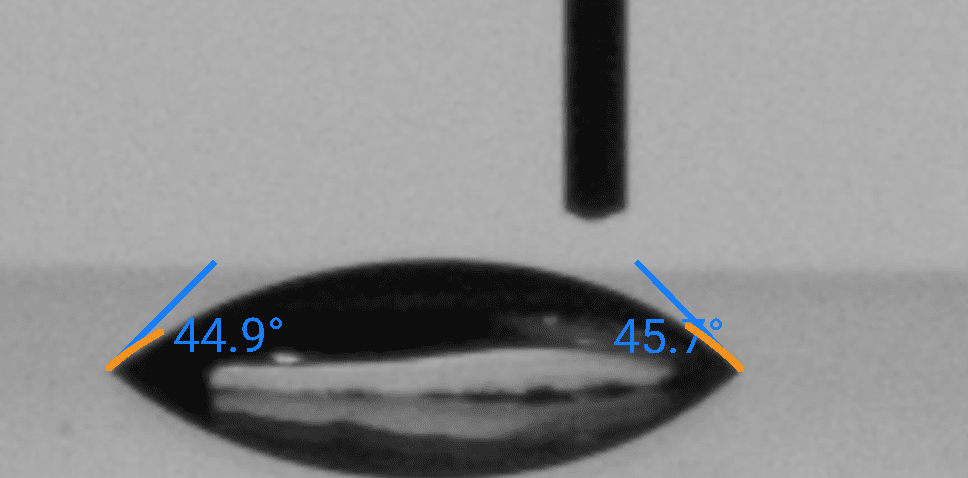
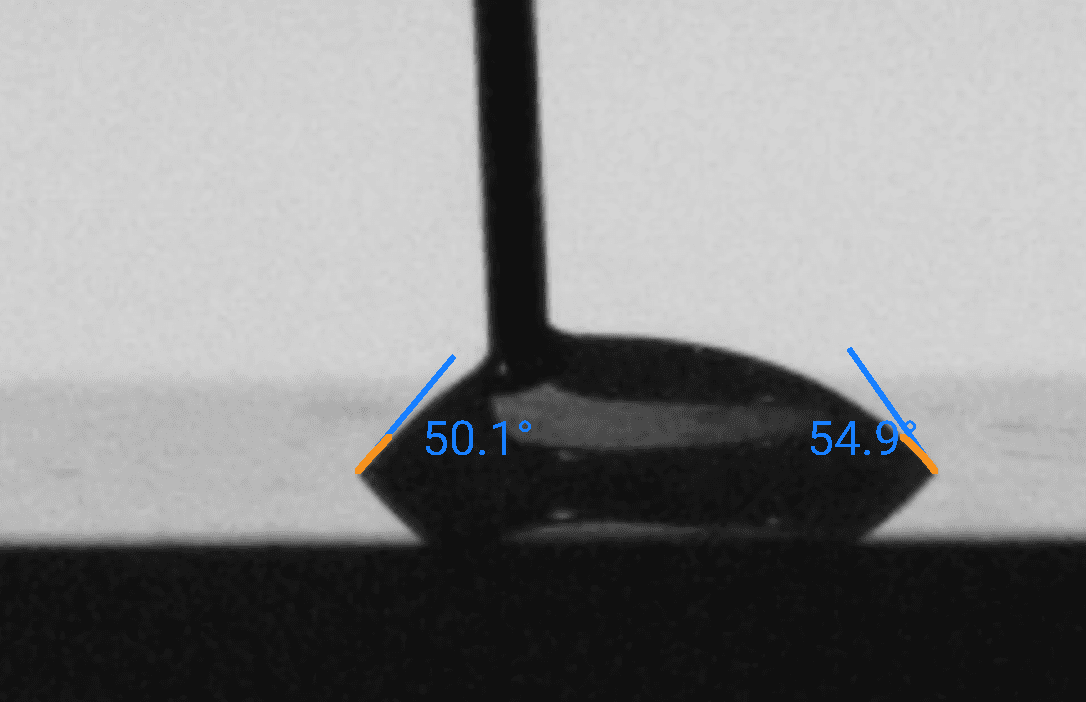
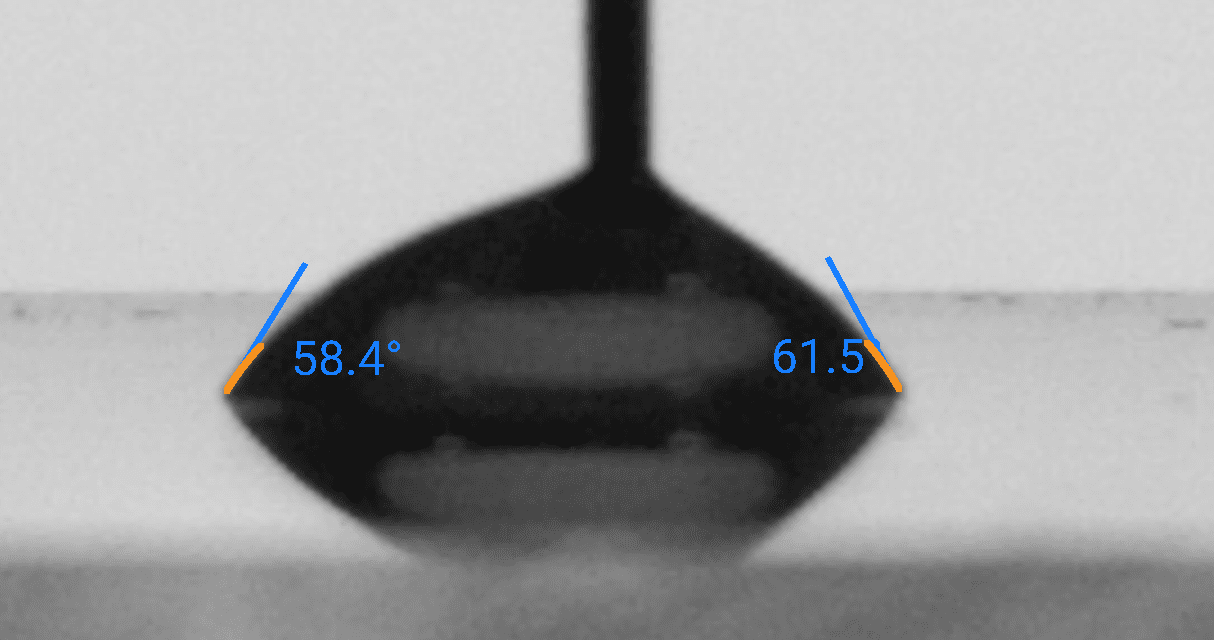
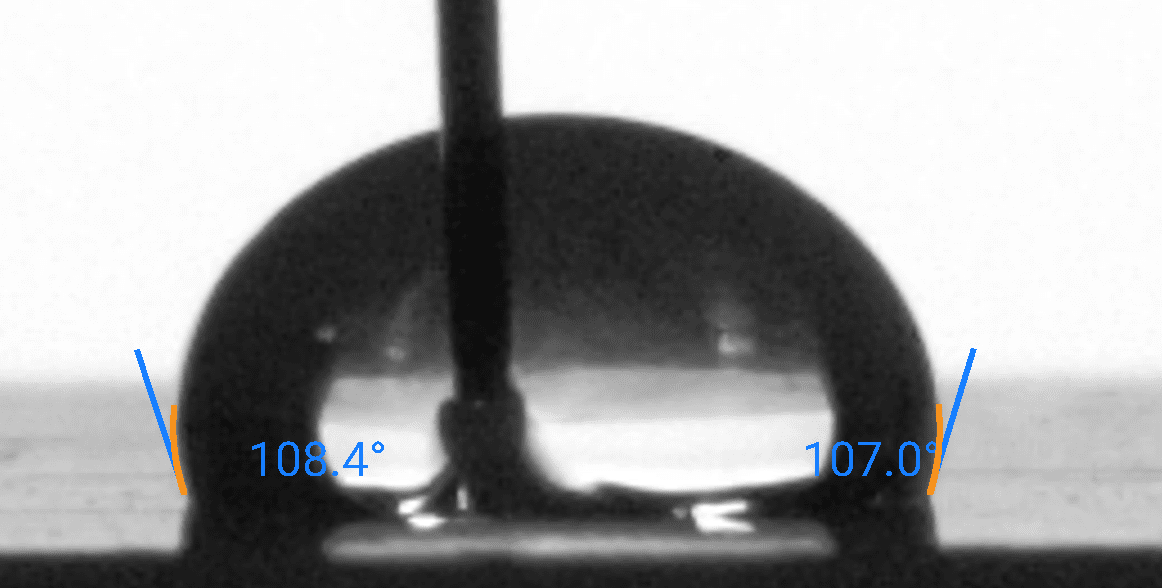
The droplet images above are taken from the same benchmark series as our open dataset. For each substrate and probe liquid we report:
● Advancing and receding contact angles (and hysteresis)
● Derived surface energy (SFE) values based on multi-liquid measurements
● Measurement conditions, uncertainties, and sample preparation details
Comparing your own droplet shapes and angles against these references is a fast way to spot contamination, treatment drift, or unexpected changes in wettability.
Fabrics teams using the Dropometer.
 Case study
Water contact angle on eleven electrospun mats ranged from 110.75 degrees for neat PLA to 138.67 degrees with Alcell lignin, with nine of ten blends above neat PLA.
How an Iowa State University coatings lab measures wetting on coated fabrics with the Dropometer
The group added a Dropometer with an automatic dropper to measure contact angle and roll off on coated fabrics, using both water and oils.
A government biomaterials and coatings team used the Dropometer to measure contact angle on water repellent coatings applied to white polyester fabric.
Water contact angle on twelve electrospun polystyrene mats ran from 130.1 to 143.2 degrees, showing how spinning conditions set the repellency of nonwoven fiber mats.
Published studies that measured with the Dropometer. Our analysis explains what was measured and how; the original paper is linked beside it.
Influence of Mixed Solvent in the Morphology and Hydrophobicity of Electrospun Polystyrene Porous Fibers
The authors measured water contact angle with the Dropometer across solvent ratios and voltages, finding angles generally rose with voltage and peaked at 143.2 degrees.
Multifunctional, Flexible, Electrospun Lignin/PLA Micro/Nanofiber Mats from Softwood Kraft, Hardwood Alcell, and Switchgrass CELF Lignin
Measured with the Dropometer, nearly every lignin blend raised water contact angle above neat PLA, a route to bio based hydrophobic mats though none reached 150 degrees.
Standards that describe these measurements for Fabrics. Our page explains how the Dropometer fits each one; the standard itself is sold by its publisher.
AATCC TM 79
Towels, wipes and wicking fabrics are judged by how fast a water drop sinks in; timed side view images record the falling contact angle until the drop is absorbed.
AATCC TM118
For stain and oil repellent finishes, the contact angle of each hydrocarbon test liquid on the fabric puts a number behind the visual grade the method assigns.
AATCC TM193
Contact angles of the graded water and isopropanol liquids on a finished fabric, plus a pendant drop check of each liquid, show where the finish starts to wet.
AATCC TM22: Water Repellency Spray Test
The spray rating stays the final grade for rainwear and outdoor gear; water contact angle and sliding angle help screen finish lots before a full spray run.
Start with the grade you need to predict. For water repellent finishes, use water contact angle at a fixed time and sliding angle. For oil repellency, measure the contact angle of each test liquid on the fabric. For printing, measure ink surface tension first. Our contact angle and sliding angle guides explain each method.
AATCC TM22 is a spray test with a visual grade. TM118 and TM193 grade oil and aqueous liquid repellency with sets of test liquids, and TM 79 times drop absorption. The Dropometer uses the sessile drop method, which adds numbers to these methods. It does not replace their grades, so correlate readings with your own results.
No. TM22 gives the final pass or fail grade, and there is no published conversion from contact angle to spray rating. Contact angle helps you screen lots before a full TM22 run and explain a poor grade. Set your own pass bands by testing 10 to 20 swatches per fabric family with both methods, as our TM22 page explains.
Fabric is porous and rough, so a drop can slowly sink in or spread along the yarns. The angle you read at 2 seconds can differ from the one at 10 seconds. Read every sample at the same drop age, and report that time with the result. See surface roughness and heterogeneity.
There is no single number, because weave, fiber and finish all change the reading. Surfaces above 90 degrees are called hydrophobic, and 150 degrees is the usual threshold for superhydrophobic. In the Cornell study of lignin and PLA fiber mats, the best mat read 138.67 degrees, below that threshold. Set your own limits against TM22. See hydrophobic and hydrophilic surfaces.
Place a drop of each AATCC TM118 test liquid on the fabric and measure its contact angle at a fixed time. The liquids have falling surface tensions, so the angle drops as the liquid becomes more oily. Check each liquid's surface tension by pendant drop before you start. The visual grade stays the reference. See AATCC TM118.
The drop shape method was validated against a KRUSS DSA100E in two peer reviewed papers, one in Review of Scientific Instruments and one in Colloids and Surfaces A. Contact angle accuracy is 0.35 degrees in the Dropometer product specification. Automatic edge and baseline detection gives the same reading from the same image. See our validation papers.
Book a 15 minute consult and we will show the Dropometer measuring the kind of surface or liquid your team works with.
Every page and paper referenced in this guide, grouped by type.