Use caseRead the use case
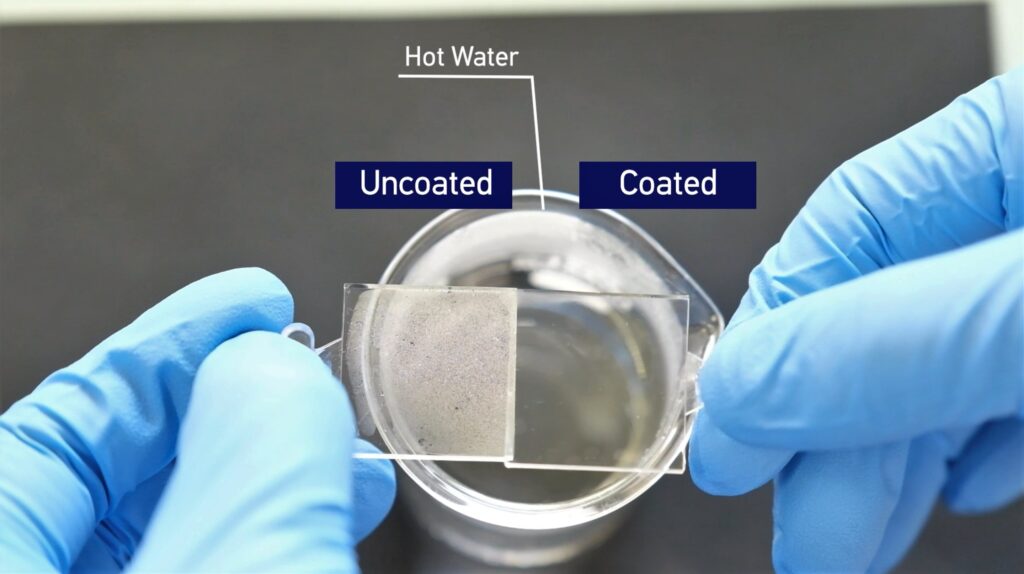
Water contact angle on treated parts and untreated controls confirms plasma reached each catheter, housing or implant surface and shows how fast the effect fades before bonding or coating.

Industry guide


This is a practical guide to surface science for teams working in the Medical Device industry.
In this guide: the four measurements that matter, where they decide yield in Medical Device, and the standards, use cases and studies behind them.
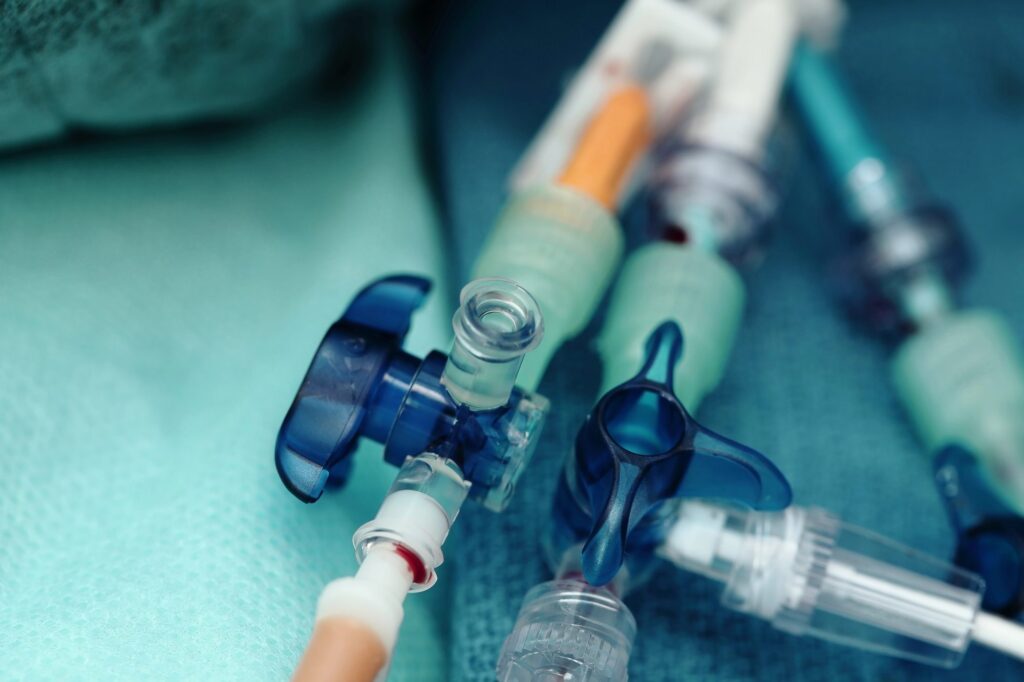
How medical device teams use contact angle, surface free energy, surface tension and sliding angle on implants, catheters, tubing and biomaterials. Each measurement is tied to a real device problem, a guidance document and published client work.
In a Harvard School of Dental Medicine study in Biomimetics, plasma treatment cut saline contact angle on machined titanium from 83.1 to 24.1 degrees. In two Universidad Católica de Temuco papers, coatings on silicone catheters lowered water contact angle by 22 to 35 degrees. Contact angle shows that a surface changed; it does not by itself show a clinical benefit.
A contact angle check on the line catches a missed plasma step, a residue or a weak coating before parts move on. Zeus ran its own Gage R&R on the Dropometer and it passed.
The FDA 510(k) guidance for contact lens care products describes finding the critical micelle concentration from surface tension across a dilution series. The Dropometer uses the pendant drop method for that surface tension step. Your own validation and regulatory pathway decide how results are used.
Use contact angle to check every surface step that affects wetting, from plasma treatment to coating cure. Start with the step that fails most often, then book a 15-minute consult about testing it on your own parts.
In medical devices, many failures start at the surface. A catheter coating that does not wet evenly can fail in use. An implant that picked up residue during cleaning can behave differently from the one that passed testing.
Water contact angle on treated parts and untreated controls confirms plasma reached each catheter, housing or implant surface and shows how fast the effect fades before bonding or coating.
Silicone Contamination Detection
Contact angle screens device parts for silicone oil, lubricant and release agent films before bonding or coating, with FTIR or XPS used to confirm what the residue is.
Surface Cleanliness Verification
Water contact angle at fixed spots shows whether cleaning removed organic films from implants and device components, a quick numeric check beside validated cleaning tests.
Catheter and Medical Device Hydrophilic Coating Validation
Water contact angle on coated catheter sections shows whether a coating cured and covered evenly, as an in process control alongside drag force lubricity tests.
Dental and Orthopedic Implant Surface QC
Water contact angle tracks how blasting, etching, cleaning, plasma and ageing change titanium implant wettability, so teams build their own reference values for each surface finish.
Anti-Fog and Anti-Condensation Coating Validation
A very low water contact angle shows an anti fog coating still spreads condensation into a clear film after cleaning and ageing, useful for healthcare eyewear and face shields.
Hydrogel and Biomaterial Wettability for Tissue Engineering
Water contact angle on swollen hydrogels and scaffolds compares formulations meant for cell attachment, a quick check between batches since no standard sets a hydrogel contact angle.
Paper Microfluidic and Lateral Flow Wicking Control
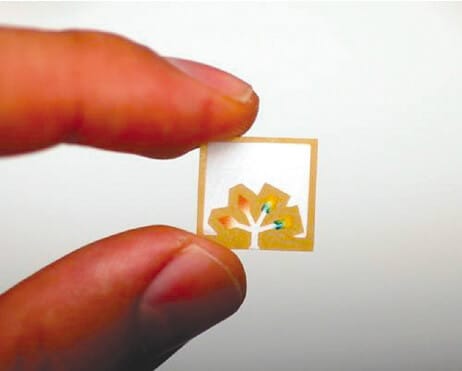
Contact angle on hydrophobic barriers and paper channels shows how a sample will wick, helping diagnostics teams trace flow time variation in lateral flow and paper assays.
Polymer Microfluidic Channel Wettability
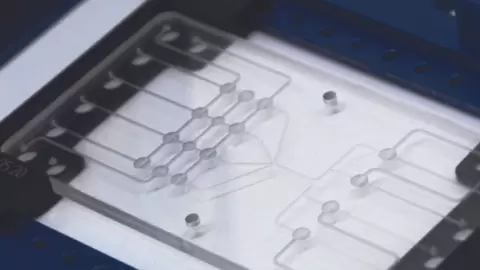
Contact angle on PDMS, PMMA and COC shows whether diagnostic cartridge channels will fill by capillary flow and whether plasma or coating treatments did their job.
Prevent Adhesive Failure Before Bonding
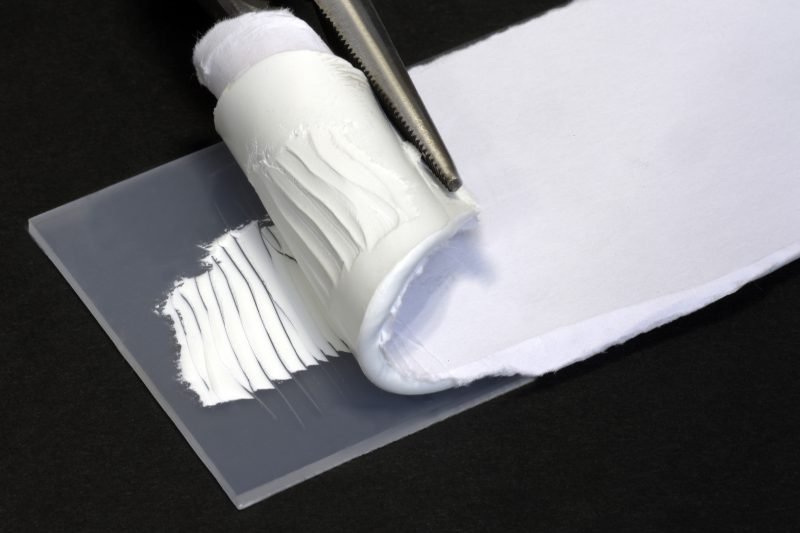
Lot by lot water contact angle and surface free energy, compared with a good bond baseline, catch contamination or faded treatment before catheter, housing or tubing joints are bonded.
The Dropometer contact angle and surface tension kit measures contact angle, surface and interfacial tension, surface free energy and sliding angle with one portable setup. Its method was validated against a KRUSS DSA100E in two peer reviewed papers. If you are new to the terms, start with wettability.
A dot means the measurement is the main check for that problem.
| Problem | Contact angle | Surface and interfacial tension | Surface energy | Sliding angle |
|---|---|---|---|---|
| Plasma Treatment for Adhesion | ||||
| Silicone Contamination Detection | ||||
| Surface Cleanliness Verification | ||||
| Catheter and Medical Device Hydrophilic Coating Validation | ||||
| Dental and Orthopedic Implant Surface QC | ||||
| Anti-Fog and Anti-Condensation Coating Validation | ||||
| Hydrogel and Biomaterial Wettability for Tissue Engineering | ||||
| Paper Microfluidic and Lateral Flow Wicking Control | ||||
| Polymer Microfluidic Channel Wettability | ||||
| Prevent Adhesive Failure Before Bonding |
Not sure which test you need? Start with how to choose a wettability testing method.
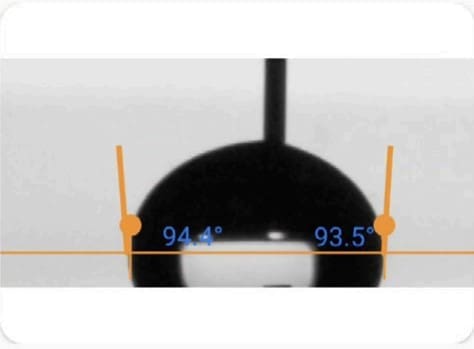
The angle a liquid drop makes where it meets a solid, in degrees. A low angle means the liquid spreads; a high angle means it beads. Use static angles for quick checks, and advancing and receding angles on real, rough or patchy surfaces, where one static value can mislead.
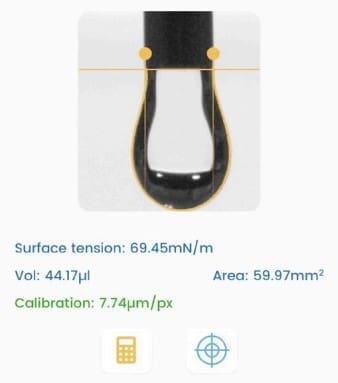
The force at a liquid surface that pulls it to the smallest area, in mN/m. The Dropometer measures it from the shape of a hanging (pendant) drop, and interfacial tension from a drop of one liquid inside another. Use static values for batch checks and dynamic values when interfaces form fast.
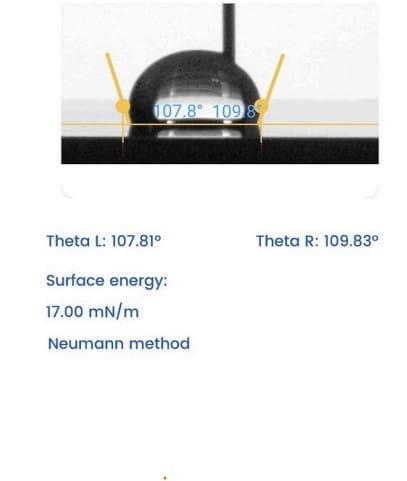
The energy needed to create new solid surface, in mJ/m². It is worked out from contact angles of two or more probe liquids. Use it before bonding, printing or coating to check that a surface is clean and treated enough.
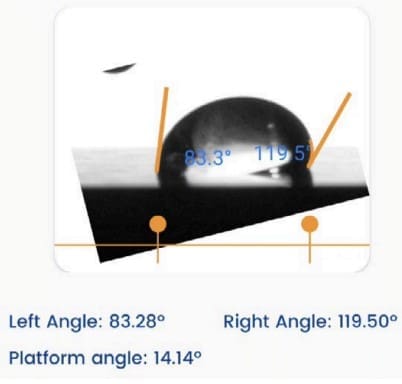
The tilt, in degrees, at which a drop starts to roll or slide off a surface. Use it for water and oil repellent surfaces, where a high contact angle alone does not show that drops will shed.
These reference measurements show how deionized water wets four standard substrates measured with the Droplet Lab Dropometer. Use them as visual and numerical benchmarks when you're checking your own sample preparation, treatments, and chemistry.
Full contact angle and surface energy datasets (including additional liquids and statistics) are available on our dataset hub.
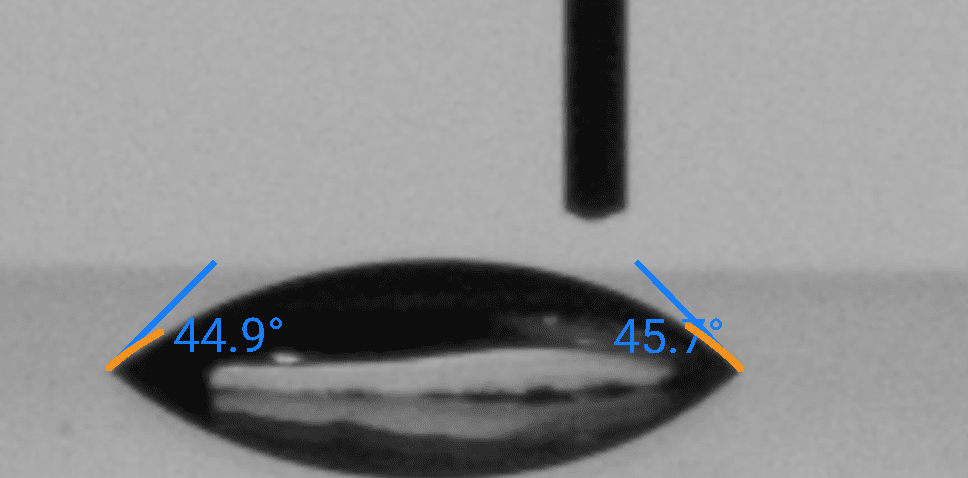
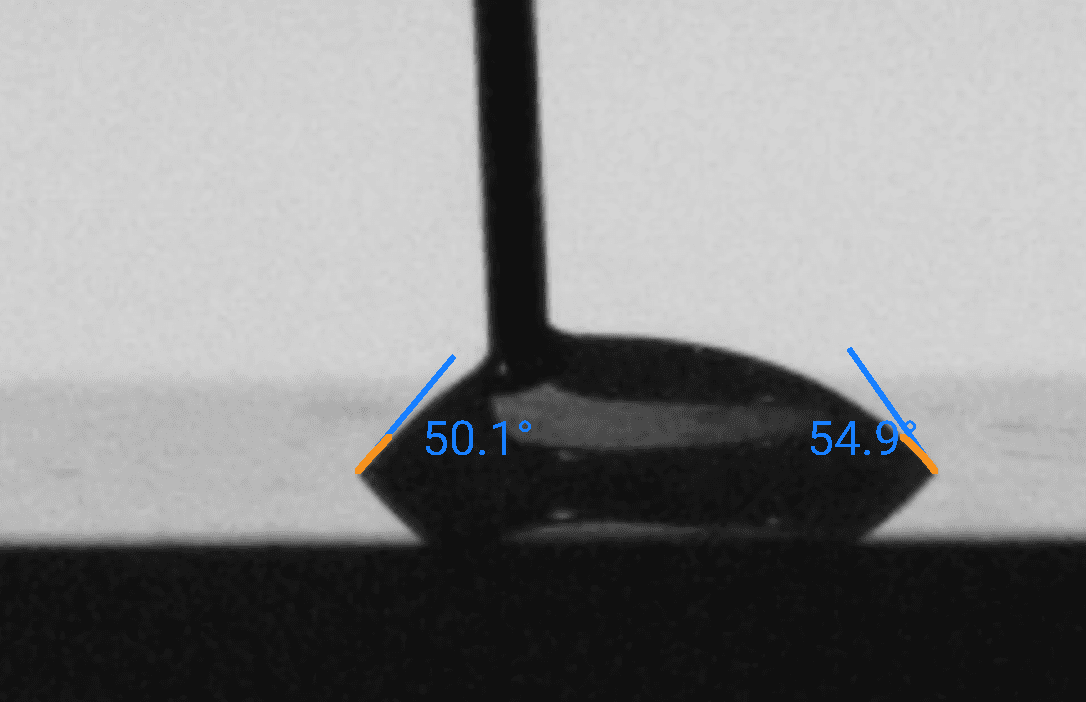
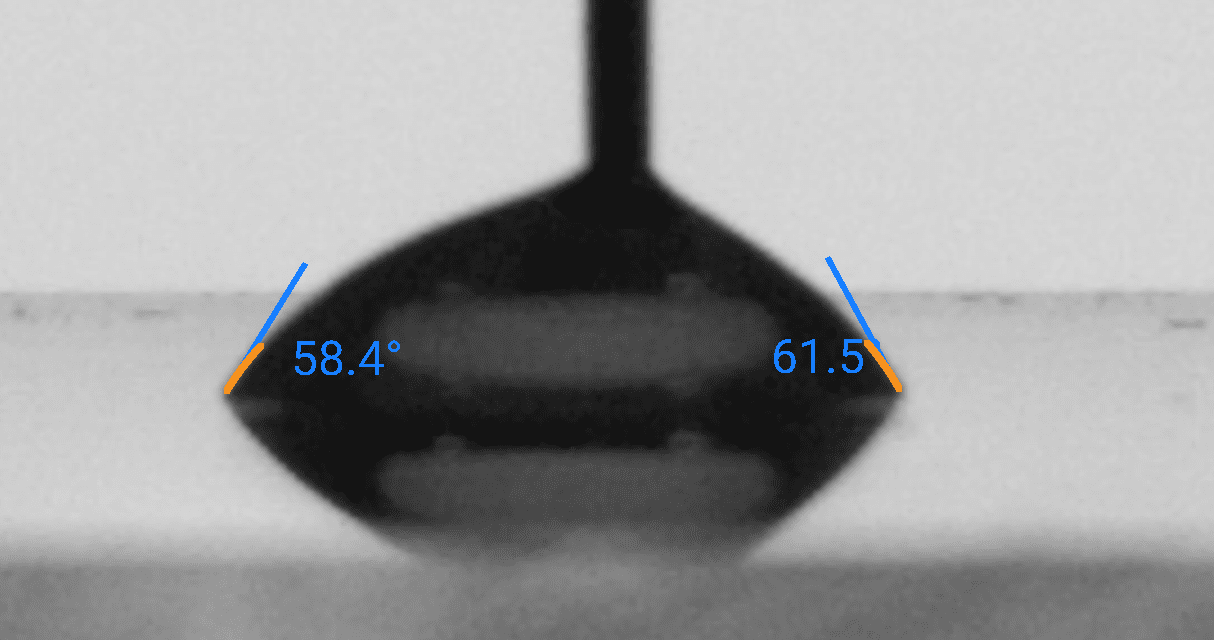
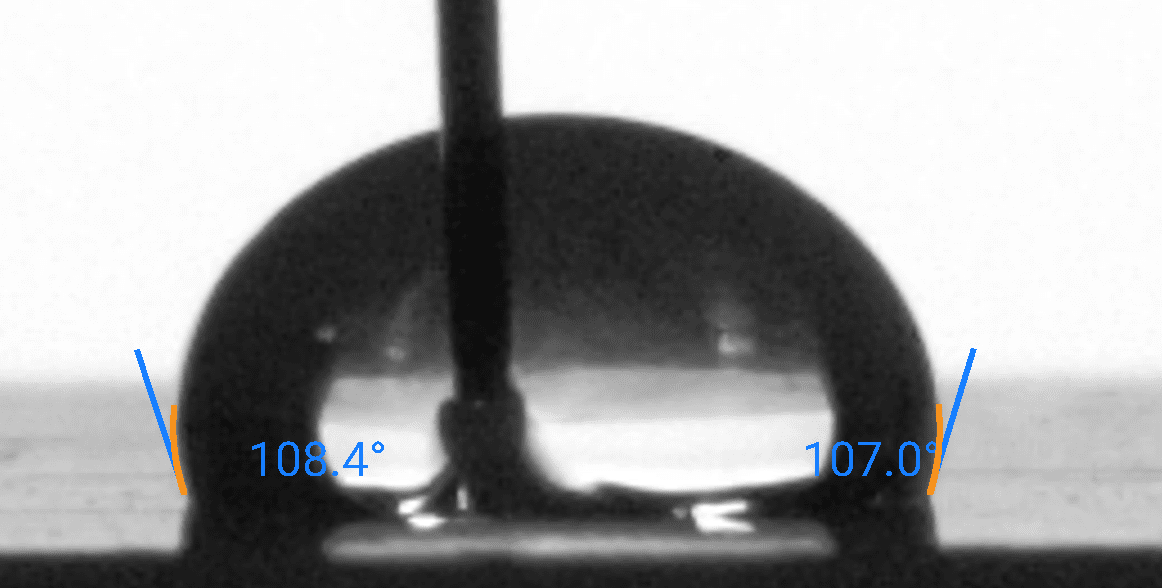
The droplet images above are taken from the same benchmark series as our open dataset. For each substrate and probe liquid we report:
Comparing your own droplet shapes and angles against these references is a fast way to spot contamination, treatment drift, or unexpected changes in wettability.
Measurements were performed with the Droplet Lab Dropometer under controlled laboratory conditions. Treat these values as sanity checks and starting points for your own process targets, not as product specifications.
Medical Device teams using the Dropometer.
Diagnostic device developers can see how this group used water contact angle to confirm laser cutting left Parafilm barriers unchanged and to help explain a weak electrode signal.
 Case study
Labs on one shared Dropometer measured saline contact angle on plasma treated titanium implant discs and water contact angle on hydrogels and silicone elastomers.
Shows contact angle on small curved parts: the team sent a stainless steel mandrel about 1 mm across for a demo, then bought a Dropometer and later a second.
Static water contact angle on cut 14Fr and 20Fr silicone Foley catheters showed every antimicrobial coating made the surface more wettable, by 22 to 35 degrees.
Across 125 water contact angle readings on SLA titanium discs, three of four rotary brush treatments made the surface more wettable, while the authors call the clinical benefit unclear.
Dental researchers used 5 µL water drops on cured provisional crown resin, 15 per group, to check an antibacterial UV coating did not worsen the surface.
 Case study
Zeus Polymer Extrusion Manufacturing
Factory floor inspectors measure contact angle on extruded tubing with a custom tube holder; Zeus ran its own Gage R&R on the Dropometer and it passed.
Published studies that measured with the Dropometer. Our analysis explains what was measured and how; the original paper is linked beside it.
Plasma Treatment to Remove Titanium Surface Contaminants and Improve Implant Biocompatibility: An In Vitro Study
Thirty seconds of vacuum plasma cut saline contact angle on machined and rough titanium discs from 83.1 to 24.1 and 77.3 to 15.7 degrees respectively.
Combinational regenerative inductive effect of bio-adhesive hybrid hydrogels conjugated with hiPSC-derived myofibers and its derived EVs for volumetric muscle regeneration
Water contact angle on swollen GelTA hydrogels, around 50 to 70 degrees, stayed similar with extracellular vesicles loaded, part of surface checks the authors linked to cell adhesion.
Effect of mechanical instrumentation on titanium implant surface properties
Median water contact angle on SLA titanium discs fell from 84.8 degrees untreated to 65.3 and 67.45 degrees after two brush systems, which also flattened the surface.
Engineered detection zone to enhance color uniformity on paper microfluidics fabricated via Parafilm®-heating-laser-cutting
Diagnostic device makers can see how water contact angle confirmed laser cutting left the Parafilm barrier hydrophobic, 108 versus 109 degrees, on a paper glucose assay.
Fullerene-like amorphous carbon nitride film surface properties and evaluating the initial adsorption kinetics of albumin and fibrinogen
A team checked its home built contact angle rig against a Dropometer reading on PTFE film, then measured carbon nitride films before albumin and fibrinogen adsorption tests.
Novel Antibacterial Resin Coating for Dental Provisional Crowns to Suppress Biofilms and Inhibit Secondary Caries
Dental device teams can see water contact angle on cured crown resin fall from 70.5 to 50.7 degrees as the antibacterial monomer rose, while biofilm results came from other assays.
A Mechanistic, Architecture-Dependent Study Combining Experiments and Molecular Dynamics to Explain AMP Release from GO-PEI Coatings
Water contact angle on catheter sections fell from 98.3 to 76.4 and 75.5 degrees with the two coatings, while release differences came from simulations and bacterial assays.
Development of Portable and Easy-to-Use Chemo/Biosensors
For paper based diagnostics, this thesis measured water contact angle on Parafilm barriers and on both faces of screen printed paper electrodes, untreated and water treated.
Drug Delivery System Based on an Antibacterial Layer-by-Layer Coating on Urinary Catheters: An Experimental and Simulation Approach
Catheter coating teams can compare bare and coated 14Fr and 20Fr Foley pieces, where water contact angle fell from 100 to 69 and 103 to 68 degrees.
Standards that describe these measurements for Medical Device. Our page explains how the Dropometer fits each one; the standard itself is sold by its publisher.
FDA 510(k) Guidance: Determining CMC by Surface Tension
For contact lens care products, the guidance finds critical micelle concentration from surface tension across a dilution series in the cleaner medium, a step the Dropometer runs by pendant drop.
Start with the step that most often goes wrong. Use water contact angle to check plasma treatment, cleaning and coatings on implants, catheters and tubing. Use surface free energy, worked out from contact angles of two or more probe liquids, when adhesives or inks must bond. Use surface tension for cleaning and lens care solutions. Our contact angle guide explains the method.
The FDA 510(k) guidance for contact lens care products describes finding the critical micelle concentration from surface tension across a dilution series. It does not set the instrument geometry, so the method is part of your validation. The Dropometer uses the pendant drop method for surface tension and the sessile drop method for contact angle. Contact angle limits for coatings are usually set in your own specification.
Yes, with a holder that keeps the curved surface level under the drop. The Temuco group measured cut pieces of 14Fr and 20Fr silicone Foley catheters. Zeus uses a custom 3D printed tube holder for its polymer tubing. Zeus ran its own Gage R&R on the Dropometer and it passed. Our catheter coating page covers the setup.
Measure water contact angle on a treated part and an untreated control, and record the time since treatment. A lower angle shows the surface became more wettable. In the Harvard School of Dental Medicine study, saline contact angle on rough titanium fell from 77.3 to 15.7 degrees after plasma. Repeat the check over time to see how long the effect lasts. See plasma treatment verification.
Not on its own. Contact angle shows that the surface changed, and you link that to biology in your own tests. A University of Maryland study found the lower contact angle coatings for provisional crowns suppressed biofilm most, but credited the antibacterial agent. The Manchester implant study said the effect of wettability on healing is unclear.
Yes. Contact angle shows how the hydrophobic barrier and the paper channel wet, which controls how a sample wicks. A Concordia University team measured Parafilm barriers before and after laser cutting. See its engineered detection zone study and its doctoral thesis on portable sensors. See lateral flow wicking control.
Yes. A University of Saskatchewan team checked its home built apparatus against a Dropometer reading on PTFE film. It then measured carbon nitride films for protein adsorption on its own rig. Its PTFE result fell within the Dropometer range. Use a stable reference film like PTFE and run both setups on the same sample.
The drop shape method was validated against a KRUSS DSA100E in two peer reviewed papers, one in Review of Scientific Instruments and one in Colloids and Surfaces A. Contact angle accuracy is 0.35 degrees in the Dropometer product specification. Automatic edge and baseline detection gives the same reading from the same image. See our validation papers.
Book a 15 minute consult and we will show the Dropometer measuring the kind of surface or liquid your team works with.
Every page and paper referenced in this guide, grouped by type.